
Understanding 1099 forms is crucial for small businesses. Whether you're dealing with independent contractors or reporting miscellaneous income, these forms are key to staying on the right side of tax compliance. The 1099-NEC is for non-employee compensation, while the 1099-MISC covers a range of payments like rent or awards.
Getting these forms right means avoiding penalties and keeping the IRS happy. It’s not just about ticking boxes; it’s about making sure your business runs smoothly without any surprises come tax season.
Here’s why you need to know these forms inside out:
Palm can help streamline this process with our tools for electronic filing and TIN matching. This reduces errors and ensures everything’s submitted on time. By understanding and managing your 1099 obligations, you’re not just avoiding penalties—you’re setting a solid foundation for your business’s growth.
Understanding the 1099-MISC and 1099-NEC forms is key for accurate tax reporting. These forms serve different purposes and cover various types of payments.
The 1099-MISC is used for reporting miscellaneous income. This includes payments over $600 for things like rent, prizes, or awards. It also covers royalties over $10, medical and health care payments, and other types of miscellaneous income. Businesses use this form to report payments that don't fall under employee wages or salaries. For a detailed guide on how to correctly handle these types of income, you can explore our complete guide to understanding the 1099-MISC form.
On the other hand, the 1099-NEC is specifically for nonemployee compensation. This form is crucial when dealing with independent contractors. If you've paid an independent contractor $600 or more in a year, this is the form you need. The 1099-NEC helps clarify that these payments are for services provided by non-employees, which is a critical distinction for tax purposes. For more information on how to obtain and manage these forms for your small business, consider reading our resource on how to obtain a 1099 for your small business.
Here's a quick comparison of the purposes for each form:
Both forms play important roles in tax reporting, ensuring that all types of income are accurately documented. Using the right form helps maintain compliance and avoids potential penalties.
Filing 1099 forms on time is crucial for staying compliant and avoiding penalties. For 2025, knowing the key deadlines ensures that your business remains in good standing with the IRS. Here’s what you need to keep in mind.
For the 1099-NEC, the deadline is January 31, 2025. This date applies whether you're filing on paper or electronically. Make sure you have all your nonemployee compensation data ready to meet this requirement. Missing this deadline could lead to hefty fines.
The 1099-MISC form has different deadlines based on how you choose to file. If you’re mailing paper forms, the due date is February 28, 2025. For those opting for electronic filing, the deadline extends to March 31, 2025. This gives you extra time to ensure everything is accurate and complete.
To make it easy, here’s a quick list of the important dates:
Keeping these dates in mind helps avoid penalties that range from $50 to $550 per form. Using tools like Palm's can simplify the filing process, ensuring everything is submitted correctly and on time. For more detailed strategies on managing these forms, you can explore top 2025 1099 tax filing tips for small business owners. Accurate and timely filing not only keeps your business compliant but also sets a foundation for growth.
Collect Information: Start by gathering all necessary details. Ensure you have complete information for each contractor or vendor, including their legal name, address, and Taxpayer Identification Number (TIN). It's crucial to have accurate W-9 forms on file for each individual or entity.
Verify Data: Double-check the data you've collected. Use TIN Matching services to verify TINs against IRS records. This step helps prevent errors and reduces the risk of penalties. Accurate information is key to a smooth filing process.
Choose the Correct Form: Determine which 1099 form applies to each payment. Use the 1099-NEC for nonemployee compensation and the 1099-MISC for miscellaneous payments like rent or prizes. For more detailed guidance on selecting the appropriate 1099 forms for small business owners, visit our resource on what 1099 forms small business owners need to know. Selecting the right form ensures compliance and accurate reporting.
Set Deadlines: Mark important deadlines on your calendar. For 2025, the 1099-NEC is due by January 31, while the 1099-MISC deadlines are February 28 for mail submissions and March 31 for electronic filings. Timely filing avoids late penalties.
Prepare for Submission: Decide how you'll submit the forms. Consider electronic filing for efficiency and accuracy. Many businesses find that online filing simplifies the process and reduces errors.
Review and Submit: Before submitting, review all forms for accuracy. Check each entry to ensure it's correct and complete. Once verified, submit the forms to the IRS and provide copies to recipients.
By following these steps, you're setting your business up for a successful and compliant filing season. Accurate preparation and timely submission are essential for maintaining good standing with the IRS.
Filing 1099 forms accurately is crucial for small businesses to avoid penalties. Mistakes in reporting can lead to fines ranging from $60 to $330 per form, depending on the delay. Intentional disregard for filing requirements can result in a minimum penalty of $660 per form with no cap. This underscores the importance of precise and timely submissions.
Accurate reporting starts with understanding common errors and how to sidestep them. Here’s a quick rundown of typical mistakes and solutions:
Missing Deadlines: Record important dates like January 31 for 1099-NEC and March 31 for electronic 1099-MISC. Use reminders or tools like Palm’s automation features to ensure you file on time.
Incorrect TINs: Mismatched or incorrect Taxpayer Identification Numbers can trigger penalties. Use TIN Matching services to verify numbers against IRS records.
Wrong Form Selection: Confusing 1099-MISC with 1099-NEC is common. 1099-NEC is for nonemployee compensation, while 1099-MISC covers miscellaneous income. For more details on the differences between these forms, explore the various types of 1099 forms and their specific uses.
Inaccurate Amounts: Double-check payment amounts for accuracy. Errors here can lead to reporting discrepancies and IRS scrutiny.
Neglecting State Requirements: Some states have specific filing demands. Stay informed about local obligations to ensure compliance.
By addressing these issues head-on, businesses can reduce the risk of penalties and maintain a smooth filing process. Accurate and timely reports help keep your business in good standing with tax authorities.
Correctly classifying workers as employees or independent contractors is crucial for small businesses. This classification impacts how you use 1099 forms and ensures compliance with IRS regulations. Misclassifying workers can lead to serious financial risks, including penalties and back taxes.
When determining classification, consider several key criteria. These criteria help differentiate between an employee and an independent contractor. Here's what to look at:
Behavioral Control: Do you control or have the right to control what the worker does and how they do their job? If you direct and manage tasks, the worker might be an employee.
Financial Control: Are the business aspects of the worker’s job controlled by you, such as how the worker is paid, whether expenses are reimbursed, or who provides tools and supplies? Greater financial independence suggests an independent contractor.
Relationship Nature: Are there written contracts or employee-type benefits, such as a pension plan or vacation pay? The presence of benefits and permanency indicates an employee relationship.
Misclassification can affect your tax reporting, leading to incorrect use of forms like 1099-NEC for contractors. To further understand the nuances of nonemployee compensation, it's essential to grasp the details of Form 1099-NEC requirements to ensure compliance and avoid penalties. It's essential to get this right to avoid penalties. Think of worker classification as a foundational step in managing compliance and protecting your business. Understanding these criteria and their implications can save you from costly errors and ensure smooth operations.
Technology makes filing 1099 forms a breeze. Automation is your friend when it comes to managing compliance and reporting. Think of it as having a reliable assistant that never sleeps.
Automation reduces manual errors, ensures deadlines are met, and keeps your records organized. Tools that integrate with your existing systems can handle Form W-9 and 1099 reporting, check supplier tax IDs, and even help prevent fraud. This means less time spent on tedious tasks and more time focusing on what matters most—growing your business.
There are plenty of software options that can simplify your filing process. They offer features like electronic submissions, real-time updates, and data verification. These tools are designed to streamline your workflow, making it easier to manage multiple forms and deadlines. With everything centralized, you can easily access and update your records. For more insights on managing 1099 forms and ensuring tax compliance, explore our guide on 1099 essentials for small business owners.
Palm's platform is a great example of how technology can aid in compliance. With features like automated government filings and 24/7 AI monitoring, it ensures all your forms are accurate and submitted on time. Plus, Palm's Data Profile securely stores your business information, making it readily available when you need it.
Using technology for filing isn't just smart—it's essential. It saves time, reduces stress, and enhances accuracy. Embrace these tools to keep your business compliant and efficient.

1099 income brings specific tax implications for businesses and independent contractors. For independent contractors, this income is subject to self-employment taxes. This means you're responsible for both the employee and employer portions of Social Security and Medicare taxes. It's crucial to set aside funds for these taxes to avoid surprises at tax time.
Deductions play a vital role in minimizing tax liabilities. Contractors can claim business-related expenses on Schedule C. These deductions might include office supplies, travel, and other necessary expenses. Accurately tracking and documenting these expenses is key to maximizing your deductions and reducing taxable income.
Businesses issuing 1099s need to ensure accurate reporting. Misreporting or failing to file can result in penalties. It's important to verify Taxpayer Identification Numbers (TINs) and keep detailed records of all payments made to contractors. For more detailed guidance on the necessity of issuing 1099 forms, you can explore our resource on what businesses need to issue 1099 forms.
Here are some key tax considerations for 1099 income:
Being aware of these implications helps manage your tax responsibilities effectively. Understanding how 1099 income impacts your taxes ensures compliance and helps you plan financially.
Understanding the ins and outs of 1099 forms is a must for smooth sailing through tax season. Grasping the differences between 1099-MISC and 1099-NEC is where it all begins. Staying on top of filing deadlines is equally crucial to avoid unnecessary penalties.
Here's a handy list of what to keep in mind:
By leveraging technology and understanding your filing obligations, you ensure that your business meets all compliance requirements. Palm's comprehensive services, like secure data storage and automated government filings, are designed to make your life easier. This approach allows you to focus on growing your business, knowing that compliance is under control.
## 2025 Small Business Tax Deductions List Source: https://www.getpalm.com/resources/2025-small-business-tax-deductions-listUnderstanding small business tax deductions can make a big difference in your financial health. They reduce taxable income, leaving more money in your business's pocket. Staying informed about the 2025 updates is crucial. It helps you maximize deductions and keeps you compliant with the latest tax laws.
Why are tax deductions important? They directly affect your bottom line. Knowing what deductions you qualify for can save you a ton of money. This isn't just about cutting costs—it's about smart financial management.
Key reasons to understand tax deductions:
Reduce Taxable Income: Every deduction lowers the amount of income you’re taxed on.
Stay Compliant: Keeps your business aligned with current tax regulations, avoiding penalties.
Enhance Financial Health: More savings mean more resources for growth and investments.
Identify Eligibility: Understanding what qualifies can open up opportunities for more deductions.
Knowing these updates and how to apply them is essential. It ensures you're not leaving money on the table. It's about making informed decisions to support your business's financial health. With the right knowledge, you can focus on growing your business, not worrying about taxes.
Operating costs are a core part of managing your small business. Expenses like rent, utilities, and supplies can be deducted from your taxable income. This deduction helps reduce the amount you owe in taxes and maintains your business's financial health. For more insights on managing these costs, explore our guide on where small businesses spend the most money, which highlights key areas such as payroll, rent, and utilities.
Home office expenses are another significant deduction. If you use a portion of your home exclusively for business, you can deduct a portion of your mortgage, rent, utilities, and repairs. This deduction is vital for those who work from home as it can substantially lower taxable income. For detailed information on how to maximize these deductions, check out our post-remote work guide for home office deduction rules in 2025.
Equipment purchases are also deductible. When you buy business-related equipment like computers, machinery, or office furniture, you can claim these as deductions. They can either be fully deducted in the year purchased or depreciated over several years.
Travel expenses incurred for business purposes can be deducted too. This includes costs for flights, hotels, and meals while on business trips. These deductions reduce the overall taxable income, freeing up funds for other business needs.
Employee salaries and benefits are deductible as well. Paying your employees and offering benefits like health insurance not only supports your team but also qualifies as a tax deduction.
Key 2025 Deductions:
Understanding these deductions is crucial. They help in reducing taxable income and support your financial strategy.

Tax credits are a big deal for small businesses. Unlike deductions that reduce taxable income, credits directly cut down your tax bill. Imagine owing less in taxes, that's the power of a tax credit.
The Research and Development (R&D) Credit is a standout in 2025. It's designed for businesses investing in innovation. If you're pouring resources into new products or processes, this credit can significantly lower your tax liability. It encourages growth and keeps your business competitive.
Another important credit is the Employee Retention Credit. This one supports businesses that keep employees on the payroll during tough times. It's a financial boost that rewards you for retaining your workforce, which is always a good thing. For a detailed guide on how to claim the Employee Retention Credit in 2025, including steps and important deadlines, you can learn more about the process here.
Key Tax Credits Available in 2025:
These credits are crucial. They don't just save money, they support growth and stability. Knowing which credits apply to your business can make all the difference. It's about taking advantage of these opportunities to strengthen your financial position.
Staying on top of tax law changes in 2025 is crucial for small business owners. Compliance isn't just about avoiding penalties; it's about ensuring your business runs smoothly. Accurate record-keeping and understanding new forms and rules are key. For detailed insights on the upcoming tax changes, you can explore our comprehensive guide on the 2025 tax changes every small business owner must know.
Non-compliance can lead to serious consequences. Penalties can eat into your profits and disrupt operations. It’s essential to know what's new in tax laws to keep your business in line.
Good record-keeping is a must. It helps in accurately reporting income and expenses. This not only simplifies the filing process but also supports your claims for deductions and credits. Ensure all transactions are well-documented, and keep those records organized and accessible.
Familiarizing yourself with new tax forms is important too. Forms like the updated W-9 for 2025 have changes that need attention. Knowing these updates helps prevent mistakes that could cost your business. For more detailed information, you can learn about the key updates to the 2025 W-9 form that are essential for small businesses.
Compliance Tips for 2025:
Update Financial Records: Regularly update and review your records for accuracy.
Understand New Forms: Familiarize yourself with changes in tax forms like the W-9.
Seek Professional Help: Consider consulting a tax advisor to navigate complex changes.
Set Reminders: Keep track of key deadlines to ensure timely filings.
Use Technology: Leverage tools for record-keeping and managing tax documents.
Keeping up with these tips can protect your business from unnecessary stress and financial loss. It's about being proactive and informed.
Maximizing tax savings in 2025 is straightforward. The right strategies and tools make a real impact. Start by organizing your records. Store receipts and documents in one place. This helps you claim every deduction you qualify for.
Tax professionals unlock hidden savings. They spot deductions and credits others miss. Their knowledge keeps your business compliant while maximizing tax benefits.
Tax software streamlines filing. Programs track expenses and manage tax documents. Automation cuts errors and saves hours, taking stress out of tax season.
Here are tips to boost your tax savings:
Maintain Detailed Records: Track business expenses and income. Use digital tools to store receipts and invoices.
Hire a Tax Professional: Expert guidance reveals deductions and credits you might miss.
Leverage Technology: Use accounting software to track and report finances.
Review Deductions Annually: Learn about new deductions and tax law changes each year, such as those discussed in our guide on essential 2025 small business tax deductions that can significantly reduce taxable income.
Plan When to Buy Equipment: Time equipment purchases to maximize deductions.
Stay Updated: Monitor tax law changes that affect your business.
These strategies keep more money in your business account, fueling growth and success.

Navigating the 2025 tax landscape requires a good grasp of available deductions and credits. It's about knowing which tax breaks can benefit your small business most. From operating costs to employee benefits, understanding these deductions can significantly enhance your financial strategy.
Keeping up with the latest tax updates isn't just about compliance; it's about leveraging opportunities to save money. When you know what's available, you can make informed decisions that support your business's growth.
Here's a quick recap of key 2025 deductions and credits:
Understanding and applying these tax breaks is crucial for maintaining a healthy financial position. Stay informed and proactive to optimize your tax savings and keep your business on a successful path.
## Common 1099 Filing Mistakes in 2025 and How to Avoid Them Source: https://www.getpalm.com/resources/common-1099-filing-mistakes-in-2025-and-how-to-avoid-themAccurate 1099 filing is a must for small businesses in 2025. These forms are the backbone of financial compliance and tax reporting. Mess up, and you're looking at penalties, audits, or both. That's why getting them right is crucial.
1099 forms report various types of income. They help the IRS verify what’s been paid and to whom. This keeps everything above board and transparent. Key forms you need to know include:
1099-NEC: For non-employee compensation. Essential if you're paying freelancers or contractors.
1099-MISC: Covers miscellaneous income like rent or prizes.
1099-INT: Used for interest income. Important if your business earns interest from savings or investments.
1099-K: Reports transactions from payment cards and third-party networks, especially crucial with new changes lowering the reporting threshold.
Understanding these forms is your first step to avoiding common mistakes. Misclassification or missing a deadline can cost you. Knowing what each form is for and when to use it is key. Get this right, and you’re on solid ground for compliance.
Filing 1099 forms can trip up even the most diligent small business owners. Mistakes happen, but knowing the common ones can save you from headaches down the line. Let’s look at where things often go wrong.
Misclassifying Workers: Mixing up employees and independent contractors can lead to serious compliance issues. Make sure you're clear on who fits which category to avoid penalties. For more insights on correctly classifying workers and understanding the distinctions between independent contractors and employees, explore our resource on how to obtain a 1099 for your small business.
Missing Deadlines: Failing to file on time is a big no-no. Mark those calendars for January 31st for 1099-NEC and March 31st for electronic 1099-MISC.
Inaccurate Taxpayer Information: Incorrect Taxpayer Identification Numbers (TINs) can cause rejected forms and IRS fines. Always double-check these details.
Wrong Form Usage: Using the wrong form for payments can cause confusion. Know when to use forms like 1099-NEC for non-employee compensation or 1099-MISC for other types of income. You can learn more about the specific forms needed by small business owners in our detailed guide on what 1099 forms small business owners need to know.
Neglecting TIN Validation: Not validating TINs increases the risk of errors. Utilize tools to ensure TINs are correct before submission.
These mistakes carry weighty consequences. Misclassifying workers or missing deadlines can result in hefty fines. Using incorrect forms or providing wrong TINs can lead to IRS scrutiny. It’s crucial to be vigilant. Taking the time to get these details right helps avoid financial setbacks and keeps your business running smoothly.

Accurate 1099 filing is crucial for keeping your business compliant and avoiding penalties. Mistakes can be costly, but with the right approach, you can prevent common errors. Here are some practical tips to help you get it right every time.
Use Reliable Tools: Invest in quality record-keeping software. This helps maintain organized and accessible records, reducing errors and ensuring easy retrieval of information when needed.
Validate Contractor Information Early: Collect W-9 forms and verify Taxpayer Identification Numbers (TINs) well before filing deadlines. Early validation minimizes the risk of submitting incorrect information. For more tips on avoiding mistakes when managing W-9 forms, explore our guide on avoiding common W-9 form mistakes for small businesses.
Adhere to Filing Deadlines: Mark your calendar for key dates like January 31 for 1099-NEC forms. Timely filing is essential to avoid late fees and penalties.
Organize W-9 Forms: Keep W-9 forms updated and stored securely. Regularly review these documents to ensure all contractor information is current and accurate.
Perform TIN Matching: Utilize IRS tools to match TINs with contractor names. This step helps catch discrepancies before filing, reducing the chance of rejected forms. For a deeper understanding of the importance of TIN matching and other 1099 essentials, consider reading our detailed resource on 1099 essentials for small business owners.
Being thorough in these areas can prevent headaches and financial setbacks. Consistent attention to detail and proactive management of your 1099 processes will keep your business on solid ground.

Understanding the ins and outs of 1099 filing is vital for staying compliant and avoiding penalties. Getting familiar with the different types of 1099 forms and their specific uses sets a strong foundation. Missteps in categorizing workers, missing deadlines, or submitting inaccurate info can lead to unnecessary headaches, including fines or IRS scrutiny. It’s all about being thorough and proactive.
For those handling financial records, like accountants and bookkeepers, using Palm’s tools can streamline this process. Automation and secure data management ensure accuracy and efficiency, reducing the room for error.
Here's a quick roundup of key points:
Know Your Forms: Familiarize yourself with 1099-NEC, 1099-MISC, 1099-INT, and 1099-K. Each serves a specific purpose, so using the right one is crucial.
Classify Correctly: Distinguish between employees and independent contractors accurately. Misclassification can lead to serious consequences.
Mind the Deadlines: January 31 for 1099-NEC and March 31 for electronic 1099-MISC are critical dates. Keep them marked.
Validate TINs: Accurate Taxpayer Identification Numbers are a must. Utilize tools to ensure they’re correct before filing.
Leverage Technology: Automate wherever possible. Palm’s platform offers automated filing and secure data management to keep everything in check.
By keeping these points in mind, you’re better prepared for 2025’s tax season, helping you avoid pitfalls and ensuring smooth operations.
## How to Automatically File Business Taxes in 2025 Source: https://www.getpalm.com/resources/how-to-automatically-file-business-taxes-in-2025Automated tax filing in 2025 makes business taxes simple. Tax regulations and deadlines create pressure for business owners. Automation helps you meet compliance requirements without stress. Automated systems prevent missed deadlines and eliminate errors in your tax returns.
Your tax filings arrive accurate and on time through automation. The system handles the complex parts while you run your business. Automated filing gives you peace of mind about your tax compliance.
Here's what automation delivers:
Time Savings: Focus on growing your business instead of managing tax paperwork.
Reduced Errors: Digital systems catch mistakes humans miss, leading to accurate filings.
Compliance Confidence: Stay current with tax laws through automated updates.
Efficiency: File taxes faster with streamlined digital processes.
Automation makes business tax filing work in 2025. It keeps your business compliant while making operations run smoothly. The system handles the details so you can focus on what matters.
Filing taxes on time is crucial for keeping businesses in good standing. Missing deadlines can lead to penalties, so knowing your key dates is essential. Here’s what you need to know for 2025.
April 15, 2025: This is the big one for calendar year filers. Make sure your returns and any taxes owed are submitted by this date. It’s a familiar date, but don’t let its familiarity lead to complacency. For more detailed guidance, consider reviewing our small business tax tips for those who haven't already filed.
Fiscal Year Filers: Your deadline is different. It falls on the 15th day of the fourth month after your fiscal year ends. If your fiscal year ends in June, your due date is October 15, 2025. Mark your calendar!
Weekends and Holidays: If a deadline falls on a weekend or holiday, the due date shifts to the next business day. Keep an eye on the calendar to avoid surprises.
Denver Sales Tax: For those operating in Denver, sales tax is due on the 20th of the month following the period of liability. Stay on top of your monthly obligations to avoid late fees.
Lodger’s Tax: If your monthly liability exceeds $300, file by the 20th of the following month. Regularity is key here.
Meeting these deadlines is about more than avoiding penalties. It’s about maintaining smooth operations and peace of mind. Keep these dates in your agenda and plan ahead to ensure compliance.
Paying taxes on time is crucial for avoiding penalties and interest. Meeting payment deadlines is part of staying compliant and keeping your business running smoothly.
Late payments can result in hefty fees that add up quickly. Not only can penalties affect your cash flow, but they can also complicate your financial planning. This makes it essential to understand and meet all tax payment requirements promptly. For small business owners in California, understanding the implications of late payments to the Franchise Tax Board can be vital. Learn more about penalties and interest for California FTB late payments to avoid unnecessary charges.
Here’s a quick rundown on what you need to know:
Penalties: Missing your tax payment deadline can lead to penalties. For instance, in Denver, you might face a 15% penalty on late payments with a minimum charge of $25.00.
Interest: Interest accumulates on any unpaid tax from the original due date until the full amount is paid. In Denver, this is 1% per month or part of a month.
Compounding Fees: Penalties and interest can compound, turning a small oversight into a substantial financial burden.
By keeping track of deadlines and ensuring timely payments, you can avoid unnecessary charges. Staying organized and proactive in managing your tax obligations is key. This not only preserves your business resources but also supports long-term financial health.
Filing business taxes can be a daunting task. An automatic six-month extension can ease the pressure. This extension gives you more time to file your return but doesn't extend the time to pay any taxes owed. Here's how to get it done.
File a Form: Submit Form 4868 for personal returns or Form 7004 for business returns by your original filing deadline. This notifies the IRS of your intention to file later.
Estimate Taxes Due: Calculate what you owe. Even with an extension, you must pay estimated taxes by the original deadline to avoid penalties.
Pay on Time: Ensure any taxes due are paid by the initial filing date. Use the IRS's online payment system for a quick and easy transaction.
Confirm Acceptance: After submitting your extension form, verify that the IRS has accepted it. This confirmation ensures your extension is valid.
Timely Submission: File your extension form before the original tax deadline to qualify. For those operating in California, understanding specific state requirements, such as filing the California Franchise Tax Return online, can be beneficial.
Prepayment: Pay any expected taxes by the original due date to avoid penalties and interest.
Accurate Estimation: Provide a reasonable estimate of your tax liability when applying for an extension.
Extensions are a handy tool for managing your tax filing timeline. With the right steps, you can secure additional time to ensure your return is accurate and complete.

Securing an extension for filing your business taxes requires careful attention to prepayment rules. It’s not just about filing a form; it’s about ensuring you’re financially prepared to cover your tax liabilities.
Prepayment involves submitting a portion of your estimated tax by the original deadline. This can be a specific percentage of your current year’s tax or the previous year’s tax, depending on your situation. The IRS typically requires you to pay at least 90% of the current year’s tax liability or 100% of the previous year’s tax to qualify for an extension without facing penalties.
Here are some acceptable methods for making prepayments:
Electronic Funds Withdrawal: Conveniently pay directly from your bank account when filing your extension form. It's quick and secure.
Credit or Debit Card: Use the IRS-approved payment processor to pay by card. It’s a flexible option if you prefer not to link your bank account.
IRS Direct Pay: Access this service through the IRS website to make a direct payment from your bank account. It’s a straightforward way to ensure your payment is processed correctly.
Check or Money Order: If you prefer traditional methods, you can mail a check or money order with your payment voucher. Make sure it’s postmarked by the due date.
Understanding and adhering to these prepayment rules is crucial. It ensures that you’re in compliance while taking advantage of the extension to file your return accurately. Planning your prepayment strategy helps avoid unexpected penalties and keeps your business on solid financial ground. For more insights on important tax changes that might affect your business in 2025, including new reporting requirements and tax credits, you can explore our detailed guide on 2025 tax changes every small business owner must know.
Overpaid on your taxes? Here's how to claim a refund or credit. The process is straightforward, but it's important to stick to the timelines. Let's break it down step-by-step.
First, identify when to file your claim. You have a three-year window from the original return due date or two years from the payment date, whichever comes later. Mark these dates on your calendar to ensure you're well within the timeframe.
Next, gather your documentation. You'll need a detailed explanation of why you believe you're owed a refund or credit. This includes any supporting documents that back up your claim, such as receipts or proof of payments. Being thorough here can save you headaches down the line.
Now, complete the Claim for Refund form. If you're filing in Georgia, you might find our guide on how to file a Georgia Refund Request Form helpful. Fill it out carefully, ensuring all information matches your records. Double-check your figures and details; errors can delay the process.
After submitting your form, keep an eye on your mail or email for updates. The IRS might request additional information, so be ready to provide it promptly. Staying responsive can help speed up the review process.
Once approved, watch for your refund or credit. It can be applied to future tax liabilities or refunded directly to you.
Remember, staying organized and proactive in your approach can simplify the refund process and ensure you get what's owed to you.
Starting January 1, 2025, businesses need to be aware of several tax rate changes. These updates could impact your financial planning and pricing strategies. Keeping informed will help you adapt seamlessly.
Denver General Sales/Use Tax: The rate is increasing to 5.15%. This applies to all applicable sales and use transactions within Denver.
Retail Marijuana Sales Tax: This tax is set to rise to 10.65%. Businesses in the marijuana retail sector should prepare for this change to manage customer pricing effectively.
Lodger's Tax in Denver: The rate will be 10.75%. If you operate in the hospitality sector, this impacts your lodging costs for customers.
Tourism Improvement District Tax: An additional 1% applies to qualifying hotels. Ensure your billing systems reflect this to avoid compliance issues.
These rate changes mean businesses might face increased operational costs. It's crucial to update your financial forecasts and potentially adjust prices to maintain profitability. Being proactive with these updates helps avoid surprises in your financial planning.
Use Palm's services to stay on top of these changes. Our platform automates filings and keeps you informed, ensuring you're always compliant. Focus on your business growth while we handle the complex compliance tasks. For those operating in Florida, make sure you are aware of vital filing requirements specific to the state for 2025 to avoid penalties and maintain smooth operations.
Online tax filing systems simplify the tax process for businesses. They are secure, user-friendly, and reliable. Filing taxes online saves time, reduces errors, and ensures all necessary forms are submitted correctly.
Security is a top priority in online systems. They employ encryption to protect your data. This means your sensitive information stays safe from unauthorized access. For example, Palm offers secure integration with FinCEN, ensuring your Beneficial Ownership Information Report is handled with care. Our platform also provides automated government filings, helping you meet all compliance requirements effortlessly.
Ease of use is another benefit. These platforms guide you through each step of the filing process. This reduces the guesswork and makes it easier to meet compliance requirements. Automated reminders keep you on track with deadlines, so you never miss an important date.
Reliability is key. Online systems provide confirmation of submission. This gives you peace of mind knowing your taxes are filed accurately and on time. Palm goes a step further with their Accurate Filing Guarantee, reducing the risk of errors that could lead to fines.
Here's a quick comparison of popular online tax filing systems:
Choosing the right system can streamline your tax process, save you time, and keep your business compliant.
Paying business taxes in 2025 is straightforward with multiple options available. Choosing the right payment method can make a difference in convenience and cost management. Here’s a look at the options you have.
Electronic Funds Withdrawal: This method lets you pay directly from your bank account when filing your taxes online. It's quick and easy. This option saves time and ensures immediate payment confirmation. However, you need to ensure sufficient funds are available in your account to avoid overdraft fees.
Credit or Debit Card: Use this option through IRS-approved payment processors. It’s convenient if you prefer not to link directly to your bank account. You can earn rewards if your card offers them. Be mindful of potential processing fees, which could add to your tax payment costs.
IRS Direct Pay: A secure way to pay directly from your bank account via the IRS website. It offers a straightforward process without additional fees. This method is great for keeping costs down, but you need to have your bank information handy for each transaction.
Check or Money Order: If you prefer traditional methods, mailing a check or money order is an option. Include a payment voucher to ensure proper credit to your account. While this method avoids digital fees, it is slower, and there's a risk of postal delays affecting your payment timing.
In-person Payment at Local IRS Office: For those who prefer face-to-face transactions, visiting an IRS office is an option. This method provides immediate confirmation of payment. However, it requires time and travel to a location, which might not be convenient for everyone.
Each method has its pros and cons. Consider your business needs, timing, and any associated costs when deciding. Keeping track of payment confirmation is important, no matter which method you choose. For more insights on how digital payment tax changes will impact your business, particularly with the IRS lowering the Form 1099-K reporting threshold, you can explore how these changes will affect business taxes in 2025.

Sales and use taxes are essential for business compliance. Understanding the differences is key to managing your obligations effectively.
Sales Tax: This is a tax on the sale of goods and services. Businesses collect it from customers at the point of sale. It's then remitted to the state. Sales tax rates can vary by jurisdiction, so it's important to know the specific rates in your area. If you're selling in multiple states, you might need to register in each one.
Use Tax: This is a tax on goods purchased without paying sales tax. Typically, it's applicable when buying from out-of-state vendors. It ensures that taxes are collected on all taxable transactions. Businesses must self-assess and pay use tax to the state where the goods are used.
For both taxes, licensing requirements are crucial. Here's a quick rundown:
Sales Tax License: Required for businesses making retail sales. This allows you to collect sales tax legally. Each state has its own process, so check local requirements.
Use Tax Registration: Businesses using goods in a state where sales tax wasn't collected must register. This allows you to report and pay use tax.
Local Licenses: Some cities or counties have additional requirements. For example, businesses in Denver need a sales tax license and may have other local obligations.
Understanding these taxes and licensing needs ensures compliance and avoids penalties. For more detailed guidance on managing tax obligations, including the Employee Retention Credit and changes in 1099 reporting, visit our resources section. It helps maintain smooth business operations.
Operating a temporary business or hosting an event has its unique tax obligations. These operations might be short-lived, but their compliance requirements are just as important. Whether you're setting up a pop-up shop or organizing a festival, there are specific licenses and tax requirements to consider.
Temporary businesses often need a special license to operate. This includes securing a temporary sales tax permit if you're selling goods. Each jurisdiction may have its own rules, so it's essential to check local regulations. Not having the right permits can lead to fines or forced closures.
Special event sales tax is also a key consideration. If you're hosting an event where goods are sold, you must collect and remit sales tax. Many states require event organizers to register for a temporary sales tax permit. This ensures the state receives its due taxes from sales made during the event.
Here's a quick guide to special event tax requirements:
Temporary Sales Tax Permit: Required for selling at events. Ensure you apply in advance.
Vendor Registration: All vendors must register with local tax authorities. This includes providing a list of items for sale.
Sales Reporting: After the event, report total sales and remit taxes. Some jurisdictions require this within a few days post-event.
Local Taxes: Be aware of additional local taxes. This might include taxes on food and beverages sold.
Understanding these requirements helps keep temporary operations compliant and avoids any unwanted surprises. Proper planning and adherence to tax obligations ensure your event runs smoothly and legally. For small business owners operating in California, understanding the California Franchise Tax Board's requirements can also be crucial in maintaining compliance with state-specific tax obligations.
Automation in business tax filing makes life easier. Meeting deadlines, understanding tax changes, and using the right tools keep your business running smoothly. Here's a quick rundown of the essentials:
Automation's Role: Simplifies the filing process, reduces errors, and saves time. It ensures you can focus on growing your business instead of getting bogged down by paperwork.
Key Deadlines: Mark your calendar with essential tax dates to avoid penalties. Staying on top of these deadlines helps maintain good standing with tax authorities.
Tax Changes Awareness: Keep informed about updates like rate changes and new reporting requirements. This knowledge allows you to adjust strategies and stay compliant.
Resource Utilization: Leverage services like Palm to automate filings and manage compliance. This keeps your business aligned with regulations while freeing up your time.
Staying informed and compliant is crucial for peace of mind and business success. Automation is a valuable ally in this journey. It handles the complexities, allowing you to focus on what matters most—your business. Keep your processes sharp, and remember, being proactive can save you from future headaches.
## Key 1099 Filing Dates and Penalties for 2025 Source: https://www.getpalm.com/resources/key-1099-filing-dates-and-penalties-for-2025Running a small business means juggling many responsibilities, and keeping up with tax compliance is one of the most critical. That's where understanding 1099 forms comes into play. These forms are essential for reporting various types of income, ensuring transparency with the IRS, and avoiding those pesky penalties that can really hurt your bottom line.
What exactly are 1099 forms, and why are they crucial for your business? Here's a quick rundown:
Filing these forms accurately and on time isn't just about keeping Uncle Sam happy. It's also about safeguarding your business against fines, which can range from $50 to $550 per form, depending on when you file.
Missing a deadline or submitting incorrect information can lead to hefty penalties. This makes it crucial to stay organized and informed. With Palm's comprehensive monitoring services, you can ensure that your business remains compliant and penalty-free, giving you more time to focus on what you do best—growing your business.
Navigating 1099 filing deadlines in 2025 is crucial for small business owners to avoid penalties. Here's a quick rundown of when you need to have those forms ready:
1099-NEC: Due by January 31, 2025. This form reports non-employee compensation and needs to be filed promptly to sidestep fines. For more insights on how to obtain a 1099 for your small business, including understanding the differences between 1099-NEC and 1099-MISC, visit our resources.
1099-MISC (Paper Filing): Must be submitted by February 28, 2025. It covers a variety of payments, including rents and prizes.
1099-MISC (Electronic Filing): The deadline extends to March 31, 2025, for electronic submissions.
1099-K: Also due by February 28 for paper filing and March 31 for electronic filing. This covers third-party network transactions.
Missing these key dates can lead to penalties ranging from $50 to $550 per form, based on how late you file. Filing even one day late can accrue interest and additional charges, which can add up quickly.
Staying on top of these deadlines ensures compliance and protects your business from unnecessary costs. With Palm’s automatic filing services and 24/7 monitoring, you can rest easy knowing your deadlines are managed efficiently. This allows you to focus more on business growth rather than stressing over paperwork. For more tips on staying compliant and reducing errors, explore our top 2025 1099 tax filing tips for small business owners.
Filing 1099 forms late or with errors can lead to financial headaches. The IRS calculates fines based on how delayed your filing is. If you're just a day late, you could face a $50 penalty per form. Delaying more than 30 days increases it to $110, and if you miss the August 1 deadline, it jumps to $290 per form. For intentional disregard, the penalty is $580 per form. These numbers add up quickly, especially for small businesses.
Accuracy is crucial. Incorrect reporting can attract similar fines. If the IRS finds mistakes, penalties can mirror those for late filings. Beyond fines, incorrect filings can trigger unnecessary audits, consuming time and resources.
Non-compliance can have more than financial repercussions. Here are some potential consequences:
Staying informed and organized is key. Using automated tools can significantly reduce the risk of errors and late submissions, ensuring compliance and peace of mind. For more insights on how missing deadlines can impact your business, explore the hidden costs of late BOI filings, which many business owners overlook, potentially affecting business credit and operational efficiency.
Staying on top of your 1099 filings doesn't have to be a hassle. With a few simple strategies, you can keep everything organized and stress-free. Here's how:
Keep Detailed Records: Store all transaction records and contracts in a secure, accessible location. Having well-organized records makes it easier to gather information when it's time to file.
Verify Tax Details: Double-check Taxpayer Identification Numbers (TINs) and W-9 forms from contractors. Accurate information prevents errors that could lead to penalties. For more insights on avoiding common mistakes with W-9 forms, explore our guide on avoiding common W-9 form mistakes for small businesses.
Use Automation Tools: Leverage tools like Palm's AI-powered monitoring and automatic filing services. Automation can save time, reduce errors, and ensure you never miss a deadline.
Create a Filing Calendar: Mark important deadlines on a calendar. This helps you stay aware of filing dates and gives you plenty of time to prepare.
Regularly Update Information: Keep your business details current. Update any changes in contact information or business structure promptly to avoid filing issues.
Consider Professional Guidance: Consult with tax professionals for complex situations. Their expertise can help you navigate complicated tax laws and ensure compliance. If you're unsure about which 1099 forms are necessary, our resource on what small business owners need to know about 1099 forms can provide valuable information.
These strategies not only help in meeting deadlines but also ensure that your filings are accurate and complete. This reduces the risk of penalties and financial strain. By streamlining your filing process, you can focus more on growing your business and less on paperwork.
Filing 1099 forms can be tricky for small business owners. One common challenge is worker misclassification. It's crucial to correctly identify employees versus independent contractors. Misclassifying can lead to penalties and back taxes. Double-check statuses with each worker to avoid this. For more information on avoiding misclassification penalties by correctly classifying workers, you can explore our detailed guide on 1099 essentials for small business owners.
Another issue is reporting errors. Incorrect Taxpayer Identification Numbers (TINs) or mismatched names can trigger fines. Make sure to verify all details before submission. Keep your records organized to minimize mistakes.
Then there's the problem of missing deadlines. Filing late can cost you up to $550 per form. Mark key dates on your calendar and set reminders to stay on track. Our resources on what businesses need to issue 1099 forms provide comprehensive details on filing deadlines and requirements to help you avoid these costly mistakes.
If you're facing any of these challenges, don't worry. There are plenty of resources to help you out:
Using these resources, you can tackle 1099 filing challenges with confidence. Keep everything organized and seek help when needed. This way, you can focus more on running your business smoothly.

Navigating the world of 1099 forms can feel overwhelming, but it's an essential part of keeping your small business on track and compliant. From understanding the different types of 1099 forms to recognizing the importance of accurate and timely filing, staying informed is key.
Being proactive about your tax responsibilities can prevent unnecessary penalties and save you money. Each form—whether it's the 1099-NEC, 1099-MISC, or 1099-K—serves a specific purpose in reporting income and ensuring transparency with the IRS. Missing a deadline or submitting incorrect information can lead to costly fines, so it pays to be diligent.
Here’s a handy list of the most important deadlines to keep in mind for 2025:
By prioritizing these deadlines and leveraging tools designed to assist with compliance, your business can avoid financial strain and focus on growth. Staying organized, using automation tools, and seeking professional advice when needed are strategies that can make the process smoother.
Ultimately, facing 1099 filing with a well-prepared mindset will help secure the stability and success of your business.
## Understanding 1099-NEC Filing Changes for Small Businesses 2025 Source: https://www.getpalm.com/resources/understanding-1099-nec-filing-changes-for-small-businesses-2025The 1099-NEC form is all about making sure nonemployee compensation gets reported properly. It's a crucial form for any small business paying freelancers or independent contractors. The IRS reintroduced the 1099-NEC in 2020 to make tax reporting clearer and more straightforward. It's all about transparency and keeping everything above board.
When is this form necessary?
Using the 1099-NEC ensures that you’re compliant with IRS rules and helps avoid any potential penalties. It's a straightforward way to keep your business on the right side of tax laws. With Palm's features, you can manage this process smoothly, keeping your records accurate and your business compliant.
The 1099-NEC filing threshold is changing in 2025. Now, any payment of $600 or more to non-employees must be reported. This is a big shift for small businesses, putting more emphasis on detailed financial tracking and accurate reporting. For more insights on these significant changes to 1099-K reporting, including strategies for managing these requirements, read about the key information on 1099-K changes for small businesses in 2025.
This change means small businesses need to tighten up their record-keeping. Every transaction with freelancers or contractors must be documented thoroughly. The aim is to ensure every dollar over that $600 threshold is accounted for and reported to the IRS.
What does this mean for small businesses?
Increased Paperwork: More transactions fall under the reporting requirement, increasing the paperwork.
Detailed Tracking: Businesses need to track payments more closely to ensure compliance.
Potential Penalties: Failure to report accurately could lead to significant penalties.
Resource Allocation: Businesses may need to dedicate more resources to manage these requirements.
Automation Benefits: Utilizing tools like Palm's platform can help meet these demands efficiently.
Staying on top of these changes is crucial. Small businesses must adapt to avoid penalties and ensure compliance. With the right tools and practices, navigating these changes can be manageable.
Keeping up with deadlines for 1099-NEC filing is crucial for small businesses in 2025. Missing these can lead to penalties, so it's important to mark your calendar.
By January 31, 2025, you need to have sent the 1099-NEC forms to both recipients and the IRS. This is a key date, so don't miss it. For more detailed guidance on navigating these forms, you can explore our resource on what small business owners need to know about 1099 forms.
After January 31, if you spot any errors, there’s still time to make corrections, but do it promptly. Corrected forms should be submitted as soon as possible to avoid complications.
Here's a quick rundown of the dates you need to remember:
January 31, 2025: All 1099-NEC forms must be filed with the IRS and provided to recipients.
February 15, 2025: Special deadline if your forms include Iowa withholding.
February 28, 2025: This is the last day to file paper 1099-MISC forms with the IRS if you're not filing electronically.
March 31, 2025: Final day for electronic filing of 1099-MISC forms. For comprehensive tips on filing these forms accurately and on time, consider checking out our top 2025 1099 tax filing tips for small business owners.
Staying organized and setting reminders can help keep you on top of these dates. Use tools like Palm's platform to streamline this process and ensure your compliance is spot-on.

Getting ready to file your 1099-NEC forms requires some organization. Here's a straightforward guide to help you navigate the process with ease.
1. Gather Necessary Information: Start by collecting all the relevant details from your independent contractors. You'll need their name, address, and Taxpayer Identification Number (TIN). Ensure you've got their W-9 forms on file. This step is crucial for accurate reporting.
2. Verify Details: Double-check the information you've gathered. Ensure names, addresses, and TINs are correct. Mistakes here can lead to rejected filings or penalties. Use Palm's platform for automated checks and peace of mind.
3. Track Payments: Carefully track all payments made to each contractor throughout the year. Ensure they meet the $600 threshold for reporting. Accurate records are your best defense against errors.
4. Choose the Filing Method: Decide whether you'll file electronically or on paper. Electronic filing is often quicker and can be more efficient, especially for those managing multiple forms. For more detailed guidance on obtaining 1099 forms for your small business, you can learn more about the process here.
5. Meet Deadlines: Mark your calendar for January 31, the deadline for submitting 1099-NEC forms to the IRS and recipients. Missing this can result in penalties, so stay on top of it.
6. Use Automation Tools: Consider leveraging automation tools provided by Palm's platform to streamline the process. This can save time and reduce the risk of errors.
By following these steps, you'll ensure your 1099-NEC filing is accurate and compliant, giving you more time to focus on what matters most—growing your business.
Accurate reporting for 1099-NEC filings is crucial. Errors can lead to penalties ranging from $60 to $660 per form, depending on how quickly they're corrected. More serious issues, like intentional disregard for filing rules, could result in even heftier fines. Beyond just financial penalties, inaccuracies might trigger IRS audits, which can be time-consuming and stressful.
Getting it right from the start saves a lot of trouble. Here's how to ensure your reports are spot-on:
Double-Check Information: Verify all contractor details before filing. A simple mistake in a name or TIN can lead to rejected forms.
Utilize Technology: Tools like Palm's platform can automate checks and reduce errors. Automation streamlines data handling and boosts accuracy. For a deeper understanding of the importance of accuracy in 1099 filings, you can explore our resources on avoiding penalties and maintaining compliance with IRS regulations.
Organize Records: Keep detailed records of payments and contractor agreements. Having everything in one place makes the process smoother.
Stay Updated: Tax laws change, so stay informed about any updates affecting 1099-NEC filings. Our guide on understanding the differences in 1099 form types can help you stay informed.
Review and Revise: Before submission, review all forms carefully to catch and correct any mistakes.
These steps ensure your 1099-NEC filings are accurate and compliant, minimizing the risk of penalties and audits.
Understanding the distinctions between the 1099-NEC and 1099-MISC forms is crucial for accurate filing. Each form serves a specific purpose, catering to different types of income reporting.
The 1099-NEC is used for nonemployee compensation. This is typically the form you'd use for payments made to independent contractors or freelancers. It's all about reporting earnings for those who aren't on your payroll but still provide services to your business. For a deeper understanding of how to handle nonemployee compensation and ensure IRS compliance, you can read more about nonemployee compensation on Form 1099-NEC.
The 1099-MISC, on the other hand, is for miscellaneous income. This form covers a broader range of payments that don't fall under the nonemployee compensation category. It's used for reporting things like rent, royalties, and other types of non-wage income. To gain comprehensive insights into the specifics of reporting miscellaneous income, you might find it helpful to explore our complete guide to understanding the 1099-MISC form.
Here's a quick look at when to use each form:
1099-NEC Use Cases:
1099-MISC Use Cases:
Choosing the correct form is essential to stay compliant with IRS rules. Make sure your records reflect the right classifications to avoid any mishaps during tax season.
Correctly classifying workers as employees or contractors is crucial for compliance. Getting this wrong can lead to hefty penalties and unwanted IRS attention. Misclassification often results in financial headaches, so it's vital to understand the criteria used to determine a worker's status.
Why does this matter? Classifying someone as a contractor when they're actually an employee can result in unpaid payroll taxes and penalties. It also affects worker rights and benefits. Getting it right is not just about compliance—it's about fairness and clarity for everyone involved. For more detailed guidance on avoiding penalties and maintaining compliance, explore our resource on avoiding common W-9 form mistakes which highlights key areas to focus on.
Here’s a straightforward list to help you assess worker classification:
Behavioral Control: Does your business control or have the right to control what the worker does and how they do their job? More control usually means employee status.
Financial Control: Are the business aspects of the worker's job controlled by the payer? This includes things like how the worker is paid, whether expenses are reimbursed, and who provides tools and supplies.
Relationship Type: Are there written contracts or employee-type benefits (like a pension plan, insurance, or vacation pay)? Relationships that seem permanent or indefinite often point to an employee relationship.
Nature of Work: Is the work performed a key aspect of the business? If it is, it’s likely the worker is an employee.
Using these criteria helps ensure you’re classifying workers correctly, avoiding compliance issues and financial penalties. Proper classification is essential for both legal compliance and maintaining good worker relations.
Technology makes 1099-NEC filing simple for small businesses. Digital tools eliminate manual work and prevent mistakes, making tax compliance straightforward. Filing software manages the entire process from W-9 collection to IRS submission, keeping you on schedule.
Our platform takes care of your tax requirements. Built-in automation keeps you compliant while you run your business.
Automated Data Collection: Collect and organize contractor information digitally, eliminating manual errors. Learn more about the importance of requesting W-9 forms from contractors to ensure smooth tax compliance.
Real-Time Accuracy Checks: Verify data accuracy before filing to prevent mistakes.
Deadline Reminders: Get alerts before important filing dates to avoid IRS penalties.
Secure Data Management: Store your business information in one protected location, ready when you need it.
Bulk Form Processing: Handle multiple 1099 forms at once to save time.
The right technology makes your work flow better. These tools keep your 1099-NEC filings accurate and compliant, freeing up time to focus on business growth.
Filing 1099-NEC forms can be tricky. Small businesses often face issues, like missing details or late submissions. These hiccups can lead to penalties, which nobody wants. But don't worry, there are straightforward solutions to keep everything running smoothly.
First up, missing information. It's a common snag. Without the right details, forms can't be processed. Double-check that you have everything you need from contractors, like their Taxpayer Identification Number and current address. Keeping W-9 forms on file helps a lot here by ensuring you have the necessary information for accurate tax reporting.
Next, late submissions. Missing deadlines can cost you. Set reminders for key dates, like January 31, to ensure forms are filed on time. Automation tools, like Palm’s platform, can send alerts and simplify the filing process.
Errors in forms are another headache. Mistakes in names or numbers can cause rejections. Review all entries before submission. Using technology to verify data can reduce these errors significantly.
Managing multiple forms can be overwhelming. Handling a stack of 1099s manually is prone to mistakes. Consider bulk processing options to streamline the workload. Tools that allow you to process many forms at once can save time and cut down on errors.
By addressing these common issues with practical solutions, you’ll keep your 1099-NEC filings accurate and timely, ensuring compliance and peace of mind.
Keeping up with the 2025 changes in 1099-NEC filing is crucial for small businesses. Understanding these updates can help you avoid penalties and ensure compliance with IRS regulations. Accurate reporting and timely submissions are more important than ever, as is being aware of the lowered thresholds and increased paperwork requirements.
Preparation is key. By staying informed and organized, you can navigate these changes smoothly. Using digital tools and automation can significantly reduce errors, save time, and streamline the entire process. Technology isn’t just a convenience; it's an essential ally in managing compliance tasks.
Here are some key takeaways:
Understand New Requirements: Familiarize yourself with the updated filing thresholds and documentation needs for 2025.
Meet Deadlines: Keep track of important dates like January 31, 2025, to avoid late filing penalties.
Ensure Accuracy: Double-check all information before submission to prevent costly mistakes and rejections.
Use Technology: Leverage platforms like Palm to automate data collection and submission, enhancing efficiency and accuracy.
Stay Informed: Keep up with any changes in tax laws and IRS guidelines to maintain compliance.
Taking these steps will help ensure your 1099-NEC filings are handled efficiently and correctly, freeing up your time to focus on growing your business.
## BOI Form Due Dates and Reporting Deadlines Source: https://www.getpalm.com/resources/boi-form-due-dates-and-reporting-deadlinesBeneficial Ownership Information (BOI) reporting is crucial for small business owners. It's not just another form to fill out; it's a key part of the Corporate Transparency Act. This act aims to enhance transparency and curb illicit activities like money laundering. By reporting who owns or controls a company, the law seeks to prevent illegal gains from hidden ownership structures.
BOI reporting is now mandatory, with enforcement kicking in on January 13, 2024. This means if you're a small business owner, keeping up with these requirements isn't optional—it's essential. Missing these deadlines can lead to hefty penalties and even criminal consequences.
Transparency: BOI reporting ensures that the real owners of companies are known, making it harder for criminals to hide behind complex corporate structures.
Compliance: Staying on top of BOI filings keeps your business in good standing with the law, avoiding fines and other penalties.
Prevention: By disclosing ownership, it helps prevent illegal activities, such as money laundering and tax evasion.
Keeping track of these filings can be daunting. Luckily, solutions like Palm are here to help simplify the process and ensure compliance. Understanding your obligations and getting them done efficiently is vital for the health of your business.
Understanding who needs to file a Beneficial Ownership Information (BOI) report is essential for compliance. The requirement targets specific entity types to ensure transparency and prevent illicit activities.
If you're running a domestic corporation or a limited liability company in the U.S., you're likely required to report. The same goes for foreign entities registered to do business in the U.S. unless they meet exemption criteria. Identifying whether your business needs to comply with these requirements is crucial to avoiding penalties.
Here's a quick rundown of the entity types required to file a BOI report:
Domestic Corporations: Any corporation formed or registered in the U.S.
Limited Liability Companies: LLCs established by filing documents with a U.S. state or similar office.
Foreign Entities: Companies registered to conduct business in the U.S., unless exempt.
However, it's also important to note that there are exemptions. For example, publicly traded companies, certain large operating companies, and many nonprofits may not need to file. For a detailed understanding of these exemptions, including the 23 specific criteria such as those for banks and insurance companies, you can explore our comprehensive guide on BOI exemptions.
Understanding these requirements can be complex, but ensuring your business falls within the right category is key to maintaining compliance. Additionally, if you're unsure about what a BOI report entails and the specific information required, we provide an in-depth overview of the BOI report to help you navigate these complexities effectively.
Deadlines for Beneficial Ownership Information (BOI) reporting are crucial for staying compliant. Missing these deadlines can lead to penalties, so it's important to know when your business needs to file.
Businesses Formed Before January 1, 2024: You have until January 13, 2025, to submit your BOI report. This gives existing entities ample time to gather the necessary information and ensure compliance.
Businesses Formed in 2024: If your company is created in 2024, you must file your BOI report within 90 days of formation. This timeline helps new businesses get started on the right foot while meeting regulatory requirements.
Businesses Formed On or After January 1, 2025: New entities established from this date onwards must file their BOI report within 30 days of formation. This quick turnaround ensures immediate compliance for newly formed businesses.
Knowing these deadlines helps small business owners plan and avoid last-minute scrambles. It's about keeping your business in good standing and steering clear of fines. Palm is here to help automate this process, making compliance easier and stress-free. For more detailed guidance on BOI filing, including potential exemptions and the consequences of missing deadlines, visit our resources on Beneficial Ownership Information Report. Understanding these timelines is the first step to ensuring your business stays compliant with BOI reporting requirements.
Filing a Beneficial Ownership Information (BOI) report means gathering specific details about your business and its beneficial owners. Knowing exactly what information is required will save you time and ensure compliance. Before you start filing, make sure you have all the necessary details at hand.
For each beneficial owner, you need:
You also need to provide information about company applicants:
Ensuring you have these details ready makes the BOI filing process smoother. For more information on the specific requirements and to understand who must file a Beneficial Ownership Information report, visit our detailed guide on filing requirements under the Corporate Transparency Act. Palm can handle the rest with ease, so you stay focused on growing your business.

Submitting your Beneficial Ownership Information (BOI) report might seem daunting, but it's straightforward with the right steps. You need to file electronically through FinCEN's secure system. Here's a quick guide to help you navigate the process.
Prepare Your Information: Gather all necessary details about your beneficial owners, including full names, dates of birth, residential addresses, and identification numbers. Make sure everything is accurate and matches official documents.
Access FinCEN's E-Filing System: Visit the FinCEN website to access their secure BOI E-Filing system. It's crucial to use this platform to ensure your information is submitted safely.
Create an Account: If you haven't already, you'll need to create an account on the FinCEN site. This account will help you manage your filings and keep track of any updates or changes.
Complete the BOI Form: Use the gathered information to fill out the BOI form. Double-check all entries for accuracy to avoid any issues or rejections.
Submit Electronically: Once your form is complete and reviewed, submit it through the system. FinCEN will send you a confirmation upon successful submission.
Keep Records: Save a copy of your submission confirmation and any related documents for your records. Having these on hand will be useful for future reference or audits.
By following these steps, you ensure that your BOI report is filed accurately and on time. This helps keep your business compliant and free from potential penalties. For more detailed guidance on the filing process and to understand the specific deadlines for various entities, you can explore our comprehensive resources on when to file your BOI report.
Missing BOI reporting deadlines brings serious consequences. BOI reporting is required by law.
The penalties for late BOI reporting hit hard. You'll face civil penalties of $500 for each day your report is late. These penalties add up fast. Criminal penalties reach $10,000 and could lead to two years in prison. For a deeper understanding of these potential repercussions, including how they can impact your operating capital and business relationships, explore our detailed analysis on the hidden costs and severe implications of late BOI filing.
Here's what happens if you miss BOI deadlines:
Submit your BOI reports on time to avoid these penalties. On-time BOI reporting keeps your business safe.
Certain entities are exempt from filing Beneficial Ownership Information (BOI) reports. Understanding these exemptions is crucial for small business owners to determine if they need to comply. Exemptions exist to avoid unnecessary filings for entities already subject to comprehensive federal or state regulations. This often includes large companies and specific types of organizations that are already transparent in their operations.
Here's a rundown of entity types typically exempt from the BOI reporting requirement:
Publicly Traded Companies: Companies that are publicly traded and meet specified criteria.
Certain Nonprofits: Many nonprofits are exempt due to their public accountability and existing regulatory requirements.
Large Operating Companies: Large companies with substantial assets and operations might not need to file. For more detailed information on which entities are required to file, you can explore our guidelines on who needs to file a BOI Report.
Banks and Credit Unions: Since they are already regulated by banking authorities, they are usually exempt.
Insurance Companies: These entities are subject to stringent state and federal oversight.
Tax-Exempt Organizations: Entities that are recognized as tax-exempt under IRS guidelines.
While these exemptions cover a wide range of entities, it's important to verify whether your business falls under one of these categories. Misunderstanding your classification could lead to compliance issues. Always check the specific criteria that apply to your entity to ensure you meet exemption requirements. To further assist in understanding these exemptions, our resource page on Beneficial Owners Report provides additional insights and tools to help you navigate compliance.
Beneficial owners play a key role in BOI reporting. They're the individuals behind the scenes who have significant control or ownership in a company. Identifying these owners is crucial for compliance and transparency.
A beneficial owner is anyone who directly or indirectly owns or controls at least 25% of a company or has substantial control over it. This includes people with the power to make major decisions or influence the company’s direction. Understanding who fits this profile ensures accurate and complete BOI reporting.
Here’s how to identify beneficial owners:
Ownership: Individuals holding at least 25% ownership in the company.
Control: Those who have the authority to make significant decisions, like appointing or removing senior officials.
Influence: Key decision-makers who can substantially impact the company’s operations or policies.
Senior Officers: Executives who run the company and have significant influence over its activities.
Recognizing these roles helps ensure that all necessary information is included in BOI reports. Proper identification of beneficial owners is critical to meet compliance obligations and avoid any potential penalties. For more insights into the importance of timely BOI compliance, understanding how it can influence financing, vendor relationships, and insurance premiums is essential. This understanding is essential for maintaining transparency and integrity within your business operations.
Protecting your Beneficial Ownership Information (BOI) is crucial. Rest easy knowing there are strong measures in place to keep your data secure when you comply with filing requirements. Government entities require this data for transparency, but they also ensure it's well-protected against unauthorized access.
Your BOI data is stored securely, with strict protocols to prevent breaches. Only specific entities have authorized access to this information. It's not open to just anyone. Those who can access it are carefully vetted and authorized under the Corporate Transparency Act. To understand more about the importance of timely compliance and the specifics of BOIR filing, you can explore our detailed guide.
Here's who can access your BOI information:
Federal Agencies: These include those involved in national security, intelligence, or law enforcement activities. They use this information to support their roles in protecting national interests.
State, Local, and Tribal Law Enforcement: They can access your BOI data, but only with court authorization. This ensures that checks and balances are in place.
Treasury Officials: Individuals from the Department of the Treasury may access your data as part of their regulatory functions.
Foreign Authorities: Access is granted through requests made by U.S. Federal agencies, ensuring that international cooperation is managed securely.
Financial Institutions: If they have customer due diligence requirements, they might access your BOI data to comply with regulations.
Federal Regulators: Entities that supervise financial institutions can access data to ensure compliance and regulatory oversight.
These measures reassure you that while your BOI data is necessary for compliance, it remains protected and used responsibly.

Legal challenges and changes to BOI regulations affect how small businesses handle compliance. You need to stay informed about these updates.
Legal cases shape compliance requirements. These cases determine how regulators enforce and interpret the rules. Recent court decisions have lifted injunctions, making BOI filings mandatory from January 13, 2024. These shifts prove why businesses must track legal developments that impact compliance. For more detailed information on the recent changes and what they mean for your business, explore our insights on the BOI filing update and its implications.
Here are key changes to monitor:
Extended Deadlines: Legal challenges may push back filing deadlines, offering more time for compliance.
Additional Exemptions: Courts might create new exemptions that change which businesses must file BOI reports.
Modified Reporting Requirements: Updates could change what information your business needs to submit.
Enhanced Penalties: New legal decisions may increase the importance of meeting deadlines.
Increased Oversight: Regulators could strengthen their review of BOI filings, leading to stricter compliance monitoring.
Tracking these changes helps you meet compliance requirements. When you understand how legal decisions shape BOI regulations, you protect your business from penalties and maintain proper compliance. To grasp the potential consequences of missing deadlines, including financial and operational impacts, visit our detailed explanation on the real cost of missing the BOI deadline.
Beneficial Ownership Information (BOI) reporting is important for small business owners. It ensures transparency, helps prevent illegal activities, and keeps your business compliant with legal requirements. Missing deadlines can lead to hefty penalties, so staying on top of your obligations is crucial.
Palm simplifies the BOI filing process, offering an automated solution that takes the stress out of compliance. With enforcement starting soon, it's the perfect time to get your filings in order and avoid any potential headaches.
Here are the key takeaways:
Mandatory Filings: BOI reporting is required for many businesses under the Corporate Transparency Act. This is not optional, so make sure your business is covered.
Avoid Penalties: Late filings can result in fines up to $10,000 and possible criminal charges. Keeping your reports on time is essential.
Know the Deadlines: If your business was formed before January 1, 2024, your report is due by January 13, 2025. New businesses have tighter deadlines, so it's important to file quickly.
Gather the Right Info: Have all beneficial owners' details ready, including names, addresses, and ID numbers. Accurate information is crucial.
Stay Updated: Regulations can change, so keep informed about any updates or legal decisions affecting BOI requirements.
With Palm's automated filing service, you can manage your BOI reporting easily and focus on what you do best—growing your business.
## CA Statement of Information Due Date Guide Source: https://www.getpalm.com/resources/ca-statement-of-information-due-date-guideThe California Statement of Information is a must-have for any business registered in California. It's your way of keeping the state in the loop about your business details, ensuring everything is up-to-date and compliant. Whether you're running a corporation, nonprofit, or LLC, this filing is essential. Not only does it keep you in good standing, but it also helps avoid those pesky penalties.
Here's what you need to know about the Statement of Information:
Keeping your business compliant doesn't have to be a headache. By staying on top of your Statement of Information, you ensure your business runs smoothly and avoids unnecessary fines. Plus, it keeps your business records accurate and transparent, which is always a good thing!
Filing the California Statement of Information is crucial for maintaining compliance. Understanding what information you need and the deadlines for filing is key. This document updates the state on your business details, like your registered agent, directors, and address.
For corporations, the initial filing is due within the first 90 days post-registration. After that, it’s an annual requirement. LLCs and nonprofits have a similar initial filing timeline but move to a biennial schedule afterward. This means their next filing is two years after the initial one.
Here's a quick rundown of the deadlines to keep in mind:
Missing these deadlines can lead to hefty penalties and even jeopardize your business's good standing. That's why it's important to mark your calendar and prepare the necessary documents on time. To ensure you are fully prepared, you can explore detailed filing deadlines and requirements to avoid any potential pitfalls. Know your business's anniversary month as it dictates when filings are due. Keeping up with these requirements ensures your business operates smoothly and stays compliant with California laws.

Failing to file your California Statement of Information leads to penalties. The state charges $250 for profit entities and $50 for nonprofit corporations that miss the deadline.
Late filings harm your standing with the state. This affects your ability to run your business and maintain a strong reputation. The Secretary of State takes missing filings seriously. Extended non-compliance blocks your business from legal operations. To understand more about the broader consequences of missing your filing deadline, including potential business suspension and registration forfeiture, explore the real cost of missing your filing deadline.
Here's what happens when you miss the filing:
File on time to protect your business. Meeting deadlines prevents penalties and keeps operations running. Think of filing requirements as a shield that guards your company's future. For more detailed information on the filing process and how to maintain compliance, consider why you must file a Statement of Information in California.
Filing your California Statement of Information can be done in a few ways. Each method comes with its own set of advantages. Here’s a quick look at how you can get it done.
Online filing is the most popular option. It’s quick, convenient, and efficient. You can complete everything from your computer, without ever leaving your office. This method lets you file through the California Secretary of State’s BizFile page, and our guide on filing your 2025 California Statement of Information offers detailed instructions and tips to streamline the process. It also helps you avoid the hassle of paper forms and the wait time associated with mailing.
If you prefer the traditional route, you can file by mail. This requires downloading the appropriate form, filling it out, and sending it to the Secretary of State’s office. While it may take longer than online filing, it’s a solid option if you’re more comfortable with paper documents.
In-person filing is another choice. You can visit the Secretary of State’s office and submit your form directly. This can be useful if you have questions or need assistance during the process.
Here’s a quick comparison of filing methods:
Choosing the right method depends on your preferences and needs. Each option ensures your business stays compliant with California’s requirements. For more comprehensive insights, our resource on California Statement of Information filing requirements can help you understand the essential details and deadlines involved.
Understanding the due dates for the California Statement of Information is key to staying compliant. Your business's specific filing date is determined by its anniversary month—the month when your business first registered with the state. This is the anchor for all future filings.
For corporations, the filing is annual. This means each year, before the last day of your business's anniversary month, you need to submit your Statement of Information. LLCs and nonprofits have a slightly different schedule. They file biennially, or every two years, with the same anniversary month deadline.
Here’s a quick breakdown to keep it clear:
Staying on top of these dates is crucial. Missing them not only results in penalties but can also affect your good standing with the state. To avoid these issues, it's beneficial to explore Palm's automated filing solutions for California Statement of Information, which can help ensure timely submissions. Keeping a reminder for your anniversary month can ensure you never miss a deadline and keep your business running smoothly.

Staying on top of your California Statement of Information is more than just ticking a box. It's about keeping your business in the state's good graces and avoiding those frustrating penalties. Missing deadlines or submitting inaccurate information can lead to financial hits and impact your business’s standing.
Here are the key takeaways:
Timely Filing is Crucial: Corporations need to file annually, while LLCs and nonprofits file every two years. The first filing is due within 90 days of registration.
Know Your Anniversary Month: This month is your anchor for all future filings, so mark it on your calendar and set reminders.
Avoid Penalties: Missing a deadline can result in fines—$250 for for-profit businesses and $50 for nonprofits. More seriously, it can lead to suspension.
Accurate Information is Key: Ensure your business details are up-to-date to prevent any compliance issues.
Choose Your Filing Method Wisely: Whether online, by mail, or in-person, pick what suits your comfort and ensures timely submission.
Staying compliant doesn't have to be stressful. By understanding these essentials, you can keep your business running smoothly and focus on what you do best—growing your business.
## When Is the Statement of Information Due in California? Source: https://www.getpalm.com/resources/when-is-the-statement-of-information-due-in-californiaStaying compliant is key for any business in California, and filing the Statement of Information is a must. This document is vital for all corporations, nonprofits, and LLCs. It keeps the California Secretary of State updated about your business's essential details.
What’s included? You’ll need to provide:
Filing this document isn’t just a good idea—it's mandatory. It ensures your business stays in good standing with the state. Forgetting or ignoring this can lead to penalties or even administrative dissolution.
For those managing their own compliance, juggling deadlines and paperwork can be daunting. But understanding and acting on these requirements means you’re safeguarding your business’s rights and standing.
Knowing when and how to file this critical document keeps you on the right side of the law, giving you peace of mind to focus on what you do best—running your business.
Understanding when to file your Statement of Information in California is crucial for staying compliant and avoiding penalties. Different business entities have specific deadlines that you need to be aware of.
Initially, every business must file its Statement of Information within 90 days of formation. Missing this initial deadline can result in penalties, which isn’t something any business owner wants to deal with. To help navigate these requirements, you can explore our detailed guide on the importance of filing a Statement of Information in California, which outlines the consequences of non-compliance.
After the initial filing, the frequency of subsequent filings depends on your type of business entity. Here’s a quick rundown:
Corporations: You’re required to file every year. This means you have an annual deadline, so make sure to mark it on your calendar.
LLCs and Nonprofits: You need to file every two years. This biennial schedule can be easy to forget, but it’s essential to keep track of your anniversary date to stay compliant. For more information on filing schedules and requirements, our resource on California Statement of Information filing deadlines provides a comprehensive overview.
First Filing for LLCs: For LLCs, your first statement is due within 90 days of formation, and after that, it’s biennial.
There’s a six-month window around your anniversary month, giving you some flexibility to submit your filing. Even with this window, timely submission is key to maintaining your business’s good standing in California. Being organized and aware of these deadlines helps protect your business rights and ensures smooth operations.

Failing to file your Statement of Information on time can lead to serious consequences for your business. Missing the deadline doesn't just come with a slap on the wrist; it can impact your business's standing and even its ability to operate legally in California.
First, there's a financial hit. If you don't complete the filing within the 60-day grace period after receiving a reminder, a $250 penalty kicks in. This is a cost any business owner would prefer to avoid. To understand more about the broader implications of missing your filing deadline, including how it can disrupt operations and damage your reputation, explore the real cost of missing your filing deadline.
Beyond the financial penalty, there's the threat of administrative dissolution. This means your business could be dissolved by the state, effectively putting a halt to your operations. Losing your business's good standing can also create hurdles in securing loans, contracts, or other business opportunities.
Here's a summary of the potential penalties:
Meeting your Statement of Information deadlines is crucial. It keeps your business in compliance and avoids unnecessary stress and complications. To ensure you're fully informed about the filing process and deadlines, consider reviewing our detailed resources on the Statement of Information filing process. Staying organized and aware of these dates is a small effort compared to the potential disruptions of non-compliance.
Filing your Statement of Information in California is straightforward, with a few options to choose from. Here’s how you can get it done.
Online Filing: The most convenient way is through the California Secretary of State's website. Using BizFile, you can submit your information quickly and get confirmation faster than other methods. It's efficient, reducing the processing time significantly. For more detailed guidance on the filing process and understanding specific requirements, you can explore our comprehensive guide on filing the California Statement of Information.
By Mail: Traditional but still effective. You can mail your completed forms to the California Secretary of State. However, keep in mind that processing times might be longer due to postal delays.
In Person: If you prefer a direct approach, you can file in person at the Secretary of State's office. This method lets you ensure everything is submitted correctly, though it might require more time if you’re not local.
For many business owners, online filing is the go-to choice. It offers ease, speed, and a user-friendly interface that guides you through the process. Just create an account on the Secretary of State’s website, fill in your details, and submit. You’ll receive a confirmation once your filing is processed, keeping your business in compliance without the hassle of paper forms.
Accurate and current details are crucial when filing a Statement of Information in California. Ensuring your submission is spot-on prevents delays, rejections, and potential penalties. Here's what you need to gather before starting the process:
Business Name: Make sure you have the exact name as registered with the Secretary of State.
Filing Number: This is the 7-12 digit number assigned to your business by the Secretary of State. Keep it handy.
Business Address: Provide the full address of your principal executive office. If you have a separate mailing address, include that too.
Officers or Managers: List the names and addresses of current officers or managers. For corporations, include directors. Accuracy here is vital.
Agent for Service of Process: Identify your registered agent’s name and address. This is the person who will receive legal documents on behalf of your business.
Business Purpose: For profit corporations and LLCs, a brief statement describing your business activities is required.
For a deeper understanding of the importance of accurate filings, you can explore our comprehensive guide on filing a Statement of Information in California, which details the critical role it plays in maintaining compliance with state regulations.
Keeping this information up-to-date not only ensures compliance but also reflects well on your business's professionalism. Before you file, double-check everything for any changes or updates. It’s a simple step that can save a lot of headaches later.

Staying on top of your compliance game is crucial. The Statement of Information is a mandatory filing for businesses in California. It keeps your business details up-to-date with the Secretary of State. Missing deadlines can lead to financial penalties or even risk your business's good standing.
To make sure you're in the clear, remember these key points:
Managing these filings might seem daunting. But, by staying organized and informed, you ensure your business remains in good standing. If handling these tasks becomes overwhelming, consider seeking assistance to streamline the process. Being proactive with compliance allows you to focus on what truly matters—growing your business.
## 2025 Incentives Guide for Small Business Energy Credits Source: https://www.getpalm.com/resources/2025-incentives-guide-for-small-business-energy-creditsSmall business energy credits are a smart way to cut down on expenses while promoting energy efficiency. These incentives are designed to help small businesses save money on energy costs and invest in sustainable practices. They can lower your tax bill and boost your bottom line by encouraging the adoption of renewable energy sources and energy-saving improvements.
2025 is shaping up to be a big year for energy credits. New incentives and extended programs mean more opportunities for savings. With the right approach, you can make the most of these credits, reduce costs, and invest in your business's future. It's an excellent time to explore these options and see how they can benefit your small business.
Federal tax credits for solar energy systems offer substantial savings for small businesses keen on sustainability. The Investment Tax Credit (ITC) and the Production Tax Credit (PTC) are two key components of these federal incentives. They provide financial benefits that can make solar energy more accessible and appealing for your business.
The ITC allows businesses to deduct a percentage of the cost of installing a solar energy system from their federal taxes. This credit is based on the overall expense of the project, making it a significant incentive for those ready to invest in solar infrastructure. It directly lowers the upfront costs, easing the financial load on businesses. For small businesses looking to optimize their financial management, understanding strategies such as expense tracking and categorization can be beneficial. Explore effective expense management strategies for small businesses to identify overspending and optimize financial decisions.
The PTC, on the other hand, is tied to the electricity a solar system generates. Businesses receive a per-kilowatt-hour credit for power produced. This encourages ongoing investment in energy production, rewarding businesses as they continue to generate renewable energy over time.
Reduced Costs: Immediate tax savings with ITC reduce the financial barrier to entry.
Ongoing Benefits: PTC provides financial returns as your system produces energy, offering long-term value.
Eco-Friendly Image: Enhance your business reputation by investing in renewable energy, showing commitment to sustainability.
Energy Independence: Decrease reliance on external energy sources, ensuring more control over energy expenses.
These credits not only support financial savings but also reinforce a business's commitment to environmentally responsible practices. Understanding these benefits can help you make informed decisions about integrating solar energy into your business strategy. Additionally, finding ways to save on operational costs, such as reducing small business insurance expenses, can further enhance your business's financial health.
To tap into energy-related tax incentives, small businesses need to meet specific eligibility criteria. These incentives are crafted to encourage energy efficiency and sustainability across various sectors. Understanding the requirements can help you navigate the application process smoothly.
Key eligibility criteria often include:
Location Requirements: Some incentives are available only to businesses operating in certain states or regions. Always check local guidelines to ensure eligibility.
Equipment Standards: Eligible equipment must meet specific energy efficiency benchmarks. This ensures that the technology used is both cutting-edge and environmentally friendly.
Operational Standards: Businesses may need to demonstrate adherence to certain operational practices that promote energy conservation.
Business Type and Size: Some programs target specific types of businesses or have size limitations. It's crucial to verify if your business fits these categories.
Common restrictions include limitations on the type of renewable energy systems that qualify and the need for installations to be completed by a certified professional. Businesses might also face caps on the amount of incentive they can receive. Additionally, there could be deadlines for applications, so timely submission is essential.
Navigating these incentives requires a clear understanding of both the benefits and the obligations involved. Each incentive program is unique, and meeting all the criteria is key to maximizing potential savings. For more insights on managing your business's financial health and compliance, you can explore financial resources and tools for small businesses, which include tips on cash flow management and compliance with government filings.

Choosing between the Investment Tax Credit (ITC) and the Production Tax Credit (PTC) hinges on your business's unique needs and circumstances. Both credits offer substantial benefits for businesses investing in solar energy, but they cater to different priorities and financial strategies.
The ITC allows you to deduct a portion of your solar project costs from your federal taxes, providing immediate financial relief. This is particularly beneficial if your business has significant up-front expenses and you want to reduce immediate costs.
The PTC, in contrast, rewards businesses based on the electricity their solar systems generate, offering ongoing savings over time. This is ideal for businesses focused on long-term energy production and sustainability.
When deciding which credit suits your business:
Scale of Investment: Consider the size and scope of your solar project. Larger investments might benefit more from the ITC's up-front deductions.
Location: Check state-specific incentives that may complement either the ITC or PTC. Some states offer additional benefits that can influence your decision.
Financial Goals: Determine whether immediate cost reductions or long-term savings align with your business strategy. For businesses looking to optimize their financial strategies and spending, exploring how AI tools can transform financial management might provide additional insights.
Bonus Credits: Explore any available bonus credits that might tip the scales in favor of one option.
Energy Output: If your system's energy production is a priority, the PTC's long-term benefits might be more attractive.
Understanding these factors helps tailor your choice to your business's financial and operational goals. Each credit has its own advantages, and choosing the right one can optimize your energy investments effectively.
Employer tax incentive programs offer significant benefits to small businesses aiming to improve their financial health and employee satisfaction. These programs provide tax breaks and credits designed to encourage businesses to invest in their workforce and community. They can help reduce tax liabilities while promoting a positive workplace environment.
Employers can take advantage of various tax incentive programs, such as:
Work Opportunity Tax Credit (WOTC): Offers credits for hiring individuals from certain target groups facing employment barriers.
Disabled Access Credit: Provides credits for small businesses that improve accessibility for disabled employees and customers.
Employer-Provided Childcare Facilities and Services Credit: Incentivizes businesses to offer on-site childcare or childcare services.
Empowerment Zone Employment Credit: Grants tax credits to businesses located in designated empowerment zones for hiring local residents.
These programs can have a profound impact on small businesses. By utilizing them, businesses can lower their overall tax burden, freeing up resources to reinvest in growth and development. They also provide an opportunity to enhance employee satisfaction by supporting diverse hiring practices and improving workplace amenities.
Understanding these incentives and incorporating them into your business strategy can lead to substantial savings and a more motivated workforce. It’s all about leveraging these opportunities to strengthen your business foundation. For additional strategies on managing your business's finances, consider exploring our insights on cash flow management and other growth resources that can further enhance your business operations.
Extra incentives like the Domestic Content Bonus and Energy Community Bonus can add significant value to your energy investments. These bonuses are designed to further boost the financial benefits for small businesses committed to sustainable energy practices.
The Domestic Content Bonus provides additional credits for using materials and components made in the USA. This not only supports local industries but also increases the overall tax benefits for your business. By opting for domestic materials, you can enhance your savings and contribute to the national economy.
The Energy Community Bonus aims to support businesses located in areas heavily reliant on fossil fuels. This bonus encourages investment in renewable energy projects in these regions, providing extra financial incentives for businesses that choose to go green. It's a great way to maximize your returns while supporting community transitions to sustainable energy sources.
Domestic Content Bonus: Rewards for using American-made materials, adding to your tax credits.
Energy Community Bonus: Extra benefits for investing in renewable projects in fossil fuel-reliant areas.
These bonuses not only increase savings but also align your business with broader environmental and economic goals. By taking advantage of these additional incentives, you can make your energy investments even more rewarding. For those interested in exploring further financial opportunities, consider checking out our comprehensive guide on finding free small business grants, which highlights various federal and corporate funding options available to entrepreneurs.
Applying for energy incentives can feel overwhelming, but breaking it down into steps makes it manageable. Here's a quick guide to help you through the process.
Identify Eligibility: Determine if your business meets the criteria for the specific incentives you're interested in. This could include factors like location, business size, and type of energy system.
Gather Documentation: Collect all necessary paperwork. This often includes proof of business ownership, tax documents, and details about the energy project you're undertaking.
Complete Application Forms: Fill out the required forms accurately. Pay close attention to details to ensure everything is correct and complete. Mistakes can delay the process.
Submit Application: Send your application through the appropriate channels. Depending on the incentive, this might be done online or via mail.
Await Approval: Once submitted, wait for confirmation. This period can vary, so patience is key. Keep an eye on any communication from the relevant authorities.
Implement Project: After approval, proceed with your energy project, ensuring compliance with any conditions set by the incentive program.
To enhance your chances of success, double-check all details before submission. Maintaining organized financial and project records simplifies the process. If possible, consult with an expert who understands the nuances of energy incentives. Their guidance can be invaluable in navigating complex requirements. For additional funding opportunities, consider exploring state and local small business grants which offer non-repayable funding to support your business growth.
State and local grants can play a crucial role in supporting small businesses. They offer additional funding that complements federal energy incentives, making it easier for businesses to adopt sustainable practices. These grants are often more accessible and tailored to meet the specific needs of local communities.
Small business owners can explore various programs to enhance their energy efficiency initiatives. Here's a quick look at some examples:
State Energy Program (SEP): Provides funding to states to design and implement energy efficiency and renewable energy projects tailored to local needs.
Local Utility Rebates: Many utilities offer rebates for energy-efficient equipment and renewable energy installations, helping reduce initial costs.
Community Development Block Grants (CDBG): Offers financial resources to develop viable urban communities, which can include energy projects.
Green Business Program Grants: Encourages businesses to adopt green practices by providing financial incentives for energy efficiency improvements.
Renewable Energy Fund Grants: Supports the development of renewable energy projects through grants that reduce the financial burden on small businesses.
Small Business Innovation Research (SBIR) Grants: Awards funds to small businesses engaging in research and development with potential for commercialization, including energy efficiency technologies.
For small business owners looking to optimize their spending and improve financial health, exploring these grant opportunities can significantly reduce the financial hurdle of implementing energy-saving measures. By taking advantage of these resources, small businesses can better position themselves for sustainable growth while contributing to the local economy. Additionally, understanding major expenses such as payroll, rent, and utilities can further aid in financial planning. Our article on analyzing major expenses faced by small businesses provides insights into effective cost management strategies.

Changes are on the horizon for energy incentive programs. Staying informed is key for small business owners. Current programs, like solar tax credits, have specific timelines. Deadlines are linked to construction start dates and service placements. Phase-outs begin in 2032, influencing when and how businesses can benefit.
Energy incentives are not static. They evolve with policy shifts and economic factors. Small businesses should keep an eye on these changes to maximize their benefits.
Policy Shifts: Government policies can introduce new incentives or alter existing ones. Staying updated ensures you're taking advantage of all available options.
Economic Conditions: Economic health can impact funding levels. Incentives might increase during economic downturns to stimulate growth.
Technological Advancements: As technology advances, new energy solutions become eligible for incentives. Keeping up with tech trends can open up new opportunities.
Environmental Goals: Changes in environmental priorities can affect the types and amounts of incentives offered. Aligning your business with these goals can lead to more benefits.
Legislative Updates: New laws and amendments can introduce additional incentives or change eligibility criteria. Regularly reviewing legislative updates is crucial. For more insights on navigating compliance amidst changing regulations, explore our guidance on Beneficial Ownership Information Report requirements.
Being proactive in understanding the timeline and potential changes helps small businesses plan effectively. This knowledge can lead to smarter investments and better financial outcomes.
As 2025 approaches, small businesses have a prime opportunity to benefit from energy credits and incentives. These programs are designed to help reduce costs and promote sustainable practices. By understanding and utilizing these incentives, businesses can enhance their financial health and align with environmental goals.
Energy credits, such as the Investment Tax Credit (ITC) and Production Tax Credit (PTC), provide significant savings. They are tailored to support businesses investing in renewable energy, making these investments more feasible and attractive.
State and local grants add another layer of support, offering funding that complements federal initiatives. These grants can be pivotal in implementing energy-efficient technologies and practices.
Employer tax incentive programs present additional benefits by encouraging workforce investments. These include credits for hiring from target groups and improving accessibility, which can reduce tax liabilities while fostering a positive workplace.
Here are the key takeaways:
Understanding these options can lead to substantial savings and a stronger business foundation. With careful planning, small businesses can thrive in the evolving energy landscape.
## 2025 Small Business Tax Deductions You Must Know Source: https://www.getpalm.com/resources/2025-small-business-tax-deductions-you-must-knowSmall business tax deductions are crucial. They reduce the amount of income that is subject to taxation, helping businesses keep more of their hard-earned money. This means more resources for growth, whether it's hiring new staff, expanding operations, or investing in new technology.
Think of tax deductions as a way to trim the fat off your tax bill. They can lower your taxable income, which might even shift you into a lower tax bracket. This can significantly impact a business's financial health and future plans.
Deductions are different from tax credits, though. Here's how:
Imagine you run a small bakery. A deduction could include costs for ingredients or equipment. If these total $10,000, that amount is deducted from your taxable income. A tax credit, on the other hand, could come from hiring new employees, directly cutting your tax bill.
Understanding these tools helps you manage your finances better, ensuring your business thrives while staying compliant with tax laws.
Small businesses can benefit from several tax deductions in 2025. These deductions help reduce taxable income and improve financial health.
Operating Costs: Everyday expenses like rent, utilities, and office supplies are deductible. Keeping track of these can significantly reduce taxable income. For more insights on managing these expenses, consider exploring effective expense management strategies for small businesses which can help optimize financial decisions.
Equipment Purchases: Buying business-related equipment qualifies for deductions. Whether it's a new computer or machinery, these expenses can be written off.
Home Office Expenses: If you work from home, a portion of your rent, utilities, and internet can be deducted. The space must be used exclusively for business.
Travel Expenses: Business travel costs, including flights, accommodation, and meals, are deductible. Save all receipts to ensure compliance.
Employee Salaries and Benefits: Wages paid to employees, along with benefits like health insurance, are deductible. This includes regular salaries and bonuses.
Professional Fees: Payments to accountants, lawyers, and consultants are deductible. These fees must be related to business activities.
Advertising and Marketing: Costs for promoting your business, whether online or offline, are deductible. This includes everything from social media ads to printed brochures.
Understanding these deductions can help small businesses manage their finances better. Efficient use of deductions can lead to substantial tax savings. For businesses that haven't filed their taxes yet, it's crucial to consider essential tax tips for small businesses to navigate tax responsibilities effectively.

Tax credits can be a game-changer for small businesses. They reduce your tax bill directly, saving you money. Here are some you should know for 2025.
The Work Opportunity Tax Credit (WOTC) encourages hiring individuals who face employment barriers. Eligible employees include veterans, ex-felons, and those on government assistance. Businesses can get a credit of up to $2,400 per qualifying hire. This not only helps your bottom line but also supports community employment.
Another valuable credit is the Small Business Health Care Tax Credit. It's for businesses with fewer than 25 full-time employees, paying average wages below a set threshold. If you cover at least 50% of employee premiums, you could get a credit covering up to 50% of those costs. This makes it easier to offer health benefits to your team.
The Employee Retention Credit supports businesses that keep employees during tough times. It allows for a credit based on wages paid to retained employees, directly reducing your tax liability. This credit is especially useful for maintaining your workforce and ensuring business continuity.
Eligibility Criteria for Tax Credits:
Using these credits can enhance your financial health and support your business goals. For more insights on optimizing your business's financial health, explore our detailed analysis on major expenses small businesses face.
Effective tax planning is essential for small businesses to maximize savings and ensure compliance. Here are some strategies to consider.
Maintain Organized Financial Records: Keep your financial documents well-organized. This includes receipts, invoices, and bank statements. Proper organization simplifies the tax filing process and helps you identify all potential deductions.
Stay Updated on Tax Law Changes: Tax regulations can change frequently. Make it a priority to stay informed about any new tax laws or amendments that might affect your business. This ensures you're always in compliance and can take advantage of new opportunities for savings.
Consult with Tax Professionals: Hiring a tax professional can be invaluable. They have the expertise to help you navigate complex tax codes, identify eligible deductions and credits, and avoid costly mistakes. Their insights can lead to significant tax savings.
Leverage Technology for Expense Management: Use AI-powered tools like Palm to automate expense tracking and management. This not only saves time but also reduces errors and ensures that you're capturing all eligible deductions. For more insights on managing expenses and improving financial operations, explore our financial resources and tools for small businesses, which include tips on cash flow management and compliance.
Plan for Retirement Contributions: Consider contributing to retirement plans, which can offer tax benefits. The SECURE 2.0 Act provides credits for businesses that establish or enhance retirement savings plans, helping you and your employees secure financial futures.
By implementing these strategies, small businesses can optimize their tax planning, ensuring compliance while maximizing deductions and credits.

Tax season can be a stressful time, but it doesn’t have to be. Understanding tax deductions and credits is crucial for maximizing savings. For 2025, knowing which deductions and credits apply can make a big difference.
Remember to keep an eye on operating costs. Everyday expenses like rent and utilities are deductible, so track them carefully. Equipment purchases, whether it’s a new computer or machinery, can also be written off. If you run your business from home, don’t forget to claim home office expenses. Travel and employee-related costs, including salaries and benefits, are also on the list. These deductions can lower taxable income significantly.
Tax credits are just as important. They reduce the amount of tax owed directly. The Work Opportunity Tax Credit and the Small Business Health Care Tax Credit are valuable options. For those who kept employees during tough times, the Employee Retention Credit offers substantial savings. These credits not only help financially but support broader business goals.
Here are some action items to consider:
Prepare now to take full advantage of deductions and credits. With the right approach, you can enhance your business’s financial health.
## 2025 Tax Changes Every Small Business Owner Must Know Source: https://www.getpalm.com/resources/2025-tax-changes-every-small-business-owner-must-knowSmall business owners must stay current with tax changes. The 2025 tax regulations will affect your business finances. Understanding these updates helps protect your business and unlock tax benefits.
Here's what you'll find in this article:
New Tax Rates: Learn the updated tax rates and how they shape your financial decisions.
Deductions and Credits: Discover available deductions and credits for your small business.
Compliance Deadlines: Mark important tax filing dates and meet compliance requirements.
Tax Planning Tips: Learn practical strategies to optimize your tax position and strengthen your finances.
Get ready for these important changes. This guide breaks down the essential tax updates for 2025. Let's prepare your business for success this tax season.
Tax brackets for 2025 are changing, and knowing these updates is crucial for your business. New rates mean adjusting your financial plans to optimize tax liability. These changes are designed to address economic shifts and ensure a fair tax system for businesses of all sizes.
Here's a quick rundown of the new tax brackets and what they mean for you:
10% Bracket: For taxable income up to $10,000. It's a slight increase in the income threshold, offering relief for lower-income levels.
12% Bracket: Applies to income between $10,001 and $40,000. This bracket covers a broader range, impacting many small businesses positively.
22% Bracket: For incomes from $40,001 to $85,000. The range expansion here may require adjustments in your tax planning.
24% Bracket: Affects income between $85,001 and $160,000. This bracket now covers more income, so assess how it aligns with your current earnings.
32% Bracket: For $160,001 to $210,000. Small businesses in this range need to evaluate potential impacts on their tax payments.
35% Bracket: Applies to income from $210,001 to $510,000. This unchanged range means consistent planning for businesses within this bracket.
37% Bracket: For income above $510,000. High-earning businesses should prepare for consistent rates but stay aware of any further legislative changes.
Understanding these brackets helps you strategize effectively. Align your business finances with these new structures to ensure a smooth tax season. To further enhance your financial planning, consider exploring effective expense management strategies for small businesses which include automating expense tracking and optimizing financial decisions.
The Corporate Transparency Act (CTA) is a significant piece of legislation for small businesses. It focuses on increasing transparency in business ownership to combat illicit activities like tax fraud and money laundering. The CTA mandates certain businesses to report beneficial ownership information, identifying individuals who own or control companies.
Here's what you need to know about the reporting requirements and deadlines:
Who Must File: Most corporations, limited liability companies (LLCs), and similar entities created or registered in the U.S. must report. However, there are some exemptions, so it's important to determine if your business qualifies. For more detailed information on who needs to file a Beneficial Ownership Information Report, explore the specific filing requirements and exemptions to ensure compliance.
Information Required: The report must include the full name, date of birth, address, and a unique identifying number (such as a driver's license or passport number) for each beneficial owner.
Initial Filing Deadline: For businesses created or registered before January 1, 2025, the initial beneficial ownership report must be filed by January 1, 2025. It's crucial not to miss your filing deadline to avoid severe penalties; learn more about the importance of timely submissions and potential consequences.
New Entities: Businesses formed after January 1, 2025, must file their reports within 30 days of formation or registration.
Updates: If there are changes in beneficial ownership, businesses must update their reports within 30 days of the change.
Understanding these requirements is crucial to ensure compliance and avoid penalties. Keep your records updated and submit accurate information to stay aligned with these federal mandates.
Certain entities are exempt from the new Beneficial Ownership Information reporting requirements. Understanding these exemptions is crucial for determining if your business needs to file.
The Corporate Transparency Act (CTA) exempts specific types of entities primarily due to their existing regulatory oversight. These entities are typically already under stringent federal or state regulations, thus alleviating the need for additional reporting.
Here's a list of entities exempt from filing:
Publicly Traded Companies: Already required to report under the Securities Exchange Act.
Government Authorities: Includes federal, state, and local government entities.
Banks: Subject to comprehensive federal regulation.
Credit Unions: Federally insured and regulated.
Insurance Companies: Licensed and regulated under state law.
Tax-Exempt Entities: Organizations with tax-exempt status under the IRS.
Large Operating Companies: Must meet specific criteria including more than 20 full-time employees, more than $5 million in gross receipts, and a physical presence in the U.S.
For more detailed information on whether your business qualifies for these exemptions, you can explore our complete guide to BOI exemptions which outlines the criteria in depth.
It's important to know if your business falls under these categories to avoid unnecessary filings. If you're unsure, seeking guidance can help clarify your obligations. Always ensure your business is aligned with federal mandates to maintain compliance and avoid penalties.
Understanding updates to tax credits and deductions is key for small business owners. The 2025 changes can significantly impact your tax liability, so it's important to know what's new and how to apply these benefits effectively.
Here are some important updates:
Research and Development (R&D) Credit: Expanded to include more industries. If your business invests in innovation, you might qualify for increased credits.
Small Business Health Care Tax Credit: Enhanced for businesses with fewer than 25 employees. Helps cover the cost of providing health insurance.
Work Opportunity Tax Credit (WOTC): Extended through 2025. Offers credits for hiring individuals from certain target groups who face employment barriers.
Energy Efficient Commercial Building Deduction: Increased deduction for businesses investing in energy-saving improvements. Helps offset costs of going green.
Bonus Depreciation: The 100% bonus depreciation continues, allowing you to fully write off qualifying assets in the year purchased. A boon for businesses investing in equipment. For those who haven't filed yet, consider taking advantage of the 100% Bonus Depreciation extended through the American Families and Workers Act of 2024.
Section 179 Deduction: The limit has been raised, enabling more immediate deductions on property purchases.
These updates present opportunities to reduce your tax bill. Evaluate which credits and deductions apply to your business, and incorporate them into your tax strategy to optimize savings. Stay informed to take full advantage of these financial benefits.
Failing to comply with new tax and reporting requirements can lead to significant consequences. Ignoring deadlines or providing inaccurate information could cost your business dearly. Both financial and legal repercussions are on the table.
Let's break down what happens if you miss filing your Beneficial Ownership Information Reports (BOIR) or fall short on tax compliance:
Civil Penalties: Missing a BOIR filing deadline starts with a $500 daily fine. This can quickly add up, putting a substantial dent in your finances. To understand the full scope of these hidden costs, explore the hidden costs and severe implications of late BOI filing, which can significantly impact your operating capital.
Criminal Penalties: More severe penalties can include up to $10,000 in fines and/or two years of imprisonment for willful non-compliance. It's crucial to stay diligent with your reporting.
Tax Penalties: Late tax filings or underpayment might lead to penalties that increase over time. These can range from a percentage of the unpaid tax to additional fixed penalties.
Interest Charges: On top of penalties, the government might charge interest on unpaid taxes. This accrues daily and can lead to a larger financial burden.
Loss of Tax Benefits: Failing to file on time could mean losing eligibility for certain tax credits and deductions, which are vital for reducing your tax liability.
Ensuring compliance with these requirements is more than just avoiding penalties—it's about safeguarding the financial health of your business. Stay proactive and informed to keep your business in good standing. For guidance on the timing of your BOI report submissions to avoid penalties, learn more about when to file your BOI report effectively.
Staying compliant with new regulations can seem daunting, but it doesn't have to be. We've got a straightforward guide to help you stay on top of everything. Ready to get organized?
Gather Your Documents: Start by collecting all necessary documents. This includes financial records, beneficial ownership details, and any previous filings. Organized documents make the filing process smoother.
Know Your Deadlines: Mark your calendar with all relevant compliance deadlines. Whether it's filing your BOIR or tax reports, knowing your dates prevents last-minute scrambles. For more detailed guidance on compliance deadlines and requirements, you can explore our founders' insights on navigating small business compliance.
Utilize Palm's Automated Services: Make use of Palm's automated filing services to handle your BOIR and other government filings. It's a time-saver and ensures everything is done accurately.
Regularly Update Your Information: Keep your business information current. Any changes in ownership or structure should be updated promptly to avoid compliance issues.
Monitor for Changes: Stay informed about any regulatory changes that might affect your business. Palm’s 24/7 AI monitoring can help keep you updated on possible issues.
Review Your Filings: Before submission, review all filings for accuracy. Palm’s expert personal review can ensure everything is correct, reducing the risk of penalties.
Seek Professional Guidance: When in doubt, consult with a compliance expert. They'll help navigate complex regulations and provide peace of mind.
Following these steps will help ensure your business remains compliant and focused on growth. Stay organized and proactive to keep everything running smoothly. For additional strategies on managing compliance efficiently, check out our blog on keeping up with small business compliance.
Keeping track of important deadlines is crucial for small business owners. Missing a filing date can lead to penalties and stress. Here’s a summary of the key deadlines you need to mark on your calendar for 2025.
January 1, 2025: Initial Beneficial Ownership Information Report (BOIR) for companies created before January 1, 2024, must be filed. Don’t miss this to avoid hefty fines. For more information on the mandatory BOI filing requirements and deadlines, you can refer to our detailed update on BOI filing enforcement and deadlines.
March 15, 2025: S Corporations and partnerships need to file their tax returns or request an extension. This is a critical date to ensure you're on track with your tax obligations.
April 15, 2025: Deadline for individual tax returns, including those for sole proprietors and single-member LLCs. Also, the first quarter estimated tax payment is due.
May 15, 2025: Nonprofit organizations must file their annual tax returns by this date. Failure to do so can result in losing your tax-exempt status.
June 15, 2025: Second quarter estimated tax payments are due. Keeping up with these payments helps avoid underpayment penalties.
September 15, 2025: Final deadline for extended S Corporations and partnerships tax returns. Also, third quarter estimated tax payments are due.
October 15, 2025: Final deadline for extended individual tax returns. Mark this as your last chance to file without incurring penalties.
December 31, 2025: Ensure any year-end financial strategies or transactions are completed to impact your 2025 taxes.
Planning ahead with these deadlines in mind will help you manage your business's obligations and maintain peace of mind. Keep this list handy to avoid any last-minute surprises.
Tax and compliance professionals help small business owners navigate regulations with confidence. These experts understand tax laws and compliance rules, which saves you time and money. Their guidance gives you peace of mind that your business meets all requirements.
When selecting professional services, consider the following:
Expertise: Pick professionals who specialize in small business tax and compliance. Their experience helps spot issues early.
Reputation: Read reviews and testimonials from other business owners. A strong reputation shows consistent results.
Communication: Work with professionals who explain tax matters in plain language. They should make complex topics easy to understand.
Technology Integration: Find professionals who use modern tools to handle your accounts. Better technology means faster, more accurate service.
Flexibility: Your business has specific needs. Choose professionals who tailor their services to match your situation.
Working with tax and compliance professionals keeps your business financially healthy and compliant with regulations. This partnership lets you focus on growing your business while experts handle the details. For additional insights on maintaining your business's financial health, you can explore why assessing and maintaining business health is crucial to ensure predictability and growth.

Navigating 2025 tax changes requires the right resources. We've gathered some essential tools and support systems to help you stay on track.
IRS Website: The Internal Revenue Service website is a key resource for the latest tax updates, forms, and filing instructions. It’s a go-to hub for understanding tax obligations.
Small Business Administration (SBA): Offers guidance and support on tax planning and financial management. Their resources include webinars, advice, and grants to assist small businesses.
Palm's Comprehensive Monitoring: Our 24/7 AI-powered monitoring keeps an eye on compliance and potential issues. It’s a reliable way to stay informed about changes affecting your business health. For more insights on how AI can enhance financial operations, explore our resources on managing small business finances with AI.
Local Chambers of Commerce: Many provide free consultations and workshops on tax preparation and compliance. They also offer networking opportunities that can lead to valuable business insights.
Accounting Software: Tools like QuickBooks or Xero help manage your finances and track expenses. They streamline the tax filing process by organizing financial data.
Professional Tax Advisers: Consulting with experts ensures you’re applying the correct deductions and credits. Their knowledge can guide you through complex tax situations.
These resources can ease the burden of tax compliance. Stay informed and organized to navigate 2025’s tax landscape effectively.
Staying informed about tax changes is crucial for small business owners. It helps you avoid penalties and make smart financial decisions. Here’s how you can keep up with the latest updates.
Subscribe to Newsletters: Sign up for newsletters from the IRS and other tax authorities. They provide timely updates on changes in tax laws and compliance requirements.
Use Palm's Comprehensive Monitoring: Take advantage of Palm's 24/7 AI-powered monitoring. It keeps you updated on compliance and potential issues, making sure you don't miss any crucial changes. For more insights on leveraging AI to streamline your financial management, learn how Palm can help remove chaos from small business finances.
Attend Workshops and Seminars: Join workshops and seminars conducted by local chambers of commerce or professional organizations. These events offer insights into upcoming tax regulations and strategies to stay compliant.
Follow Industry Blogs: Regularly read blogs from reliable sources like Palm. They often provide expert analysis and tips specifically tailored for small businesses. Discover what might be holding back your small business growth and how to address these challenges effectively.
Engage with Professional Networks: Participate in online forums and professional networks. Engaging with peers can provide valuable information on how others are handling tax updates.
Consult with Tax Professionals: Regular consultations with tax advisors can help you understand complex changes and apply them effectively to your business.
These strategies will help you stay ahead and manage your tax obligations efficiently. Being proactive in seeking information ensures your business remains compliant and financially healthy.
Understanding the 2025 tax changes is crucial for small business owners. It helps you navigate new requirements, optimize savings, and maintain compliance. With new tax brackets, reporting mandates, and updates to credits and deductions, there's a lot to keep track of. Staying informed ensures your business remains in good standing and financially healthy.
Here are the key takeaways:
Stay Informed: Keep up with tax changes to make smart financial decisions and avoid penalties.
Review New Brackets: Check how the new tax brackets affect your business and adjust your financial plans accordingly.
File BOIR On Time: Ensure compliance with Beneficial Ownership Information Reports to avoid hefty fines.
Utilize Tax Credits and Deductions: Identify applicable credits and deductions to reduce your tax burden.
Meet Compliance Deadlines: Mark your calendar with important 2025 filing dates to stay on track.
Monitor Changes: Use tools like Palm’s AI monitoring to stay updated on compliance and potential issues.
Seek Expert Advice: When in doubt, consult with tax and compliance professionals to navigate complex regulations.
These steps will help you manage your business's obligations and focus on growth. Stay organized, proactive, and informed to ensure a successful 2025 tax season.
## Annual Filings for Florida Small Business Owners Source: https://www.getpalm.com/resources/annual-filings-for-florida-small-business-ownersStaying on top of annual filings is key for Florida's small business owners. Compliance with state and federal regulations isn't just a formality; it's crucial for maintaining good standing and avoiding hefty penalties. You don't want any nasty surprises, right?
Annual filings in Florida are straightforward but essential. Businesses often need to submit the Florida Annual Report and tangible personal property tax returns. These filings update the state on your business's current status and ensure you're meeting all legal obligations.
Missing these deadlines can lead to serious consequences. Picture this: failing to file by the required dates means facing penalties, restricted operations, or even the risk of losing your business rights. A $400 late fee for missing the May 1 deadline could be just the start of your troubles. Nobody wants that stress.
Our approach at Palm is all about making this process as smooth as possible. With automated filings and compliance reminders, we help you avoid these pitfalls, leaving you with more time to focus on what truly matters—growing your business. Keeping up with these requirements isn't just about ticking boxes; it's about securing your business's future.
Florida Annual Report is essential for businesses. It's all about keeping your business details up-to-date with the state. This includes your registered agent information and principal address. It's not just a formality; it keeps your business in good standing. You need to file it every year and missing the deadline can be costly. Filing late means a $400 penalty. If you don't file by September, you risk administrative dissolution. This could affect your business’s legal recognition and liability protection. For a detailed understanding of the filing process and to ensure compliance, consider using Palm's automated filing service for the Florida Annual Report, which simplifies the process and helps avoid penalties.
Tangible personal property tax returns are another key filing for Florida businesses. They apply if you own physical assets like machinery or equipment. You report these assets using Form DR-405. The first $25,000 of tangible property is exempt from tax, but you still need to report it to qualify for the exemption. This return is due by April 1 each year. Filing late or not at all can lead to fines and other penalties.
Key Deadlines and Penalties:
Florida Annual Report Deadline: May 1. Late fee: $400.
Administrative Dissolution Risk: September, if not filed.
Tangible Personal Property Tax Return Deadline: April 1.
Staying on top of these filings helps avoid penalties and keeps your business running smoothly.

Federal tax obligations are a big part of running a small business. Understanding what you need to file and when is crucial to staying compliant and avoiding penalties. Different business structures have different requirements, so let's lay them out.
Sole proprietors, you're going to use Form 1040 with a Schedule C. This form reports your business income and expenses right alongside your personal tax return. It keeps things simple by treating your business income as personal income.
If you're running a partnership, you'll need Form 1065. This form is the U.S. Return of Partnership Income. You’ll also provide a Schedule K-1 to your partners, detailing their share of income, deductions, and credits.
For C Corporations, the form to know is Form 1120. It reports income and deductions, and you pay income tax at the corporate level. S Corporations use Form 1120-S. This passes income directly to shareholders, who report it on their personal taxes.
LLCs have some flexibility. By default, multi-member LLCs are treated as partnerships, while single-member LLCs are treated as sole proprietorships. You can elect corporate taxation for your LLC by filing Form 8832. This choice can’t be changed for five years, so weigh your options carefully.
Understanding these forms and requirements is key to keeping your business on track with federal taxes. For additional insights, explore our resources on who needs to file a Beneficial Ownership Information Report to ensure your business is fully compliant with all reporting obligations.
LLCs in Florida have unique filing needs. Single-member LLCs are treated as sole proprietors. This means you file your business income and expenses with your personal taxes using Form 1040 and Schedule C. It keeps things straightforward.
Multi-member LLCs, however, are taxed as partnerships. You'll need to file Form 1065 to report the partnership's income, deductions, and credits. Each member receives a Schedule K-1 showing their share of these amounts, which they report on their personal returns. You can choose corporate taxation by filing Form 8832, but this locks your decision for five years.
Tangible personal property tax returns are a must for LLCs with physical assets in Florida. Use Form DR-405 to report items like machinery or equipment. The first $25,000 is exempt, but reporting is still required to qualify for this exemption. The deadline is April 1 each year.
Avoiding common pitfalls is crucial. Set reminders for filing deadlines. Double-check your data to prevent errors that lead to penalties. Understand your LLC's tax classification and ensure you're using the correct forms. For those looking to establish a new LLC, we provide essential resources such as the Florida LLC Articles of Organization to help you get started correctly. Palm offers automated reminders and expert reviews to help keep your filings accurate and on time. With these tips, you can manage compliance smoothly and focus on growing your business.

Annual filings keep your business compliant and in good standing. They might seem like just another task on your list, but they are vital for avoiding penalties and ensuring smooth operations. Let's recap the key filings and deadlines you need to keep an eye on.
Florida Annual Report: Due by May 1. Missing this means a $400 penalty, and not filing by September risks administrative dissolution.
Tangible Personal Property Tax Return: Due by April 1. Required if you own physical assets, with fines for late submissions.
Federal Tax Forms:
Annual filings aren't just about ticking boxes. They're about ensuring your business stays legally recognized and protected. Understanding these requirements helps you stay ahead of deadlines and avoid any last-minute stress. Use reminders and tools to manage these tasks efficiently. Proactive compliance keeps your business running smoothly, letting you focus on what really matters—growing your business.
## Are Digital W-9 Forms Legal for Your Business? Source: https://www.getpalm.com/resources/are-digital-w-9-forms-legal-for-your-businessW-9 forms are a big deal for businesses. They play a crucial role in tax compliance and reporting. These forms help businesses collect taxpayer identification details from contractors and vendors. This ensures that tax reporting to the IRS is spot on.
Why are W-9 forms so important? They make sure that businesses report income accurately, which is key to staying on the right side of tax laws. Here's when you might need a W-9 form:
These forms are essential for collecting the right taxpayer info. They are used when businesses need to file an information return with the IRS. This includes cases where payments to individuals, like freelancers and vendors, exceed $600 in a year.
Using W-9 forms ensures that all income is reported accurately, helping businesses avoid IRS complications. They are more than just paperwork; they're a tool for maintaining compliance and avoiding penalties.
Handling W-9 forms is a crucial part of business compliance. Digital forms offer a modern twist on this process, bringing efficiency and ease of storage right to your fingertips. Paper forms, on the other hand, are the traditional route, but they can be cumbersome to manage and store.
With digital W-9 forms, you gain the advantage of quick access and streamlined storage. No more digging through piles of paperwork to find the right document. Everything is neatly organized and easily retrievable. Plus, with platforms like ours, digital forms can be securely stored and autofilled, saving you even more time.
But what about security and authenticity? These are valid concerns when it comes to digital forms. Ensuring that digital W-9 forms are signed with validated e-signatures is key. They must comply with specific validation requirements, just like traditional signatures. This ensures the same level of authenticity and legal standing as paper forms.
For businesses dealing with various tax forms, it's important to also understand the implications of other forms like the 1099-K. Understanding the tax implications of the 1099-K form is crucial for accurate reporting and avoiding IRS complications, especially with changing thresholds in the coming years.
Here's a quick comparison of digital and paper W-9 forms:
Choosing the right format depends on your business needs, but digital forms clearly offer a more streamlined and efficient process.
Digital W-9 forms are indeed legal. The IRS allows businesses to use electronic versions, provided they meet specific guidelines. These forms must ensure the taxpayer's identity is validated and the form is securely handled. This makes electronic submissions a viable option for businesses aiming to streamline their compliance processes.
To use digital W-9 forms legally, certain requirements must be met. Here's what you need to consider:
Identity Verification: The form must include a validated e-signature. Only a U.S. person, such as a U.S. citizen or resident alien, can sign. This ensures the person has the authority to provide taxpayer information.
Secure Handling: Digital forms need to be stored and transmitted securely. Platforms like Palm offer systems that ensure data protection, giving you peace of mind. For more insights on how Palm simplifies compliance, explore our free and easy filing services, which include tools for secure data management and automated processes.
Compliance with IRS Guidelines: Electronic W-9 forms must follow IRS standards. This includes using platforms that support specific validation requirements, such as those provided by trusted e-signature services.
Digital W-9 forms offer a modern solution for managing taxpayer information. By meeting these requirements, businesses can take advantage of easier access and organization while staying compliant with IRS regulations. This approach simplifies administrative tasks, allowing business owners to focus more on their core operations.

Digital W-9 forms are a vital tool for businesses aiming to keep their compliance in check. They simplify the task of managing tax information, especially when dealing with numerous transactions. This ensures that businesses remain aligned with IRS requirements without a hitch.
Accurate record-keeping is a core benefit of using digital forms. They provide a seamless way to store and retrieve taxpayer information, reducing the risk of errors. This is crucial when you're handling multiple contractors and vendors. Quick access to accurate data means that filing information returns, like those required by the IRS, becomes a breeze.
Verification processes are another key element. Digital forms often include features like validated e-signatures. This ensures that the information collected is authentic and trustworthy. With platforms like Palm, you get secure handling and storage of these digital forms, which further enhances compliance. For businesses operating in California, understanding the requirements for filing the 2025 California Statement of Information can be crucial. Our comprehensive guide on filing your 2025 California Statement of Information offers insights into maintaining compliance and avoiding penalties.
By adopting digital W-9 forms, businesses not only maintain compliance but also enhance their operational efficiency. This means less time spent on administrative tasks and more focus on growing the business.
Digital W-9 forms bring convenience, but security is vital. Handling sensitive taxpayer information requires careful measures to protect data during transmission and storage. Follow these best practices to ensure the security of your digital W-9 forms.
Use Secure Platforms: Choose platforms that offer strong encryption and data protection features. This ensures that your information is safe from unauthorized access during transmission.
Validate E-signatures: E-signatures must comply with specific validation requirements. Use trusted services like DocuSign or Adobe Acrobat to ensure signatures are legally valid and secure.
Implement Access Controls: Limit access to digital W-9 forms to authorized personnel only. Use role-based permissions to control who can view or edit sensitive data. This reduces the risk of unauthorized access.
Regularly Update Security Protocols: Stay informed about the latest security threats and update your protocols accordingly. Regular updates help protect against new vulnerabilities.
Conduct Security Audits: Regularly review your security measures to identify and address any weaknesses. This proactive approach helps maintain the integrity of your data protection strategies.
Secure Data Storage: Store digital forms in secure, encrypted databases. Ensure that backup systems are also protected to prevent data loss.
By following these practices, businesses can confidently use digital W-9 forms while safeguarding taxpayer information. Maintaining security helps ensure compliance and protects against potential data breaches. For businesses operating in California, it's also important to stay informed about California's annual statement filing requirements to avoid penalties and maintain compliance.
Businesses embracing digital W-9 forms face a few hurdles. Compliance with electronic transaction standards is a major concern. Ensuring that digital forms meet IRS requirements is crucial. The forms must be securely handled and the taxpayer's identity must be verified through validated e-signatures.
Finding reliable digital signature solutions is another challenge. Not all platforms offer the same level of security and compliance. Businesses need to choose services that guarantee the authenticity and legal standing of e-signatures.
Security concerns also come into play. Handling sensitive taxpayer information requires robust data protection measures. There’s a need to ensure that data is safe from unauthorized access and breaches.
Businesses may also struggle with technology adoption. Transitioning from paper to digital forms can require changes in processes and systems. This might involve training staff or integrating new software solutions.
Here are some solutions to these challenges:
Use Trusted Platforms: Opt for platforms that comply with IRS standards and offer secure e-signature solutions.
Regular Security Audits: Conduct routine checks to ensure that data protection measures are up-to-date.
Staff Training: Provide guidance on using new digital systems to ensure smooth adoption.
Access Controls: Implement permissions to restrict access to sensitive data, protecting against unauthorized entry.
Stay Informed: Keep track of changes in compliance requirements to ensure ongoing adherence to standards. For small businesses, staying informed about compliance can be challenging, but utilizing resources like Palm's free filing service for Beneficial Ownership Information Reports can help manage these tasks more efficiently.
Tackling these challenges head-on helps in leveraging the benefits of digital W-9 forms while maintaining compliance and security.

Managing digital W-9 forms requires the right tools. Let's explore what makes a tool effective for handling these essential documents.
Secure storage protects sensitive taxpayer information. Your chosen platform must include strong encryption and security measures to prevent unauthorized access.
Deadline tracking matters. Automated reminders ensure you submit forms on time, maintain compliance, and never miss critical filing dates. For more information on the importance of timely compliance and avoiding penalties, consider reading about the real cost of missing your filing deadline.
System integration streamlines your workflow. When your W-9 management tool connects with accounting software and business systems, you eliminate manual data entry and reduce errors.
The right digital W-9 management tool simplifies compliance, saves valuable time, and protects sensitive information.
Digital W-9 forms are a practical solution for managing business tax information. They simplify compliance and ensure accurate reporting to the IRS. Here’s a quick wrap-up of what you should know:
Legality and Compliance: Digital W-9 forms are legal when they meet IRS guidelines. They require identity verification through validated e-signatures.
Security: Using secure platforms is essential. Ensure your digital forms are encrypted and protected against unauthorized access.
Efficiency: Digital forms streamline tax information management. They make accessing and organizing data easier and faster.
Accuracy: E-signatures and secure handling help maintain the integrity of the information collected.
Cost-Effectiveness: Reducing paperwork and storage costs makes digital forms a smart choice for businesses.
Palm offers a robust platform designed to support these needs. Our services ensure that your digital W-9 forms are managed securely and efficiently. With secure integration and expert review, you can trust us to handle your compliance needs. Embracing digital solutions not only helps in staying compliant but also allows you to focus more on growing your business.
## Avoiding Common W-9 Form Mistakes for Small Businesses Source: https://www.getpalm.com/resources/avoiding-common-w-9-form-mistakes-for-small-businessesForm W-9 is a key player in the world of tax compliance for small businesses. It's the form your business needs when you're working with freelancers or contractors. If you pay them $600 or more in a year, this form is essential. It's how you collect their taxpayer-identification numbers, which is crucial for reporting to the IRS.
Getting the Form W-9 right is non-negotiable. Errors or missing information can lead to serious headaches. Incorrect forms might mean you report the wrong info to the IRS. That can bring penalties, delays, and unwanted scrutiny. Ensuring accuracy and completeness in Form W-9 is not just good practice—it's essential for smooth business operations and avoiding tax troubles.
Handling Form W-9 might seem simple, but small errors can create big problems. Here are some common mistakes businesses often make.
Incorrect Taxpayer-Identification Numbers: Entering the wrong taxpayer-identification number is a frequent misstep. It can happen due to typos or misunderstanding of the required number type, like EIN vs. SSN. Wrong numbers lead to IRS mismatches, causing potential penalties.
Outdated Information: Failing to update information is another trap. Businesses grow, and people's details change. Not keeping Form W-9 current can mean reporting incorrect data, which might lead to scrutiny or fines.
Missing Signatures: A Form W-9 without a signature is incomplete. This oversight is easy to make, especially when rushing through paperwork. An unsigned form isn't valid and can delay processes.
Inaccurate Business Classification: Misclassifying the business type leads to incorrect tax reporting. Knowing whether to mark as an individual, corporation, or partnership is crucial for accurate filings.
Why do these mistakes happen? Often, it's just a lack of time or attention. Small business owners juggle many tasks, and compliance can slip through the cracks. But these errors have consequences, including financial penalties and damaged business credibility. For instance, if you miss a filing deadline, the consequences can be severe, as detailed in our discussion on the real cost of missing your filing deadline.
Being thorough with Form W-9 is vital. Ensuring accuracy helps maintain trust with the IRS and keeps business operations running smoothly. Taking a few extra minutes to double-check details can save a lot of hassle later.

Managing Form W-9s efficiently can save time and prevent headaches. Here are some tips to keep things on track:
Organize Records: Maintain a dedicated file system for all W-9 forms. Use digital folders to keep everything in one place. This helps when you need to access or update information quickly.
Verify Information Promptly: Check the details on each W-9 as soon as you receive it. Confirm the taxpayer-identification number and business classification. Early verification reduces errors down the line.
Regular Updates: Set reminders to review and update W-9 forms regularly. Businesses and contractors change, and keeping forms current avoids reporting outdated information.
Use Reliable Tools: Consider accounting software to manage W-9 forms. These tools can automate parts of the process, like reminders for updates or checks for missing signatures.
Secure Storage: Keep W-9 forms in a secure location, whether physical or digital. Data security is crucial, especially with sensitive taxpayer-identification numbers.
For businesses involved in frequent transactions, understanding the implications of receiving a 1099-K form is essential to maintaining compliance. This form is particularly relevant for those with substantial payment transactions, and you can learn more about it and its thresholds to ensure accurate income reporting to the IRS.
Setting up robust systems for managing W-9s ensures that everything runs smoothly. It reduces the margin for error and makes it easier to comply with tax regulations. Investing a little time in organization and verification can prevent many future issues.
Errors on Form W-9 can lead to more than just paperwork headaches. They can have serious financial and legal consequences for businesses. Incorrect or incomplete submissions may result in fines and penalties, affecting your bottom line. The IRS relies on this form to match reported income to taxpayers, and any discrepancies can trigger audits. Misreporting or failing to provide accurate information increases the risk of scrutiny, which can disrupt business operations.
If a business submits a W-9 with errors, it might face backup withholding. This means 24% of payments could be withheld and sent to the IRS. This can strain cash flow and complicate financial planning. Backup withholding kicks in when taxpayer-identification numbers are missing or incorrect, making accuracy essential.
Fines and Penalties: Inaccurate W-9s can lead to penalties for failing to report correct information. These fines can accumulate quickly, impacting financial stability.
Backup Withholding: Providing incorrect taxpayer-identification numbers can result in 24% backup withholding, affecting cash flow.
Increased Audit Risk: Errors increase the likelihood of IRS audits, bringing additional stress and potential costs.
Operational Disruptions: Dealing with penalties or audits can distract from day-to-day business tasks, affecting overall productivity. For further insights into how compliance issues can disrupt operations, explore the hidden costs associated with late filing of Beneficial Ownership Information Reports, which can also lead to severe penalties and operational challenges. Learn more about these hidden costs and how to avoid them.
Understanding these implications emphasizes the need for meticulous attention to detail when completing Form W-9. Ensuring accuracy not only prevents financial and legal issues but also maintains smooth business operations.

Understanding and managing Form W-9 is crucial for small businesses. It helps keep tax compliance on track and avoids unnecessary headaches. Here's a quick recap of what you need to remember.
Errors on Form W-9 can lead to fines, penalties, and even audits. That's why accuracy is essential. Ensuring correct taxpayer-identification numbers, up-to-date information, and proper signatures can prevent issues with the IRS. Regularly reviewing your forms and maintaining organized records will keep your business running smoothly.
Take these steps to ensure compliance:
Double-Check Information: Verify all details on Form W-9, including taxpayer-identification numbers and business classification.
Keep Records Organized: Use digital tools to maintain easy access to updated forms.
Stay Updated: Regularly update W-9 forms to reflect any changes in business or contractor details.
Consider Automation: Use reliable accounting software to streamline the process and reduce errors.
Prioritize Data Security: Store forms securely, protecting sensitive information from unauthorized access.
By following these best practices, you can minimize errors and focus on your business's growth. Peace of mind comes from knowing your compliance tasks are handled efficiently. A little attention to detail now can save a lot of trouble later.
## Borrowing Guide for Maximum SBA Loan Amounts Source: https://www.getpalm.com/resources/borrowing-guide-for-maximum-sba-loan-amountsSBA loans are a lifeline for small businesses seeking financing. They help get things moving by partnering with the Small Business Administration (SBA) and private lenders. These loans are designed to make borrowing easier and more accessible for small business owners. How? The SBA backs a portion of the loan, reducing the risk for lenders and opening doors for businesses that might otherwise struggle to secure funds.
One of the biggest perks of SBA loans is the favorable terms they offer. You can enjoy lower interest rates and longer repayment periods. This means a smaller dent in your monthly budget and more breathing room to focus on what truly matters—growing your business.
Here are the main types of SBA loans:
7(a) Loan: The most popular option, ideal for a wide range of needs like working capital, equipment purchase, and refinancing existing debt.
504 Loan: Perfect for purchasing major fixed assets like real estate or machinery, supporting long-term development and expansion.
Express Loan: Quick access to funding with a streamlined process for smaller loan amounts, keeping operations smooth and steady.
Understanding these options can help you decide which path aligns with your business goals. With the right SBA loan, you can secure the funds needed to take your business to the next level.
Understanding the maximum loan amounts for different SBA programs is crucial for planning business financing. Each program caters to specific needs, offering varying caps that can significantly impact your funding strategy.
The SBA 7(a) Loan Program is a versatile option for many business purposes. It allows for a maximum loan amount of $5 million, making it suitable for those aiming to manage working capital, purchase equipment, or even refinance existing debt. For businesses considering significant investments in real estate or machinery, the SBA 504 Loan Program is tailored to these needs. Its structured financing can support loans of up to $16 million, depending on the project and down payment involved.
Smaller funding needs might lead you to the SBA Express Loan, which offers quicker access to funds with a cap of $500,000. This program is ideal for businesses needing swift financial support without the lengthy processing times of larger loans.
For those exploring various funding avenues, learning about how to find free small business grants can complement your loan strategy. This guide highlights federal and corporate funding opportunities that can provide additional financial support.
Every business has unique financing requirements. Understanding these limits helps in selecting the right SBA loan program that aligns with your growth goals, ensuring you secure the necessary funds to expand and strengthen your operations effectively.
Getting an SBA loan could be a smart move for small businesses, but it starts with understanding the eligibility requirements. We’ve broken down the essentials to help guide you through the process.
To start, your business needs to operate within the United States or its territories. It should be a for-profit venture, meaning non-profits don't qualify for these loans. Meeting the SBA's size standards is crucial. These standards vary by industry, but they generally define what constitutes a "small" business.
Your business must demonstrate a financial need that can't be met through traditional lending sources. This means proving that you've tried other avenues for funding without success. Good personal credit is also a must for business owners. In some cases, collateral might be required to secure the loan.
Here's a quick rundown of the key requirements:
U.S. Operations: Your business must operate in the U.S. or its territories.
For-Profit Status: Only for-profit businesses are eligible.
Size Standards Compliance: Meet the SBA's criteria for what defines a small business in your industry.
Financial Need: Show that traditional financing isn't available to you.
Good Credit: Owners should have strong personal credit scores.
Collateral: Be prepared to offer collateral if required.
Legal Compliance: Your business shouldn’t be involved in illegal activities.
Having the necessary documentation ready can streamline your application. This includes financial statements, tax returns, and a detailed business plan. To further understand the importance of a well-structured business plan, which includes an executive summary, market analysis, and financial projections, consider exploring our comprehensive guide on starting and growing your small business. Meeting these requirements can set your business on the path to securing a valuable SBA loan.

Collateral and down payments are crucial in securing an SBA loan. These requirements can differ based on the type of loan and the borrower's profile. Understanding these aspects can help you better navigate the loan process.
Collateral serves as a safety net for lenders. It can include business assets like equipment, real estate, or inventory. The more collateral you can offer, the stronger your loan application appears. However, not all SBA loans require collateral, especially for smaller amounts.
Down payments show your investment in the venture. They typically range from 10% to 30% of the loan amount. The exact percentage depends on the loan type and the borrower's financial health.
Here's a quick look at different loan types and their typical requirements:
SBA 7(a) Loans: These generally require a down payment between 10% and 30%. The amount depends on factors like your financial history and the specific lender's policies.
SBA 504 Loans: These loans often need a down payment of 10% to 20%. The project type and borrower qualifications can influence the exact requirement.
SBA Express Loans: These might not demand collateral for smaller loans. However, lenders may still seek a personal guarantee from the business owner.
Every borrower is unique. Aligning your collateral and down payment with your business profile can make the loan process smoother and increase your chances of approval. Understanding the significance of maintaining a well-documented business profile not only aids in securing loans but also enhances trust with lenders and stakeholders.
SBA loans offer terms that can make borrowing more manageable for small business owners. A key aspect is the extended repayment periods, which can stretch up to 25 years depending on the loan type. Longer terms mean smaller monthly payments, allowing businesses to allocate funds towards growth and operations without straining their budgets.
Interest rates for SBA loans are typically lower than those of conventional loans. This competitive edge is enhanced by the SBA guarantee, which reduces the lender's risk. The rates are usually pegged to the prime rate, plus an additional percentage that varies based on the loan amount and term length. To further understand the impact of financial management on business growth, consider exploring how monitoring reported information and maintaining a healthy business profile can enhance loan eligibility, as discussed in our insights on factors affecting small business growth.
When it comes to interest rates, you have two options: fixed and variable. Here's a quick breakdown:
Fixed Rates: These remain constant throughout the loan's life. They offer predictability, making it easier to plan your finances since you know exactly how much you'll pay each month.
Variable Rates: These can fluctuate based on market conditions. While they might start lower than fixed rates, they can increase, which might affect your repayment amounts over time.
Understanding these terms and rates helps you make informed decisions about which SBA loan best suits your business needs, ensuring you're equipped to manage repayments effectively.
When considering funding options, it's essential to weigh the alternatives to SBA loans. Each option has distinct benefits and drawbacks, depending on your business needs.
Traditional bank loans are a common choice. They often offer competitive interest rates but come with strict eligibility criteria. You might need a strong credit score and collateral. The application process can be lengthy, mirroring some SBA loan challenges.
Lines of credit provide flexibility. They allow you to withdraw funds as needed, which is ideal for managing cash flow. However, interest rates can be higher, and you'll need to maintain good credit to access favorable terms.
Grants are attractive because they don't require repayment. They're available from various sources, including government entities and private organizations. For a deeper understanding of how to leverage non-repayable funding opportunities, explore our comprehensive guide to state and local small business grants. The downside is that grants are competitive, often with stringent application requirements.
Here's a quick rundown of alternative funding options:
Traditional Bank Loans: Suitable for those with strong credit and collateral.
Lines of Credit: Flexible, ideal for variable expenses, but may come with higher interest rates.
Grants: Non-repayable funds with competitive application processes.
Understanding these options helps you determine when an SBA loan might be the optimal choice for your business.

SBA loans can strengthen your business financing plan. These loans help businesses of all sizes. When you know your SBA loan options, you open doors to growth and stability.
SBA loans give you lower interest rates and more time to repay. They help small businesses get capital for equipment, real estate, or other needs. You'll need to pick between options like 7(a) loans for general use or 504 loans for big purchases - each serves a specific purpose.
To qualify for an SBA loan, your business must meet key requirements. You need to operate in the U.S., run a for-profit business, and show why you need the funds. Your credit score matters, and you might need to offer collateral.
Look into other options like bank loans, credit lines, or grants. Each choice brings unique benefits and challenges. Understanding these details helps you make smart financial moves.
Here's a quick recap of the key points:
Loan Types: 7(a) loans for diverse needs, 504 loans for fixed assets, Express loans for quick access.
Eligibility: U.S. operations, for-profit status, financial need, and good credit.
Alternatives: Consider bank loans, lines of credit, or grants for additional funding options.
You now have the knowledge to select the right business loan and financing path.
## Calculating Your California Franchise Tax Minimum Payment Source: https://www.getpalm.com/resources/calculating-your-california-franchise-tax-minimum-paymentCalifornia franchise taxes play a crucial role in the financial landscape for businesses operating in the state. These taxes are a mandatory obligation, serving as a fee for the privilege of doing business in California. Understanding your business's responsibility in this area is vital for maintaining compliance and avoiding unnecessary penalties.
Franchise taxes apply to various business types, including corporations and noncorporate entities. While the minimum annual payment for noncorporate entities is set at $800, corporations might pay either this minimum or a percentage of their net income based on their specific corporate tax rate. This setup ensures that the state can support infrastructure and services benefiting businesses and residents alike.
Here's a quick rundown of what you need to know about California franchise taxes:
Obligatory Payment: Every business must pay a minimum franchise tax of $800 yearly.
Income-Based Option: Corporations might owe more if their net income multiplied by the corporate tax rate exceeds $800.
Compliance Requirement: Timely payment is essential to keep your business in good standing.
State Support: These taxes contribute to public services and infrastructure, supporting the overall business environment.
Grasping the basics of California franchise taxes helps ensure your business remains compliant and avoids potential financial setbacks.
In California, franchise tax obligations depend on the type of business entity you're running. Corporations, limited liability companies (LLCs), limited partnerships (LPs), and limited liability partnerships (LLPs) are generally required to pay this tax. Each entity type has specific rules to follow. Corporations usually face a minimum tax of $800 or a percentage of net income, whichever is higher. LLCs, LPs, and LLPs also have the $800 minimum requirement but may have different income-based calculations.
Certain exemptions and special rules exist. Newly incorporated corporations are exempt from the minimum franchise tax during their first year. There's also a 15-day rule: if a business operates for 15 days or less within a tax year and doesn't conduct any business, it's exempt from paying the tax for that period. Exemptions might also apply to nonprofits and 'learners' in some localities, where reduced minimum wages or tax reliefs are offered. Understanding these exemptions can be crucial for maintaining compliance and financial health. For more detailed guidance on related compliance requirements, such as the California Statement of Information filing, you can explore our comprehensive resources.
Understanding these obligations and exemptions is key to managing your business's financial responsibilities in California effectively.

Calculating your California franchise tax minimum payment is straightforward. Here’s a step-by-step guide to help you figure it out:
Identify Business Type: Determine if your business is a corporation, LLC, LP, or LLP. Each has specific tax obligations.
Check the Minimum Requirement: The base franchise tax is $800 for noncorporate entities. Corporations must pay this or a percentage of their net income, whichever is higher.
Calculate Net Income: Corporations should calculate their net income. This is your total revenues minus expenses.
Apply Relevant Tax Rate: Use California's corporate tax rate to calculate your potential tax based on net income. This rate varies, so check the current rate applicable to your business.
Determine Your Obligation: Compare your calculated tax based on net income to the $800 minimum. Pay the higher amount.
Consider First-Year Exemptions: If your corporation is in its first year, you’re exempt from the minimum tax. Other exemptions might apply, so ensure you're aware of these.
Document and Pay: Keep records of your calculations and make sure payments are made by the deadline to avoid penalties. For more detailed information on maintaining compliance with California regulations, including filing deadlines and procedures, explore our California Statement of Information filing guide.
Each of these steps is crucial. Accurately calculating your payments ensures you meet your obligations and maintain good standing. If the process seems complex, consider using tools or services that automate compliance tasks, making it easier to manage your business finances efficiently.
Paying your California franchise tax on time is crucial. Miss a deadline and you could face penalties. Corporations need to pay by the first quarter of each accounting period. For LLCs, it's by the 15th day of the fourth month from the date of filing. If you're in a wildfire-affected area, there's an extension until October 15, 2025.
Penalties for late payments can add up quickly. Businesses could face a $250 penalty for missing deadlines, and this might lead to further complications. Understanding the broader consequences of missing your filing deadline can help you avoid disruptions in operations and maintain your business's good standing.
Let's talk about how you can make those payments. Here’s a quick rundown of your options:
Online Payment: Fast and easy. Use the California Franchise Tax Board's website for secure transactions.
Mail: Send a check or money order along with your tax return. Make sure it's postmarked by the due date.
In-Person: Visit a Franchise Tax Board field office. Double-check the office hours and any COVID-19 restrictions before you go.
Third-Party Services: Use authorized third-party providers. They can process your payment and handle the logistics.
Choosing the right method depends on your convenience and how comfortable you are with technology. Whichever way you choose, timeliness is essential. Keeping track of these deadlines and knowing your payment options will help you manage your tax obligations smoothly.

Staying compliant with California franchise tax requirements doesn't have to be a headache. A few simple strategies can keep your business on track and penalty-free.
Start by keeping your business information up-to-date. This means regularly reviewing and updating any changes in your business structure, address, or management team. It ensures that all filings reflect your current operations.
Setting reminders is another game-changer. Mark key dates like tax filing deadlines, annual updates, and renewal dates on your calendar. This way, you'll never miss a crucial deadline and can avoid those pesky late fees.
Automation tools can be a lifesaver. Platforms like Palm’s offer automatic filing services that ensure your documents are submitted on time without manual input. This means one less thing to worry about in your busy schedule.
Here's a quick list of tips to help maintain compliance:
Annual Updates: Make it a habit to review and update your business information every year.
Set Reminders: Use digital calendars or apps to alert you of important filing deadlines.
Leverage Automation: Consider tools that automate filings and track compliance tasks.
Consult Experts: When in doubt, reach out to tax professionals for guidance on tricky compliance issues.
Stay Informed: Keep an eye on any changes in tax laws or requirements that might affect your business.
By integrating these strategies, maintaining your California franchise tax compliance becomes a straightforward task. This proactive approach saves you time and helps your business stay in good standing with the state.
## California Franchise Tax Payment Plans for Small Businesses Source: https://www.getpalm.com/resources/california-franchise-tax-payment-plans-for-small-businessesManaging California business taxes requires careful planning. California Franchise Tax Payment Plans provide a clear path forward. These plans help you meet tax obligations while keeping your business running smoothly. Setting up a payment plan ensures you stay compliant with state requirements while protecting your financial stability.
Small businesses face common tax challenges:
Cash Flow Management: Seasonal revenue changes make it hard to set aside money for taxes.
Tax Regulations: State and local tax rules change often, creating confusion about payment requirements.
Financial Penalties: Late or incomplete payments lead to fees that hurt your bottom line.
Payment plans divide your tax bill into smaller monthly amounts. This structure helps you budget effectively and maintain steady cash flow. You gain peace of mind knowing exactly how much to pay each month. The state processes each payment automatically, helping you avoid missed deadlines and penalties.
These payment plans give small businesses a practical way to handle tax obligations while keeping operations running smoothly.
Setting up a Franchise Tax Payment Plan in California is straightforward. Here's how you can do it:
Visit the Franchise Tax Board (FTB) Website: Head to the official FTB site. This is where you'll initiate the payment plan process.
Choose Your Payment Plan Option: Select from available plans. The FTB offers different options depending on your tax situation and the amount you owe.
Provide Necessary Information: Gather your business details. This includes identification numbers and financial info to assess your eligibility.
Submit Your Request: Complete the online form. Follow the prompts to submit your payment plan application through the FTB's secure portal.
Review and Confirm: Double-check your information. Ensuring accuracy helps avoid delays or complications.
Monitor Your Plan: Use the FTB's online services to track payments. This keeps you informed and helps manage your obligations.
Sticking to the terms of your payment plan is crucial. Missing payments or failing to comply can result in additional penalties and interest charges, which hurt your business financially. Adhering to the plan not only keeps you compliant but also maintains your business's credibility.
Potential platforms to manage your payment plans include:
By leveraging these platforms, you ensure a smooth and stress-free tax payment experience.

Tax credits are a big help for small businesses facing Franchise Taxes. They cut down your tax bill and ease financial strain. In California, you have options that can lighten your load.
California Earned Income Tax Credit (CalEITC): Offers credit for low-income workers. It can slash state tax liability by up to $3,529, depending on income and family size.
Young Child Tax Credit: Provides extra relief if you qualify for CalEITC and have kids under six.
Child and Dependent Care Expenses Credit: Helps cover costs if you’re paying for childcare while you're working.
Child Adoption Costs Credit: Offers financial relief for adoption-related expenses.
Federal credits are another way to save. The Employee Retention Credit and Paid Leave Credit are aimed at supporting small businesses, reducing your tax burdens significantly.
These credits directly reduce the amount you owe. Instead of just lowering taxable income, they knock dollars off your tax bill. This means more funds stay in your business, available for growth and operational needs.
Understanding and applying these credits can be complex. They require attention to detail and awareness of eligibility criteria. But the payoff in potential savings makes them worth the effort. For additional guidance on managing your taxes and understanding potential deductions, you might find our small business tax tips valuable, especially if you haven't filed yet.
Understanding Franchise Tax Payment Plans is a crucial step for small businesses in California. These plans offer a way to manage tax obligations without disrupting cash flow. Knowing how to set up a payment plan can keep your business compliant and financially stable. Tax credits provide additional relief, reducing the overall tax burden and freeing up funds for growth.
Staying on top of your tax obligations isn't just about avoiding penalties. It's about ensuring your business remains in good standing and continues to thrive. With tools and services like Palm, you can streamline this process, automate filings, and monitor your business's health around the clock.
Here are some actionable takeaways for small businesses:
Understand Payment Plans: Know how they work and how they can help you manage large tax bills.
Set Up a Plan: Use the Franchise Tax Board's resources to establish a payment plan that fits your business needs.
Leverage Tax Credits: Identify and apply for tax credits that can reduce your tax liabilities.
Stay Compliant: Use tools like Palm to automate filings and monitor compliance deadlines.
Monitor Your Finances: Regularly check your financial health to avoid surprises and stay prepared for tax obligations.
Managing taxes efficiently allows you to focus on growing your business, knowing your compliance needs are under control.
## California LLC Franchise Tax Due Dates & Payment Options Source: https://www.getpalm.com/resources/california-llc-franchise-tax-due-dates-payment-optionsCalifornia's LLC Franchise Tax is a mandatory levy, crucial for maintaining your business's legal standing in the state. This tax is essential for entities operating legally within California, ensuring they contribute to state functions and services. It's not just an optional fee—it's required for compliance and staying in good standing.
Who needs to pay this tax? Here's a quick rundown:
For these entities, the standard franchise tax is $800 annually. And if your LLC is bringing in over $250,000 in California income, there's an additional fee to consider. This structured tax system helps the state support public services and maintain infrastructure, making it a fundamental part of doing business in California. Understanding these obligations is key to ensuring your business stays compliant and operates smoothly.
Understanding the specific deadlines for paying the California LLC Franchise Tax is crucial for maintaining your business's compliance. Missing these deadlines can result in penalties and disrupt your business operations. Here's what you need to know about timing your payments right:
LLCs: Your first-year annual franchise tax is due by the 15th day of the fourth month after registering with the Secretary of State. Typically, this falls around April 15th. If your LLC earns over $250,000 in California income, any additional fees are due by June 15th.
Corporations: These entities must pay the franchise tax by the 15th day of the third month after the beginning of the tax year. This setup ensures corporations contribute to state functions promptly. For those managing corporate compliance, understanding the annual filing requirements for the California Statement of Information is also essential to avoid penalties.
S Corporations: Similar to regular corporations, the franchise tax is due by the 15th day of the third month after the start of the tax year.
Limited Partnerships (LPs) and Limited Liability Partnerships (LLPs): These partnerships must also adhere to the same deadline as corporations, ensuring timely tax payments.
Adhering to these deadlines is vital. It keeps your business in good standing, prevents unnecessary penalties, and allows you to focus on other business priorities. Make sure you mark these dates and plan your finances accordingly. Keeping track of these deadlines helps maintain compliance and avoids any operational hiccups. For further assistance in managing your compliance tasks, consider using Palm's automated filing solutions to simplify the process and ensure timely submissions.
Paying your California LLC Franchise Tax is straightforward with several options to fit your needs. Whether you prefer the convenience of online payments or the security of traditional methods, there's a way to ensure your obligations are met without a hitch.
Online payment is a popular choice for many businesses. The California Franchise Tax Board’s Web Pay service enables secure electronic transactions. This option is not only convenient but also helps ensure your payments are processed on time, keeping your business compliant effortlessly. For more detailed guidance on maintaining compliance, including filing deadlines and requirements, you might find our California Statement of Information filing deadlines resource helpful.
For those who prefer a more hands-on approach, mailing your payment is another viable option. You can send a check or money order directly to the California Franchise Tax Board. Just make sure to include the necessary details like your LLC's name and identification number to avoid any processing delays.
In-person payments are also available if you prefer handling these matters face-to-face. Visit a local Franchise Tax Board field office to pay your tax directly. This method might suit those who want immediate confirmation and the opportunity to address any questions in real-time.
Choosing the right payment method for your LLC Franchise Tax can help streamline your financial processes and keep your business running smoothly.

If your LLC is generating more than $250,000 in gross income within California, you're looking at additional fees on top of the standard $800 franchise tax. These fees are tiered based on your income level, ensuring that businesses with larger revenues contribute more to state functions.
Here's a breakdown of the income brackets and the fees you need to be aware of:
To settle these fees, you'll need to file using California Form 568. It's crucial to accurately report your income to avoid penalties or interest charges. For detailed guidance on maintaining compliance with California's filing requirements, consider exploring our Statement of Information Filing Guide for California Business Owners. These additional fees are a significant consideration for high-revenue businesses, impacting budgeting and financial planning.
Understanding these fees and including them in your financial strategy is essential for maintaining compliance and operational efficiency. High-income LLCs must stay on top of these obligations to avoid disruptions and ensure continued success.
Missing the deadline for your California LLC Franchise Tax can lead to serious repercussions. It's not just about an extra charge; it can disrupt your business operations significantly. Paying on time is crucial to keep everything running smoothly.
Failing to meet these deadlines can have several negative outcomes:
Penalties: There's a 10% fee added to your outstanding tax balance for every month it's unpaid. This can quickly add up, making your financial situation even more challenging.
Interest Charges: On top of penalties, interest accrues on the unpaid tax amount. This means the longer you wait, the more you'll owe.
Suspension: Your business might face suspension, which means you lose the legal right to operate in California. This can halt all your business activities, affecting your income and reputation. Learn more about the broader implications of missing your filing deadlines and how it can affect your business operations by exploring the real cost of missing your filing deadline in California.
Forfeiture of Rights: If suspension issues aren't resolved, your LLC's rights and privileges could be forfeited. This makes it even harder to get back on track and restore your business fully.
Avoid these consequences by keeping track of your tax deadlines. Stay compliant and protect your business from unnecessary hurdles. For more detailed guidance on staying compliant, consider reading about the importance of filing a Statement of Information in California.
Managing your California LLC Franchise Tax doesn't have to be a headache. With a few smart strategies, you can ensure timely compliance and keep penalties at bay. Here are some practical tips to help you stay on top of your tax obligations.
Set Reminders: Use digital calendars to set up alerts for tax deadlines. This ensures you never miss a due date, keeping your business in good standing.
Leverage Electronic Payments: Opt for online payment systems like the California Franchise Tax Board’s Web Pay. It's a quick and secure way to handle your taxes, reducing the risk of late payments.
Professional Assistance: Consider hiring a tax professional. They can provide valuable insights and help you navigate complex tax requirements, ensuring you’re always compliant.
Automate Filings: Use services that offer automatic filing options. This saves you time and effort, allowing you to focus on other business priorities. For more guidance on managing your filing obligations, explore our comprehensive guide on filing your 2025 California Statement of Information.
Organized Record-Keeping: Keep all your financial documents in one place. This makes it easier to prepare for tax season and ensures accuracy in your filings.
Stay Informed: Regularly check updates from the California Franchise Tax Board. Staying informed about any changes in tax laws helps you adjust your strategies accordingly. You can also read our annual statement filing guide for California businesses to understand key deadlines and compliance requirements.
Implementing these strategies can simplify your tax compliance process. It’s all about staying organized, using technology, and seeking help when needed.

Navigating the California LLC Franchise Tax doesn't have to be a headache. Keeping your business compliant and avoiding penalties is crucial. We’ve covered essential points to help you manage your obligations effectively.
Mandatory Tax: The California LLC Franchise Tax is a required annual payment for registered entities like LLCs, S corporations, and C corporations, set at $800.
Additional Fees: High-income LLCs, earning over $250,000, face additional tiered fees based on their income, essential for budgeting.
Deadlines: Timely payments are critical. Mark your calendar for the 15th day of the fourth month post-registration for LLCs, with June 15th for additional fees, to avoid penalties.
Payment Methods: Options include online, mail, or in-person payments, ensuring flexibility based on your preferences.
Consequences: Missing deadlines can result in penalties, interest, business suspension, or forfeiture of rights.
Strategies: Setting reminders, leveraging electronic payments, hiring professionals, automating filings, and organized record-keeping are effective in maintaining compliance.
Understanding these points is key to ensuring smooth operations and protecting your business from unnecessary disruptions. Stay informed and proactive to keep your business in good standing in California.
## Choosing the Right Tax ID for Your W-9 Source: https://www.getpalm.com/resources/choosing-the-right-tax-id-for-your-w-9Filling out a W-9 form is a must for freelancers and small businesses. It's how you report your tax information to those who pay you. When you fill out a W-9, you need to provide a Tax ID. This is where the choice between an EIN (Employer Identification Number) and an SSN (Social Security Number) comes in. Picking the right one is key for staying compliant and simplifying your operations.
A Tax ID is like your business's fingerprint in the tax world. It helps the IRS track your income and ensures everything's in order. It's crucial for avoiding mix-ups and keeping your tax matters straight. But which one should you use on your W-9?
EIN: This is perfect for businesses. It's a unique number assigned to your business by the IRS. If you're running a company or even a sole proprietorship, using an EIN can keep your personal info, like your SSN, private.
SSN: This number is personal and tied to you. If you're a sole proprietor without employees, you might use your SSN. But be cautious, as it links directly to your personal records.
Choosing between an EIN and an SSN depends on your business setup and privacy preferences. Understanding their roles helps you make the right decision for your W-9.
Picking between an EIN and an SSN for your W-9 isn't just a formality. It impacts your privacy and business operations. Let's break down the key features of each to help you choose the right Tax ID for your business needs.
EIN: Designed for businesses. It keeps your personal Social Security Number private. An EIN is a must if you have employees, operate as a corporation or partnership, or plan to open a business bank account.
SSN: Tied to your personal identity. It's used by sole proprietors without employees. While convenient, using an SSN means your personal information might be more exposed.
Businesses that want to separate personal and business finances should opt for an EIN. It's essential for LLCs, corporations, and partnerships. An EIN also simplifies your tax reporting if you hire employees or offer retirement plans. For more insights on maintaining compliance and avoiding penalties, especially in California, you might find our guide on filing the 2025 California Statement of Information useful.
If you're a sole proprietor without employees, using your SSN could be simpler. It's suitable for freelancers or small operations where privacy isn't a big concern. However, be cautious about privacy risks.
Choosing the right Tax ID affects how your business interacts with the IRS and the level of personal information you share. Consider your business structure and privacy preferences when making this decision.

Choosing the right Tax ID for your business is crucial. It affects privacy, compliance, and future operations. Let's break down the steps to find the best fit for your needs.
1. Identify Your Business Type:
2. Evaluate Privacy Concerns:
3. Consider Filing Requirements:
4. Assess Long-term Implications:
5. Follow This Step-by-Step Guide:
By following these steps, you'll choose the Tax ID that fits your business's unique requirements. Make sure your decision aligns with your operational goals and privacy preferences.

Choosing the right Tax ID for your W-9 is all about understanding your business needs. Here's a simple breakdown to help you decide:
Know Your Business Type: If you're a sole proprietor without employees, sticking to an SSN might be easier. But if your business is an LLC, corporation, or partnership, an EIN is the way to go. It separates your personal and business finances.
Privacy Matters: Want to keep your personal details safe? An EIN protects your SSN from being shared. If privacy isn't a big deal for you, an SSN could still work if you prefer a straightforward approach.
Filing Needs: Planning to hire employees or open a business bank account? You'll need an EIN. It’s required for payroll taxes and most financial institutions. If you're running solo, an SSN might be enough.
Think Ahead: Consider where your business is headed. If you're aiming for growth, an EIN makes scaling easier. If you're content staying small, using your SSN might be less hassle.
Making the right choice boils down to your specific situation. By weighing these factors, you'll be set to make the best decision for your W-9 needs. Understanding your options gives you the confidence and clarity to handle your business compliance smoothly.
## Complete Guide to SBA Loan Requirements 2025 Source: https://www.getpalm.com/resources/complete-guide-to-sba-loan-requirements-2025SBA loans give small businesses access to funding at lower rates. The U.S. Small Business Administration guarantees a portion of each loan, working with approved lenders to provide the actual funds. This makes lenders more willing to approve small business loans.
SBA loans stand out for their business-friendly terms. They give you capital to fuel growth and maintain healthy cash flow. Even when standard bank loans seem out of reach, SBA loans help your business move forward.
SBA loans are a vital lifeline for many small businesses. To access these funds in 2025, businesses must meet specific eligibility criteria.
First, a business must operate as a for-profit entity. Nonprofits and charitable organizations don't qualify for SBA loans. The business must also be located in the U.S. or its territories, ensuring it contributes to the domestic economy.
Size matters too. The business must meet the SBA's size standards, which vary by industry but generally focus on employee count or annual receipts. A small business in one industry might not qualify in another due to these variations.
Personal credit scores are crucial. Lenders typically expect a good score, often in the 600s or higher. This reflects the business owner's creditworthiness and ability to repay the loan.
Accurate financial documentation can't be overstated. Lenders require comprehensive records, including personal and business financial statements, tax returns, and a detailed business plan. This documentation helps demonstrate financial need and the owner's investment in the business. For guidance on creating a detailed business plan, explore our comprehensive guide on how to start and grow your small business, which emphasizes essential elements such as an executive summary and financial projections.
Meeting these requirements is key to securing an SBA loan. Accurate documentation not only supports your application but also builds lender trust, paving the way for potential funding.

SBA loans offer a variety of options tailored to different business needs. Each loan type serves unique purposes, making it easier for businesses to find the right fit for their financing requirements.
Standard 7(a) Loans: Up to $5 million for a wide range of business purposes, including working capital, expansion, and equipment purchases.
SBA Express Loans: Up to $500,000 with expedited processing, ideal for working capital, expansion, and real estate purchases.
504 Loans: Up to $5 million (or $5.5 million for certain projects) for purchasing long-term fixed assets like land and equipment.
SBA Microloans: Up to $50,000 specifically for working capital, inventory, and equipment.
Export Working Capital Loans: Up to $5 million to support export sales, providing a boost for businesses looking to expand globally.
International Trade Loans: Up to $5 million aimed at expanding export sales or modernizing to compete with foreign competitors.
CAPLines: Various credit lines designed to meet short-term and cyclical working capital needs.
The flexibility of SBA loans allows businesses to access funds for diverse purposes. Whether you're looking to expand, purchase equipment, or improve cash flow, there's likely an SBA loan that aligns with your business goals. For those interested in exploring additional funding options, our guide to state and local small business grants provides insights into non-repayable funding opportunities. This diversity ensures that businesses, regardless of their specific needs, can find the financial support necessary to thrive.
Getting an SBA loan can seem like a maze, but we've got a simple map to guide you through. Here’s how to navigate the process step by step.
First, determine your eligibility. Make sure your business meets the SBA's requirements like for-profit status, U.S. location, and size standards. Check your personal credit score too, as lenders usually prefer scores in the 600s or higher.
Next, choose the right loan type. Different options cater to different needs, whether it's a 7(a) loan for general purposes or a 504 loan for purchasing fixed assets. Identify what fits your business best.
Once you've got your loan type sorted, prepare your documentation. Here’s what you typically need:
Consider leveraging tools like the Palm Profile to streamline your documentation process and maintain a healthy business profile, which is crucial for loan eligibility.
submit your application through a qualified lender. Lender selection is crucial. Choose one experienced with SBA loans to make the process smoother and increase approval chances. They can guide you through the nuances, ensuring everything's in order.
Following these steps will put you on a solid path to securing an SBA loan, helping fuel your business's growth and success.
SBA loans offer several advantages that can be appealing to small business owners. First off, they come with low interest rates that are competitive and capped, which can save you money over time. Long repayment terms are another perk, especially if you're financing real estate, as you could have up to 25 years to pay back the loan. Plus, the government guarantee reduces lender risk, which means you might find it easier to get approved for the funds you need.
On the downside, the application process for SBA loans can be rigorous. Be ready for a detailed and time-consuming journey. You might also face collateral requirements, depending on the loan type. This means you'll need to provide some form of security to back your loan. Mind that lender requirements can vary, so what works with one lender might not with another.
For small business owners seeking to streamline their financial management and compliance, consider utilizing tools like the Palm Profile. This platform can help consolidate financial visibility and facilitate compliance, including offering free filing for Beneficial Ownership Information Reports to avoid penalties.
Pros:
Cons:
Understanding these pros and cons will help you make an informed decision about whether an SBA loan is the right fit for your business needs.

SBA loans can be a fantastic resource for small business owners looking to secure funding for growth and stability. Understanding the ins and outs of these loans can make a significant difference in your business journey.
SBA loans come with a range of benefits, like competitive interest rates and flexible repayment terms. They can provide the financial backing needed for expansion, equipment purchases, or even just maintaining a healthy cash flow. These loans are designed with small businesses in mind, offering terms that are more favorable than many traditional loans.
To make the most of SBA loans, remember these key points:
Grasping these aspects of SBA loans positions your business for success. They offer a viable path to funding, helping you achieve your business goals. With the right approach and understanding, SBA loans can be a crucial part of your strategy for growth.
## Due Dates and Calculation Guide for Quarterly Tax Payments 2025 Source: https://www.getpalm.com/resources/due-dates-and-calculation-guide-for-quarterly-tax-payments-2025Quarterly tax payments are a way for businesses to pay their estimated taxes throughout the year. Instead of waiting until the end of the year, businesses spread out their tax payments over four installments. This approach helps businesses manage cash flow and stay on top of their tax obligations as they earn income.
Steady Cash Flow: Making smaller payments throughout the year helps businesses manage their finances better.
Avoid Big Year-End Bills: By paying quarterly, businesses avoid a large tax bill at the end of the year.
Stay Compliant: Regular payments keep businesses in compliance with tax laws, reducing stress.
Compliance is crucial. Missing a quarterly payment can lead to penalties and interest charges. It’s essential for businesses to understand their estimated tax obligations and stay ahead of deadlines. Reliable compliance ensures smooth operations and financial stability. By understanding the purpose and requirements of quarterly tax payments, businesses can effectively manage their tax responsibilities without the burden of unexpected penalties.
Deadlines matter. Missing them can result in penalties, interest charges, and unnecessary stress. Planning ahead keeps you in the clear and helps maintain a healthy cash flow. For small businesses, staying on top of quarterly tax payments is crucial.
Here's a quick rundown of the key dates for 2025:
Not meeting these deadlines can be costly. Late payments usually lead to penalties and interest charges. This can shrink your profit margins and lead to financial strain. It can also impact your business's compliance status, potentially leading to more serious consequences down the line. For insights on the broader implications of missing filing deadlines, explore our article on the real cost of missing your filing deadline.
Palm's automated filing services can help you stay on schedule. The platform offers features like on-time filing automation and 24/7 AI-powered monitoring to keep your business compliant. With Palm, you can focus on what matters most—growing your business—without the added stress of missing important tax deadlines.
Calculating your quarterly tax payments doesn't have to be a headache. You can use several methods to figure out what you owe.
Start by estimating your annual tax liability. It's based on your income, deductions, and credits for the year. Once you have that number, divide it by four to get your quarterly payment.
If you prefer a more precise approach, use withholding tables or financial formulas. The IRS provides tax tables to help you determine your estimated tax. These tables take into account your income bracket and filing status.
Here's a quick way to calculate:
Estimate Annual Income: Calculate your expected annual income, including all sources.
Determine Deductions and Credits: Identify all deductions and credits you're eligible for.
Calculate Tax Liability: Use the IRS tax tables or formulas to find your total tax liability.
Divide by Four: Split the total tax by four to get your quarterly payment.
Here's an example. Suppose your estimated annual income is $120,000. After deductions, your taxable income is $100,000. Using the IRS tax tables, your total tax liability is $20,000. Divide this by four, and you owe $5,000 each quarter.
Palm’s tools can help streamline this process. With 24/7 AI monitoring, you stay informed about your financial health. That means fewer surprises and more peace of mind. For more insights on managing your business finances efficiently, explore how AI tools are transforming small business financial management, offering automated tracking and actionable insights.
Registering as a withholding agent or employer is essential for handling tax obligations. Here's how to get started.
First, secure your Federal Employer Identification Number (FEIN). This number is your business's tax ID. It's critical for all tax purposes.
Once you have your FEIN, you'll need to register with the state where your business operates. Each state has its own requirements, so it's important to follow the correct procedures. For instance, if you're operating in Florida, it's crucial to keep your business information updated to avoid penalties. You can learn more about the process of maintaining compliance by filing an annual report in Florida.
Here's what you generally need:
FEIN: Your Federal Employer Identification Number is mandatory.
Business Details: Provide your business name, address, and contact information.
NAICS Code: This classification code is used to identify your business activity.
State-Specific Forms: Fill out the necessary state forms, which may vary by location.
Now, let's talk specifics. In Iowa, registration includes signing up with the Iowa Workforce Development for unemployment insurance. This involves obtaining a NAICS classification for tax purposes.
In Connecticut, manage your tax accounts through the myconneCT portal. This portal streamlines the process for withholding agents and employers.
Accurate registration ensures compliance. It also helps avoid penalties and keeps your business in good standing. Proper registration is the first step in managing your tax responsibilities effectively.

Tax withholding is a process where a portion of an individual's income is withheld by an employer or payer to cover anticipated taxes owed to the government. It's like a pay-as-you-go system for taxes, ensuring that the taxpayer meets their tax obligations gradually over the year. This applies to both wages and nonwage income, such as pensions or dividends, and helps prevent a hefty tax bill at year-end.
Types of income subject to withholding include:
Special considerations exist for calculating withholding. In Iowa, for example, tax withholding is determined using updated tables or percentages, and the IA W-4 form is used to assess allowances. Connecticut has its forms, like the CT-W4, to adjust withholding for wages and pensions. It's essential to factor in allowances and exemptions to determine the correct amount withheld, ensuring compliance and avoiding underpayment penalties. Accurate withholding helps manage cash flow and reduces the risk of surprises during tax season. Understanding these processes, along with ensuring accurate income reporting, can help avoid complications such as those explained in our detailed guide on the 1099-K form.
Filing taxes doesn’t have to be a hassle. You have several options for filing your tax returns and making payments. Electronic filing is the most popular and convenient method. It's fast, secure, and can even help you get refunds quicker. Many states, like Iowa and Connecticut, offer online platforms for electronic filing. You simply create an account, log in, and follow the prompts to file your return.
If you prefer traditional methods, mailing paper forms is still an option. This method is slower and can take longer for processing, but it's available for those who prefer it. Just make sure you've got the right forms and address before sending them off.
Here are some tools you can use for filing:
Online Tax Software: Provides a user-friendly interface to guide you through filing.
MyIowaUI Account: A platform for managing unemployment insurance tax filings in Iowa.
MyconneCT: Connecticut’s online service for tax filing and payments.
IRS E-File: Offers electronic payment options and step-by-step filing instructions.
Each method has its perks. Electronic filing is quick and reduces the chance of errors. Mailing forms can suit those who like a physical paper trail. Both methods ensure your taxes are filed, but electronic options often provide more convenience and security. Choose the one that best fits your needs and keeps you compliant.
Failing to meet quarterly tax obligations can lead to significant financial and legal consequences for your business. Non-compliance isn't just a minor oversight; it can seriously affect your company's bottom line and reputation.
Penalties and interest are the most immediate financial impacts. When you miss a payment deadline, penalties kick in. These penalties vary but can quickly add up, eating into your profits. Interest charges also accrue on late payments, increasing your tax liability over time.
Penalty Rates: States like Connecticut impose a 10% penalty on late tax payments.
Interest Accrual: Interest is generally calculated at 1% per month on unpaid taxes.
Additional Fees: In some states, extra fees apply for underpayment or late filing.
The impact of non-compliance goes beyond just costs. It can damage your business's standing with tax authorities, leading to increased scrutiny. This might even result in audits, which are time-consuming and stressful. Non-compliance can also affect your ability to secure loans or attract investors, as it reflects poorly on your business management.
Imagine a scenario where a business misses several quarterly payments. The accumulated penalties and interest could significantly impact cash flow, forcing the business to cut back on essential operations or growth initiatives. This kind of financial strain can be tough to recover from.
Staying compliant with quarterly tax payments is essential for maintaining your business's financial health and reputation. Keeping track of deadlines and understanding your tax obligations helps avoid these costly consequences. For businesses also dealing with Beneficial Ownership Information requirements, being proactive can prevent further financial strain, as outlined in our article on the hidden costs of late BOI filing.
Tax exemptions and deductions can significantly lower your business's tax bill. Knowing what's available is crucial for maximizing savings. Businesses can qualify for various exemptions based on income levels, specific activities, or even geographic location.
Common exemptions include allowances for certain income brackets, age-related exemptions, and exemptions for military service. In some states, like Iowa, exemptions can also apply to specific types of nonwage income. It's essential to check the specifics for your state to see what your business might qualify for. For businesses wondering about their eligibility for Beneficial Ownership Information (BOI) exemptions, understanding the criteria is vital. We provide detailed insights into BOI exemptions and whether your business qualifies, which is crucial to avoid penalties.
When it comes to deductions, there are several categories to consider:
Operating Expenses: Costs directly related to running your business, such as rent, utilities, and office supplies.
Employee Salaries and Benefits: Wages, health insurance, and retirement contributions can be deducted.
Depreciation: Deduct the cost of business assets over time.
Travel and Meals: Expenses incurred for business travel and meals can be partially deducted.
Marketing and Advertising: Costs related to promoting your business.
Here's an example. Suppose your business in Iowa has an annual income of $100,000. You qualify for a $5,000 exemption due to certain income allowances. With deductions totaling $20,000 for operating expenses and salaries, your taxable income drops to $75,000. These exemptions and deductions help in reducing the overall tax burden, making compliance more manageable.
Understanding these can make a big difference in your year-end tax situation. Keep track and stay informed to take full advantage of what’s available.
Accuracy in tax reporting is essential. It keeps your business in good standing and avoids costly audits. Errors in reporting can lead to penalties, which can be a financial burden. Ensuring your reports are accurate protects your business's reputation and financial health.
Here are some tips for accurate filing:
Keep Detailed Records: Maintain up-to-date records of all income, expenses, and deductions. This helps ensure you capture all necessary information when filing.
Double-Check Entries: A quick review of all figures and details can catch simple mistakes that might otherwise lead to discrepancies.
Use Reliable Software: Consider using tax preparation software that checks for errors and offers guidance on tax laws. For small businesses looking to streamline their expense management, Palm offers automated solutions that simplify tracking and categorizing expenses, helping to prevent misclassification and ensure accuracy.
Understand Your Deductions: Know which deductions and credits you qualify for to avoid underreporting or missing out on potential savings.
Stay Informed on Tax Law Changes: Tax laws can change frequently. Keeping abreast of these changes ensures you're filing correctly.
A common reporting error is misclassifying income or expenses. For example, confusing personal expenses with business expenses can lead to inaccuracies. Another frequent mistake is failing to update your records regularly, which can result in missing deductions or credits. Regularly reviewing and updating your financial records helps prevent these issues and ensures a smooth tax filing process.
Managing tax withholding and filing can get tricky when you're juggling multiple sources of income. Whether you have several employers or a mix of employment and freelance gigs, getting your tax ducks in a row is crucial. Each income source might handle withholding differently, and you don't want to underpay or overpay your taxes.
Here are some strategies to navigate this complexity:
Consolidate Information: Gather all your income details from each source. This includes W-2s from employers and 1099s from freelance work.
Adjust Withholding: Use the IRS withholding calculator to adjust your W-4 forms with each employer. This helps ensure the right amount is withheld based on your total expected income.
Quarterly Payments: If you have significant non-employment income, consider making estimated tax payments quarterly to avoid penalties.
Track Deductions: Keep a detailed record of deductible expenses related to each income source to maximize your tax savings. For additional guidance on managing your expenses and deductions, explore our insights on where small businesses typically spend the most money, which can help you optimize your financial strategies.
Imagine a scenario where Jane works two part-time jobs and freelances on the side. She consolidates her income info and uses the IRS calculator to adjust her W-4s. She also tracks her freelance expenses diligently. To cover her freelance income, she makes quarterly payments. By taking these steps, Jane avoids surprises at tax time and stays compliant.
Nonresident aliens and agricultural workers face unique challenges when it comes to quarterly tax payments. These special cases require careful attention to ensure compliance and avoid penalties.
Nonresident aliens usually need to file Form 1040-NR if they have U.S. source income. This group must determine if they meet the substantial presence test or have a qualifying tax treaty that affects their tax obligations. Special considerations: They might have different tax rates or exemptions. They also need to be aware of potential dual-status tax issues, especially if their residency status changes during the year.
Agricultural workers often have fluctuating income due to seasonal patterns. Their tax payments might need adjustments throughout the year. Unique considerations: They should pay attention to the special rules for farm income and expenses. They also have different filing deadlines if they choose to file as farmers, which can affect their quarterly payment schedule.
Addressing these cases requires a tailored approach. For nonresident aliens, understanding the interplay between U.S. tax laws and international treaties is crucial. Agricultural workers need to regularly review their income projections and adjust their estimated tax payments accordingly. Staying informed about specific tax rules for these groups is key to managing their tax responsibilities effectively.

End-of-year tax reporting is a critical task for businesses. It's about dotting the i's and crossing the t's on your financial records. This process involves compiling all the necessary forms to report employee compensation and other income to the IRS.
You need to make sure all your ducks are in a row when it comes to which forms are required. Here’s a quick rundown of the key forms you’ll need:
W-2 Forms: Used to report wages paid to employees and the taxes withheld from them. Employers must provide a W-2 for each employee.
1099 Forms: Report various types of income other than wages, salaries, and tips. These are essential for freelancers or contractors.
1099-INT: Used for reporting interest income over $10.
1099-DIV: Details dividend income distributions.
1099-MISC: Covers miscellaneous income, such as rent or payments to an attorney.
Deadlines for submission are strict. W-2 forms should be sent to employees by January 31st. Likewise, 1099 forms must be submitted to the IRS and the recipient by this date. Missing these deadlines can lead to penalties. To avoid such penalties, consider exploring automated filing solutions offered by Palm, which can simplify the filing process and help maintain compliance.
End-of-year reporting ensures all income is accurately recorded and taxes are properly accounted for. Maintaining organized records throughout the year can make this process smoother and reduce the risk of errors. Ensure all submissions are timely to keep your business in good standing.
Disagreements with tax decisions or rates happen. When they do, knowing how to appeal is crucial. Whether you're a small business owner or an accountant managing client accounts, understanding the appeal process can save time and money.
Appeals might be necessary if there's an error in tax computation or if you believe a decision doesn't reflect your financial situation accurately. It’s a chance to present your case and seek a fair resolution.
Here’s a step-by-step guide to appeal a tax decision:
Review the Notice: As soon as you receive a tax rate or decision notice, check it for accuracy. Look for errors or miscalculations that you can contest.
Gather Documentation: Collect all relevant documents that support your case. This might include financial statements, previous tax filings, or correspondence with tax authorities.
File an Appeal: Submit your appeal within the specified timeframe—usually 30 days from the notice date. Include all necessary documentation and clearly state your reasons for the appeal.
Attend Hearings: Be prepared to attend any hearings or meetings. This is your opportunity to present your evidence and argument in person.
Await Decision: After the hearing, wait for the appeal decision. This can take some time, so patience is key.
For example, consider a small business in Iowa that faced an unusually high unemployment insurance tax rate. By reviewing their notice, they found a clerical error in the employee count. They promptly filed an appeal, providing payroll records as evidence. The appeal was successful, and the tax rate was adjusted, saving the business significant costs.
Understanding these steps ensures you’re prepared to tackle any discrepancies confidently. Appeals are your tool for ensuring fair tax treatment. For additional insights on managing financial operations and compliance, explore our resources on financial management and compliance automation, which can provide guidance on automating expense management and understanding compliance requirements.
Navigating quarterly tax payments can feel like a maze, but being proactive is key. Understanding the essentials helps you keep your business compliant and stress-free. Regular payments spread your tax load, easing cash flow and avoiding surprise bills. Missing deadlines isn’t just a hassle; it can lead to penalties that chip away at your profits. Reliable compliance ensures smooth operations and financial stability.
Accuracy in reporting is crucial. Keeping detailed records and using reliable tools for filing can prevent costly errors. Palm's automated services can be a real lifesaver here, ensuring your filings are timely and accurate. The platform provides a secure space for your business data, reducing the chance of mistakes.
Plan Ahead: Know your deadlines for quarterly payments and mark them on your calendar.
Use Reliable Tools: Leverage software like Palm to automate your compliance tasks.
Stay Organized: Maintain up-to-date records to support accurate reporting.
Understand Your Obligations: Familiarize yourself with both federal and state tax requirements.
Monitor Your Business Health: Regular checks can alert you to potential issues before they become problems.
Staying informed keeps you one step ahead. Tax regulations can change, so it’s important to keep up with the latest updates to avoid surprises. By focusing on these key points, you’ll ensure that your business remains compliant and financially healthy.
## Essential Business Steps for Independent Contractor W-9 Source: https://www.getpalm.com/resources/essential-business-steps-for-independent-contractor-w-9W-9 forms play a crucial role in business operations. They’re your go-to for gathering taxpayer identification info from independent contractors and vendors. Why does this matter? Well, it’s all about keeping things legit with the IRS. By using W-9 forms, businesses ensure they report payments accurately. This helps prevent any tax compliance hiccups down the road.
Here's the deal: When you hire a contractor or make payments to vendors, you need their taxpayer info. The W-9 form is how you get it. It’s straightforward but vital. Without it, you might end up with incomplete records, which isn’t great when it’s time to file those 1099 forms.
Using these forms keeps your business in good standing with the IRS. It’s about making sure everything adds up when tax season rolls around. Whether you’re a small business owner or manage a fleet of freelancers, W-9 forms are your friends in maintaining smooth operations and solid compliance.
Filling out a W-9 form is straightforward, but it’s important to get the details right. Accuracy helps avoid unnecessary complications with the IRS. Here's what you need to include:
Start with your name. If you’re an individual, use your personal name. If it’s a business, enter the business name or "disregarded entity" name that's on your tax returns.
Next, fill in your business name. This is applicable if it differs from your personal name. For businesses, this might be a trade name or DBA (Doing Business As).
Then, select your federal tax classification. This involves checking the box that represents your business type, like individual/sole proprietor, corporation, partnership, or LLC.
Address is up next. Provide the complete mailing address where you want tax documents sent. Make sure it’s current and correct.
The taxpayer identification number (TIN) is crucial. It could be your Social Security Number (SSN) or Employer Identification Number (EIN). This number ensures that the IRS can accurately track tax obligations. For those dealing with various payment transactions, it's also important to understand the implications of receiving a 1099-K form, which helps ensure all income is properly reported.
Don’t forget the signature and date. By signing, you’re certifying that everything on the form is correct.
These fields create a clear snapshot of who you are for tax purposes. Keep everything accurate to maintain smooth transactions with contractors and vendors.
Requesting a W-9 form is a key step when starting a relationship with a new vendor or contractor. It’s not just about ticking boxes; it’s about ensuring accurate tax reporting and staying compliant. When you bring on a contractor or begin working with a vendor, having their taxpayer info on file is essential. This helps you report payments correctly to the IRS, avoiding future headaches.
Timing matters. It’s best to request a W-9 form right at the start of your business relationship. This way, you’re not scrambling for information come tax time. Plus, it sets a professional tone, showing you're serious about compliance from day one.
Having these forms on file keeps everything running smoothly. It’s about making sure the numbers add up when it’s time to report payments. Efficient record-keeping like this is vital for maintaining compliance and avoiding IRS issues. For more tips on staying compliant with tax requirements, consider exploring our small business tax tips, which offer guidance on managing tax responsibilities effectively.

Backup withholding is a tax mechanism that the IRS uses to ensure they collect income taxes owed. It's like a safety net for the IRS to make sure they're getting the right amount of taxes. When does it kick in? When payees don't provide correct taxpayer identification numbers on their forms, like a W-9, or if there's a history of underreporting income.
Here's how it works. If the IRS spots these issues, they require the payer to withhold a flat 24% from payments and send it directly to them. This withholding helps cover any potential tax liabilities the payee might have. It's a way to keep the tax system running smoothly and avoid any revenue loss.
W-9 forms play a crucial role in preventing backup withholding. By ensuring all the details on a W-9 are accurate, businesses and payees can avoid unnecessary withholding. It's about keeping the paperwork neat and tidy to sidestep any IRS complications. For businesses concerned about compliance, understanding the real costs of missing important deadlines like the Beneficial Ownership Information can offer insights into potential financial and operational repercussions.
Understanding these triggers helps businesses and contractors keep their financial interactions clean and straightforward. Proper W-9 management is key to dodging the backup withholding hassle.
Filling out and submitting a W-9 form is straightforward. Here’s a step-by-step guide to help you get it right.
Download the Form: Grab the W-9 form directly from the IRS website to ensure you have the latest version.
Enter Your Name: Write your full legal name in the first box. This should match the name on your tax returns.
Business Name or Disregarded Entity: If you operate under a business name or DBA, enter it here. Leave it blank if it’s not applicable.
Federal Tax Classification: Check the box that matches your business type—individual/sole proprietor, corporation, partnership, etc.
Exemptions: Only fill this part if your business is exempt from backup withholding or FATCA reporting. Most individuals can skip this.
Address: Provide a current mailing address where tax documents can be sent. This helps keep your records up-to-date.
Taxpayer Identification Number (TIN): Enter your Social Security Number (SSN) or Employer Identification Number (EIN). This is crucial for accurate tax reporting.
Certification: Sign and date the form to certify the information is correct. This step is important for validating the form.
Once you’ve completed the form, you’ll need to submit it to whoever requested it. This might be a client, employer, or business partner. Keep a copy for your records to ensure everything is in order when it's time to file your taxes.
Completing a W-9 accurately helps maintain smooth financial transactions and compliance. It's a small step in keeping your business organized and efficient.
Managing W-9 forms keeps your business organized and compliant. A proper system for collecting and storing forms ensures quick access when you need them.
Set up a storage system for W-9 forms - physical or digital works. Store forms in a consistent way and label them clearly. This makes finding specific forms simple when reporting payments.
Digital tools make W-9 management easier. Set up automated reminders to notify vendors when they need to update their information. This keeps your records current without extra work.
Check your W-9 forms regularly. A yearly review helps catch outdated information or errors before they cause problems. For businesses operating in California, it's also important to maintain compliance by filing a Statement of Information to keep your business details up to date and avoid penalties.
Proper W-9 management prevents compliance issues and supports accurate financial reporting.

Understanding the ins and outs of W-9 forms is vital for smooth business operations. These forms help you gather essential taxpayer info from contractors and vendors, keeping your IRS reporting accurate. They ensure your financial records are in top shape, ready for tax season.
Accuracy is key. W-9s must be filled out correctly to avoid any compliance issues. This means getting the names, addresses, and taxpayer identification numbers right. Keeping this information up-to-date is a good habit for businesses to maintain.
Managing these forms efficiently is just as important. A reliable system for storing and retrieving W-9s saves time and reduces errors. Consider using digital solutions to streamline this process and keep everything secure.
By integrating these practices, businesses remain organized and compliant, paving the way for financial clarity and stability.
## Essential Funding Guide for Business SBA Disaster Loans Source: https://www.getpalm.com/resources/essential-funding-guide-for-business-sba-disaster-loansSmall businesses often face unexpected challenges. Whether it’s a natural disaster or a global pandemic, these events can disrupt operations and threaten financial stability. That’s where SBA Disaster Loans come in. They're designed to provide crucial support when businesses need it most, offering a financial lifeline to help you get back on your feet.
There are a few types of SBA Disaster Loans that businesses can tap into:
Economic Injury Disaster Loans (EIDLs): Offer working capital to businesses suffering substantial economic injury, including impacts from events like COVID-19.
SBA Disaster Loans with Federal Declaration: These are automatically available following a federal disaster declaration, helping both businesses and individuals recover.
SBA Disaster Assistance Loans without Federal Declarations: Available for smaller-scale disasters recognized at state and local levels.
These loans are vital for sustaining and rebuilding businesses during crises. They provide much-needed capital to stabilize finances and continue operations. The accessibility of these funds means that businesses can quickly secure the support they need to manage through tough times. With these resources, companies can focus on recovery and growth, knowing they have a reliable partner in the SBA.
SBA Disaster Loans offer critical support for businesses in need. To qualify, businesses must meet specific criteria based on the loan type. For Economic Injury Disaster Loans (EIDLs), a business must show substantial economic injury. This includes financial hardships like those caused by COVID-19. For loans linked to federally declared disasters, eligibility often depends on the level of damage and official declarations. Businesses should verify these details as they vary by situation.
Applying for SBA Disaster Loans involves several steps:
Visit the SBA Website: Start by accessing the official SBA site to gather necessary information.
Check Eligibility: Review the specific criteria for each loan type to ensure your business qualifies.
Prepare Documentation: Gather financial statements, tax records, and any documentation related to the disaster's impact.
Complete the Application: Fill out the online application form with accurate details to avoid processing delays.
Submit and Follow Up: After submission, monitor your application status and provide any additional information requested by the SBA.
Watch Walkthrough Videos: Use available resources like video tutorials for guidance through the application process.
Contact the SBA Hotline: For personalized assistance, reach out to the SBA hotline for support.
For businesses specifically interested in deferring their Economic Injury Disaster Loans, we offer a detailed guide on how to defer your EIDL, which can save eligible borrowers up to 90% on payments for a period of up to 6 months.
Following these steps can help navigate the application process smoothly. Being prepared and informed ensures that businesses can access the financial aid needed to recover and thrive.

SBA Disaster Loans offer a lifeline for small businesses facing tough times. These programs provide financial support to help businesses recover and maintain operations. Here's a look at some key programs and what they bring to the table.
Economic Injury Disaster Loans (EIDLs) focus on providing working capital to businesses experiencing significant economic setbacks. This program is crucial for businesses that have suffered due to events like COVID-19, offering funds to cover essential expenses and keep things running smoothly. With EIDLs, businesses can manage their cash flow effectively during challenging periods. For further insights on managing cash flow and deferring Economic Injury Disaster Loans, explore our financial resources and tools for small businesses.
The Paycheck Protection Program (PPP) is another vital resource. It aims at job retention by offering loans that cover payroll and essential operational costs. The PPP provides flexible terms, allowing businesses to choose a loan period that suits their needs, ranging from 8 to 24 weeks. This flexibility ensures that businesses can continue supporting their workforce and maintain stability.
EIDL Benefits: Offers working capital, aids in managing cash flow, supports financial stability during crises.
PPP Benefits: Focuses on job retention, covers essential expenses, provides flexible loan terms, and includes expanded eligibility for different organizations.
These programs are designed to help businesses navigate through difficult times, ensuring they have the resources needed to recover and thrive. By offering financial support, the SBA empowers businesses to focus on growth and stability.

Using SBA Disaster Loans effectively helps your business succeed. Here are key steps to take:
Prioritize Essential Expenses: Cover critical costs first. Pay for essentials like payroll, rent, and utilities that keep your business running.
Maintain Clear Financial Records: Track every dollar you spend from the loan. Good records make documentation simple and protect your business.
Explore Additional Resources: Learn about financial support programs. Organizations like SCORE provide free tools and guidance to strengthen your business.
Plan for Repayment: Include loan payments in your cash flow planning. Clear financial forecasting prevents payment issues and keeps your business stable.
Stay Updated with SBA Programs: Monitor SBA loan program changes. Understanding program updates helps you access the right support at the right time.
SBA Disaster Loans work best with careful planning. Focus on essential costs, keep detailed records, and look ahead. This approach turns loan funding into lasting business success. Use every resource to build a stronger business through challenges.
## Filing Guide for California Businesses Using FTB Form 3522 Source: https://www.getpalm.com/resources/filing-guide-for-california-businesses-using-ftb-form-3522FTB Form 3522 is the go-to form for paying California's mandatory $800 Annual Franchise Tax for LLCs. It’s a must-have for any LLC doing business in the Golden State. Why’s this tax a big deal? It keeps your business in good standing with California’s state laws and lets you continue operating without a hitch.
Think of FTB Form 3522 as your ticket to compliance. Here's what you need to know:
Mandatory Payment: Every LLC in California has to pay this $800 tax each year. It's not about how much you earn—every LLC pays, period.
Compliance: Paying this fee is crucial for maintaining your LLC's legal status in California. Skip it, and you risk penalties or losing your good standing.
Annual Requirement: It’s not a one-time deal. Make sure it’s on your calendar every year to avoid any surprises.
Due Regardless of Income: Even if your LLC doesn't make a dime, the tax is still due. It’s the cost of doing business in California.
Stay on top of this requirement to keep your business running smoothly. Understanding and handling FTB Form 3522 is just one step in navigating California's business landscape.
Filing FTB Form 3522 is straightforward when you know the steps. Here’s how to get it done:
Get the Form: Download FTB Form 3522 from the California Franchise Tax Board's website. It’s essential to have the latest version.
Gather Information: Have your LLC's name, address, and identification number ready. You’ll also need your business’s filing period details.
Fill Out the Form: Enter the required information carefully. Double-check your LLC’s details to avoid mistakes that could lead to delays or penalties.
Calculate the Payment: The fee is a flat $800. Ensure the amount is correct, as it’s non-negotiable regardless of your LLC’s income.
Review for Accuracy: Look over the completed form. Ensure all information is correct and matches your business records.
Submit the Form: Mail the form and payment to the address provided on the form. Keep a copy for your records.
Confirmation: After submission, track your payment to confirm it’s processed. This ensures your LLC remains compliant.
Avoid common mistakes like missing deadlines or using incorrect business information. For further guidance on maintaining compliance, explore our comprehensive Statement of Information Filing Guide for California Business Owners, which provides detailed steps and related obligations. Always use accurate data and submit on time to avoid penalties. Keeping your records organized helps streamline this process each year.
Missing the deadline for FTB Form 3522 can lead to headaches you don't want. The $800 Annual Franchise Tax must be paid by the 15th day of the fourth month after the beginning of the tax year. For most businesses, this means April 15. It's crucial to keep this date circled on your calendar. Staying on top of this deadline ensures your LLC remains in good standing with California's state laws.
Failing to meet the deadline can have several consequences. Here’s what you might face:
Penalties: Late payments result in penalties and interest that can quickly add up, increasing your financial burden.
Loss of Good Standing: Missing the deadline can lead to your LLC losing its good standing status. This can affect your ability to do business legally within the state. For more insights on maintaining compliance and avoiding penalties, you might want to explore the potential consequences of missing filing deadlines in California.
Operational Restrictions: Non-compliance might lead to restrictions on your business operations, affecting your day-to-day activities.
Legal Complications: Falling out of compliance can result in legal complications, creating more hassle and potentially impacting your business reputation.
Mark your calendar and ensure timely payment to avoid these issues. Compliance is key to keeping your business running smoothly in California.
The $800 Annual Franchise Tax is a requirement for every LLC operating in California. It’s a fee that ensures your business can legally function within the state. This tax is about maintaining compliance and staying in good standing with California's regulations. Regardless of your LLC’s income or activity level, this fee is mandatory every year.
This tax isn’t just a bureaucratic hurdle. It's a key part of keeping your business compliant and avoiding penalties that can arise from non-payment. For California LLCs, staying on top of this annual obligation is crucial for uninterrupted operation. To further ensure compliance, understanding the California Statement of Information filing deadlines and requirements can help you avoid penalties and maintain good standing.
Here are some frequently asked questions about the $800 Annual Franchise Tax:
What is the purpose of the tax?: It's a fee for the privilege of doing business in California, ensuring your business remains in compliance with state laws.
Who needs to pay it?: Every LLC formed or registered to do business in California must pay this annual tax.
When is it due?: The tax is due by the 15th day of the fourth month after your tax year begins, commonly April 15.
Does income affect the tax?: No, the tax is a flat fee regardless of your LLC's income.
What happens if I don’t pay?: Non-payment can result in penalties, interest, and potentially losing your LLC’s good standing with the state.
Understanding and staying on top of the $800 Annual Franchise Tax keeps your LLC compliant and ready for business in California. Additionally, navigating the annual statement filing process for California businesses is essential to avoid penalties and maintain compliance with state regulations.

California's LLC Fee is calculated based on the LLC's gross income attributable to California. This fee is separate from the $800 Annual Franchise Tax and follows a tiered structure. Understanding this structure is crucial for determining the correct fee amount for your business.
Here's how the calculation works:
$0 to $249,999: No additional fee is required beyond the $800 Annual Franchise Tax.
$250,000 to $499,999: A $900 fee is added to the $800 Annual Franchise Tax.
$500,000 to $999,999: A $2,500 fee is required along with the $800 Annual Franchise Tax.
$1,000,000 to $4,999,999: This bracket incurs a $6,000 fee in addition to the $800 Annual Franchise Tax.
$5,000,000 and above: A $11,790 fee is added to the $800 Annual Franchise Tax.
To determine your LLC Fee, calculate the gross income your LLC earns within California. Identify which bracket your income falls into and apply the corresponding fee. This straightforward approach ensures you comply with California's requirements and avoid potential penalties. For more detailed guidance on maintaining compliance with California's regulations, you might find it beneficial to explore the ultimate guide on filing a Statement of Information in California, which outlines the importance of timely filings and the consequences of non-compliance.
The key is understanding your business's income level and applying the correct fee from the brackets listed. This ensures your LLC remains compliant and avoids unnecessary financial stress.
Filing FTB Form 3522 can be a breeze if you know your options. You can either file online or go the traditional mail route. Each method has its perks, so let's see what's what.
Filing online is quick and straightforward. You can access the form on the California Franchise Tax Board's website. It saves time and reduces the chance of errors since you can double-check everything before hitting submit. Plus, you get immediate confirmation that your payment is received, which is great for peace of mind. For businesses needing additional guidance on timely submissions, you can explore resources like understanding deadlines for filing the California Statement of Information, which highlight important compliance requirements.
Prefer the old-school way? You can file by mail. Download the form, fill it out, and send it along with your payment to the address listed on the form. Make sure to send it well ahead of the deadline to account for postal delays. You'll need to track the payment to ensure it’s processed.
| Method | Benefits | Considerations |
|---|---|---|
| Online Filing | Fast, immediate confirmation, error reduction | Requires internet access, familiarity with online forms |
| Mail Filing | No need for internet, tangible proof of submission | Postal delays, needs tracking, slower confirmation |
Both methods have their pros and cons. Choose what works best for you and your LLC’s needs. Staying on top of your FTB Form 3522 is essential for keeping everything in line with California's requirements.
Filing FTB Form 3522 late can lead to some serious headaches for your LLC. You might think it's just another form, but missing the deadline has real consequences. First off, expect penalties. California doesn't take kindly to late payments, and you'll see additional charges pile up fast. Penalties can strain your finances, making a tough situation even tougher.
Interest charges are another issue. Beyond penalties, interest accrues on unpaid taxes, adding more to what you owe. This can quickly grow, increasing your financial burden and potentially affecting your business plans.
Late filing can also jeopardize your LLC's good standing with the state. Falling out of compliance affects your legal status, limiting your ability to operate smoothly. This can lead to operational restrictions, making it harder to conduct business. For more information on maintaining compliance in California, consider the importance of filing a Statement of Information to avoid penalties and ensure your business remains in good standing.
Here's a breakdown of the fees and penalties you might face:
Late Payment Penalty: 5% of the unpaid tax for each month it's late, up to 25%.
Interest Charges: Accrues on the unpaid tax from the due date until it's paid.
Good Standing Loss: Non-compliance can affect your business reputation and operations.
Operational Impact: Limits on business activities due to non-compliance.
Keep these consequences in mind to avoid unnecessary stress. Staying on top of deadlines is crucial for keeping your LLC in good shape.
Staying on top of FTB Form 3522 deadlines can save your business from unnecessary penalties and stress. Here’s how you can manage your filing with ease.
Set reminders well in advance of the due date. Scheduling alerts on your calendar helps ensure you’re prepared and can avoid a last-minute rush.
Use tracking systems to monitor your filing status and deadlines. Keeping everything organized with a reliable system can streamline your process and minimize errors.
Seeking advice from financial professionals can be beneficial too. They can provide tailored guidance to ensure you're meeting all requirements accurately.
Here are some tools and strategies to keep you organized:
Digital Calendars: Use apps like Google Calendar to set automatic reminders for important dates.
Task Management Software: Tools like Asana or Trello can help you track filing tasks and progress.
Document Storage: Keep digital copies of forms and receipts in a secure location for easy access and record-keeping.
Professional Consultations: Schedule regular check-ins with an accountant or compliance expert for peace of mind. For detailed guidance on maintaining compliance, especially regarding the California Statement of Information, our comprehensive guide to filing your 2025 California Statement of Information offers insights into deadlines, requirements, and filing methods.
Staying proactive and organized will help maintain your LLC's good standing and ensure you meet California's compliance requirements year after year.
A registered agent is crucial for your LLC's compliance and smooth operation. This person or entity is your official point of contact with the state, responsible for receiving legal documents, including tax obligations and compliance notices. They help ensure your business stays in good standing by promptly managing state correspondence.
Choosing a registered agent means designating someone reliable who can maintain a physical address in the state and is available during regular business hours. This role is not just about receiving mail; it's about managing critical communications that affect your LLC's legal standing. For businesses in Florida, it's important to understand the process of changing a registered agent, which includes filing the necessary forms with the Florida Department of State. You can learn more about this process and the associated filing steps by visiting our guide on changing your registered agent in Florida.
Here are the key responsibilities of a registered agent:
Receive Legal Documents: Accepts service of process, including lawsuits or subpoenas, ensuring you are informed of any legal actions.
Manage State Correspondence: Handles official notices from the state, such as annual report reminders and tax notifications.
Maintain Availability: Must be present at the registered office during business hours to receive documents and ensure timely communication.
Ensure Compliance: Helps your business meet state requirements by managing and forwarding important correspondence accurately.
Keep Records: Maintains a log of all received documents and correspondence for accurate record-keeping and future reference.
A registered agent acts as your LLC's reliable liaison with the state, ensuring you never miss crucial legal or compliance information.
Managing tax obligations for multiple LLCs can be tricky. Each one has its own set of responsibilities, and keeping track of them all can feel overwhelming. But don't worry, there are ways to make compliance easier.
First, remember that each LLC must file its own FTB Form 3522 and pay the mandatory $800 Annual Franchise Tax. This is non-negotiable, regardless of how many LLCs you own. Staying organized is key to ensuring each LLC remains in good standing with California state laws. For those managing LLCs in California, it's crucial to understand the importance of timely filing of the Statement of Information, which is required annually for corporations and biennially for LLCs. Learn more about the Statement of Information and how automated filing solutions can help.
Here are some tips for managing multiple LLC obligations:
Centralized Record Keeping: Maintain a central file for all LLC documents. This includes tax forms, payment receipts, and compliance records to avoid mix-ups.
Digital Tools: Use software or apps designed for business management. They can help track deadlines and alert you when filings are due.
Consistent Processes: Develop a standard process for handling each LLC's tax filings. Consistency reduces the risk of errors and ensures nothing is overlooked.
Professional Assistance: Consider hiring a professional or using a compliance service for expert guidance. They can help manage deadlines and ensure all obligations are met accurately.
Regular Reviews: Schedule periodic reviews of each LLC's compliance status. This helps catch any issues early and keeps your businesses running smoothly.
By staying organized and using these strategies, you can manage your multiple LLCs effectively and avoid unnecessary penalties.
Understanding how to calculate your LLC fees and correctly file taxes is key for staying compliant. There are plenty of resources to help you navigate this process smoothly. Here’s a quick rundown of where you can find the info you need.
Start by visiting official government websites. They’re packed with up-to-date guides and forms for calculating fees and filing taxes. These sites provide reliable information straight from the source, so you can be sure you’re getting the right details.
Consider professional services if you're looking for more personalized guidance. Experts can offer tailored advice and help you understand specific requirements for your LLC. This can be especially useful if you’re juggling multiple obligations.
We’ve also got some great tools and resources to help you out:
California Franchise Tax Board: Offers official forms and instructions for filing FTB Form 3522 and other tax-related documents.
IRS Website: Provides federal tax forms and guidance, helping you manage tax obligations beyond California's state requirements.
Palm’s Compliance Platform: Features automated filing services and 24/7 monitoring to keep your business on track with deadlines and requirements. For specific guidance on important filings, explore the California Statement of Information Filing Guide which details periodic updates required by the state.
Accounting Software: Tools like QuickBooks or Xero can assist in tracking expenses and calculating taxes easily.
Professional Tax Advisors: These experts can give you advice tailored to your business’s specific tax situation.
Using these resources, you’ll be better equipped to handle your LLC’s financial responsibilities and ensure compliance with California’s tax laws.

California LLCs face several tax obligations to keep operations smooth and compliant. Understanding these duties helps avoid unnecessary penalties and keeps your business in good standing.
First up is the Annual Franchise Tax. Every LLC in California must pay this $800 fee, regardless of income or activity level. It's a basic cost of having a business in the state and crucial for maintaining compliance.
Then there's the LLC Fee. This is separate from the Annual Franchise Tax and depends on your LLC's gross income attributable to California. Calculated in tiers, it kicks in when your income reaches $250,000, with specific amounts for higher brackets.
Besides state taxes, don't forget about Federal Tax Filings. Your LLC might need to file federal taxes depending on its structure, such as Form 1065 for partnerships or Form 1120 for corporations. It's essential to understand your federal obligations to avoid surprises.
For a deeper understanding of maintaining compliance in California, check out our detailed guide on California Statement of Information requirements which explains the importance of updating essential business details.
Here's a quick rundown of what your California LLC needs to handle:
Keeping track of these obligations is vital. Use reliable tools and resources to ensure timely and accurate submissions.
Filing FTB Form 3522 can come with its fair share of pitfalls. Avoiding these common mistakes ensures your LLC remains compliant and avoids unnecessary penalties.
One frequent error is missing the filing deadline. This results in penalties and interest, affecting your financial stability. Always double-check the due date and set reminders well in advance.
Incorrect information is another issue. Double-check all entries on the form, especially your LLC’s name and identification number. Errors here can lead to delays and complications.
Many filers overlook the importance of keeping records. Failing to retain copies of submitted forms and confirmation receipts can cause headaches if issues arise later.
Here are some tips to help you avoid these mistakes:
Set Reminders: Use digital calendars to alert you of upcoming deadlines.
Double-Check Details: Review all entries on the form for accuracy before submission.
Keep Copies: Retain copies of all submitted forms and confirmation receipts for your records.
Use Official Forms: Always download the latest form from the California Franchise Tax Board’s website to ensure it’s current. For businesses needing other essential forms, explore our variety of free forms available for small businesses to ensure compliance.
Seek Professional Help: Consider consulting a tax professional if you’re unsure about any part of the filing process.
Staying organized and vigilant can prevent these common mistakes, ensuring your LLC remains in good standing with California’s requirements.
Navigating the FTB Form 3522 is crucial for keeping your California LLC in good standing. Understanding the filing requirements, deadlines, and potential penalties ensures smooth business operations and avoids unnecessary stress. Compliance with California’s tax obligations is an ongoing process, and being well-informed is your best tool.
Here’s a quick rundown of what you should focus on:
Know Your Deadlines: Mark the due date on your calendar to avoid late penalties. It’s usually the 15th day of the fourth month after your tax year begins.
Accurate Information: Double-check all information on the form before submitting. Correct details prevent delays and ensure compliance.
Understand the Fees: Besides the $800 Annual Franchise Tax, know if additional LLC fees apply based on your gross income.
Choose Your Filing Method: Decide between online or mail filing. Each has its benefits, so pick what suits your business best.
Stay Organized: Keep copies of all submissions and confirmations. This makes future filings easier and provides proof if needed.
Use Resources Wisely: Leverage tools like Palm’s compliance platform to automate filings and reduce administrative burdens.
By staying proactive and informed, you’ll keep your LLC compliant and focused on growth. Understanding the essentials of FTB Form 3522 helps you manage your business efficiently.
## Filing Your California Franchise Tax Return Online Source: https://www.getpalm.com/resources/filing-your-california-franchise-tax-return-onlineRunning a business in California means dealing with the Franchise Tax. Filing your California Franchise Tax Return online isn't just a chore—it's a necessity. You need to stay compliant and avoid those pesky penalties. Missing deadlines can lead to fines and even operational restrictions, which is the last thing any business owner needs. Filing online is a smart move, offering benefits that make the whole process easier.
Why file online? Let’s break it down:
Efficiency: Save time with faster processing. No more waiting in lines or dealing with snail mail.
Accuracy: Reduce errors with automated calculations and pre-filled forms.
Security: Protect your sensitive information with secure online submissions.
Convenience: File from anywhere, at any time. No need to adjust your schedule.
Confirmation: Get instant confirmation of submission, so you have peace of mind.
Filing your Franchise Tax Return online helps you manage your compliance efficiently, letting you focus on what really matters—growing your business. Staying on top of your tax obligations not only keeps the taxman happy but also keeps your business running smoothly.
To file your California Franchise Tax Return online, you'll need to gather a few key documents and information first. Preparation is the name of the game. Start with the necessary forms, like the IRS Form 990 variations. These forms are vital for reporting your income and calculating your tax obligations accurately.
For business owners, it's crucial to know which forms apply to your specific business type. Each type has its own set of responsibilities. Here's a quick rundown:
Corporations: Must file Form 100 or 100W. This includes C corporations and S corporations operating in California.
LLCs: Required to file Form 568. This applies to LLCs treated as partnerships or disregarded entities for tax purposes. It's important to be aware of California Statement of Information filing deadlines and requirements to maintain compliance and avoid penalties.
Nonprofits: Use Form 199 or 199N, depending on your gross revenue. Nonprofits must demonstrate their tax-exempt status.
Partnerships: Should file Form 565. Partnerships are responsible for reporting income, deductions, and credits.
Sole Proprietors: File using Schedule C, which is part of your personal tax return.
Before filing, ensure all your financial records are in order, including income statements, balance sheets, and any relevant deductions. Accurate records help in filling out these forms correctly and avoiding errors.
Keep an eye on filing deadlines specific to your business type. Missing them can lead to penalties. Make sure your business info is up-to-date to avoid any compliance issues. If you are managing compliance for your business, understanding how often to file a Statement of Information in California can be crucial. Learn more about the filing frequencies and automated solutions offered by Palm.
By staying organized and informed, you'll breeze through the process, keeping your business in good standing.
Timing matters for California Franchise Tax Returns. The deadline depends on your fiscal year. Most businesses must file by April 15, which matches the federal deadline. When April 15 lands on a weekend or holiday, you'll file on the next business day.
Need more time? You can get an extension. Remember - while you'll have extra time to file, you still must pay any taxes by the original deadline to avoid penalties. For businesses navigating these deadlines, understanding the importance of timely compliance can prevent costly penalties and disruptions.
Essential dates:
Filing Deadline: April 15, 2025
Automatic Extension: Six-month extension to October 15, 2025. The extension happens automatically - no separate request needed.
Payment Deadline: April 15, 2025. Pay by this date even with an extension.

Filing your California Franchise Tax Return online is straightforward. Here's how to get started:
Create an Online Account: Go to the California Franchise Tax Board website. Find the option to register. Enter your business details. Set up your username and password.
Gather Required Documents: Collect income statements, balance sheets, and any deductions. Have your EIN or SSN ready.
Log In to Your Account: Use your credentials to log in. Access the filing section.
Select the Correct Form: Identify your business type. Choose the appropriate form, like Form 100 for corporations or Form 568 for LLCs.
Input Financial Data: Enter your financial details. Use the automated calculations feature to minimize errors.
Review and Confirm: Double-check all entries. Ensure everything is accurate. Make any necessary corrections.
Submit Your Return: Once reviewed, submit your return electronically. You'll receive confirmation.
Pay Any Taxes Owed: If you owe taxes, pay by the deadline. Use the online payment option for convenience.
For more comprehensive guidance on maintaining compliance with California's filing requirements, including the Statement of Information, you can explore our detailed guide on filing the Statement of Information to ensure your business remains in good standing.
Filing online saves time and reduces the risk of errors. Plus, you get instant confirmation, which gives you peace of mind. Follow these steps and keep your business compliant with ease.
Filing your California Franchise Tax Return online can seem straightforward, but even small missteps can lead to big headaches. Let's go over some common mistakes and how to keep them from tripping you up.
First, double-check all your entries. Mistakes often happen when business owners rush through forms. A wrong number or missing detail can cause delays or penalties. Make sure your income, deductions, and other figures are accurate. Use tools that offer automated calculations to reduce errors.
Next, don't miss your deadlines. Filing late is a frequent issue. Mark key dates on your calendar or set reminders. The payment deadline is the same whether you file on time or get an extension. For more detailed guidance on meeting your filing deadlines, explore our resource on critical deadlines for filing a Statement of Information in California.
Keep your information updated. Changes in business structure, address, or ownership need to be reflected in your filings. Failing to update these details can lead to compliance issues. For businesses in California, ensuring your Statement of Information is current is vital. You can learn more about maintaining compliance by reading our comprehensive Statement of Information filing guide.
Proper documentation is crucial. Ensure you have the necessary financial records and forms ready. Keep organized records throughout the year to simplify the filing process.
Avoid these pitfalls with a few practical tips:
Stay Organized: Maintain neat records and update information regularly.
Set Reminders: Use calendar alerts to remember important deadlines.
Review Details: Double-check all entries for accuracy before submission.
Use Automation: Leverage software that automates calculations and form-filling.
By steering clear of these common mistakes, you'll make the filing process smoother and keep your business on track.
When filing your California Franchise Tax Return, knowing available deductions and credits can significantly reduce your tax liability. California offers several opportunities to ease the tax burden for businesses.
Start with the Earned Income Tax Credit (EITC). While typically associated with personal tax returns, it can benefit certain small business owners who meet income requirements. Check if your earnings qualify for this credit and how it can lessen your overall tax bill.
Businesses might also explore the Research and Development (R&D) Credit. If your company invests in innovation, this credit encourages research activities by offsetting some expenses.
Consider the New Employment Credit. This credit supports businesses hiring employees in certain distressed areas or sectors. Qualifications depend on the location and the nature of employment provided.
The California Competes Tax Credit is another option. It's available for businesses aiming to grow in the state. It's competitive and requires application, but it can offer substantial savings.
For more detailed guidance on maintaining compliance with California's tax regulations, you might find our annual statement filing guide for California helpful. This resource provides insights into financial health assessments and compliance reporting, which can complement your tax filing strategy.
Here's a quick summary of these potential benefits:
Earned Income Tax Credit: Available to qualifying business owners based on income.
R&D Credit: For businesses engaged in research activities.
New Employment Credit: For hiring in designated areas or sectors.
California Competes Tax Credit: For businesses expanding within the state.
Understanding these deductions and credits is essential for any business. They can provide valuable savings, helping you reinvest in growth and operations. Always ensure you meet all qualifications and keep accurate records to maximize your benefits.
Handling payments for your California Franchise Tax Return online is straightforward. The California Franchise Tax Board (FTB) provides several payment methods to suit your needs. Whether you prefer electronic payments or traditional methods, there's an option for you.
Start with Electronic Funds Withdrawal (EFW). This is a simple and secure way to pay directly from your bank account. Just provide your bank details during the filing process, and the amount will be withdrawn automatically.
Another option is Credit Card Payment. You can use your credit card to pay online through the FTB's authorized payment processor. Be aware that a service fee is usually charged for this convenience.
If you prefer not to pay electronically, Mailing a Check or Money Order is still an option. Make sure to include your business's tax identification number and the appropriate form number on your payment to ensure it's credited correctly.
For businesses also handling their compliance needs, it's crucial to understand the importance of timely submissions. Businesses in California must file a Statement of Information to maintain good standing. Learn more about how Palm can streamline this filing process and help reduce the risk of penalties.
To verify your payment and filing, follow these steps:
Check Your Email: After submission, you'll receive a confirmation email from the FTB. This email confirms that both your filing and payment have been received.
Log into Your Online Account: Visit the FTB website and log into your account. Here, you can view the status of your filing and payment.
Review Your Bank Statement: If you used EFW, check your bank statement. Ensure the withdrawal matches the amount you authorized.
For credit card payments, review your card statement for the transaction.
These steps ensure you can confirm that everything is processed correctly, giving you peace of mind and letting you get back to running your business.

Understanding tax obligations depends on your business structure. Different entities face unique requirements when filing their California Franchise Tax Return online.
Corporations have specific obligations. C corporations and S corporations must file Form 100 or 100W annually. They calculate taxable income by determining gross income and subtracting allowable deductions. Corporations pay a minimum franchise tax of $800 each year, even if they operate at a loss.
LLCs also have distinct requirements. They file Form 568 and face an annual franchise tax of $800. Depending on their revenue, LLCs might incur an additional fee. They report their income, deductions, and credits, which influence the tax owed. For more detailed guidance on maintaining compliance and avoiding penalties, consider reviewing our comprehensive guide on filing a Statement of Information in California.
Nonprofits, on the other hand, often enjoy tax-exempt status. They file Form 199 or 199N based on their gross revenue. While they might not have the same tax liabilities as for-profit entities, they must still ensure compliance through proper reporting.
Here's a quick comparison of obligations:
Understanding these obligations helps small business owners manage their compliance effectively. Making use of automated filing services can simplify the process, ensuring accuracy and timeliness.
Filing your California Franchise Tax Return online simplifies your tax process. Online filing brings efficiency, accuracy, and security to your business. The digital process streamlines your workflow and reduces stress. Filing correctly protects your business and maintains compliance.
Meeting deadlines and requirements protects your business. You avoid penalties and keep your business in good standing. Online systems cut errors and save time. This lets you focus on growth instead of paperwork.
Here are the key takeaways:
Timeliness Matters: File by deadlines to stay compliant and avoid penalties.
Accuracy is Key: Double-check entries to prevent mistakes and fines.
Utilize Online Systems: Get speed, convenience, and security.
Know Your Requirements: Understand your tax obligations and forms.
Stay Organized: Keep records current for smooth filing.
Explore Deductions: Find deductions and credits to reduce your tax bill.
These steps make filing straightforward. You gain more time to build your business.
## Getting an SBA Loan with Bad Credit in 2025 Source: https://www.getpalm.com/resources/getting-an-sba-loan-with-bad-credit-in-2025SBA loans are a go-to for small businesses looking for affordable financing. They're known for offering lower interest rates and longer repayment terms compared to traditional loans. These perks make them appealing to many entrepreneurs who want to grow their businesses without breaking the bank.
However, getting an SBA loan can be tough if you have bad credit. Lenders see low credit scores as a sign of risk, which can make them hesitant to approve a loan. A credit score of 680 or higher is typically preferred, but there are ways around this for those with lower scores.
Access to financing is crucial for business growth. It allows business owners to invest in new opportunities, manage cash flow, and expand operations. While bad credit poses challenges, understanding the options and preparing adequately can open doors to securing an SBA loan.
SBA loans are a lifeline for many small businesses, even when credit scores aren't perfect. In 2025, several SBA loan options cater to those facing credit challenges. These loans offer flexibility and support to keep businesses moving forward.
Focusing on SBA microloans, they're particularly friendly for those with bad credit. These loans offer amounts up to $50,000, making them ideal for startups or small ventures looking to cover initial costs. Microloans often come from non-profit community lenders who focus on supporting small businesses. They offer more lenient credit requirements, emphasizing business potential over credit history. This makes them accessible to entrepreneurs eager to build and grow, providing a stepping stone for future financial stability. For additional support and resources, small business owners can explore various funding options, such as those highlighted in our guide on state and local small business grants, which emphasizes non-repayable funding opportunities to enhance growth.

Improving loan eligibility when you have bad credit is possible with the right strategies. Even though a low score can be a hurdle, there are ways to overcome it and secure the financing you need.
These strategies can significantly impact your loan eligibility. Offering collateral reassures lenders about recovering their funds. A compelling business plan demonstrates that you have a clear path to growth and financial stability. Securing a cosigner adds another layer of security for lenders, making it easier to get favorable loan terms. By focusing on these areas, you can improve your chances of securing an SBA loan, even with bad credit.
Finding funding when you have bad credit might seem tough, but there are several alternative options out there for small businesses. Let me tell you about a few that could be a good fit for you.
These options can be a lifeline for businesses struggling with credit issues. Grants give you a boost without adding debt. CDFI loans and merchant cash advances provide access to capital when you need it most. Business credit cards offer flexibility and can help you manage expenses more effectively. Exploring these avenues can help your business thrive, even if traditional loans seem out of reach.
Getting an SBA loan with bad credit can feel daunting, but with the right approach, it's doable. Start by understanding exactly what lenders are looking for. They want assurance that their investment in your business is secure. This means gathering all necessary documents and crafting a robust business plan.
Here's a step-by-step guide to navigating the application:
Gather Financial Documents: Collect your financial statements, tax returns, and any documents that show your business's financial health. Lenders need this information to evaluate your creditworthiness. For more insights on maintaining a healthy business profile, consider how monitoring reported information can impact your loan eligibility, as discussed in our article on key factors affecting small business growth.
Check Credit Reports: Review your credit report for accuracy. Correct any errors before applying. Even minor mistakes can affect your loan application.
Develop a Business Plan: Create a detailed business plan that outlines your vision, market, and strategies. This shows lenders your business's potential for growth and profitability.
Identify Collateral: Determine what assets you can offer as collateral. This reduces the lender's risk and can improve your chances of approval.
Find a Cosigner: If possible, enlist a cosigner with good credit. Their backing can provide additional security for the lender.
Preparation is key. A well-prepared application not only meets lender requirements but also demonstrates your commitment and professionalism. Taking the time to gather documents, understand your credit, and develop a strong business plan can significantly enhance your chances of securing a loan. For a deeper understanding of how accurate business reporting can influence lender decisions, check out our guide on business reporting essentials for SMBs.

Getting SBA loans with bad credit in 2025 is straightforward when you know your options. Small business owners have access to various loan programs and funding sources. Building credit helps secure better terms and unlock more capital. With proper planning, these financial tools become available even with credit issues.
Understand Loan Options: Learn about SBA 7(a), 504, and Microloan programs. Each program serves specific business needs.
Improve Creditworthiness: Build your application strength with collateral, a detailed business plan, and a qualified cosigner.
Explore Alternative Funding: Consider grants, CDFI loans, merchant cash advances, and business credit cards as backup options for bad credit situations.
Prepare Thoroughly: Collect your financial documents, review your credit report, and list potential collateral before applying.
Getting an SBA loan with bad credit takes work, but remains achievable. Following these steps and preparing well helps small business owners secure the funding they need to succeed.
## Guide to California S-Corp Tax Requirements and Deadlines Source: https://www.getpalm.com/resources/guide-to-california-s-corp-tax-requirements-and-deadlinesCalifornia's S-Corp franchise tax is a crucial aspect of running a business in the state. It applies to S-Corporations and plays a significant role in maintaining compliance with California's tax laws. Understanding this tax is essential for any S-Corp operating in California, as it directly impacts your business's financial obligations.
The California franchise tax is essentially a minimum tax that all S-Corps must pay annually. For most S-Corps, this means a minimum payment of $800 to the California Franchise Tax Board. This tax is not just a one-time fee; it's an ongoing requirement that businesses need to factor into their yearly budget.
Here's a quick rundown of what you need to know about the S-Corp franchise tax:
These key points ensure you're well-informed about the franchise tax, helping you manage compliance and financial planning effectively.
S-Corporations in California have specific deadlines to meet for filing and paying their franchise tax. These deadlines ensure compliance and help avoid penalties. It's crucial to keep track of both state and federal timelines to keep your business in good standing.
For most S-Corps, the state and federal tax deadlines align. The typical deadline for filing both state and federal taxes is April 15. However, if your S-Corp is a multi-member entity, the deadline shifts to March 15. This earlier date is something to keep on your radar.
Missing these deadlines can lead to penalties, which can strain your financial resources. It’s essential to plan ahead and mark these dates on your calendar.
Here’s a quick cheat sheet of important S-Corp tax dates:
For California businesses, it's also important to file a Statement of Information to maintain compliance. Learn more about the filing deadlines and requirements for the California Statement of Information to avoid penalties and ensure your business remains in good standing.
Staying on top of these deadlines ensures your S-Corp meets its tax obligations without unnecessary stress.

Electing S-Corp status in California offers small businesses some great perks and a few hurdles to consider. The benefits often make it an appealing choice.
One major advantage is tax savings. S-Corps can distribute profits as dividends, reducing self-employment taxes. This structure allows you to enjoy the financial benefits of your hard work without all of it going to the IRS. Plus, S-Corp taxation means the business avoids corporate taxes, giving you more financial flexibility.
Another key benefit is limited liability protection. This separates your personal assets from your business, safeguarding your personal finances against business debts or lawsuits. This peace of mind is invaluable for business owners.
But there are challenges. Compliance obligations can be demanding. You need to maintain certain operational formalities, like holding regular meetings and keeping detailed records. Missing these can bring penalties and legal issues. To assist with maintaining compliance, consider exploring our resources on filing deadlines and procedures for California businesses, which detail the critical requirements to keep your business in good standing.
The California franchise tax is another hurdle. It’s a minimum $800 annual fee plus a 1.5% tax on net income. This tax can impact your financial planning and slightly offset the tax benefits of S-Corp status.
Here are some benefits of S-Corp taxation:
Navigating these benefits and challenges is a critical part of running an S-Corp in California. Understanding them helps you make informed decisions for your business’s financial health.
Filing and paying the California franchise tax for S-Corporations is straightforward if you know the steps. Here's how to get it done smoothly:
Gather Necessary Information: Collect your S-Corp's financial records, including net income details. You'll need this data to accurately calculate your tax.
Choose Your Filing Method: Decide whether you'll file online, by mail, or in person. Online filing is often the quickest and most convenient option.
Complete Required Forms: Fill out Form 100S, the California S Corporation Franchise or Income Tax Return. Ensure all sections are completed accurately to avoid delays.
Calculate Your Tax: Determine your minimum tax of $800 or 1.5% of net income, whichever is higher. Accurate calculations are essential to avoid underpayment penalties.
Submit the Form: Send your completed Form 100S through your chosen method. If filing online, follow the prompts on the California Franchise Tax Board's website. For more detailed guidance on staying compliant with California's filing requirements, consider reading about the California Statement of Information filing process, which outlines key steps and related obligations.
Make Your Payment: Pay the calculated tax amount using the approved payment options. You can pay online, by check, or in person at designated offices.
Keep Records: Retain copies of your filed forms and payment confirmations. These records are crucial for future reference and audits.
Following these steps ensures your S-Corp meets its tax obligations without stress. Accuracy and timely submissions keep your business in compliance and in good standing.
Mistakes with the California S-Corp franchise tax can sneak up on any business. Simple missteps like missing deadlines or filing incorrectly can lead to penalties. Keeping a sharp eye on these common errors helps.
Missed Deadlines: Forgetting tax deadlines is a frequent issue. Mark all key dates on your calendar. Set reminders to ensure timely submissions. For more insights on the repercussions of missing filing deadlines, explore our article on the real cost of missing your filing deadline.
Incorrect Filings: Errors in forms can cause headaches. Double-check all entries before submission. Use tools or services that review your paperwork for accuracy.
Underpayment: Calculating the wrong tax amount is costly. Understand your net income and apply the correct percentage. Consider consulting with a tax professional for precision.
Lack of Records: Not keeping a copy of filed forms leads to trouble. Always keep a detailed record of all submissions and payments. It’s your backup for resolving disputes.
Ignoring Penalty Notices: Overlooking penalty notices can escalate issues. Address any notices immediately to reduce further implications.
Follow these tips to avoid common pitfalls:
Being aware of these mistakes and strategies can keep your S-Corp compliant and stress-free.

Navigating California's S-Corp franchise tax is crucial for keeping your business in good standing. Paying the annual franchise tax keeps you compliant with state regulations and allows you to focus on growth without worrying about penalties. Staying on top of these obligations is key to maintaining your business's financial health and reputation.
Here's a quick recap of the essentials:
Annual Obligation: Every S-Corp in California has to pay the $800 franchise tax annually, plus 1.5% on net income. This is part of your yearly budget.
Timely Filing: Mark your calendar. Multi-member S-Corps file by March 15, while most file by April 15. Missing deadlines can lead to penalties.
Operational Formalities: Maintain regular meetings and records. This ensures you meet compliance standards and avoid legal issues.
Liability Benefit: S-Corp status provides limited liability protection, keeping personal assets safe from business liabilities.
Tax Savings: Distributing profits as dividends can lower self-employment taxes, offering some financial relief.
Understanding these points helps you make informed decisions. Keeping up with your S-Corp's tax obligations means less stress and more focus on what really matters—growing your business.
## Guide to Penalties and Interest for California FTB Late Payments Source: https://www.getpalm.com/resources/guide-to-penalties-and-interest-for-california-ftb-late-paymentsStaying on top of California Franchise Tax Board (FTB) regulations is crucial. Missing a filing deadline doesn't just mean a slap on the wrist. It can lead to hefty penalties and interest that pile up, affecting your business's financial health.
Penalties kick in if you miss your due dates. The FTB doesn't mess around. They charge 25% of the tax amount due after any payments and credits. For individuals, the minimum penalty is $135 or 100% of the tax due, whichever is less. It's a chunk of change that can really hurt if you're not prepared.
Interest is another beast. It accrues from the original due date of the tax return until full payment is received. This means the longer you delay, the more you pay. Interest also builds up on penalties from the effective date until you settle up. Keeping track of these mounting costs is vital.
Financial Drain: Fines and interest can seriously impact your cash flow.
Reputation Risk: Late filings might harm your business's reputation with partners and clients.
Operational Stress: Ongoing penalties and interest can create unnecessary stress, diverting focus from growth.
Understanding FTB penalties and interest is essential for every business. Proper tax management isn't just a good practice; it's necessary to keep your business in good standing.
The California Franchise Tax Board (FTB) has a clear method for calculating penalties on late filings and payments. Understanding this can help businesses avoid unnecessary financial strain. Penalties are applied when taxes aren't filed or paid by their due dates.
The FTB calculates penalties as a percentage of the unpaid tax. Usually, this is 25% of the tax amount due after considering any payments or credits made by the original due date. For individuals, the minimum penalty is either $135 or 100% of the tax due, whichever is less. This ensures that even small amounts of unpaid taxes can result in significant penalties.
The penalty calculation takes several factors into account. It considers the amount of tax due, any payments or credits made by the due date, and the type of taxpayer (individual or business). This means bigger tax amounts can lead to higher penalties.
Penalty Percentage: 25% of the unpaid tax amount.
Minimum Penalty for Individuals: $135 or 100% of the tax due, whichever is less.
Penalty Start Date: From the original due date of the tax return.
These penalties can stack up quickly. Staying on top of filing deadlines and ensuring payments are made on time is crucial to avoid these costs. For more detailed guidance on staying compliant with filing deadlines, especially for California businesses, explore our insights on California Statement of Information filing requirements and deadlines to help maintain your business's good standing.

Interest on unpaid taxes with the California Franchise Tax Board (FTB) starts accumulating right from the original due date of your tax return. It's like a clock that doesn't stop until the full payment is received. This means any delay in settling your dues results in more interest adding up over time. It’s crucial to understand how this interest is calculated so you can manage your finances better.
Here's how it works:
Interest Start Date: The moment the original tax return due date passes without payment, interest begins to accrue. This applies to both unpaid taxes and any penalties that have been assessed.
Interest Calculation: The FTB calculates interest daily, based on the unpaid tax amount and any penalties. The rates applied are set by the FTB and can vary, so it's essential to stay updated.
Rate Updates: The FTB updates their interest rates periodically. To find the most current rates, taxpayers should check the FTB's official website, where these rates are published.
Understanding these details can help you avoid unexpected financial burdens. Keeping an eye on these interest rates and how they're applied can save you from potential financial headaches. Always aim to settle your tax obligations promptly to minimize interest charges. For businesses operating in California, it's also important to stay compliant with other state requirements, such as filing a Statement of Information, to avoid additional penalties and ensure smooth operations.
Avoiding penalties starts with timely filing. Submit tax returns before the deadline and pay the full tax amount. This is the simplest way to dodge penalties and interest. If full payment isn't possible, consider entering into installment agreements. This can help manage payments and keep penalties at bay.
Professional advice is invaluable. Tax professionals can guide you through the complexities of tax compliance and help you avoid common pitfalls. They can also assist in setting up installment plans if needed.
Sometimes, things happen that are out of your control. In cases of personal injury, disaster, or illness, you may qualify for penalty abatement. Requesting penalty abatement involves explaining your circumstances to the California Franchise Tax Board (FTB). If the FTB finds your reason valid, they may waive the penalties.
Here's a quick list to help keep your compliance on track:
File Promptly: Ensure all tax returns are filed by the due dates. For California businesses, understanding the importance of timely Statement of Information filings can prevent costly penalties and maintain good standing.
Pay in Full: Settle your tax liability completely to avoid accruing interest.
Installment Agreements: If full payment isn't feasible, explore installment options.
Seek Expertise: Consult tax professionals for sound advice and strategy.
Penalty Abatement: Apply if you have a reasonable cause for not meeting tax obligations.
Staying on top of these strategies can help you maintain compliance and avoid unnecessary financial burdens.

Navigating the landscape of California Franchise Tax Board (FTB) regulations is a must for any business owner. We've talked about how missing deadlines can lead to costly penalties and interest, which can affect your cash flow and reputation. It's crucial to be on top of these requirements to keep your business in good standing.
Being proactive about your tax obligations can save you from unnecessary financial strain. Knowing how penalties are calculated and understanding how interest accrues helps you manage your finances better. It's not just about avoiding penalties; it's about making sure your business operates smoothly without the stress of compliance issues hanging over your head.
Here's a quick recap of what we've covered:
Understanding Penalties: Know how the FTB calculates penalties to avoid them.
Interest Accrual: Stay informed about how interest piles up on unpaid taxes and penalties.
Avoidance Strategies: File and pay on time, consider installment plans, and consult professionals.
Penalty Abatement: If life throws you a curveball, explore options for penalty abatement.
Keeping these points in mind helps you stay compliant and focused on what really matters—growing your business.
## Guide to Quick Business Funding with Fast SBA Loans Source: https://www.getpalm.com/resources/guide-to-quick-business-funding-with-fast-sba-loansFast SBA loans are a lifeline for small businesses that need quick funding. They're crafted to deliver essential capital swiftly, ensuring businesses can tackle immediate challenges or seize growth opportunities without delay. These loans are about providing small businesses with the financial boost they need to maintain stability and fuel expansion.
SBA Express loans are a standout feature of fast SBA loans. They're specifically designed for rapid access to working capital. With a streamlined approval process, businesses can secure up to $500,000 without waiting for direct SBA approval. This makes SBA Express loans an ideal choice for entrepreneurs who need funds on the double.
SBA loans offer vital funding for businesses that meet certain criteria. To qualify, your business must be for-profit and fit within the SBA's size standards. Additionally, you should exhibit a need for financing that can't be met through traditional lenders.
Good personal credit is often necessary, and some loans may require collateral. Specific documentation is also crucial to establish eligibility. For a deeper understanding of how to maintain financial stability and secure funding, our Business Reporting 101 for SMBs article provides essential insights into the importance of a well-maintained business profile.
For SBA Express loans, there are particular requirements to consider. These loans are designed for quicker access to funds, so lenders have additional criteria:
Meeting these criteria is essential. It simplifies the application process and enhances your chances of getting the funding you need. Understanding these requirements helps you prepare better and align your financial documents, ensuring a smoother path to securing an SBA loan.
Fast SBA loans offer several advantages that make them a top choice for businesses needing quick financial support. They're designed to fast-track access to capital, providing essential funding without the long wait times associated with traditional loans. The government backing of these loans enhances their appeal by reducing lender risk and opening doors for more small businesses to qualify.
SBA Express loans stand out for urgent financial needs. They're crafted to meet immediate funding requirements with minimal hassle. These loans offer rapid access to working capital, often without the need for extensive documentation or direct SBA approval.
For small business owners interested in exploring other funding opportunities, our comprehensive guide on finding free small business grants provides valuable insights into federal and corporate funding options.
Traditional loans typically involve lengthy approval processes and stricter criteria. Fast SBA loans, on the other hand, are geared towards providing quick access to funds with supportive terms. They're a practical solution for businesses that need financial assistance without delay.

SBA loans come in various forms, each tailored to meet different business needs. For those seeking quick funding, several options stand out. The 7(a) loan, SBA Express loan, and Microloan are all designed to provide essential financial support efficiently.
7(a) Loan: Offers flexible funding for various purposes, such as purchasing equipment or real estate. It's the most popular SBA loan, providing substantial amounts for businesses with steady revenue.
SBA Express Loan: Known for its rapid approval process, often within 36 hours. It provides up to $500,000 for working capital, business expansion, or refinancing debt. Ideal for businesses needing immediate access to funds.
Microloan: Provides smaller amounts, up to $50,000, perfect for startups or small businesses needing minimal capital. Often used for inventory, supplies, or working capital.
Each loan type suits different scenarios. The 7(a) loan is versatile, suitable for significant investments or expansion projects. The SBA Express loan is perfect for urgent financial needs, where speed is crucial. Microloans are beneficial for new businesses or those needing modest funding to cover initial expenses. For those exploring various funding avenues, it's also worth considering state and local small business grants, which offer non-repayable funding options that can support growth through strategic financial backing.
Understanding these options helps business owners choose the right loan for their situation, ensuring they have the financial support needed to thrive.
Applying for SBA loans is straightforward if you follow a few key steps. The streamlined process makes fast options like SBA Express loans more accessible. Here's how you can navigate the application smoothly.
Find an SBA Lender: Use tools like Lender Match to connect with SBA-approved lenders. This tool helps you find the right fit based on your business needs.
Prepare Necessary Documents: Gather essential documents such as financial statements, business history, and SBA Form 1919. These are crucial for both the SBA and lender requirements.
Complete the Application: Submit your application with all required forms and documents. Ensure everything is accurate and complete to avoid delays.
Review and Compare Offers: Once approved, compare offers from different lenders. Look for terms that best suit your financial situation and business goals.
Getting your documents ready is a vital part of the process. You’ll need:
Here are some tips for a successful application:
Approaching the process with preparation and organization can greatly enhance your chances of securing an SBA loan. Additionally, understanding the factors that might be keeping your small business from growing can provide valuable insights into maintaining a healthy business profile.
SBA loans are incredibly versatile, offering funds that can be used for a variety of business needs. They help businesses purchase essential equipment, manage cash flow, and even refinance existing debts. Whether you're looking to expand your operations or stabilize your current financial situation, SBA loans provide a financial boost that aligns with your business goals.
When you're considering an SBA loan, it's crucial to align the loan's purpose with your strategic business goals. Think about how the funds will support your long-term vision. This ensures you're not just addressing immediate needs but also paving the way for sustainable growth. Strategic use of loan funds can be a powerful tool in achieving financial stability and business expansion. For additional resources and insights on managing cash flow and navigating government compliance, explore Palm's financial management tools designed to simplify these processes for small businesses.
SBA loans and alternative funding options each have their own perks and drawbacks. SBA loans are a popular choice for small businesses due to their favorable terms and government backing. They're known for lower interest rates and extended repayment periods, making them attractive for businesses planning long-term growth. However, they often involve a lengthy application process and may require collateral, which can be a barrier for some startups.
Alternative loans, like those from banks or credit unions, offer quicker access to funds. They're ideal for businesses needing immediate capital without the wait. These loans might come with higher interest rates and shorter repayment terms but are accessible for businesses that don't meet SBA criteria.
SBA Loans:
Alternative Loans:
When choosing a loan type, consider your business needs and financial situation. If you need quick funding and can handle higher interest, alternative loans might be suitable. For long-term investments and lower costs, SBA loans are often better. Evaluate your credit score, revenue history, and how fast you need the funds to find the best fit. For more insights into maintaining your business’s financial health, consider exploring the importance of assessing and maintaining the health of small businesses, which can guide you in making informed financial decisions.

Fast funding can be a real game-changer for small businesses, but it's not without its challenges. Entrepreneurs often rush into decisions, enticed by the prospect of quick cash. Understanding common pitfalls can save you from future headaches.
Overlooking Repayment Terms: It's easy to focus on the amount you need and forget about how you'll pay it back. Make sure you thoroughly understand the repayment schedule and interest rates.
Ignoring Loan Fees: Application fees, origination fees, and other hidden costs can add up quickly. Ensure you know all the costs involved before signing anything.
Neglecting Alternative Options: Fast loans aren't the only option. Grants, alternative funding, and even Palm's compliance automation services might offer better solutions for your needs. For instance, exploring cash flow management tips such as leveraging AI tools for automated expense tracking can provide significant financial advantages.
Skipping Due Diligence: Not all lenders have your best interests at heart. Research thoroughly to avoid scams or predatory lending practices.
Underestimating Documentation Needs: Even fast loans require some paperwork. Be ready with financial statements and credit history to avoid delays.
How can you avoid these pitfalls? Start by taking a step back. Evaluate not just the immediate need for funds but also the long-term impact on your business. Compare different funding options, keeping an eye on the total cost of borrowing. Read the fine print, and don't hesitate to ask questions. A little caution now can save a lot of trouble later.
Navigating the world of SBA loans can feel overwhelming, but understanding the essentials makes it manageable. Fast SBA loans are designed to provide businesses with a swift financial boost, helping you maintain stability and seize growth opportunities. With options like SBA Express loans, you gain access to capital promptly, thanks to a streamlined approval process.
Swift Access to Funds: Fast SBA loans ensure you get the financial support you need quickly, which is crucial for tackling immediate business needs.
Reduced Lender Risk: With SBA backing, lenders are more inclined to offer loans, even if your business doesn't meet the usual criteria.
Favorable Loan Terms: Enjoy competitive interest rates and longer repayment periods, making these loans an attractive choice.
Eligibility Requirements: Ensure your business meets the basic criteria, such as being for-profit, having a good credit score, and demonstrating a need for financing.
Application Process: Prepare by gathering necessary documents and using resources like Lender Match to find suitable lenders.
Fast SBA loans offer a vital resource for businesses needing quick funding. The benefits of rapid access and favorable terms make them a top choice for many. It's crucial to weigh your options carefully and align your choice with your business goals. By doing so, you can secure the funding needed to support and grow your business effectively.
## Guide to SBA Express and Traditional Loan Differences Source: https://www.getpalm.com/resources/guide-to-sba-express-and-traditional-loan-differencesSmall business owners, have you heard about SBA loans? These are financial lifelines designed to help you. Backed by the U.S. Small Business Administration (SBA), these loans offer a safety net for businesses that might struggle to secure traditional financing. With government backing, SBA loans provide competitive terms and are accessible to many businesses.
What types of SBA loans are out there? Here's a quick list:
Each loan type has its unique features, but they all share the benefit of being partially guaranteed by the government. This means less risk for lenders and potentially more favorable terms for you.
Understanding these options can open doors to financial support, helping you manage cash flow and grow your business. Keep an eye on these opportunities as you plan your business's financial future.
SBA Express loans are all about speed and flexibility, offering small businesses a much-needed quick financial solution. They're part of the SBA's 7(a) loan program, giving businesses faster access to funds with a streamlined application process. If you need funds quickly, this might be the right fit.
These loans come with a maximum loan amount of $500,000, backed by a 50% government guarantee. This means lenders are more willing to provide these loans, knowing they have some security. This can be a huge advantage for small businesses that need funding without the usual wait times.
Let's break down some key features:
These features make SBA Express loans an excellent choice for businesses needing a rapid financial boost. They're designed to help businesses manage immediate needs and seize opportunities without delay.
Traditional SBA loans offer a range of features that cater to various business needs. These loans are not as quick to secure compared to SBA Express loans, but they come with their own set of benefits.
Traditional SBA loans typically provide a broader range of loan amounts, allowing businesses to access more substantial funding depending on their requirements. This can be particularly useful for large-scale projects or long-term business development plans.
Unlike the Express loans, traditional SBA loans often involve longer approval times. This is mainly due to their extensive documentation requirements and thorough review processes. However, this detailed scrutiny can also mean more tailored loan terms that align closely with your business goals.
Let's highlight some key characteristics of traditional SBA loans:
For those exploring funding options, understanding the landscape of available grants can be beneficial. You might find it useful to explore state and local small business grants to complement your funding strategy. These aspects make traditional SBA loans a solid option for businesses that can afford the time and effort to secure more comprehensive funding solutions.
SBA Express loans and traditional SBA loans serve different business needs. Understanding their key differences can help you decide which is right for your business.
Speed is a significant factor. SBA Express loans are designed for quick access to funds. The approval process is streamlined, often providing funding within 36 hours. Traditional SBA loans, however, typically take longer, usually 30 to 90 days due to a more comprehensive review process.
Loan limits also distinguish these options. SBA Express loans cap at $500,000, making them suitable for smaller, immediate needs. Traditional SBA loans can offer higher amounts, ideal for larger projects or long-term investment strategies.
The application scrutiny level is another consideration. SBA Express loans require less documentation, focusing on faster processing. Traditional loans involve detailed evaluations and extensive paperwork, which can result in tailored terms aligned with specific business objectives.
Here's a quick comparison:
Choosing between these loans depends on your business's urgency, financial needs, and ability to handle detailed documentation. Understanding these differences helps in making an informed decision. For more insights on managing your business's financial health and compliance, consider exploring Palm's financial resources and tools, which offer guidance on cash flow management and compliance tasks.

Small business owners, wondering if you qualify for an SBA loan? Here’s what you need to know about eligibility.
First off, your business must be for-profit and operate within the U.S. It's gotta meet the SBA's size standards, which generally means your business must be considered small by their guidelines. This is crucial because the SBA aims to support small enterprises.
An essential criterion is having a good credit score. Typically, a minimum score of 650 is needed for an SBA Express loan. Lenders want to see a solid credit history to ensure your business can handle the loan repayments.
You also need to show that you've invested equity into your business. This means putting your own money or resources into the venture. It demonstrates commitment and reduces risk for lenders.
Another requirement is exhausting conventional loan options before turning to the SBA. You should be able to show that you've tried to secure funding through other means without success. For those exploring various funding avenues, you might find it helpful to look into finding free small business grants, which provides insights into federal and corporate funding opportunities.
Here's a quick rundown of the key points:
Meeting these criteria is essential for securing an SBA loan, offering your business the funding boost it needs.
Applying for an SBA loan? Here’s how to get started:
Gather Documentation: First, you'll need to collect all necessary documents. This includes your business financial statements, personal financial information, tax returns, and a solid business plan. Having these ready will make the process smoother. For guidance on crafting a compelling business plan, check out our comprehensive guide on starting and growing your small business, which emphasizes the importance of a well-structured plan.
Choose a Lender: Next, decide on a lender. You can use the SBA's lender match tool on SBA.gov to find one that suits your needs. Alternatively, go directly to a lender in the SBA's Preferred Lenders program. These lenders have the authority to make decisions on behalf of the SBA, often speeding up the process.
Prepare Your Application: With your documents and lender in hand, prepare your application. Make sure everything is accurate and complete to avoid delays. For SBA Express loans, look for lenders with delegated authority, as they can expedite the process.
Submit Application: Once ready, submit your application directly to your chosen lender. They’ll review it and, if necessary, request additional information. Stay in touch with them to ensure everything is on track.
Understand the Timeline: Be aware of the timeline. While SBA Express loans can be quicker, traditional SBA loans might take longer due to more extensive reviews. Expect a timeline of 36 hours for Express loans and 30 to 90 days for traditional ones.
Following these steps will help you navigate the SBA loan application process efficiently.
SBA Express loans and traditional SBA loans each have their own set of terms and interest rates, making them suitable for different needs.
SBA Express loans are known for their flexibility and speed, but what about the terms? Typically, these loans have a maximum amount of $500,000. The repayment terms can vary based on the loan's purpose. For working capital, terms are usually up to seven years. If you're purchasing equipment, expect up to 10 years for repayment. Real estate purchases might stretch terms up to 25 years. Interest rates for Express loans are generally variable, often ranging from 10.5% to 14%. They're pegged above the prime rate, offering competitive rates due to the government's backing.
Traditional SBA loans, on the other hand, offer a broader range of amounts. Loan limits can go beyond $500,000, depending on the specific program. Like Express loans, terms vary with the loan's use. Equipment and working capital loans typically have up to 10 and 7 years, respectively, while real estate loans can extend up to 25 years. Interest rates for these loans are also pegged above the base rate but tend to be lower than those for Express loans, thanks to the extensive vetting process.
For small business owners, understanding these financial options is crucial. During events like National Small Business Week, various resources and updates on SBA funding are highlighted, offering further insights into government-backed financial support.
Here’s a quick breakdown:
Understanding these terms and rates helps in making an informed choice for your business needs.
SBA Express loans offer several benefits that make them attractive to small business owners. First up, the speed. Processing is quick, which means you can access funds faster than most other loan options. This is great for businesses that need immediate financial support to seize opportunities or address urgent needs.
Flexibility is another key advantage. You can use the funds for a wide range of purposes. Whether you need working capital, want to purchase equipment, or plan to expand operations, an SBA Express loan can cover it. This flexibility allows you to adapt to changing business conditions without being pigeonholed into specific uses for the funds.
The application process is streamlined, reducing the hassle of paperwork. This makes it easier and less time-consuming to apply, which is a boon for busy entrepreneurs juggling numerous tasks. Plus, the 50% government guarantee means lenders are more likely to approve applications, even if your credit isn't perfect.
For small business owners looking to maintain financial health and ensure growth, it's crucial to consider the importance of assessing and maintaining business health, which can improve vendor terms and access to funding.
Here's a quick rundown of the benefits:
These features make SBA Express loans a solid choice for businesses looking for quick and versatile financing solutions.
SBA Express loans have their perks, but they also come with some limitations. It's important to be aware of these when deciding if they're the right choice for your business needs.
The maximum loan amount is one limitation. SBA Express loans cap at $500,000. This might not be enough for businesses with larger financing needs or those planning significant expansions. If your business requires more substantial funding, you might need to explore other options.
Interest rates can also be a concern. Although SBA Express loans offer competitive rates, they can range from 10.5% to 14%. These rates are higher compared to traditional SBA loans, which might offer lower rates due to a more comprehensive vetting process. This means you could end up paying more over the life of the loan.
Here's a quick overview of the drawbacks:
These factors should be considered carefully. While SBA Express loans provide speed and flexibility, they may not be suitable for every business situation. Understanding these drawbacks, alongside strategies for managing your business expenses, such as optimizing payroll, rent, and other costs, can help you make a more informed decision about your financing options. For more insights on managing major expenses, you can explore our analysis of where small businesses spend the most money.
Need quick funding for your small business? SBA Express loans might be your go-to solution. They're designed for entrepreneurs who need fast access to capital. If you're facing an unexpected opportunity or challenge and can't afford to wait, these loans could be the perfect fit.
Imagine you're trying to capitalize on a sudden market trend. You need to ramp up production and meet demand swiftly. An SBA Express loan, with its streamlined process and rapid approval, helps you seize the moment without delay.
Say you're a new startup and your equipment just broke down. You can't afford to halt operations, but traditional loans take too long. With an SBA Express loan, you get funds quickly, keeping your business running smoothly.
Consider a scenario where you want to expand your business location. You've found the perfect spot, but it won't stay available for long. An SBA Express loan provides the speed and flexibility to secure that location before it's too late.
For those interested in ensuring their business remains compliant while focusing on growth, explore our growth resources for small businesses. These resources cover essential tools and insights, including compliance information related to Beneficial Ownership Information reporting and how Palm can automate necessary filings.
Here's why you might choose an SBA Express loan:
These loans offer a fast, efficient way to access capital, making them a great choice for businesses that prioritize speed and simplicity.

Small business owners, looking beyond SBA loans? There are alternative financing options that might suit your needs better. Microloans and online business loans offer different benefits, often with simpler applications and quicker access to funds.
Microloans are small, short-term loans typically aimed at startups or businesses with fewer financing needs. These loans can be a good choice if you're seeking smaller amounts, usually up to $50,000. They're often provided by non-profit organizations and come with lower interest rates.
Online business loans provide another route. They're fast, convenient, and often have more flexible qualification requirements. These loans are offered by various online lenders, giving you the chance to compare terms and find one that fits your specific situation.
Here's a quick overview of some alternative options:
These options can provide the flexibility and speed you need to keep your business moving forward. Whether you need a small boost or a quick cash flow solution, exploring these alternatives can be beneficial.
SBA Express loans help businesses grow with fast, flexible funding. The simple process lets you act quickly when opportunities arise. When you need capital for expansion or immediate business needs, these loans deliver.
SBA Express loans provide up to $500,000 for inventory, equipment, or hiring staff. You'll spend less time on paperwork and more time building your business thanks to rapid approvals.
The government guarantees 50% of each loan, which lowers risk for lenders and improves your approval odds. This helps businesses without extensive credit history secure funding. Interest rates stay competitive with similar fast-funding options.
For businesses looking to maximize growth potential, understanding key factors that might be holding you back is crucial. Explore the key factors affecting small business growth, such as monitoring reported information like liens and lawsuits, and learn how tools like Palm Profile can help maintain a healthy business profile.
Here's how SBA Express loans fuel your growth:
SBA Express loans power business growth with speed and simplicity. You get the capital you need to expand without delay.
Understanding the differences between SBA Express and traditional loans can help you choose what's best for your business. These options each have their strengths depending on what you need.
SBA Express loans are great for quick access to funds. They offer up to $500,000 with a streamlined application process. This makes them ideal for urgent business needs where you can't afford to wait. Lenders are more likely to approve these loans thanks to a 50% government guarantee, which also provides some flexibility in loan uses.
Traditional SBA loans, on the other hand, are a solid choice for larger, more long-term financial needs. They offer a greater range of loan amounts and often come with lower interest rates. This option requires more documentation and a longer approval time but also offers more tailored terms suited to your specific business goals.
Here's a quick recap of the highlights:
Choosing the right loan involves considering your business's urgency, financial needs, and readiness for paperwork. Understanding these differences will guide you to the best decision for your business growth.
## Home Office Deduction Rules for 2025 Post-Remote Work Guide Source: https://www.getpalm.com/resources/home-office-deduction-rules-for-2025-post-remote-work-guideWorking from home is here to stay, and so are the tax perks that come with it. Home office deductions can save you money if you qualify, and knowing the rules is key as we move into 2025. If you're using part of your home exclusively for business, you might be eligible to claim some expenses on your taxes.
Here’s what you need to know:
Exclusive Use: The space you’re claiming must be used only for business. No mixing it with personal activities.
Regular Use: You should use this space consistently, not just once in a blue moon.
Principal Place: Your home must be your main business location, or where you regularly meet clients or customers.
Separate Structure: If you have a separate building, like a shed or garage, you might be able to claim it too, as long as it’s business-only.
As remote work becomes a permanent fixture, it’s crucial to stay updated on these guidelines. Understanding these deductions can lead to significant tax savings, making it worthwhile to get your home office setup right. A properly claimed deduction can ease the financial burden and keep your business running smoothly.
Home office deductions are evolving in 2025. New rules are reshaping how you can claim these deductions. Understanding these changes is vital for maximizing your tax benefits.
First up, eligibility criteria have tightened. The space must be your primary workspace, and it's crucial that it remains solely for business use. Shared spaces or part-time use will no longer qualify.
Next, deduction methods have seen revisions. The simplified square footage method remains available, allowing $5 per square foot with a cap at 300 square feet. However, the detailed method requires more documentation now, including utility bills and maintenance records. This means keeping organized records is more essential than ever.
For those looking to optimize their expense management and keep track of these detailed records, our blog on expense management strategies for small businesses offers insights into automating tracking and categorization of expenses, which can be particularly useful given the new reporting requirements.
Reporting requirements have also shifted. The IRS now requests more detailed breakdowns of expenses. This means specifying costs like internet, utilities, and repairs separately. It’s a good practice to track these throughout the year to ease the reporting process.
Eligibility Criteria: Must be primary business space, exclusive use required.
Deduction Methods: Simplified method unchanged, detailed method requires more documentation.
Reporting Requirements: More detailed expense breakdown required.
Staying updated on these changes can lead to better tax savings. Keep your records straight and make sure your space is eligible to make the most of these deductions.
Home office deductions can be a valuable tax advantage if you meet the eligibility criteria. To qualify, you need to ensure that your home office is dedicated solely to business activities. This means the area must be used exclusively for work purposes. No personal activities, like watching TV or hosting non-business guests, should take place in this space.
Regular use is another important factor. The space should be used consistently and routinely for your business operations. Sporadic use won't cut it. Your home must also serve as your principal place of business. This means it's where you conduct the majority of your work or frequently meet with clients or customers.
Examples help clarify these rules. If you have a spare room you use daily for video calls, meetings, and paperwork, this likely qualifies as a home office. On the other hand, if you occasionally set up your laptop on the dining room table, that doesn't meet the criteria.
A separate structure, like a detached garage or studio, can also qualify if it's used solely for your business. This setup can offer more flexibility, but again, exclusivity and regularity are key.
Understanding these criteria is crucial for accurately claiming deductions and maximizing your tax benefits. For small business owners who have not yet filed their taxes, it's important to consider various tax strategies, such as those outlined in our four essential tax tips, which can help navigate the complexities of business tax filing and optimize deductions.
Understanding home office deductions means choosing the right method. We've got two main options for you: simplified and actual expense. Each method has its perks and choosing the right one depends on your situation.
Simplified Method: This is straightforward. You get $5 per square foot, up to 300 square feet. No need for detailed records. Just know your space size and you're good to go. It's perfect if you like things easy and fit within the limit.
Actual Expense Method: This one's for the detail-oriented. You calculate the actual costs of your home office. This includes a portion of your rent or mortgage, utilities, and even repairs. You'll need to keep receipts and documents. It may take more time, but it could mean bigger savings if your expenses are high.
To make this clearer, think about a small home office. If it's 200 square feet, using the simplified method gives you a flat $1,000 deduction. But if your actual expenses—like rent, utilities, and maintenance—add up to more, the actual expense method might save you more money.
Choosing between these methods means weighing ease against potential savings. Look at your home office setup and decide which aligns best with your financial goals. For additional insights on managing other business-related expenses, such as insurance, explore strategies for finding savings on your small business insurance, which can help optimize your overall financial management.

Misconceptions about home office deductions can cause confusion and missed opportunities for tax savings. Let's clear them up.
Myth: Home Office Deductions Trigger Audits: There's a belief that claiming a home office deduction automatically flags an audit. This isn't true. While detailed records are essential, deductions are common and won't necessarily lead to an audit.
Myth: You Need a Separate Room: Many think a home office must be an entirely separate room. The reality is any space meeting the IRS's exclusive and regular use criteria qualifies, whether it's a corner of your living room or a dedicated office.
Myth: Only Homeowners Can Deduct: Renters can claim home office deductions too. The deduction applies to both renters and homeowners, provided the space is used exclusively for business.
Myth: Small Spaces Don't Qualify: Even small areas can count. There's no minimum size requirement for a home office, so long as the space is used exclusively and regularly for business.
Myth: It's Too Complicated: Some avoid the deduction due to perceived complexity. However, with methods like the simplified option, claiming can be straightforward.
Understanding these facts helps ensure you're not missing out on valuable deductions. Keep accurate records and ensure your space meets the criteria, and you can benefit from home office deductions without worry. For more insights on managing your business expenses effectively, explore our article on how small businesses can optimize their spending to improve financial health.
Remote work isn't just a trend; it's become the new normal. Businesses are adapting, and home office setups are more common than ever. This shift impacts how home office deductions apply for 2025. With more people working from home, understanding these deductions is crucial for maximizing tax savings.
The rise in remote work has led to increased scrutiny of home office deductions. The IRS wants to ensure spaces claimed are truly for business use. More folks working from home means more claims, and the IRS is keen on keeping things accurate. For those involved in small businesses, it's important to stay informed about macro trends affecting small businesses, including the integration of AI and technology, which can also play a role in managing remote work setups efficiently.
Hybrid work models are also on the rise. As people split their time between the office and home, claiming deductions gets trickier. The space must still meet the exclusive and regular use criteria, even if you're not there every day. If you're working from home a few days a week, make sure that space still qualifies.
A graphical representation would show this growth. Imagine a line graph with a steady incline, illustrating the rise in remote work from 2020 to now. This growth changes the landscape of home office deductions, making it essential to stay informed and compliant.
Understanding these shifts helps you navigate tax rules better. As remote and hybrid work evolve, so will the application of these deductions. Keeping up with these trends can ensure you make the most of available tax benefits.
Accurate record-keeping is crucial when claiming home office deductions. Keeping detailed documentation supports your claims and ensures you're ready if the IRS ever comes knocking. Here's the lowdown on what you need to have in order.
Start with utility bills. Keep track of electricity, water, and internet expenses. These are part of your home office costs. Save every bill, either digitally or in a dedicated folder, so you can easily access them when it's time to file taxes.
Rent or mortgage payments are next. You’ll need records showing how much you spend on your home. If you're a renter, keep your lease agreement and monthly rental receipts. Homeowners should maintain mortgage statements.
Repairs and maintenance are also important. If you've had to fix the roof over your office or patch up the walls, keep those receipts. They count towards your deduction if they directly affect your workspace.
Here's a quick checklist to help you keep everything straight:
Utility Bills: Collect monthly statements for electricity, water, and internet.
Rent/Mortgage Payments: Keep lease agreements or mortgage statements.
Repairs and Maintenance: Save receipts for any work done on your office area.
Property Taxes: Record payments if you're a homeowner.
Depreciation Records: If applicable, document any depreciation calculations for your home office space.
Organized records make tax filing smoother. They substantiate your claims and can save you from headaches down the line. Keep everything in order to maximize your home office deductions.
Filing your home office deductions can feel daunting, but it doesn't have to be. Here's a step-by-step guide to make sure you get it right.
Step 1: Determine Eligibility: Ensure your space is used exclusively and regularly for business. It should be your main place of work.
Step 2: Choose Your Method: Decide between the simplified method or the actual expense method. The simplified method offers $5 per square foot, up to 300 square feet. The actual expense method requires detailed records of your home office costs.
Step 3: Gather Documentation: Collect all necessary documents. This includes utility bills, rent or mortgage statements, and any receipts for repairs or maintenance related to your office space.
Step 4: Complete the Correct Forms: Use Form 8829 if you're opting for the actual expense method. For the simplified method, just calculate your deduction and report it on Schedule C.
Step 5: Review and File: Double-check your entries for accuracy. Submit your completed forms with your tax return.
Common mistakes to avoid:
Mixing Personal and Business Use: Ensure your home office is strictly for business.
Using Inaccurate Measurements: Measure your office space accurately to avoid errors.
Neglecting Record Keeping: Keep meticulous records to support your deductions.
Missing Deadlines: File on time to avoid penalties.
Staying organized and following these steps can help you claim your deductions correctly and maximize your tax benefits. For small business owners, understanding the importance of maintaining detailed records and verifying information is crucial, especially when dealing with forms like the 1099-K for accurate income reporting. This can aid in avoiding IRS complications and ensuring all income is accounted for.
Certain home office deduction exemptions and special cases apply that can benefit specific professions or temporary arrangements. Understanding these nuances can help you maximize your tax savings.
Some professions inherently qualify for different treatment. For example, individuals in the gig economy who handle freelance work or independent contracting may find that their home workspace qualifies under less stringent conditions. This is because their home often serves as the primary business location, making it easier to meet the criteria of exclusivity and regular use.
Temporary arrangements can also play a role. Suppose you're temporarily working from home due to an employer mandate or external circumstances, like a temporary job relocation. In that case, your home office may still qualify for deductions. However, the space must meet the regular use and exclusivity requirements during the period claimed.
Home-based daycare providers have a unique exemption. While the space is used for both business and personal activities, it can still qualify for deductions. The key is to calculate the percentage of time the space is used for business and apply that to the overall space used.
For shared living spaces, like a studio apartment, deductions can be tricky but not impossible. As long as you can clearly define the portion used exclusively for business, you may still qualify. Calculating the exact square footage dedicated to business activities is crucial in these scenarios.
Understanding these exemptions can help ensure you’re not left out of potential tax savings. It's always wise to keep detailed records and consult tax professionals to navigate these complexities accurately. For those managing their own compliance, exploring resources on business reporting essentials for SMBs can provide further insights into maintaining accurate records and adhering to reporting requirements.
Managing home office deductions can be a breeze with the right tools and resources. There are several platforms designed to help you streamline the filing process, making it easier to stay organized and compliant.
Palm Profile: Offers a centralized, secure hub for all business data. It makes keeping track of expenses and documents effortless, reducing the time you spend on paperwork. For more details on how Palm simplifies compliance through automated filings and 24/7 AI monitoring, explore our free and easy filing services.
IRS Online Tools: The IRS provides a range of free tools on their website to assist with tax filing. These include interactive tax assistants and deduction calculators to help you determine eligibility and calculate potential savings.
Accounting Software: Platforms like QuickBooks or FreshBooks automate expense tracking, helping you maintain accurate records throughout the year. They can integrate with bank accounts to categorize transactions, making tax time less stressful.
Expense Tracking Apps: Apps such as Expensify or Mint make tracking daily expenses simple. They offer features like receipt scanning and automatic categorization, ensuring you don’t miss any deductible expenses.
Palm's BOIR Service: While focused on compliance, this service ensures your business filings are up to date, indirectly supporting a smooth tax season by keeping your business records accurate. Learn more about how Palm's AI tools can help you manage your finances efficiently by reading about how we get our hands dirty with your finances.
Exploring these resources can help you file your home office deductions with ease. They provide the support you need to ensure compliance and maximize your tax benefits, giving you more time to focus on your work.
Failing to correctly or timely file your home office deductions can lead to significant penalties and interest charges. The IRS expects accuracy and punctuality, and missing the mark can hurt your finances.
Incorrect filings may lead to audits. If discrepancies are found, you could face fines or be required to pay back taxes with interest. Late filings can also trigger penalties, adding to your tax burden. Keeping your records organized and ensuring accurate reporting helps avoid these pitfalls.
Interest charges accrue on unpaid taxes from the due date until the payment is made. This can quickly add up, increasing the overall amount you owe. Avoiding these charges is crucial for maintaining healthy business finances.
Here's how to steer clear of these consequences:
Stay Organized: Keep detailed records of all expenses and documents related to your home office. Organized files make accurate reporting easier and more reliable.
Use Reliable Tools: Consider platforms like Palm Profile for managing business data. This helps keep track of everything in one secure place, reducing errors.
Meet Deadlines: Always file on time. Mark your calendar with important tax dates to avoid last-minute rushes. For businesses in California, understanding the requirements for filing a Statement of Information can help maintain compliance and avoid penalties.
Double-Check Entries: Before submitting, review all your information for accuracy. Ensuring everything is correct can prevent costly mistakes.
Paying attention to these details can save you from unnecessary stress and financial strain. Accurate and timely filings keep your business in good standing with the IRS.

Maximizing your home office deductions involves a few smart strategies. First, choose the right deduction method. The simplified method is straightforward. You get a flat rate per square foot, which works great if your expenses are low. But if you've got higher costs, the actual expense method could save you more. Just make sure to keep your receipts organized.
Don’t overlook allowable expenses. Many forget about the small stuff. Things like office supplies or a portion of your utility bills can add up. Even repairs directly related to your office space count. Keeping detailed records of these can significantly boost your deductions.
Consider the space itself. If your home office is a separate structure, like a garage or studio, that space is eligible too. Just ensure it’s used solely for business. This can offer more flexibility in claiming deductions.
Review your eligibility regularly. Changes in how you use your space or shifts in your work habits can affect your deductions. Staying informed helps ensure you’re claiming everything you’re eligible for.
To simplify filing, platforms like Palm Profile can help manage and organize your business data, making it easy to track expenses and ensure compliance. This keeps your deductions accurate and maximized, saving you time and reducing errors. For further strategies on managing your business finances effectively, consider exploring how AI tools can transform the management of small business finances by automating tasks and providing insightful recommendations.
Staying ahead with your taxes means thinking about the next few years, not just the current one. Preparing for future tax years requires understanding changes and keeping your documentation up-to-date all year long. A little effort now can save a lot of stress later.
Start by familiarizing yourself with new tax rules and regulations. Tax codes can change, and knowing what to expect helps you plan better. Check for updates regularly, especially those that might affect deductions. Consistent knowledge keeps you prepared.
Maintain organized records. This means having receipts, bills, and any relevant documents ready. Use a system that works for you, whether it's digital or paper. Organized records make filing easier and more accurate.
Consider tools that help manage your finances. Platforms like Palm provide automated expense tracking and data management, ensuring your business information is secure and easy to access. They help keep your compliance tasks on track and reduce errors. To further enhance your financial management, explore our cash flow management tips that emphasize the importance of financial forecasting and accessing low-interest funding.
Here's a checklist to keep you ready all year:
Review Tax Changes: Stay informed of any new tax laws that may affect your business.
Organize Financial Documents: Keep receipts, bills, and financial statements in order.
Use Reliable Tools: Consider platforms for automated expense and document management.
Track Deductible Expenses: Regularly update your records with all potential deductions.
Consult a Tax Professional: Periodically check in with a tax advisor to ensure compliance.
By following these steps, you'll be well-prepared for future tax years, reducing stress and maximizing your tax benefits.
Home office deductions for 2025 come with a set of updated rules that you need to navigate carefully. Understanding these guidelines ensures you're maximizing your tax benefits while staying compliant. The key is to ensure your space is exclusively and regularly used for business. Keep your records in order and stay informed about any changes in tax laws that may affect your filings.
Here's what to keep in mind:
Eligibility is Crucial: The home office must be your primary place of business, used exclusively and regularly for work.
Method Matters: Choose between the simplified or actual expense method based on your costs and record-keeping ability.
Stay Organized: Maintain detailed records of all expenses related to your home office—utility bills, rent, mortgage, and repairs.
Be Aware of Changes: Tax rules evolve, so keep yourself updated to ensure compliance and take advantage of any new opportunities.
Utilize Tools: Platforms like Palm Profile can help manage your business data efficiently, making tax season less stressful.
Staying on top of these aspects can make a significant difference in your tax filing experience. By managing your home office deductions smartly, you can ease the financial load and focus more on growing your business.
## How Long to Keep W-9 Records for Your Business Source: https://www.getpalm.com/resources/how-long-to-keep-w-9-records-for-your-businessEver wondered why hanging on to those W-9 records is a big deal? They might seem like just another piece of paper, but they're crucial for your business. Keeping these records isn't just smart—it's necessary. They play a big role in ensuring accurate income reporting to the IRS and keeping you ready for any audits that might come your way.
Legal Compliance: You've got to comply with IRS requirements. W-9s help you report the correct Taxpayer Identification Number (TIN) for contractors and vendors.
Audit Preparedness: No one loves audits, but being prepared is key. W-9s provide a paper trail that can save you time and hassle.
Accurate Reporting: They ensure your 1099 forms are spot-on. Accurate reporting is crucial to avoid penalties and keep your business in good standing.
Backup Withholding: If a contractor doesn’t provide a valid TIN, you might need to withhold taxes. Keep those W-9s to verify you’re doing it right.
Managing your W-9 records isn’t just about avoiding trouble—it’s about running a smooth, well-oiled business. Proper record management is a no-brainer for staying on top of your financial game.
Keeping W-9 records isn't just a good idea—it's a must for compliance. The IRS recommends holding onto these records for at least four years from the date the tax return was filed or the tax was paid, whichever is later. This ensures you have the necessary documentation in case of an audit or any discrepancies.
IRS Requirement: Retain W-9s for a minimum of four years. This is crucial for accurate income reporting and verification. For more information on income reporting, you might want to understand the tax implications of receiving a 1099-K form, which is essential for distinguishing between business and hobby income.
Best Practices: Consider keeping records longer to cover any extended audit periods. Digital storage can help you manage this efficiently.
Secure Storage: Ensure these documents are stored securely to protect sensitive information like taxpayer identification numbers.
Regular Updates: Regularly update your records to reflect any changes in business relationships or contractor information.
Failing to keep W-9s can lead to several issues. Without them, you might face challenges in verifying income or taxpayer identification numbers during audits. This could result in penalties or delays in processing your tax filings. Proper retention not only aids in compliance but also supports a smoother tax reporting process, reducing the risk of non-compliance headaches.

Organizing W-9 records might seem tedious, but it's essential for keeping your business in compliance and avoiding headaches later on. Having a well-structured system ensures you can easily access the records when needed.
| Storage Method | Pros | Cons |
|---|---|---|
| Digital Storage | Easy access, space-saving, searchable, secure backups | Requires digital management skills, potential technical issues |
| Physical Storage | Tangible, no tech skills needed | Space-consuming, risk of loss or damage, harder to search |
Centralized System: Keep all W-9s in one place. Whether you choose a physical file cabinet or a digital folder, consistency is key.
Use Technology: Digital solutions like Palm’s data profile can help with secure storage and easy retrieval of your W-9 records, enhancing efficiency in managing business data.
Regular Audits: Check your records periodically to ensure everything is up-to-date and easily accessible. This helps in catching any discrepancies early.
Backup Copies: For digital records, make sure to have backup copies stored securely, ideally in a cloud-based system. Physical records should have duplicates stored in a separate location.
Access Control: Limit access to these records to authorized personnel only, ensuring data security and confidentiality.
Proper organization of W-9 records is a straightforward way to maintain compliance and reduce stress. By leveraging digital tools, you can streamline the process and make record-keeping less of a chore. For businesses operating in California, understanding the importance of regular compliance checks and filing requirements can be crucial. Our comprehensive guide to filing the 2025 California Statement of Information provides valuable insights into maintaining compliance and avoiding penalties.

Hanging on to W-9 records is crucial for any business. These forms aren't just paperwork—they're your ticket to staying compliant and avoiding penalties. Keeping them organized and accessible is key to ensuring smooth sailing during audits and accurate income reporting.
Retention Duration: Hold onto W-9s for at least four years. This aligns with IRS recommendations and protects you in case of discrepancies or audits.
Legal Necessity: W-9s are vital for reporting accurate Taxpayer Identification Numbers. They're your defense against potential IRS penalties.
Organization: Whether digital or physical, keep your records centralized. Tools like Palm's data profile can optimize digital storage and retrieval.
Audit Readiness: Regularly review and update your records. This proactive approach helps you catch issues early and ensures everything is in order.
Data Security: Secure storage is essential to protect sensitive information. Limit access to authorized personnel to maintain confidentiality.
Backup Withholding: W-9s help manage backup withholding when a contractor doesn't provide a valid TIN. They're proof you're handling taxes correctly.
Keeping your W-9s organized and secure isn't just about compliance; it contributes to a well-managed business. Implementing these practices will help you maintain order and reduce stress, ensuring you're always prepared for financial obligations.
## How to Claim Employee Retention Credit in 2025 Source: https://www.getpalm.com/resources/how-to-claim-employee-retention-credit-in-2025The Employee Retention Credit (ERC) is a tax relief measure aimed at supporting businesses during the economic strain caused by COVID-19. Originating under the CARES Act in 2020, the ERC has been a lifeline for many, providing a financial cushion to help keep employees on payroll.
Over the years, the ERC has evolved significantly:
For businesses, 2025 marks a crucial year:
Understanding these aspects of the ERC is vital for maximizing its benefits. This credit remains a key component in the toolkit for businesses striving to maintain resilience in challenging times.
Businesses aiming to claim the Employee Retention Credit (ERC) retroactively in 2025 must meet specific eligibility criteria. Understanding these requirements is essential for ensuring compliance and maximizing potential benefits.
First, businesses must have experienced a significant decline in gross receipts. This means comparing quarterly revenues to the corresponding quarter in 2019 and showing a notable decrease.
Additionally, businesses that faced operational suspensions due to government COVID-19 restrictions are eligible. This includes both full and partial suspensions, affecting normal business operations.
For those who received a Paycheck Protection Program (PPP) loan, the ERC is still accessible. However, it's crucial to avoid using the same wages for both ERC claims and PPP loan forgiveness. Careful coordination is required to navigate this overlap effectively.
Here's a quick rundown of eligibility requirements:
The American Rescue Plan Act extended the ERC eligibility into 2021, including a special provision for Recovery Startup Businesses. These are businesses that began operations after February 15, 2020, and meet specific financial criteria. This allows newer businesses to access the ERC benefits, offering support as they establish themselves. For further insights on managing financial challenges, small business owners can explore free small business grants, which provide various funding opportunities to aid in business recovery and growth.

Businesses looking to retroactively claim the Employee Retention Credit (ERC) for eligible periods need to follow a clear process. Here's how to get started:
Gather Documentation: Collect all necessary payroll records. Identify the qualified wages paid to employees from March 13, 2020, through the end of the program.
Use IRS Form 941-X: This form, known as the Adjusted Employer’s Quarterly Federal Tax Return, is critical. Complete a separate Form 941-X for each quarter you wish to amend.
Calculate Eligible Wages: Clearly outline the wages and associated health plan expenses eligible for the ERC. Ensure all calculations are precise.
Submit by Deadlines: For 2020 claims, the deadline is April 15, 2024. For 2021 claims, aim for April 15, 2025. Timely submission is key to avoid missing out.
Review and Double-Check: Accuracy is crucial. Double-check your calculations and ensure all information is complete before submitting each form.
Consult Professionals: If you're unsure, consulting with a tax professional or accountant can provide guidance. They can help navigate the complexities and ensure compliance.
Deadlines and accuracy matter a lot when claiming the ERC. Missing a deadline or submitting incorrect information can lead to delays or denials. It's essential to stay organized and meticulous in your approach. Accurate documentation and timely filing can make the process smoother and more efficient. For businesses also managing other compliance tasks, free filing of Beneficial Ownership Information Reports can be a helpful resource to streamline administrative duties.
Calculating your Employee Retention Credit (ERC) starts with understanding what qualifies as wages. Qualified wages include the wages and compensation paid to employees, along with associated health plan expenses. These wages should have been paid between March 13, 2020, and September 30, 2021, or until December 31, 2021, for Recovery Startup Businesses.
For large employers, qualified wages are those paid to employees who didn’t perform services during eligible periods. Small employers can claim all wages paid to employees, regardless of work status.
Factors to include in calculations:
Example calculation: Suppose a small business paid $8,000 in wages and $2,000 in healthcare costs to an employee in Q3 2021. The eligible wages for the ERC would be $10,000. With a 70% credit rate, the ERC for that employee in Q3 2021 would be $7,000.
Understanding these elements ensures the accurate calculation of your ERC amount, helping you maximize the potential benefits for your business. For more insights on managing your business expenses effectively, our article on understanding where small businesses spend the most money provides a detailed analysis of major expenses and strategies to optimize spending.
Navigating the Employee Retention Credit (ERC) in 2025 requires careful attention to detail. Businesses must be aware of potential pitfalls to make the most of this opportunity. Overlapping claims with the Paycheck Protection Program (PPP) funds is a major concern. You can't use the same wages for both ERC and PPP loan forgiveness. Coordinate carefully to avoid compliance issues and maximize benefits.
Common errors can derail your ERC claims. Here are some to watch out for:
Compliance is crucial when claiming the ERC. Ensure all documentation is accurate and complete. This not only avoids fines but also speeds up the process. The IRS will scrutinize ERC claims closely, so getting everything right is essential.
Being thorough and attentive now can save headaches later. By understanding these key considerations and common pitfalls, businesses can confidently navigate the ERC process in 2025.

Claiming the Employee Retention Credit (ERC) in 2025 benefits your business's bottom line. Here's what you need to know.
Your business qualifies by showing reduced gross receipts or proving operational limits from COVID-19 restrictions. If you received a PPP loan, you can still claim the ERC - just track which wages apply to each program.
Here's what matters:
Mark these deadlines. This is your final opportunity to claim the ERC retroactively. Missing out means leaving money on the table that could help your business thrive.
Check your eligibility now. Gather your documents. Submit accurate filings on time. These steps protect your access to valuable tax credits.
## Impact of Digital Payment Taxes on 2025 Business Taxes Source: https://www.getpalm.com/resources/impact-of-digital-payment-taxes-on-2025-business-taxesDigital payment tax changes are on the horizon for 2025, and they’re a big deal for businesses using platforms like Venmo and Cash App. The IRS is tightening its grip on digital transactions with a new reporting threshold for Form 1099-K. It’s now set at $600. This means more businesses will have to report their income from these platforms.
Why should you care? It’s all about compliance. The IRS wants to ensure businesses accurately report income from digital payments. This shift aims to capture a broader spectrum of transactions, reflecting the rise in digital payment use. Small businesses, in particular, need to pay attention to these changes. Underreporting income could lead to penalties. Understanding this new threshold can help you avoid surprises.
What should small business owners do? Start by reviewing your digital payment records. Ensure everything aligns with this new IRS focus. Keeping your financial house in order will make tax season smoother. The changes underscore the importance of meticulous record-keeping. It’s crucial for staying on the right side of tax laws.
Prepare now, and you’ll navigate these changes smoothly. Compliance isn’t just about avoiding penalties; it’s about running a healthy business.
Correctly classifying transactions on platforms like Venmo and Cash App is crucial for avoiding misreporting. Knowing the difference between personal and business transactions helps prevent headaches during tax time.
Personal Transactions: These are payments between friends or family. Examples include splitting a dinner bill, sending a birthday gift, or paying rent to a roommate. They are not meant for goods or services.
Business Transactions: These involve payments for goods, services, or business-related expenses. If you receive payments for freelance work, sell products, or charge for services, these count as business transactions.
Misclassification can lead to receiving incorrect Forms 1099-K, which might incorrectly report personal payments as business income. This could result in tax issues and unnecessary stress. To further understand the implications of the 1099-K form and ensure accurate reporting, you can explore our detailed guide on why you might receive a 1099-K.
Tips for Avoiding Misclassification:
Separate Accounts: Use different accounts for personal and business transactions. This keeps your records clean and straightforward.
Label Transactions: Clearly indicate the purpose of each transaction. For example, note "gift" for personal payments or "invoice" for business payments.
Regular Reviews: Periodically review your transaction records. Ensure everything is classified correctly and matches your business records.
Clear records and proper classification make tax compliance easier. Keeping these tips in mind can help you steer clear of complications, ensuring you only report what's necessary.

Form 1099-K plays a crucial role in business tax reporting. It details the gross amount of payment transactions from digital platforms like Venmo and Cash App. This form helps the IRS ensure businesses report their income accurately.
Accurate reporting starts with verifying the transactions on your Form 1099-K. First, review each transaction to confirm that they are business-related. Check the amounts reported and ensure they match your records. If something seems off, it’s time to take action.
Found an error? Contact the payment platform immediately to request a corrected form. Keep records of your communication and any corrected forms. This documentation is vital if discrepancies arise later.
To avoid discrepancies, maintain detailed records of all transactions throughout the year. Separate personal and business transactions to keep everything clear. Regularly review your financial records to catch any inaccuracies early.
Using tools like Palm can help streamline this process. Our AI-powered platform ensures your financial data is organized and easily accessible. With features like 24/7 AI monitoring and secure data storage, you can rest easy knowing your business health is constantly safeguarded. For more insights on how to tackle financial management challenges, you might find our blog on key factors affecting small business growth useful.
Accurate Form 1099-K reporting is essential for staying compliant with the IRS. By verifying transactions and correcting errors promptly, you ensure your business taxes are in order.
Keeping accurate transaction records is crucial for businesses using digital payment platforms. It helps ensure compliance and smooth tax reporting. Here are some best practices to consider:
Separate Accounts: Maintain separate accounts for personal and business transactions. This clarity prevents mix-ups and simplifies record-keeping.
Detailed Notes: Record the purpose of each transaction. Note whether it’s a personal payment or a business expense. This clarity aids in accurate classification.
Retain Documentation: Keep invoices, receipts, and any relevant documents. They support your income claims and deductions during tax filing.
Accurate record-keeping offers several benefits. It simplifies tax compliance by ensuring all income is properly reported. It reduces the risk of errors, which could lead to penalties or audits. With clear records, you’ll have reliable data at your fingertips when preparing tax returns.
Storing records securely is also vital. Digital tools like Palm Profile can help by organizing and safeguarding your business's financial data. This ensures everything you need is in one place, making it easy to access and manage. To further enhance your financial management, consider exploring expense management strategies that can optimize your business decisions and support tax planning.
By following these practices, businesses can maintain clean, organized records, paving the way for error-free tax compliance.

Getting ready for the 2025 tax season means understanding new tax rules and keeping your business transactions in check. Digital payment tax changes are here, and they're reshaping how businesses report income. With the IRS setting the reporting threshold for Form 1099-K at $600, more transactions come under scrutiny. It's crucial to classify transactions accurately and maintain clear records to avoid any hiccups.
To help you prepare, here's a quick checklist:
Review Transactions: Regularly check your digital payment records. Make sure business and personal transactions are separated.
Classify Correctly: Label each transaction clearly. Use separate accounts for personal and business dealings. This helps in avoiding misclassification.
Keep Detailed Records: Retain all receipts and invoices. Document the purpose of each transaction to support your claims during tax filing.
Stay Informed: Keep up with tax changes. Knowing the latest can save you from unexpected penalties and ensure your business remains compliant.
Understanding these changes and adapting your practices will set you up for success. Staying proactive helps you avoid pitfalls and ensures a smoother tax season. Your business thrives when compliance becomes a part of your routine.
## Key 2025 W-9 Form Updates for Small Businesses Source: https://www.getpalm.com/resources/key-2025-w-9-form-updates-for-small-businessesStaying on top of W-9 form updates is a big deal for small businesses. The W-9 form is all about collecting taxpayer identification information. It's essential for anyone working as an independent contractor or freelance professional. Accurate information on this form helps businesses report payments correctly to the IRS.
Mistakes or missing details can lead to headaches like backup withholding or compliance issues. That's not a road you want to go down. Keeping your W-9 details up-to-date is a must-do for smooth operations.
Here are the key reasons to pay attention to W-9 updates:
Accuracy is Key: Proper taxpayer ID info prevents errors in IRS filings.
Avoid Penalties: Mistakes can lead to backup withholding, which means the IRS might take a portion of payments upfront.
Compliance Matters: Staying compliant with tax laws keeps your business running smoothly.
Financial Clarity: Ensures all income is reported accurately, avoiding future tax complications.
Understanding why these updates matter sets the stage for handling your business's financial compliance with confidence.
The 2025 W-9 form has some notable changes aimed at enhancing accuracy and compliance. These updates are crucial for small businesses to understand, as they affect how taxpayer information is reported.
The biggest change is the addition of a legal entity box. This new section allows businesses to specify their entity type directly on the form. It's a simple addition, but it helps clarify the nature of your business, which is important for tax purposes.
Another tweak is the removal of the exempt payee code box. This streamlines the form, making it less cluttered and easier to fill out. It reduces confusion about whether this part needs to be filled, simplifying the reporting process.
Updated instructions are also part of the 2025 overhaul. The instructions now provide clearer guidance on completing the form accurately. This is a response to common errors in past filings, aiming to reduce mistakes and potential IRS issues.
For those looking to stay ahead of compliance requirements, understanding the broader implications of legal documentation and beneficial ownership is crucial. Our comprehensive guide on filing the 2025 California Statement of Information offers insights on maintaining compliance and avoiding penalties.
Here's a rundown of key updates:
Legal Entity Box: Specify your business type clearly.
Exempt Payee Box Removed: Simplifies the form layout.
Clearer Instructions: Helps avoid common mistakes and ensures compliance.
These changes are about making the form more user-friendly and ensuring that all businesses report their information correctly. Understanding these updates will make filing smoother and help avoid potential compliance headaches down the line.
Completing the updated W-9 form accurately is crucial for small businesses. It all starts with getting your taxpayer information right. Let's break it down step-by-step to help you fill it out without a hitch.
Gather Your Information: Have your Taxpayer Identification Number (TIN) and legal entity classification ready. Double-check these details—they must be spot-on.
Legal Entity Box: Specify your business type. This is new and helps clarify your business's nature. It's essential for accurate tax reporting.
Skip the Exempt Payee Box: No need to worry about this one. It's been removed, making the form cleaner and simpler.
Fill Out All Sections: Ensure every required section is completed. This includes your name, address, and TIN. Miss nothing!
Review Updated Instructions: Follow the new instructions closely. They’re clearer now, designed to help you avoid common errors.
Double-Check Your Entries: Before submitting, review everything for accuracy. Mistakes can lead to IRS issues, so it’s worth the extra look.
Accuracy is key here. Correct taxpayer info prevents IRS errors and compliance headaches. Understanding legal entity classifications ensures proper reporting. Avoiding common mistakes saves time and trouble. Thanks to updated instructions, completing the W-9 has never been clearer.
Small businesses need to pay attention to the 2025 W-9 form updates. These changes affect how they report taxpayer information and classify their business entities. The inclusion of a legal entity box means businesses can clearly specify their type, which is crucial for accurate tax reporting. This change helps avoid confusion and ensures that businesses are correctly categorized for tax purposes.
Providing the correct Taxpayer Identification Number (TIN) is now more important than ever. Accurate TINs prevent errors in IRS filings, reducing the risk of penalties. The updated form's clearer instructions further aid small businesses in avoiding mistakes. Simplified reporting processes mean less time spent on paperwork and more on running the business.
Here's how these updates impact small businesses:
Entity Classification: Clear legal entity classification improves tax accuracy.
TIN Accuracy: Ensures proper IRS filings, minimizing penalties.
Simplified Reporting: Reduces time spent on compliance tasks.
Clear Guidance: Updated instructions help prevent common filing errors.
Understanding these changes equips small businesses to deal with tax compliance efficiently. By staying informed, they can confidently manage their reporting obligations and focus on growth. For small businesses that haven't yet filed their taxes, exploring essential tax tips can provide further guidance on managing tax responsibilities effectively.

Understanding the 2025 W-9 form updates is crucial for small business owners. These changes aren't just about filling out a form; they're about ensuring your business remains on the right side of tax compliance. The updated form now includes a legal entity box, which simplifies how businesses classify their type for tax purposes. Removing the exempt payee code box makes the form more straightforward, reducing potential confusion.
Updated instructions help you fill out the form accurately, minimizing the risk of mistakes and IRS issues. Accurate taxpayer info and legal entity classification are essential to avoid penalties and compliance headaches. These updates enhance the clarity and efficiency of the reporting process, making it easier for businesses to stay compliant.
Here are the key takeaways from the 2025 W-9 updates:
Legal Entity Box: Clearly specify your business type for accurate tax reporting.
Exempt Payee Box Removed: Streamlines the form, making it easier to complete.
Updated Instructions: Provides clearer guidance, reducing common filing errors.
Accurate TIN Reporting: Essential for correct IRS filings and avoiding penalties.
Simplified Process: Saves time and reduces compliance stress for small businesses.
Navigating these updates effectively helps small businesses maintain compliance and focus on growth. Understanding and implementing these changes ensures smooth operations and peace of mind.
## Key Differences Between California Franchise Tax and LLC Fee Source: https://www.getpalm.com/resources/key-differences-between-california-franchise-tax-and-llc-feeCalifornia's business tax landscape can be a bit daunting, especially for small business owners and those managing compliance tasks. It's crucial to have a clear understanding of the key taxes involved, particularly the Franchise Tax and the LLC Fee. These taxes are essential components of maintaining legal and financial compliance for your business.
California LLCs face specific tax obligations that are pivotal to their operation in the state. Knowing what's required helps avoid unnecessary penalties and keeps your business in good standing. Here's a quick look at the two main taxes you need to be aware of:
Franchise Tax: This is an annual $800 fee imposed on every LLC registered to do business in California. It's a flat fee, meaning it applies regardless of your business's profitability.
LLC Fee: An additional fee based on the LLC's gross income attributable to California. This fee varies, ranging from $900 to $11,790, depending on your income bracket.
Understanding these taxes helps in planning and managing your business's financial obligations. Staying informed ensures compliance and smooth operations, letting you focus more on growing your business rather than dealing with tax woes.
California requires all LLCs to pay an annual Franchise Tax. This fee is $800, and it applies to every LLC registered to do business in the state. It's a straightforward requirement, not tied to how much money your business makes. Whether your business is thriving or just getting started, the Franchise Tax is a flat fee that needs to be paid.
This tax is due by the 15th day of the fourth month after your LLC is formed. For most, that means having it ready by April 15th. Even if your LLC isn't making a profit yet, this fee is still mandatory. It's a basic part of staying compliant with California's tax rules. To ensure comprehensive compliance, businesses should also be aware of the California Statement of Information filing requirements, which are essential for maintaining good standing with the state.
Here's a breakdown of the Franchise Tax:
Understanding this tax helps you plan your finances better and avoid any unexpected penalties. It's one of those essential compliance pieces that ensures your business can continue operating smoothly in California.
California's LLC Fee is a crucial financial obligation for businesses operating in the state. It's calculated based on your company's gross income that's attributable to California. This fee isn't a flat rate; it's tiered, meaning the amount you pay depends on your income bracket.
Here's a simple breakdown of the income brackets and their corresponding fees:
These tiers mean that as your business income increases, so does the LLC fee. It's important to calculate your gross income accurately to determine which bracket you fall into. This helps you plan your finances better and stay compliant with state requirements. For more detailed information on compliance, consider exploring our California Statement of Information Filing Guide, which provides essential details about maintaining compliance through accurate and timely updates.
Understanding the LLC Fee ensures you can budget effectively and avoid unexpected costs. Keeping track of your income and knowing your fee tier will help you manage your financial responsibilities and maintain good standing in California.

Franchise Tax and LLC Fee are two distinct financial obligations for businesses in California, each with its own calculation method, frequency, and purpose.
Franchise Tax is a flat annual fee of $800 that every LLC must pay. This fee is a straightforward requirement for maintaining the legal standing of an LLC in California. It applies uniformly across all LLCs, regardless of their income or profitability. The purpose of this tax is to ensure compliance with state regulations and to keep the LLC in good standing.
LLC Fee, on the other hand, is based on the LLC's gross income attributable to California. This is not a flat fee but varies according to income brackets. The fee starts at $900 for incomes between $250,000 and $499,999 and can go up to $11,790 for incomes of $5,000,000 or more. This means the higher the income, the higher the fee, reflecting the business's success in the state. For more detailed guidance on maintaining compliance, including the implications of these fees, you can refer to our California Statement of Information filing guide.
Here’s a quick rundown of the key differences:
Understanding these differences helps in better financial planning and ensures compliance with California's tax obligations.
Calculating and paying the California Franchise Tax and LLC Fee might seem tricky, but it doesn't have to be. Let's break it down step-by-step.
To handle the Franchise Tax, follow these steps:
Determine Tax Year: Identify your LLC's tax year. The Franchise Tax is due by the 15th day of the fourth month of this tax year.
Complete Form FTB 3522: This form is used to pay the annual $800 Franchise Tax. Fill it out with your LLC's details.
Submit Payment: Ensure you remit the $800 payment using the form. This keeps your LLC compliant with California's requirements.
For the LLC Fee, here's what you need to do:
Calculate Gross Income: Determine your LLC's gross income attributable to California. This will help you find the fee bracket you fall under.
Estimate Fee Using Form FTB 3536: Use this form to calculate and pay your LLC Fee. The amount varies based on your income bracket.
Pay by Deadline: The due date is the 15th day of the sixth month of your tax year. Typically, this means having it ready by June 15th.
Include with Tax Return: You may need to report these payments on your LLC's state tax return.
For more detailed guidance on maintaining compliance, you might find it helpful to explore resources on California Statement of Information filing deadlines and requirements. This can provide additional insights into managing your business's obligations.
Being thorough with these steps ensures you meet all obligations, helping avoid penalties and keeping your business on track.
LLCs in California face several tax obligations that impact their financial planning and operations. Beyond the Franchise Tax and LLC Fee, there are other state and federal taxes that LLCs must consider. Understanding these implications can help you manage your finances more effectively.
California imposes a state income tax on LLCs based on their net income. This is in addition to the federal income tax obligations all businesses face. For LLCs electing to be taxed as corporations, the tax landscape may differ slightly, affecting how net income is reported and taxed. For a deeper understanding of maintaining compliance with California's regulations, you might find our ultimate guide on filing a Statement of Information in California useful. This guide outlines the critical role of this document in ensuring compliance.
On the federal level, LLCs must comply with federal tax obligations, which include paying payroll taxes if they have employees. These taxes contribute to Social Security and Medicare and are essential for maintaining compliance with federal regulations.
LLCs can also take advantage of certain deductions to ease their tax burdens. Here's a list of potential deductions and obligations:
Recognizing these deductions can help reduce taxable income and improve cash flow. Keeping detailed records and consulting with a tax professional ensures you're maximizing your deductions while staying compliant with all tax laws.
Starting a new LLC in California? Understanding your tax obligations in the first year is key. Both the Franchise Tax and LLC Fee have specific rules for when they kick in.
New LLCs must pay the Franchise Tax right from the start. This $800 fee is due by the 15th day of the fourth month after your LLC is formed. Even if your business isn't making money yet, this fee is unavoidable. It's a crucial step to keep your LLC in good standing with the state.
For the LLC Fee, things are a bit different. This fee is based on your gross income that comes from California. If your income reaches certain thresholds, you’ll need to pay the fee according to your income bracket. But if your LLC doesn’t make much in the first year, you might not owe this fee. It's important to track your income carefully to know if and when this fee applies.
For those unsure about filing requirements, understanding how often to file a Statement of Information in California is crucial. This document needs to be filed annually or biennially, depending on your business type, to maintain compliance and avoid penalties.
Here's a quick look at the key points for new LLCs:
Staying on top of these requirements helps you avoid penalties and keeps your business running smoothly from day one.
Understanding these taxes is a must for any business operating in California. The Franchise Tax and LLC Fee each have their own set of rules and implications. Grasping these details can save your business from unnecessary penalties and keep it on the right track.
The Franchise Tax is a consistent $800 fee that every LLC must pay annually. This fee doesn't change based on your business's income. It's a flat requirement to ensure you remain in good standing with the state.
The LLC Fee is a bit different. It's based on your gross income from California and varies across income brackets. The more your business earns, the higher the fee. This adds a layer of complexity but also aligns with your business's success.
Here's a quick recap of the major differences:
Navigating these taxes effectively helps your business stay compliant and focus on growth. Sound financial planning and understanding these obligations are key to success in the California business landscape. With the right knowledge and tools, managing these taxes can become a seamless part of your business operations.
## Key Differences Between W-9 and 1099 for Small Businesses Source: https://www.getpalm.com/resources/key-differences-between-w-9-and-1099-for-small-businessesThe W-9 and 1099 forms are essential tools in the world of business reporting. They ensure accurate tax compliance for contractors and independent workers.
The W-9 form is used to collect necessary information from contractors or suppliers. It includes details like legal names, addresses, and taxpayer identification numbers (TIN). This data is crucial for businesses when it's time to report payments made to these individuals. The W-9 is essentially the starting point, gathering the information needed to proceed with accurate reporting.
On the other side, the 1099 form is all about reporting. Once a business has paid a contractor, the 1099 form steps in. It outlines the total earnings paid to the contractor that year. This helps the IRS track income that isn't part of a regular salary or wage, ensuring everyone stays on the right side of tax regulations.
Both forms play a critical part in managing tax obligations. They help businesses maintain compliance and offer a clear record of payments made. Understanding their roles makes the process of handling business taxes smoother and more efficient for everyone involved.
The W-9 form is a simple yet crucial document in the tax reporting process for small businesses. It collects essential information from independent contractors and suppliers, forming the backbone of accurate tax records. Accurate completion is vital as it directly impacts the smooth running of tax reporting.
Think of the W-9 as a straightforward questionnaire. It's all about capturing the contractor's identity and tax-related details. Here's a quick look at what typically gets collected:
Submitting a W-9 isn't just about filling out fields. There's a legal responsibility tied to it. When contractors sign off on this form, they're certifying that the information is correct. This certification is crucial because it ensures that businesses report payments accurately to the IRS. Incorrect information can lead to reporting issues and potential penalties, making accuracy a top priority.
For small businesses, managing these forms efficiently can be a breeze with Palm's data management capabilities. They offer peace of mind by securely storing and autofilling business data, simplifying the compliance process. Additionally, small business owners can benefit from Palm's free and easy filing services, which focus on crucial compliance requirements like the Beneficial Ownership Information Report (BOIR) and annual reports, ensuring compliance is handled smoothly and efficiently.
The 1099 form is a key document for reporting various types of non-employment income. It's issued by businesses to contractors, freelancers, and other service providers who have received payments throughout the year. This form plays an important role in ensuring that all income is reported accurately to the IRS, which helps maintain fiscal compliance.
Businesses or payers issue a 1099 form to document any payments made that are not part of regular salaries or wages. It includes earnings over $600 paid to individuals or entities for services provided. The purpose of this form is to accurately report miscellaneous income, which helps the IRS track income that might otherwise go undocumented. For a more detailed explanation on the 1099-K form, including changes in thresholds and the importance of accurate income reporting, read our guide on why you might receive a 1099-K form.
Here's when a 1099 form is needed:
Issuers must ensure 1099 forms are completed and sent to recipients by January 31 each year. Filing deadlines for the IRS are typically by the end of February if paper-filed or by the end of March if e-filed. Meeting these deadlines is crucial for avoiding penalties and staying compliant with tax regulations.

W-9 and 1099 forms serve distinct roles in the tax landscape for small businesses. The W-9 is primarily for gathering information, while the 1099 focuses on reporting earnings. These forms work together to streamline the tax reporting process for businesses and contractors alike.
In practice, these forms work hand in hand. Businesses collect W-9 forms from contractors to ensure they have accurate information. This data populates the 1099 forms, which businesses submit to the IRS and give to contractors. This process helps maintain compliance, reduces errors, and simplifies reporting obligations. For small business owners looking for efficient compliance solutions, our Palm Profile platform offers tools for automating state filings and notifications, which can complement the tax reporting process.
A W-9 form is all about gathering information. You'll use it when you're setting up a new working relationship with a contractor or supplier. This form is filled out by U.S. suppliers and independent contractors who expect to earn $600 or more from your business in a year. It ensures you have the necessary details like their taxpayer ID number, which you'll need later for reporting.
For a 1099 form, think of it as your reporting tool. You issue this to contractors once they've earned $600 or more for services during the tax year. The purpose is to document non-employee income for the IRS. Make sure the 1099 is prepared and sent by January 31st to keep everything above board.
W-9 Form Usage Examples:
1099 Form Usage Examples:
Understanding when to use each form helps keep your business compliant and ensures smooth financial operations. It's about having the right info at the right time. To further streamline your compliance tasks, consider leveraging automated tools like Palm's solutions, which can assist in managing essential forms and deadlines efficiently.
Handling W-9 and 1099 forms carries legal and tax responsibilities for both businesses and contractors. Businesses must collect W-9 forms to gather necessary taxpayer information from contractors. This information is crucial for issuing 1099 forms, which report non-employee compensation to the IRS. Proper use of these forms ensures accurate tax calculations and compliance with federal guidelines.
Contractors receiving a 1099 form are responsible for reporting and paying taxes on their earnings. For businesses, misclassifying employees as contractors can lead to severe consequences. Accurate classification is essential to avoid misunderstandings and financial penalties.
Compliance with tax regulations is not just about avoiding penalties. It's about maintaining trust and credibility with stakeholders. Proper classification of workers and accurate reporting are vital. They ensure businesses operate smoothly and remain in good standing with tax authorities.
Managing W-9 and 1099 forms can be straightforward with a few smart strategies. Collect forms early to avoid last-minute scrambles. Ask contractors for a completed W-9 when you start working together. This way, you have all the details you need when it's time to issue a 1099.
Verify information. Double-check that the legal name, address, and taxpayer identification number (TIN) on the W-9 are accurate. Mistakes can cause issues when filing 1099 forms, potentially leading to penalties or delays.
Stay organized. Use a dedicated system to keep track of all your W-9 and 1099 forms. This helps you meet deadlines and ensures no important documents slip through the cracks. Knowing where everything is makes the filing process much smoother.
Leveraging tools and systems can make managing these forms easier. Palm's platform offers features like secure data storage and autofill capabilities, reducing manual errors and saving time. For businesses operating in California, understanding the importance of timely compliance with state-specific requirements, such as filing the California Statement of Information, is crucial. Our guide on filing the 2025 California Statement of Information provides insights into maintaining compliance and avoiding penalties. Compliance is about being proactive, and having the right systems in place can help keep your business on track.
W-9 and 1099 forms help small businesses manage financial compliance. Each serves a specific purpose. The W-9 collects detailed tax information from contractors. This ensures that businesses have the right data for tax reporting. Meanwhile, the 1099 form reports the income of freelancers and contractors to the IRS. This helps track non-employment income accurately.
Proper use and compliance with these forms are crucial. It prevents issues with tax authorities and avoids penalties. Missteps can lead to costly fines or audits. Keeping everything in order with W-9 and 1099 forms ensures smoother financial operations. Businesses can focus more on growth and less on compliance headaches.
To wrap things up, here are some key takeaways:
Understanding these forms and using them correctly supports your business's financial health. It's about having all the right pieces in place to meet tax obligations seamlessly.
## Key Information on 1099-K Changes for Small Businesses in 2025 Source: https://www.getpalm.com/resources/key-information-on-1099-k-changes-for-small-businesses-in-2025The 1099-K reporting thresholds are shifting, and it’s essential for small businesses and individuals to stay informed. Starting in 2025, the threshold for reporting payment transactions via credit cards and third-party networks will drop significantly. Previously set at over $5,000, this threshold will decrease to as low as $600 by 2026. This change means more small transactions will be reported to the IRS, highlighting the importance of keeping detailed financial records.
These changes are crucial for ensuring all income is accurately reported. They stem from the American Rescue Plan of 2021, targeting the growing gig economy and online sales. By lowering the threshold, the IRS aims to capture unreported income and ensure everyone meets their tax obligations. Understanding the implications of these changes can help small business owners stay compliant and avoid any IRS complications. It's about being proactive with your business's financial health and keeping everything above board.
The new 1099-K threshold changes are shaking things up for small businesses. Starting in 2025, businesses will need to report more transactions, creating a need for meticulous financial tracking. This new requirement means more paperwork and a stronger emphasis on keeping business and personal transactions separate.
Imagine a small handmade goods seller who previously flew under the radar with occasional online sales. Under the new threshold, they'll need to report many more sales, making it crucial to maintain detailed records. Another example is a freelance graphic designer who uses several third-party platforms for payments. They'll now have to document each payment more thoroughly to ensure compliance. For a comprehensive understanding of these changes and how they impact tax obligations, explore our detailed explanation on why you might receive a 1099-K form.
These changes demand that small business owners stay vigilant. With more transactions falling under scrutiny, the importance of organized, precise records is paramount. Understanding these new requirements will help businesses navigate the complexities and prevent any unwanted surprises come tax time. To further assist in this process, our Business Reporting 101 guide can provide additional insights into maintaining financial stability and compliance.
Understanding who needs to file a 1099-K is vital for small businesses navigating tax obligations. The form is primarily for those with transactions processed through credit cards and third-party payment networks. Payment settlement entities, like credit card processors and third-party networks, issue these forms to businesses and individuals who meet specific criteria.
In 2025, small business owners need to be aware of the following filing criteria:
For small businesses, the responsibility lies not just in receiving the 1099-K form but ensuring accurate reporting of income. Businesses must keep thorough records of all transactions to verify the information reported by payment entities. This helps in distinguishing between business and personal income, crucial for compliance. To further streamline compliance efforts, Palm's tools offer automated solutions and insights that can help in consolidating financial visibility and ensuring accurate reporting.
Payment settlement entities are tasked with issuing 1099-K forms to qualifying businesses by January 31 each year. They report the gross amount of transactions, which businesses must reconcile with their own records. The collaboration between entities and businesses ensures that income is accurately reported to the IRS, preventing potential penalties.
Small businesses should stay on top of their records and understand the criteria for receiving and filing a 1099-K. This diligence helps maintain compliance and simplifies the tax process. Additionally, understanding the broader compliance landscape, such as who needs to file a BOI Report, can further ensure that small businesses avoid civil and criminal penalties while staying focused on growth.
Handling the new 1099-K reporting requirements might feel overwhelming, but a few strategic steps can ease the process. The key is preparation and organization. Start by ensuring your bookkeeping is airtight. This means keeping personal and business finances separate. It helps clear up confusion and makes tax time a lot smoother.
Accurate records of all income and expenses are crucial. They ensure you report everything correctly and can easily verify any discrepancies on your 1099-K forms. Regularly update these records to prevent last-minute tax season chaos.
Organization is not just about keeping records; it's about saving time and reducing stress. By maintaining order in your financial documents, you'll meet IRS requirements and focus more on growing your business. Consistent organization is your ally in staying compliant and penalty-free.
Getting ready for tax season with the new 1099-K changes can seem daunting, but it's manageable with the right approach. Start by reviewing your financial records thoroughly. Ensure all transactions are accurately documented and distinguish between business and personal deals. This clarity will help in aligning your records with the 1099-K reports you'll receive.
Set aside funds for tax payments throughout the year. Estimating your tax liability based on income and expenses can prevent any last-minute scrambles for cash. Consistently saving a percentage of your income for taxes can ease the financial burden when payment time rolls around.
For additional strategies on managing your finances effectively, consider exploring expense management strategies for small businesses, which emphasize tracking income and expenses, creating budgets, and managing cash flow.
Seeking professional help can make a significant difference. Tax professionals can provide insights into the 1099-K changes and help you navigate complex requirements. They bring expertise in identifying potential deductions and credits, ensuring you don't miss out on savings. Consulting with a tax advisor can offer peace of mind, knowing your compliance is managed by an expert.
Small businesses will face some bumps with the new 1099-K threshold changes. Many might struggle with understanding which transactions are taxable. This can lead to errors that are costly down the line. Misclassifying personal payments as business income is another common issue. It’s crucial to get these distinctions right to avoid unnecessary tax headaches.
Best practices include maintaining a solid bookkeeping system. Keep business and personal expenses separate. This makes it easier to track and report accurately. Check your records against payment platforms regularly. This helps catch discrepancies early and prevents bigger issues later. Also, ensure your Taxpayer Identification Number (TIN) is correct on all platforms. This avoids mismatches that can complicate tax filings.
By focusing on these strategies, small business owners can navigate the 1099-K changes smoothly. It’s all about diligence and using the right tools to stay on top of requirements. For additional insights on managing compliance and administrative tasks, explore our growth resources for small businesses which cover essential tools and insights for protection and expansion.
The 1099-K threshold is changing, and small business owners need to prepare. The reporting requirement drops from $5,000 to $600 by 2026, which means more transactions need reporting. Good financial records and tax knowledge matter now more than ever.
These updates come from the American Rescue Plan of 2021. The law aims to track income from gig work and online sales. When you stay informed, you protect your business from IRS issues.
Take charge of your finances now. Check your records often, keep business money separate from personal funds, and talk to tax experts when you need help. Good habits today mean fewer headaches at tax time.
Smart preparation frees you to grow your business. Build solid financial habits now, and you'll handle these new rules with ease.
## Managing Multiple Incomes for 2025 Side Hustle Taxes Source: https://www.getpalm.com/resources/managing-multiple-incomes-for-2025-side-hustle-taxesIncome diversification is key. It's about having multiple income streams instead of relying on just one paycheck. This approach is becoming more common as people seek financial stability in an uncertain world. Side hustles and passive income sources are on the rise, offering a safety net and more room for growth.
Why is income diversification beneficial?
Financial Security: Relying on one income can be risky. Having multiple streams can cushion you against job loss or economic downturns.
Opportunities for Growth: Different income sources can open doors to new ventures and skills, potentially leading to greater earnings.
Reduced Dependency: More income streams mean less reliance on a single employer or industry, giving you more control over your financial future.
Exploration of Interests: Diversifying income can allow you to pursue passions and interests that may not be feasible through a traditional job alone.
With the trend of side hustles growing, more U.S. workers are embracing this strategy to enhance their financial resilience. It’s practical, forward-thinking, and smart for anyone looking to secure their financial future.
Side hustles and passive income offer different paths to financial growth. A side hustle is an active endeavor, where you engage in work outside your main job. It requires ongoing effort and time commitment. Think of freelancing, consulting, or selling handmade crafts online. These activities need regular attention and involvement.
Passive income, on the other hand, is income that flows with minimal ongoing effort. It often involves an initial setup, and once established, it generates revenue with limited additional input. Examples include earnings from investments, rental properties, or selling digital products like e-books or courses. After the initial work, these sources can continue to provide income without daily management.
Understanding these differences is crucial when managing multiple income streams. Each requires unique strategies for maintenance and growth. Knowing what kind of income you're dealing with can help you plan your time and resources more effectively. For small business owners looking to enhance their financial strategies, exploring cash flow management tips can provide valuable insights into maintaining financial health.
Side Hustles: Freelancing, consulting, selling crafts, tutoring.
Passive Income: Rentals, investments, digital products, dividend stocks.
Recognizing the nature of each income type allows you to align your efforts with your financial goals. Whether it's a side hustle or passive income, each stream has its place in building a diverse financial portfolio. The key is to balance effort with reward, ensuring each income source supports your financial aspirations.
Finding new income streams? It starts with what you know. Look at your current skills, job, and hobbies. What can you offer that others might need? Maybe you’re great at graphic design or have a knack for teaching. These can turn into profitable side hustles.
Start by listing what you’re good at. Think about your work skills. Are there services you can offer? If you’re an accountant, maybe offer bookkeeping for small businesses. If you’re a teacher, consider tutoring or creating online courses.
Next, think about what you love. Hobbies can become side gigs. Enjoy photography? Try selling photos online or offering sessions. Love crafting? Sell handmade items on platforms like Etsy, which can be a great way to expand your revenue streams and drive customer engagement.
Here’s how to brainstorm new income sources:
Evaluate Skills: List your professional skills and personal talents. What services could you offer based on these?
Explore Hobbies: Identify hobbies that could generate income. Can you monetize them?
Research Market Needs: Look at trends in your field. What’s in demand? Can your skills or hobbies fill a gap?
Consider Passive Income: Think about creating digital products or investing in rental properties for ongoing revenue.
Seek Feedback: Talk to friends or mentors about your ideas. They might see opportunities you’ve missed.
By following these steps, you can uncover potential income streams that align with your strengths and passions. For further insights on leveraging technology to optimize your business operations, consider how small business owners are using AI and technology to effectively combat labor shortages and enhance productivity.
Digital platforms are game-changers for expanding income streams. They offer a world of opportunities to sell products, provide services, and create subscription-based content.
Think about selling digital products. Platforms like Etsy and Gumroad let you offer e-books, courses, and more. These products can reach a global audience without the overhead of physical goods. For small business owners looking to leverage technology and AI to optimize their operations and customer engagement, our article on how AI and technology can combat labor shortages provides valuable insights.
Online services are another avenue. Freelancing websites like Upwork and Fiverr connect you with clients needing skills from graphic design to writing. These platforms make it easy to showcase your expertise and find work.
Subscription-based content is growing too. Platforms like Patreon and Substack allow you to offer exclusive content to subscribers. This model provides a steady income and fosters a close connection with your audience.
Digital platforms simplify the process of reaching new customers and managing income streams. They provide the tools needed to diversify your earnings and tap into a broader market. Whether you're selling a digital product or offering a service, these platforms can help you grow your income efficiently.

Offline income opportunities are a great way to diversify your earnings. They offer hands-on experiences that can complement digital ventures, creating a balanced income portfolio. These activities often allow for personal interaction and can enhance your reputation in your field.
Workshops are a popular choice. If you have expertise in a particular area, hosting workshops can be both rewarding and profitable. They provide a platform to share knowledge and connect with participants face-to-face, which can be more engaging than online methods. For small businesses looking to capitalize on seasonal opportunities, understanding the role of AI and proactive management can be crucial. You can explore strategies in our small business guide to a successful summer.
Coaching or consulting services are also effective. If you have skills that others want to learn, offering one-on-one coaching sessions can be a lucrative option. Consulting allows you to provide tailored advice and solutions to clients, often at a premium rate.
Offline opportunities don't stop there. Here's a list of examples you might consider:
Tutoring: Share your knowledge in subjects you excel at with students who need help.
Pet Sitting: Offer your services to pet owners in need of a trustworthy caretaker.
House Sitting: Look after properties while owners are away, providing security and maintenance.
Speaking Engagements: Share your insights at events or conferences, building your personal brand.
Conducting Workshops: Teach a class on a topic you're passionate about.
These offline ventures can blend seamlessly with digital income streams, offering a well-rounded financial strategy. By exploring these options, you can find new ways to leverage your skills and interests for additional revenue.
Handling multiple income sources? Taxes can get tricky. When you’ve got side hustles and passive income, it's crucial to know how taxes apply. Each income type might have different tax rules. It's smart to set aside a portion of your earnings for taxes.
Different streams can mean varying tax rates. Freelance work, rental income, and dividends all have their own tax implications. Keeping track helps avoid surprises come tax season. If you're dealing with transactions through credit cards or third-party networks, understanding the tax implications of the 1099-K form is essential for accurate reporting and avoiding IRS complications.
Consulting a tax professional isn't just a good idea—it's essential. They can guide you through the maze of tax obligations, ensuring you’re compliant and taking advantage of any deductions or credits.
Here’s what to keep in mind:
Set Aside Funds: Keep a percentage of each income stream for taxes. This prevents shortfalls when tax payments are due.
Understand Tax Rates: Different types of income might be taxed at different rates. Know what applies to your streams.
Consult Professionals: A tax advisor can help you navigate the complexities of multiple income sources. They’ll ensure compliance and optimize your tax strategy.
Maintain Records: Accurate records of all income are crucial for accurate reporting and potential audits.
Keep Updated: Tax laws change. Staying informed helps you adapt your tax planning strategies effectively.
Managing taxes for multiple incomes requires planning and organization. By being proactive, you can smoothly handle your tax responsibilities and keep more of what you earn.
Managing taxes for your side hustle in 2025 doesn’t have to be a headache. With the right strategies, you can keep things smooth and stress-free. It starts with tracking income and expenses diligently. Every dollar you earn or spend counts, so keep those records organized. This helps you maximize deductions and avoid any surprises come tax time.
Consider using tax software to streamline your process. These tools make it easy to categorize expenses and ensure nothing slips through the cracks. They can also guide you on the latest tax laws, which is crucial as regulations can change yearly. For more insights on managing expenses efficiently, you might find our article on effective expense management strategies for small businesses helpful, as it discusses automated tracking and categorization tools.
Understanding deductions is key. Many expenses tied to your side hustle might be deductible. Think about costs like home office space, travel, and even internet usage. Knowing what you can deduct means more money stays in your pocket.
Here are some strategies to help you manage your side hustle taxes effectively:
Track Everything: Keep detailed records of all income and expenses. This makes tax time easier and helps you identify all deductible items.
Use Tax Software: Invest in reliable tax software. It simplifies the process and keeps you updated on tax laws.
Learn About Deductions: Understand what expenses are deductible. This includes office supplies, travel, and utilities.
Set Aside Funds: Regularly save a portion of your income for taxes. This prevents last-minute scrambles to pay your tax bill.
Consult a Tax Professional: Get expert advice to navigate complex tax scenarios and ensure compliance. If you haven't filed your taxes yet, consider reviewing our essential tax tips for small businesses to help you navigate deadlines and potential tax credits.
By staying organized and informed, you can manage your side hustle taxes efficiently, leaving you more time to focus on growing your business.
Investing is a smart way to build passive income. It lets your money work for you, providing ongoing revenue without daily effort. Stocks, real estate, and bonds are popular choices, each offering different benefits.
Stocks can be a powerful tool for income. Dividend stocks pay you regularly just for holding them. They’re great for generating steady cash flow. Plus, over time, stocks can appreciate in value, boosting your wealth.
Real estate offers another income stream. Rental properties provide monthly income from tenants. Real estate can appreciate, increasing your asset value. It can be a stable and rewarding investment with the right management.
Bonds are like loans you give to governments or companies. They pay you interest, providing a reliable income source. Bonds are less volatile than stocks, making them a safer choice for cautious investors.
Stocks: Invest in dividend stocks for regular payouts. Stock appreciation can also grow your wealth over time.
Real Estate: Own rental properties to receive monthly income and potential property value increases.
Bonds: Purchase bonds for steady interest payments, offering a stable income source with lower risk.
Diversifying your investments across these types can balance risk and reward. It’s about creating a mix that aligns with your financial goals. For small business owners, understanding financial benchmarks is crucial; using AI tools like Palm can help automate financial tasks and provide insights for better decision-making, as detailed in these essential small business benchmarks. Investing wisely can set you up for long-term financial success.
Balancing active and passive income streams can maximize your financial return and optimize your time. Active income from side hustles demands time and effort. It keeps your cash flow dynamic and can be reinvested into passive income ventures, which require less ongoing involvement.
Start by identifying what each income source requires. Active side hustles, like freelancing or consulting, need regular attention. They're great for immediate income. Passive sources, such as investments or rental properties, need initial setup but offer long-term returns.
Finding the right balance means managing your time and resources efficiently. Here's how:
Prioritize Tasks: Allocate time based on potential returns. Focus on activities that offer the highest impact.
Automate Where Possible: Use tools and platforms that simplify processes. Automation can save time and reduce manual work.
Regularly Review and Adjust: Assess your income streams periodically. Consider leveraging insights on maintaining financial health, such as using AI tools for financial organization to improve predictability and access to funding. Make changes to optimize for better results.
Set Clear Goals: Have specific financial goals for both active and passive streams. This helps in maintaining focus and measuring success.
Diversify Wisely: Spread your efforts across different streams to minimize risk. Each income type should complement the others.
Balancing these income streams allows you to leverage your efforts, ensuring a steady flow of earnings while keeping your workload manageable.
Handling multiple income streams can be rewarding, but it’s easy to feel overwhelmed. Burnout happens when you’re juggling too much. You need a plan to manage your time and energy effectively.
First, consider your priorities. Identify which income streams are most important to you. Focus on those with the highest returns and personal satisfaction. This helps you allocate your time more wisely.
Scheduling is your friend. Use tools or apps to organize your tasks. Block out time for each project and stick to your schedule. This prevents last-minute scrambles and keeps your workload manageable. For small business owners, leveraging AI tools can significantly streamline your financial management and help you stay organized. Consider how AI can remove chaos from small business finances by automating tasks and offering real-time insights.
Don’t forget to take breaks. Regular downtime is crucial for recharging. Stepping away from work helps maintain your focus and creativity. It’s okay to rest—your productivity will benefit in the long run.
Here are some tips to prevent burnout:
Set Boundaries: Define clear work hours and stick to them. Protect your personal time.
Delegate Tasks: If possible, share responsibilities with others. Don’t try to do everything yourself.
Stay Organized: Keep your workspace tidy and your tasks well-organized. It reduces stress and saves time.
Practice Self-Care: Make time for activities that relax you, like exercise or hobbies.
Reflect Regularly: Assess your workload and adjust as needed. Be open to changing your approach if something isn’t working.
Preventing burnout is about balance. By managing your time and priorities, you can handle multiple incomes without sacrificing your well-being.
Reinvesting extra income from side hustles or passive streams can fuel wealth growth and ensure long-term financial stability. It’s about making your money work for you. Consider where your earnings can have the most impact.
First, think about boosting your investment portfolio. Stocks, bonds, or real estate can offer steady returns. Diversifying helps spread risk, providing a balanced approach to income growth.
Paying down debt is another smart move. Reducing liabilities can free up cash flow and improve your financial health. It might not feel like investing, but cutting down debt can save you more in interest over time.
Consider enhancing your skills or education. Courses or certifications can open doors to higher-paying opportunities. Investing in yourself often yields significant returns, both financially and personally.
Set aside funds for business expansion. Whether it’s upgrading equipment or marketing your services, reinvesting in your business can lead to increased income. For small business owners, utilizing technology like AI can be pivotal. Discover how AI can enhance growth and efficiency for small businesses by automating tasks and streamlining operations.
Here’s a list of potential reinvestment options:
Stocks and Bonds: Grow your portfolio with diverse investments.
Real Estate: Consider rental properties for ongoing income.
Debt Reduction: Pay off high-interest debts to save money.
Skill Enhancement: Invest in courses or certifications.
Business Growth: Allocate funds for expanding operations.
Reinvesting isn’t just about growing money; it’s about securing your financial future. Use these strategies to ensure your earnings continue to work for you.

Tax credits can be a great way to save money, especially for small business owners and side hustlers. These credits reduce the amount of tax you owe, directly impacting your bottom line. Knowing what's available and how to claim them is crucial for maximizing savings.
First, look into energy efficiency credits. If you've invested in renewable energy sources like solar panels or energy-efficient equipment, you're likely eligible for federal and state credits. These can significantly lower your tax bill.
Another opportunity is the Research & Development (R&D) tax credit. If your business has been working on developing or improving products, processes, or software, you might qualify. This credit rewards innovation and can be a substantial saving.
Don't forget about the Work Opportunity Tax Credit (WOTC). If you've hired employees from certain target groups, like veterans or long-term unemployed individuals, this credit can offer significant savings. It's designed to encourage businesses to provide employment opportunities to those who may face challenges in the job market.
For additional strategies on optimizing your business expenses, consider exploring how AI solutions can help manage major expenses like payroll and insurance. These insights can complement your tax credit savings by improving overall financial health.
Here's a quick rundown:
Energy Efficiency Credits: For investments in renewable energy or energy-saving upgrades.
R&D Tax Credit: For activities related to research and development.
Work Opportunity Tax Credit: For hiring employees from eligible groups.
Knowing and applying these credits can make a big difference. They provide a chance to reduce taxes and keep more money in your pocket. Always consult with a tax professional to ensure you’re taking full advantage of these opportunities.
Managing multiple incomes can be a juggling act, but with the right strategies, it doesn't have to be chaotic. Keeping your finances organized is key. Start by setting up separate accounts for each income stream. This makes it easier to track what's coming in and going out, helping you manage your cash flow effectively.
Budgeting is your next best friend. Knowing your expenses and predicting income helps in planning where your money should go. Allocate funds for necessities, savings, and investments. This way, you're always prepared for both expected and unexpected expenses.
Financial planning is essential too. Regularly review your financial goals and adjust your strategies as needed. This keeps you on track and ensures your efforts align with your long-term objectives.
For small business owners, leveraging technology can be a game-changer. Consider using AI-driven tools that simplify expense management and cash flow operations. Explore how AI can transform your financial operations by automating compliance and providing valuable insights into your business health.
Here are some tips to streamline your financial management:
Separate Accounts: Use different bank accounts for each income source to simplify tracking and avoid confusion.
Create a Budget: Plan your spending and saving, ensuring you cover all bases and have a financial cushion.
Regular Reviews: Set aside time to review your finances and make adjustments. Staying informed helps you make better decisions.
Automate Savings: Use automatic transfers to move a portion of each income into savings or investment accounts.
Track Expenses: Use tools or apps to keep tabs on spending. This prevents overspending and highlights areas for improvement. For more strategies on managing costs, learn how to tackle inflation and rising business expenses effectively.
Implementing these strategies can make managing multiple incomes much easier, helping you maintain financial health and focus on growth.
Juggling multiple income streams can be a rewarding endeavor. It builds financial resilience and opens doors to new opportunities. We've explored how side hustles and passive income can diversify your earnings and enhance your financial stability. Knowing the tax implications of these income types is crucial as we head into 2025.
Managing these streams effectively involves organization and planning. Tracking income, understanding deductions, and setting aside funds for taxes are essential practices. Using tools like Palm can streamline expense management, keeping your financial records tidy and accurate.
Here's what to remember:
Diversify Earnings: Having multiple income streams boosts your financial security.
Know Your Income Types: Differentiate between side hustles and passive income for better management.
Stay Organized: Use separate accounts and budgets for clarity and control.
Understand Tax Rules: Keep up with tax laws and use deductions to your advantage.
Reinvest Wisely: Allocate extra income toward investments or skill enhancement for growth.
Being prepared for 2025 side hustle taxes means less stress and more focus on growing your ventures. Stay informed, stay organized, and let your diversified income work for you.
## Qualifying for CA First-Year Franchise Tax Exemption Source: https://www.getpalm.com/resources/qualifying-for-ca-first-year-franchise-tax-exemptionCalifornia's franchise tax is a mandatory fee for businesses operating in the state. It ensures businesses contribute to state infrastructure and services. This tax is typically $800 annually, affecting LLCs, LPs, LLPs, and corporations from their second taxable year unless they qualify for an exemption. Understanding this tax is crucial for new startups aiming to manage their finances effectively.
Purpose: Supports California's infrastructure and public services.
Mandatory: Required for most business entities operating in California.
Financial Implications: An $800 minimum annual fee for maintenance of state services.
First-Year Exemption: Some new businesses can qualify for this exemption in their first year.
The first-year exemption is a valuable relief for startups, offering them a financial break as they establish themselves. As you navigate your business's early days, knowing whether you qualify for this exemption can significantly ease your financial burden. Understanding these foundational elements of the franchise tax sets the stage for a well-informed approach to compliance and financial planning.
California's first-year franchise tax exemption is a great relief for new businesses. It's available to specific types of business entities formed within certain dates. Knowing if your startup qualifies can save you that initial $800 fee, giving you more room to focus on growing your business.
Eligible entities for the first-year franchise tax exemption include:
LLCs: Limited Liability Companies formed between January 1, 2021, and December 31, 2023, are eligible.
LPs: Limited Partnerships created within the same timeframe qualify for this exemption.
LLPs: Limited Liability Partnerships also fall under this exemption if formed during the specified period. Understanding the implications of the Corporate Transparency Act and the necessity of filing a Beneficial Ownership Information Report (BOIR) for certain LLCs and LLPs can further aid in compliance and operational readiness. For more on this, explore our detailed discussion on Statement of Information filing and related obligations for California business owners.
S Corporations: These corporations can benefit from the exemption if they were incorporated on or after January 1, 2000.
C Corporations: Similarly, C Corporations incorporated after the same date are eligible.
This exemption is especially beneficial for those establishing a new business structure. It allows startups to allocate more resources towards their foundational operations without worrying about the immediate burden of franchise taxes. Understanding these eligibility criteria is crucial for any entrepreneur looking to optimize their startup's early financial planning.
First-year exemption benefits are a lifeline for new startups. They ease the financial load, making it easier for entrepreneurs to kickstart their dreams without worrying about immediate costs.
This exemption allows startups to breathe easy, focusing on growth and innovation. Instead of diverting funds to state taxes, businesses can channel resources into product development, marketing, or hiring talent. It's a financial cushion that nurtures early-stage growth. For those interested in broader exemption criteria, Palm provides detailed information on BOI exemptions, which can help businesses determine their eligibility and avoid penalties.
For new businesses, this exemption is more than just a tax break. It's an encouragement to take that leap into entrepreneurship. By lowering the initial barriers, California fosters a thriving environment for business creation.
Reduced Financial Burden: By saving the $800, startups can allocate funds to critical areas like operations or infrastructure.
Encourages Innovation: Frees up capital that can be reinvested into developing new products or services.
Supports Growth: Provides financial flexibility to explore new markets or expand existing ones. For additional growth resources, Palm offers insights and tools for small business expansion, emphasizing compliance and cash flow management.
Promotes Entrepreneurship: Makes starting a business more accessible and appealing by reducing initial costs.
This exemption is a strategic advantage for startups, laying a foundation for sustainable growth and success. It gives new businesses the breathing room they need to establish themselves and thrive in a competitive market.

To snag that first-year franchise tax exemption in California, your business needs to tick off a few boxes. It's all about timing and structure. First up, your business type matters. LLCs, LPs, and LLPs need to have been formed between January 1, 2021, and December 31, 2023. If you're running a corporation—whether it's an S or C corp—those incorporation dates are crucial too.
Your business should be officially registered in California. This means you need to have all your paperwork in order and filed with the state. To ensure you're on top of all necessary filings, check out our resource on California Statement of Information filing deadlines and requirements. The exemption isn't just handed out; it requires that you meet these specific conditions.
Let's break it down:
Type of Business: Must be an LLC, LP, LLP, or a corporation (S or C).
Formation Dates: LLCs, LPs, and LLPs need formation dates between January 1, 2021, and December 31, 2023.
Business Registration: Must be registered in California with all necessary documents filed.
By meeting these criteria, you're on track to claim the exemption. It's a savvy move for startups looking to manage costs in those crucial first months. Knowing if you qualify can make a significant difference in your financial planning, letting you focus on what really matters—growing your business.
The 15-day rule is a handy provision for businesses incorporated at the tail end of a tax year. It allows these businesses to defer the franchise tax obligation to the following year under certain conditions. This rule can be a relief for startups aiming to maximize their initial financial strategies.
Here's how it works. If your business is formed within the last 15 days of the tax year and doesn't conduct any business during this period, you can skip paying the franchise tax for that year. You're effectively given a head start, allowing you to begin your operations in the new year without the immediate burden of this tax.
Consider this scenario. Suppose you incorporate your business on December 20th and don't engage in business activities until January. Thanks to the 15-day rule, you wouldn't owe the franchise tax for that brief period in December. Instead, your first tax requirement would kick in the following year, giving you more time to prepare and allocate resources effectively.
This rule can be a strategic advantage for new startups, helping them ease into their financial planning without the rush of immediate tax obligations. It's important to know these nuances, especially when every dollar counts in the early stages of business growth. For businesses operating in California, understanding compliance requirements such as the Statement of Information filing frequency can further help in planning and avoiding penalties.
California's first-year franchise tax exemption has seen several changes over the years, impacting how new businesses manage their initial tax obligations. Understanding these shifts is essential for startups aiming to benefit from any available tax relief.
Here's a look at the key changes:
2020 Budget Act: This was a significant moment for the franchise tax exemption. The act introduced a temporary suspension of the first-year exemption for certain new businesses, affecting those formed in 2020. This suspension was part of broader budget adjustments in response to economic conditions.
2021 Reinstatement: With economic conditions stabilizing, the first-year exemption was reinstated in 2021. This change allowed LLCs, LPs, and LLPs formed between January 1, 2021, and December 31, 2023, to enjoy a one-time waiver of the $800 minimum franchise tax. This was a welcome relief for new startups, allowing them to navigate their initial year without this immediate financial burden.
Current Status: As of 2024, the exemption for newly formed LLCs, LPs, and LLPs was not extended further by the California legislature. Businesses formed in 2024 and beyond should plan accordingly, as they will be required to pay the franchise tax from their first year unless new legislative changes occur. For those navigating these requirements, understanding the deadlines and procedures for filing a Statement of Information in California is crucial to avoid penalties and ensure compliance.
These changes reflect California's evolving approach to supporting new businesses while balancing state budget needs. For startups, staying informed about these shifts is crucial for effective financial planning.
Once your business moves past its first year in California, the tax landscape shifts a bit. That initial grace period is over, and it's time to settle into regular tax obligations.
All LLCs, LPs, LLPs, and corporations are required to pay a minimum franchise tax of $800 annually starting from their second taxable year. This fee is a baseline contribution to support California's infrastructure and services.
But what else should you expect? Here’s a quick rundown:
Standard Franchise Tax: The $800 minimum is mandatory, regardless of profit or loss.
Additional Taxes: Corporations may face extra taxes based on net income. This means, beyond the minimum, there's a percentage to pay depending on how well your business is doing financially.
Annual Reporting: Besides taxes, there’s an obligation to file annual or biennial statements to maintain compliance. Missing these can lead to penalties. For more details on the importance of annual statement filing and how to navigate it, you can refer to our annual statement filing guide for California.
Filing Deadlines: Stay aware of specific deadlines for tax payments and filings to avoid late fees and keep your business in good standing.
Navigating these obligations can seem daunting, but it’s essential for keeping your business compliant and financially healthy. Understanding these requirements helps you plan better and allocate resources effectively throughout the year.
Not every business can claim California's first-year franchise tax exemption. Some scenarios might prevent eligibility, making it essential to be aware of these limitations.
Businesses formed after December 31, 2023, won't qualify. The exemption is limited to those established within the specified timeframe, so planning ahead is crucial if you're aiming for this benefit.
Reorganization to dodge taxes is a no-go. If a business restructures merely to avoid franchise tax, it won't meet the exemption criteria. The state keeps a close eye on these activities to ensure compliance.
Not being qualified by the Secretary of State is another roadblock. Your business must meet all state qualifications to be eligible. This involves having all your registration paperwork in order and ensuring everything is filed correctly.
For more detailed guidance on maintaining compliance and ensuring your business meets all necessary qualifications, you can explore our comprehensive resources, such as the importance of accurate beneficial ownership information for small businesses, particularly LLCs and corporations, in our guide to filing your 2025 California Statement of Information.
Here are the key limitations:
Formation Date: Must be before December 31, 2023.
Reorganization: Cannot restructure just to avoid taxes.
State Qualification: Must be qualified by the Secretary of State.
Being aware of these limitations helps you plan effectively. It's all about knowing the rules and ensuring your business setup is compliant from the start. This knowledge aids in avoiding surprises and ensures a smooth path to potential tax relief.

California's first-year franchise tax exemption is a dynamic area, with potential changes always on the horizon. Staying informed about these updates is crucial for startups to manage financial planning effectively.
For now, the exemption applies to LLCs, LPs, and LLPs formed between 2021 and 2023. However, the California legislature has not extended this benefit for businesses formed in 2024 and beyond. This decision emphasizes the importance of keeping an eye on legal developments.
Future changes in tax laws could impact how new businesses plan their budgets and compliance strategies. Entrepreneurs should be proactive in monitoring legislative updates to avoid surprises. For detailed guidance on maintaining compliance, consider exploring Palm's resources that automate tracking, reminders, and submissions for various filing requirements, including the California Statement of Information.
Consider these points for future planning:
Legislative Changes: Keep track of any new bills or amendments that could alter the current tax exemption status.
Economic Conditions: Be aware that shifts in the economy might influence state decisions on tax exemptions.
Compliance Requirements: Stay updated on potential changes in filing and reporting obligations associated with franchise tax.
Professional Guidance: Consult with financial advisors or use services like Palm for expert insights on how changes might affect your business.
Being prepared for these considerations can help your startup navigate the evolving landscape of California tax laws with confidence and clarity.
California's first-year franchise tax exemption cuts costs for new startups. The rules are straightforward, and the savings help your business grow faster in its early days.
Here are the key takeaways:
Eligibility Matters: LLCs, LPs, LLPs, and corporations must form within specific dates to qualify. Check that your business structure meets state rules to get the tax break.
Timely Registration: Register your business in California and file initial paperwork on time. Late registration means no exemption.
Strategic Timing: Use the 15-day rule when starting your business late in the year. This pushes your tax payment into the next year, giving you extra time to grow.
Stay Informed: Watch for new laws. Tax rules change, and these changes affect your planning.
Avoid Penalties: Know what can void your exemption. Examples include changing your structure to dodge taxes or missing Secretary of State qualifications.
Plan for the Future: Be ready for regular taxes after your exemption ends. Build this into your budget now to stay ahead.
This guide helps you handle startup taxes better, letting you put more energy into building your business.
## Regulatory Filings for Small Business Owners Explained Source: https://www.getpalm.com/resources/regulatory-filings-for-small-business-owners-explainedRegulatory filings might sound dull, but they're crucial for keeping your small business in the clear. These filings ensure you stay compliant with laws and avoid those pesky penalties. They're about maintaining your good standing and legal status.
What exactly are regulatory filings? They’re official documents that businesses need to submit to government agencies on a regular basis. Think of them as a routine check-up for your business's health.
Here are some common filings you might run into:
Each of these filings has its own rules and deadlines. Missing them can lead to fines or even impact your ability to operate. That's why it's essential to know what you need to file and when.
By staying on top of these filings, you not only protect your business but also pave the way for future growth. It's all about keeping things smooth and seamless, so you can focus on what truly matters—running your business.
Compliance isn't just a checkbox for small businesses. It's essential for keeping your operations smooth and legal. Failing to comply with regulatory filings can lead to serious consequences that no business owner wants to face.
Missing a filing deadline or submitting incorrect information can result in costly fines. These fines can quickly add up, putting a strain on your business's financial health. Worse yet, repeated non-compliance might cause legal issues that could jeopardize your ability to operate. To understand the broader consequences, including potential daily fines and legal repercussions, it's crucial to be aware of the real cost of missing the BOI deadline.
Potential Legal and Financial Penalties:
Beyond fines and legal issues, non-compliance can impact your business reputation. Suppliers, customers, and partners might hesitate to work with a company that doesn't meet its obligations. This can limit growth opportunities and harm your brand image.
Staying compliant ensures your business is in good standing with government agencies. This helps you avoid unnecessary headaches and focus on what really matters—growing your business. Palm is here to streamline these processes, so you can rest easy knowing your compliance is under control.
Beneficial Ownership Information (BOI) reporting is a key aspect of compliance for small businesses. It involves identifying and reporting details about individuals who own or control a company. This requirement is part of the Corporate Transparency Act, aimed at enhancing transparency in business ownership.
The purpose of BOI reporting is to prevent illicit activities like money laundering and terrorism financing. By identifying the individuals who have significant control over a company, it becomes harder for bad actors to hide behind corporate structures. This strengthens national security and protects the financial system from threats.
For those unfamiliar with the specifics, our detailed guide on what a BOI Report entails provides essential insights into the importance of these filings and the serious consequences of non-compliance.
Here's what you need to include in a BOI report:
Understanding these requirements helps ensure your business remains compliant. With BOI reporting, you're not just following the law; you're contributing to a safer business environment. It's crucial to gather and report this information accurately and on time.
Businesses must file Beneficial Ownership Information (BOI) reports under the Corporate Transparency Act. This law helps prevent illegal activities by requiring businesses to report their ownership structure.
Who needs to file? Domestic corporations and Limited Liability Companies (LLCs) must submit these reports. Foreign entities doing business in the United States must also file. The law applies to any business registered with a state secretary or similar office. For detailed information on the requirements, you can explore our guide on who needs to file a BOI Report, which outlines the necessary steps and compliance measures.
Some entities qualify for exemptions under the law.
Review the exemption criteria for your business carefully. Submit your reports by the deadline to stay compliant and avoid penalties.

Understanding when to submit your regulatory filings is crucial for keeping your business compliant. Each filing type has its own deadline, and missing these can lead to penalties.
Staying ahead of these deadlines prevents unnecessary fines and keeps your business running smoothly. Palm offers automated filing solutions to ensure you never miss a deadline. Let us handle the compliance, so you can focus on growing your business.
Filing your Beneficial Ownership Information (BOI) might seem daunting, but it's straightforward with the right steps. Here's a simple guide to help you through the process.
Step 1: Gather Necessary Information
Start by collecting the details you'll need. This includes each beneficial owner’s full name, address, date of birth, and an identification number from a government-issued ID. Ensure these details are accurate to avoid submission issues.
Step 2: Understand the Filing Requirements
Know the specific requirements for your business type. Domestic corporations and LLCs must file, but check if your business might be exempt. Familiarize yourself with deadlines to ensure timely compliance. For more detailed information on who must file and potential exemptions, you can explore our resource on who is required to file a Beneficial Owner Information Report.
Step 3: Access the Filing System
Visit the BOI E-Filing system provided by FinCEN. This secure platform is where you'll submit your information. Create an account if you don't already have one, and follow the prompts to start your filing.
Step 4: Complete the Form
Enter the gathered information into the electronic form provided. Double-check all entries for accuracy. Mistakes here could lead to fines or require resubmission, so take your time.
Step 5: Submit and Confirm Submission
Once you've filled out the form, submit it through the FinCEN system. You'll receive a confirmation once your report is successfully filed. Keep a copy of this confirmation for your records.
Following these steps helps ensure your BOI report is filed correctly and on time. Staying organized and informed is key to staying compliant. For additional resources and guidance on the filing process, including avoiding penalties, visit our comprehensive resources on Beneficial Ownership Information Reports.
Meeting regulatory filing requirements can be a tough job for small business owners. Understanding the rules, keeping up with deadlines, and making sure everything's accurate can feel overwhelming. Mistakes can lead to penalties, so let's talk about some common issues and how to tackle them.
One major challenge is keeping track of deadlines. With different reports due at various times, it's easy to miss a crucial date. This can result in fines or legal trouble. To understand the severe implications of missing these deadlines, explore the real cost of missing your filing deadline, which can disrupt business operations and damage reputations.
Owners often struggle with understanding complex regulations. The legal jargon and detailed requirements can be confusing. Another issue is ensuring accuracy in filings. Providing incorrect information can lead to delays or rejections. Gathering the right data and double-checking details take time, which many owners lack.
Here are some solutions to these challenges:
Organize Your Calendar: Set up reminders for all filing deadlines. Use digital calendar apps to keep everything on track.
Use Automated Services: Automate your filings with tools like Palm to ensure you never miss a deadline and reduce manual errors.
Stay Informed: Regularly review any changes in regulations. Subscribe to updates from relevant government agencies.
Seek Professional Help: Consider hiring a consultant or using expert review services to ensure your filings are accurate and compliant.
Centralize Data Management: Use platforms like Palm Profile to securely store and manage business information, making it easier to access and update when needed.
By addressing these challenges effectively, you can focus more on running your business and less on paperwork.
Certain businesses may qualify for exemptions from specific regulatory filing requirements. These exemptions are designed to alleviate the compliance burden for organizations that meet particular criteria. Understanding if your business is exempt can save you time and resources.
Exempt entities typically include those that are already subject to extensive reporting requirements or have a specific organizational purpose. For instance, publicly traded companies often don't need to file Beneficial Ownership Information (BOI) reports because they already disclose similar information to the Securities and Exchange Commission (SEC). Nonprofits are another common exemption, as they are generally required to provide detailed disclosures under different regulations.
It's essential for business owners to carefully review the exemption criteria. Some businesses might qualify based on size, revenue, or the nature of their operations. If you're unsure, consult the specific regulations or seek professional guidance to determine your exemption status. To further understand the common misconceptions surrounding BOI filing and ensure your business remains compliant, you can explore our insights on debunking myths about BOI filing.
Here are a few examples of entities commonly exempt from filing requirements:
Understanding these exemptions is crucial for maintaining compliance while avoiding unnecessary filings. Keep your business running smoothly by knowing which rules apply to you.
Beneficial ownership information is sensitive and needs to be secured properly. Under regulatory frameworks, this information is protected through strict security measures to prevent unauthorized access. The systems handling this data employ advanced encryption technologies, ensuring that all submissions remain confidential and secure during transmission and storage.
Access to beneficial ownership information is tightly controlled and limited to specific entities. Here's a rundown of who can access it:
Federal Agencies: Those engaged in national security, intelligence, or law enforcement activities have authorized access.
State, Local, and Tribal Law Enforcement: With court authorization, these agencies can access the information for specific legal purposes.
Treasury Officials: Access is granted for regulatory and compliance reasons.
Certain Foreign Authorities: In specific scenarios, foreign authorities may access the information, usually under agreements or treaties.
Financial Institutions: Those with customer due diligence requirements might need access to comply with regulations.
Federal Functional Regulators: These regulators access the data to ensure compliance with federal laws.
The security of beneficial ownership information is paramount, safeguarding businesses and maintaining trust in the regulatory process. By understanding who can access this information, businesses can feel assured that their sensitive data is handled with the utmost care and protection. To further understand the implications of Beneficial Ownership Information Reports, including who needs to file and the deadlines, you can explore our detailed guide on Understanding the Beneficial Ownership Info Report (BOIR).
Compliance affects small businesses economically in several ways. Filing costs and the potential benefits of avoiding penalties are significant parts of running a business.
Filing regulatory documents, like the Beneficial Ownership Information Reports (BOIR), involves both time and resources. While some filings might be minimal in cost, others can add up, especially without the right guidance. Missing deadlines or filing incorrectly can lead to fines, which can strain a small business's budget. To understand the hidden costs and implications of late filing, learn about the severe repercussions and potential financial strain that many business owners might not anticipate.
Economic Impacts:
Filing Costs: These can vary based on the type and complexity of the filing. Over time, these expenses can become substantial for small businesses.
Avoiding Penalties: Staying compliant helps businesses avoid costly fines. These fines can be significant, especially for repeated offenses, impacting financial stability.
Business Reputation: Compliance maintains a good standing with partners and customers, which can lead to more business opportunities and growth.
Operational Efficiency: By streamlining compliance through tools like Palm, businesses can allocate resources more effectively, focusing on growth rather than administrative tasks. For small business owners looking to simplify compliance and reduce associated burdens, explore how Palm's solutions can help maintain efficiency.
The benefits of compliance extend beyond avoiding fines. It helps in building trust and credibility in the marketplace. Staying compliant with regulatory requirements keeps businesses in good standing and contributes to long-term success.
Scams related to regulatory filings are a concern for small business owners. They often prey on the fear of non-compliance, posing as official agencies or offering fraudulent services. These scams can lead to financial loss and data breaches, so it's crucial to be vigilant.
Common scam tactics include sending fake emails or letters that mimic official correspondence. Scammers might use urgent language, threatening penalties or legal action if immediate payment isn't made. Some even create fake websites that look like legitimate government portals.
Another tactic is offering "expedited" filing services for a fee, claiming they can help you avoid penalties or speed up the process. These services are often unnecessary, as most filings can be done directly through official channels without extra cost.
To protect your business, it's important to verify any communication you receive. Here's how:
Check the Source: Always verify the sender's email address or the letterhead's authenticity. Official communications will come from government domains.
Avoid Clicking Links: Be cautious with links in emails. Instead, visit official websites directly by typing the URL in your browser.
Look for Red Flags: Beware of urgent language or pressure tactics. Legitimate agencies won't threaten you with immediate penalties.
Verify with Authorities: If in doubt, contact the relevant government agency directly to confirm the legitimacy of the communication. For detailed steps on protecting your business from these scams, consider reading our small business guide to avoiding BOIR scammers.
Secure Your Information: Never share sensitive information like your EIN or banking details unless you're certain of the recipient's identity.
Staying informed and cautious can help you avoid falling victim to these scams. Protect your business by ensuring every communication is legitimate and secure.
Navigating regulatory compliance can be a daunting task for small business owners. Understanding filing obligations and staying ahead of deadlines is crucial. Thankfully, there are resources available to make this process easier.
Businesses can benefit from using compliance tools and documents that help streamline filing requirements. These resources offer guidance and support, ensuring your business remains in good standing.
Here’s a list of helpful compliance tools and documents:
Filing Calendars: Keep track of all your filing deadlines in one place. Use digital calendars to set reminders and avoid missing crucial dates.
Automated Filing Services: Platforms like Palm offer automated solutions for state and local filings, ensuring submissions are timely and accurate. For more insights on how to efficiently manage your annual reports and avoid penalties, explore our guide on filing annual reports for small businesses.
BOI Filing Guides: Detailed instructions on how to complete Beneficial Ownership Information reports accurately and on time. To understand the importance of this report and how it impacts small businesses, visit our founders' insights on essential compliance tools.
Compliance Checklists: Comprehensive lists outlining the necessary steps and documents required for various filings.
Consultant Services: Professional services that provide expert advice and review of your filings to ensure compliance.
Government Resources: Access official websites and documents for the latest regulations and filing requirements.
Data Management Tools: Utilize platforms like Palm Profile for secure storage and management of business data, easing the process of information retrieval for filings.
Utilizing these resources can alleviate some of the stress associated with regulatory compliance. By staying informed and organized, you can focus more on growing your business and less on paperwork.
Regulatory filing requirements are constantly evolving, and staying updated is crucial for small business owners. New rules can impact how you report information and meet compliance standards. Here's a summary of recent changes you should know about:
Recent updates have introduced new deadlines and adjusted reporting criteria for various filings. The aim is to enhance transparency and ensure businesses are accurately represented. Keeping track of these changes can prevent costly mistakes and maintain smooth operations.
Here's a timeline of key updates:
January 2024: New federal mandate on Beneficial Ownership Information (BOI) Report filing takes effect, requiring most small businesses to submit details about ownership. To learn more about the requirements and resources available for this mandate, visit our BOI Report guidance page.
Ongoing: California Statement of Information filings for corporations are due annually, while LLCs and nonprofits file biennially. Initial submissions must occur within 90 days of registration. For detailed information on the filing deadlines and requirements, check out our California Statement of Information filing deadlines resource.
2025: Updated compliance checks will be implemented, affecting how businesses report changes in ownership or management.
Keeping informed about these changes helps avoid penalties and ensures compliance. It's important to regularly review your filing obligations and consult resources to stay ahead. Being proactive about regulatory updates is key to protecting your business and focusing on growth.
Staying on top of regulatory filings is crucial for your small business. It's about keeping your business compliant and avoiding any unnecessary penalties. Regulatory filings may seem overwhelming, but understanding what’s required and when can save time and money.
We've covered the essentials of various filings—like BOI reports and annual reports—and why they're vital. Compliance isn't just about checking boxes; it's about safeguarding your business's future and reputation.
Here’s a recap of the key points:
Understand Your Obligations: Know which filings apply to your business, like the BOI report for many small businesses.
Stay Ahead of Deadlines: Missing a filing deadline can lead to fines. Use tools to track and manage these dates efficiently.
Ensure Accuracy: Double-check all information before submission. Mistakes can cause delays or penalties.
Consider Exemptions: Some businesses might qualify for filing exemptions. Understanding these can save time and resources.
Use Automated Solutions: Platforms like Palm can automate filings and provide ongoing monitoring, freeing you to focus on business growth.
Protect Your Data: Ensure your business information is securely stored and managed to avoid breaches.
By understanding and managing these aspects of regulatory filings, your business can maintain compliance and concentrate on achieving success.
## SBA Microloans Guide for Small Business Startups Source: https://www.getpalm.com/resources/sba-microloans-guide-for-small-business-startupsSBA microloans are a lifeline for small business startups. These loans provide crucial financial support, with amounts up to $50,000. They're designed to help new and underserved businesses get off the ground. Unlike larger, more traditional loans, SBA microloans are accessible through nonprofit community-based lenders, making them a great option for startups and minority-owned businesses.
Typical uses for SBA microloans include:
What makes SBA microloans different? Their flexibility and accessibility. While other SBA loans might focus on larger sums or specific purposes, microloans cater to immediate, varied business needs. This versatility is key for entrepreneurs in the early stages of business formation. Whether you're looking to boost working capital or upgrade equipment, an SBA microloan could be the perfect fit for your startup journey.
Eligibility for SBA microloans requires meeting several key criteria. Typically, these microloans are available for small businesses that have been operational for a short period or are just starting out. Nonprofits and certain types of businesses might not qualify, so it's crucial to know your eligibility status.
To apply, you'll need to provide financial documentation. Here’s a list of what's generally required:
Applicants often face challenges like stringent documentation requirements and credit score concerns. To overcome these, focus on building a strong business plan that clearly demonstrates how the loan will help your business grow. Keep your financial records organized and consider improving your credit score before applying.
Understanding these steps can simplify the process. By preparing the necessary documents and addressing potential hurdles, you position your business for a better chance at securing an SBA microloan.

Applying for an SBA microloan is straightforward if you know the steps. Here's how to get started:
Collateral and personal guarantees might be part of the process. Collateral can be anything from equipment to inventory that you pledge as security for the loan. A personal guarantee means you're personally responsible for repaying the loan if your business can't.
Interest rates for SBA microloans usually range from:
Understanding these elements will help you navigate the SBA microloan application with confidence. Additionally, exploring state and local small business grants can provide alternative funding opportunities that don't require repayment, offering a strategic way to support your business growth alongside loans.
SBA microloans offer some great advantages for small business startups. They're often easier to qualify for compared to traditional loans, making them accessible for new and underserved entrepreneurs. With amounts up to $50,000, they provide a flexible financial boost for various business needs, from working capital to equipment upgrades. The community-based lenders involved create a supportive environment, often offering guidance and resources alongside the loan itself.
However, there are some disadvantages to consider:
When comparing SBA microloans to other funding options, they stand out for their accessibility and support. Yet, businesses needing more substantial funding might look into other SBA loans or alternative financing like grants, crowdfunding, or traditional business loans. For those interested in exploring grant opportunities, our guide on finding free small business grants provides insights into various federal and corporate funding options. Each option comes with its own set of requirements and benefits, so it's essential to consider what aligns best with your business goals and financial situation.
SBA microloans are a solid funding option for startups, offering financial support with flexibility and accessibility. They cater to new and underserved businesses, helping them tackle initial costs and grow. With amounts up to $50,000, these loans are provided through nonprofit community-based lenders, making them more accessible than traditional financing.
Here's a quick rundown of the main points:
SBA microloans play a crucial role in startup growth. They provide the financial lift needed for entrepreneurs to kickstart their ventures. By understanding the application process and requirements, startups can effectively leverage these loans to fuel their business aspirations. These microloans not only offer essential funding but also foster a supportive environment for budding businesses.
## Small Business Guide to California Franchise Tax Board Source: https://www.getpalm.com/resources/small-business-guide-to-california-franchise-tax-boardMeet the California Franchise Tax Board (FTB), the powerhouse behind state taxes that keep California running smoothly. It's more than just a name—it's the agency that manages two major tax programs: personal income taxes and corporate taxes. If you're a small business owner in California, knowing your way around the FTB is essential for staying on the right side of the law and avoiding any nasty surprises.
Why should you care about the FTB? Because it's all about compliance. The FTB is responsible for collecting and managing state taxes, which fund the public services we all rely on. Keeping up with FTB regulations isn't just a legal requirement; it's a contribution to the community.
Here's a quick look at what the FTB does:
Understanding the FTB and its rules is key for any small business striving to thrive in California. Stay informed, and you’ll keep your business healthy and compliant.
Running a small business in California means keeping up with several tax responsibilities. Understanding these obligations is crucial for compliance with the California Franchise Tax Board and for avoiding penalties.
Small businesses may face various types of taxes. Here’s a breakdown:
Income Tax: Small businesses, including sole proprietorships, partnerships, and corporations, must report and pay state income tax. The rate and requirements depend on the business structure and income level.
Franchise Tax: LLCs, corporations, and S corporations must pay an annual franchise tax. For LLCs, it includes an $800 minimum fee, with additional charges if gross income crosses specific thresholds. For more detailed guidance on maintaining business compliance and understanding related obligations, consider reviewing our Statement of Information Filing Guide for California Business Owners, which also covers the annual $800 Franchise Tax.
Sales Tax: If your business sells tangible goods, you're generally required to collect sales tax from customers and remit it to the state. This applies to both in-person and online sales.
Employment Taxes: If you have employees, you need to handle payroll taxes, including state unemployment insurance and disability insurance taxes.
Property Tax: Businesses owning property must pay property tax based on the assessed value of their property.
Tax obligations can vary based on your business structure. For instance, LLCs enjoy management flexibility and pass-through taxation, while S corporations might offer self-employment tax benefits.
Understanding these obligations ensures your business stays compliant and avoids unnecessary financial stress.
Every LLC and corporation in California faces the $800 annual franchise tax, a mandatory fee imposed by the California Franchise Tax Board (FTB). This tax applies regardless of whether your business is active, inactive, or even if it didn't generate any income during the year. Paying this tax is crucial to maintaining good standing with the state and avoiding penalties.
The franchise tax is essentially a cost of doing business in California. It helps fund the infrastructure and services that support businesses and communities throughout the state. Timely payment of this tax is important for compliance and to prevent any additional charges or legal issues.
Here's a quick rundown of the $800 franchise tax:
Who Pays: All LLCs, corporations, and S corporations registered in California.
When Due: Typically due by the 15th day of the 4th month after the beginning of the tax year.
Why It's Charged: To contribute to state revenue, supporting essential services and infrastructure.
Penalties for Late Payment: Includes fines and potential suspension of business operations.
Staying on top of this obligation ensures your business remains compliant and avoids unnecessary complications. To further ensure your business remains in good standing, consider automating your compliance tasks, such as filing the California Statement of Information, which is crucial for updating essential business details and avoiding penalties. It's one less headache when you're focused on growing your business.
might seem daunting, but it's pretty straightforward. Here’s a step-by-step guide to help you get started and make sure you're in line with state regulations.
Choose a Business Name: Pick a unique name that complies with California’s naming requirements. Make sure it's not already in use by another business.
Appoint a Registered Agent: This person or entity will handle legal documents for your LLC. They must have a physical address in California.
File the Articles of Organization: Submit this key document to the California Secretary of State. It includes essential details about your LLC and requires a $70 filing fee. For those forming an LLC in Florida, understanding the requirements for the Florida LLC Articles of Organization is crucial for ensuring a smooth filing process.
Draft an Operating Agreement: While not mandatory, it’s wise to create one. It outlines your LLC's management structure and operational procedures.
Obtain an Employer Identification Number (EIN): Get this from the IRS. It’s necessary for taxes and hiring employees.
Comply with Local Licenses and Permits: Check what licenses and permits are needed for your specific business operations.
File a Statement of Information: You must file this within 90 days of forming your LLC and renew it every two years to keep your information current. To ensure compliance with state regulations, explore our comprehensive guide on filing a Statement of Information in California, which details the importance of maintaining transparency and accountability for your business entity.
Each step in forming an LLC is crucial. Choosing a name sets your business identity. Appointing a registered agent ensures you don’t miss important documents. Filing the Articles of Organization gets your LLC officially recognized. The Operating Agreement helps avoid conflicts by clearly defining roles and responsibilities. The EIN is essential for tax purposes, and local permits keep your operations legal. The Statement of Information keeps your business in good standing with the state. Following these steps carefully ensures your business is compliant and ready to thrive.
Filing requirements in California can seem overwhelming, but understanding them is crucial for keeping your business compliant. Whether you're just starting out or maintaining an established business, staying on top of these requirements helps avoid penalties and keeps your operations running smoothly.
The initial step for most businesses is filing the Articles of Organization. This is your foundational document and must be submitted to the California Secretary of State. It includes essential details like your business name, purpose, and registered agent. You'll need to consider this your business's birth certificate, setting the stage for your compliance journey.
Once your business is off the ground, the next critical filing is the Statement of Information. This document keeps the state updated with your business's current information and must be filed within 90 days of forming your LLC. After that, it needs to be renewed every two years. To better understand the filing deadlines and requirements for the California Statement of Information, you can explore detailed resources that emphasize the importance of timely submissions to maintain compliance.
The FTB plays a vital role by overseeing these filings and ensuring you’re on the right track. Accurate and timely submissions not only ensure compliance but also protect your business from potential fines and operational hiccups.
Staying compliant in California is crucial for small businesses. Keeping your business information current and adhering to filing deadlines can save you from hefty penalties. It's about making sure all your ducks are in a row, so you can focus on what you do best—running your business.
First, ensure that all business licenses and permits are up to date. This isn't a one-and-done task. Regularly check that everything’s in order to avoid any surprises.
Next, stay on top of filing your periodic reports. For LLCs, this means submitting a Statement of Information within 90 days of formation and every two years after that. It keeps the state informed about your business details. For more detailed guidance on filing requirements and deadlines, explore our California Statement of Information Filing Guide which outlines the necessary steps and consequences of non-compliance.
Then, don't forget about the $800 annual franchise tax. This is a must-pay fee, and timely payments help keep your business in good standing. Missing this can lead to fines and even the suspension of business operations.
Urate records of all business transactions and communications. This makes it easier to prepare for taxes and audits, and helps in maintaining transparency with stakeholders.
Here's a quick checklist to help with ongoing compliance:
Update Licenses and Permits: Regularly verify and renew as needed.
File Periodic Reports: Submit the Statement of Information as required.
Pay the Franchise Tax: Ensure the $800 fee is paid annually.
Maintain Accurate Records: Keep detailed and organized business records.
Following these steps ensures your business stays compliant with California regulations.
Running a small business comes with its share of expenses, but smart tax management can ease the burden. Tax deductions are your friend, reducing the amount of taxable income and, ultimately, your tax bill. By understanding what expenses are deductible, you can keep more money in your pocket.
When you start a business, you can deduct up to $5,000 of your startup costs. This includes a range of expenses that are essential to getting your business off the ground. Keeping track of these costs is crucial for maximizing your deductions. For insights on managing these expenses effectively, consider exploring expense management strategies tailored for small businesses, which also highlights the importance of tracking income and expenses and creating a budget.
Here's a handy list of deductible expenses you should consider:
Startup Costs: Deduct up to $5,000 for expenses related to setting up your business. This includes filing fees, licenses, and other initial costs.
Operational Expenses: Regular costs like rent, utilities, and office supplies are deductible. These are necessary for running your business day-to-day.
Employee Salaries: Wages paid to employees are deductible. This also includes benefits like health insurance.
Marketing and Advertising: Costs for promoting your business, whether it's online ads or print materials, are deductible.
Professional Services: Fees paid for legal, accounting, and consulting services can be deducted. These services support your business operations and compliance.
Understanding these deductions not only saves you money but also aids in better financial planning. By keeping detailed records and consulting with a tax professional, you can ensure you're taking full advantage of available deductions. This helps in reducing your overall tax liabilities and keeps your business financially healthy.
Every small business in California needs a registered agent. This isn't just a formality; it's a vital part of staying compliant with the California Franchise Tax Board (FTB). The registered agent serves as the official point of contact between your business and the state. Their role is to receive important legal documents and correspondence on behalf of the business.
A registered agent can be an individual or a business entity, but they must have a physical address in California. This ensures that all communications are received reliably and timely. Choosing a reliable registered agent means you won't miss critical documents that could affect your business standing.
For those needing to change their registered agent, it's important to understand the necessary steps and documentation. Our guide to the Florida Registered Agent/Office Change Form highlights the importance of maintaining updated compliance records, which is equally applicable for California businesses.
Here's what a registered agent does for your business:
Receive Legal Documents: They handle service of process, which includes receiving lawsuits or subpoenas.
Manage Official Correspondence: They get official state communications, such as annual report notices or tax forms.
Maintain a Physical Address: They provide a stable location for service, crucial for businesses without a permanent office.
Ensure Privacy: They offer a layer of privacy by keeping your personal address off public records.
Having a registered agent helps your business stay organized and compliant with state regulations. It's a crucial step in maintaining good standing with the FTB and avoiding penalties.
Choosing the right business structure is crucial. It affects taxes, management, and compliance. Let's look at the differences between LLCs and S Corporations to help you decide which fits your needs.
Management Flexibility:
Tax Treatment:
Compliance Requirements:
LLCs are easier to manage with fewer formalities. They offer flexibility and pass-through taxation, but all profits are subject to self-employment taxes.
S Corporations offer potential tax savings on self-employment taxes. They come with more compliance responsibilities and structured management.
Both structures offer liability protection. Your choice depends on how you want to manage your business and your tax strategy. Consider your business goals and consult a professional to make an informed decision.
Keeping your small business compliant with the California Franchise Tax Board (FTB) is essential to avoid fines and maintain smooth operations. Here’s how you can stay on top of things:
Stay on Top of Deadlines: Mark your calendar for key filing dates. This includes your annual $800 Franchise Tax due date and your biennial Statement of Information filing. Missing these can lead to penalties. To understand the broader consequences of missing these deadlines, explore the real cost of missing your filing deadline, which outlines potential operational disruptions and financial penalties.
Accurate Record-Keeping: Maintain detailed records of all transactions and communications. Accurate records make it easier to file taxes and prepare for potential audits. They also help in tracking your business’s financial health.
Regularly Review Business Licenses and Permits: Ensure all your business licenses and permits are current. Regular checks help you avoid unexpected lapses that could disrupt operations.
Utilize Compliance Resources: Take advantage of the resources available to streamline compliance tasks. Automated services like Palm can help with timely filings and monitoring, reducing the burden of manual tracking. For businesses operating in California, understanding how often to file a California Statement of Information can simplify compliance and ensure you meet all necessary deadlines.
Monitor Financial and Operational Changes: Keep an eye on any changes in your business structure or operations that could affect your tax obligations. This helps in adjusting your compliance strategy accordingly.
Each step is crucial in maintaining compliance with the FTB. Staying organized with deadlines ensures you meet all regulatory requirements. Accurate records not only support compliance but are vital for strategic business decisions. Keeping licenses up to date prevents operational hiccups. Utilizing automated resources can save time and reduce errors. Monitoring changes in your business helps adapt to new compliance needs, keeping your business in good standing with the FTB.
Understanding and complying with the California Franchise Tax Board (FTB) is crucial for small businesses. It ensures smooth operations and helps avoid penalties. Navigating tax obligations, like the $800 franchise tax and various other taxes, is part of staying compliant and in good standing with the state.
Palm is here to make things easier. With our automated filing services, ongoing monitoring, and expert reviews, your business compliance is in safe hands. Our platform not only helps with timely filings but also offers a comprehensive view of your business data through our Palm Profile. This ensures your business information is always up-to-date and ready for any compliance needs.
By keeping these points in mind, you can focus on what matters most—growing your business. Compliance doesn't have to be daunting, and with the right tools and knowledge, it's manageable.
## Step-by-Step Guide to Filling Out a W-9 Form Source: https://www.getpalm.com/resources/step-by-step-guide-to-filling-out-a-w-9-formFilling out a W-9 form is crucial for anyone working as an independent contractor, freelancer, or running a business that gets payments needing tax reporting. It's all about making sure the IRS has the right info about your earnings. This form helps businesses collect taxpayer identification numbers (TINs), keeping everything above board with the tax folks.
What's the deal with the W-9? It's mainly used for non-employee relationships to get the right tax details. When you fill it out, you're helping your client or company ensure they're reporting payments correctly. It's not just a formality—it's a key part of staying compliant with federal tax laws.
Here’s a quick rundown on why the W-9 is important:
By providing accurate info on your W-9, you’re making tax season smoother for everyone involved. It’s a small step with big implications for tax compliance.
Wondering if you need to fill out a W-9 form? It’s pretty straightforward. If you’re working as an independent contractor, freelancer, or running a business that gets payments needing tax reporting, you’ll likely need to complete one.
Businesses might ask for a W-9 in several scenarios:
For those handling significant transactions, understanding tax documentation is crucial. For example, if you're involved in payment transactions exceeding thresholds, the importance of accurate income reporting through forms like the 1099-K becomes evident. Businesses request a W-9 to collect your taxpayer identification number (TIN). This ensures they report payments to the IRS accurately. If you're an independent contractor or freelancer, your earnings need proper documentation, and the W-9 is key to that process.
Knowing when a W-9 is required helps you stay compliant with tax obligations. It’s about providing clear tax details to those who pay you, making sure earnings are on the right track with the IRS. Fill it out when requested to keep your tax matters in good shape.

Filling out a W-9 form is a straightforward process. Here's how you can do it accurately:
Enter Your Name: Write your full name exactly as it appears on your tax return. If you have a business name or a "doing business as" (DBA) name, include that too.
Select Your Tax Classification: Check the box that describes your tax status. Options include Individual/Sole Proprietor, C Corporation, S Corporation, Partnership, Trust/estate, or LLC. If you're an LLC, specify if it's taxed as a corporation or partnership.
Enter Your Address: Provide your current mailing address. This is where any tax documents will be sent, so make sure it's accurate.
Provide Your TIN: Enter your taxpayer identification number. This could be your Social Security Number (SSN) if you're an individual or sole proprietor, or an Employer Identification Number (EIN) if it's a business.
Certify the Form: Sign and date the form to certify that the information provided is accurate. Your signature confirms that the data is correct and that you're not subject to backup withholding unless notified by the IRS.
Special Circumstances: If you're a resident alien, additional steps may be required. Check IRS guidelines to ensure compliance with requirements for non-U.S. citizens.
By following these steps, you ensure the W-9 form is filled out correctly, helping your clients report payments accurately and keeping your tax records in order. For small business owners, maintaining organized financial records is essential, especially when considering tax tips that can help streamline the tax process and avoid penalties.
Submitting your W-9 form is pretty straightforward. Once you've filled it out, you'll need to hand it over to the requester—usually the business or client who needs your tax details. Make sure the information is accurate to avoid any hiccups.
Here are some common ways to submit your W-9:
Record-keeping is crucial. Keeping a copy of your completed W-9 form is important for your own records. This helps when preparing your taxes and if you ever face an audit. It's always smart to have a backup of your documentation.
Ensuring you keep these details organized will make your financial life much easier. It’s a simple step, but it plays a big role in staying compliant and prepared for tax season.
Backup withholding is a tax mechanism that kicks in when specific tax info isn't provided. If you don't submit a W-9 form, the IRS requires payers to withhold 24% of your payments. This ensures taxes are collected on income that might otherwise slip through the cracks.
Implications of Backup Withholding:
Reduced Payments: You'll receive only 76% of your earnings, as 24% goes straight to the IRS.
Ongoing Withholding: This continues until you provide a valid W-9. You might see a long-term impact on cash flow if the form remains unsubmitted.
IRS Scrutiny: Without accurate reporting, you may draw unwanted attention from the IRS, potentially leading to audits or further inquiries.
Refusing to provide a W-9 has its own set of challenges. Businesses might decide not to engage with you if you don't furnish this form. This could limit your opportunities, as many prefer to avoid the administrative hassle of backup withholding.
If you provide incorrect info, there are potential fines and penalties. Ensuring your W-9 is accurate and timely is key to smooth business operations and maintaining good rapport with clients. Keeping your tax details in order can save you from these financial headaches, similar to avoiding the hidden costs of late BOI filing, which can significantly impact your business's financial health.

Filling out a W-9 form is a straightforward but essential task for freelancers, independent contractors, and businesses. This form helps ensure that the IRS has the right information about your earnings, allowing for accurate tax reporting. By providing your taxpayer identification number (TIN) and other details, you help your clients meet their federal tax compliance obligations.
Here's a quick recap of the key points about the W-9:
Tax Compliance: The W-9 is crucial for tax compliance, ensuring all parties report income accurately to the IRS.
Essential for Non-Employees: It's used by freelancers, independent contractors, and other non-employees to provide tax details.
Backup Withholding: Not providing a valid W-9 can lead to a 24% backup withholding, reducing your immediate cash flow.
Record Keeping: Keeping a copy of your completed W-9 is important for personal records, tax preparation, and potential audits.
Submitting the Form: You can submit it via email, mail, or in person, depending on what the requester prefers.
Understanding the W-9 and its implications is key to staying compliant and avoiding penalties. By managing this simple paperwork, you ensure smoother financial dealings and maintain good standing with your clients and the IRS. Keeping these key points in mind will simplify your tax obligations and help you focus on growing your business.
## Step-by-Step Guide to the SBA Loan Application Process Source: https://www.getpalm.com/resources/step-by-step-guide-to-the-sba-loan-application-processSBA loans open doors for small business financing. The process is simple when you break it down step by step:
First, identify your small business project. Set clear goals for starting or expanding your business. Your vision shapes the path forward.
Next, determine your financing needs. Create financial projections. Calculate startup costs and total funding requirements.
Then, find a bank to finance your loan. Connect with SBA Preferred Lenders that align with your needs. Meet with them to learn their requirements and explore your options.
Now, complete your full loan application package. Prepare essential documents including financial statements, tax returns, and business plans. Your documentation shows your business strength and growth potential.
The bank moves to underwriting with the bank. Your lender evaluates your application, reviews risk factors, and checks credit history. This review confirms your business meets lending standards.
Finally, reach the closing stage. Meet final requirements and complete your loan. Sign agreements, submit remaining paperwork, and receive your funding.
These steps guide you toward the capital your business needs to grow.
Start by setting clear business goals. Know what you want to achieve with the loan. Are you launching a new product or expanding your market reach? Understanding your objectives will guide the rest of the process.
Next, calculate the required financing. Create detailed financial projections. Include startup costs, operational expenses, and any other financial needs. This helps you understand how much funding you need and ensures you're asking for the right amount. For more guidance on creating effective financial projections, you can explore our comprehensive guide on starting and growing your small business, which covers essential elements like market analysis and financial planning.
Prequalify for funding by assessing your creditworthiness. Check your credit score and history. Lenders will look at these to determine your eligibility for an SBA loan. Address any credit issues before applying.
To make your application stronger, work on a business plan. It should outline your business model, market analysis, and growth strategy. Include financial projections and cash flow analysis to demonstrate your business's potential. Consider reading about factors that might be hindering your small business growth to ensure your business plan addresses potential challenges and optimizes your chances for success.
Consider consulting with financial advisors. They can provide insights and guidance on the appropriate amount of financing. They can also help you understand the loan requirements and what lenders are looking for.
Gather all necessary documents. These typically include financial statements, tax returns, and legal documents like business registration. Having everything ready will streamline the application process.
By starting with these steps, you'll be well-prepared to navigate the SBA loan application process.

Choosing the right SBA-approved lender is crucial for your loan journey. Start by researching potential lenders. Look for SBA Preferred Lenders with experience in your industry. Check reviews and ask for recommendations from fellow entrepreneurs.
Consider multiple options. Don't settle on the first lender you find. Compare their terms, rates, and customer service. A lender that understands your business goals can make a significant difference.
Prepare to discuss your business plan. Lenders want to see a clear vision of your business's future. Your plan should cover your business model, market analysis, and financial projections. Be ready to articulate how the loan will help you achieve your goals.
When it comes to working with lenders, stay organized and communicative. Keep all your documents and correspondence in one place. Respond promptly to any requests for information. This keeps the process moving smoothly.
You might also consider using loan packaging services to assist with your application. These services can:
Streamline the process: They handle the paperwork and submit your application to multiple lenders.
Provide expertise: They know what lenders are looking for and can help strengthen your application.
Save time: With their help, you can focus on running your business while they manage the loan details.
Collaborating effectively with a lender and using available resources can expedite your SBA loan process, getting you one step closer to your business goals. Additionally, exploring various funding options can be beneficial, such as looking into state and local small business grants which can provide non-repayable funding opportunities to support your growth.
Collecting the right documents for your SBA loan application is crucial. Here's what you'll need:
Personal and Business Financial Statements: These show your financial health.
Government-Issued ID: Proof of identity is mandatory.
Credit Reports: Lenders check your creditworthiness.
Personal and Business Tax Returns: Demonstrates your earning history.
Business Plan: This outlines your strategy and potential.
Professional Resumes: Highlights your experience.
Business History: Provides context to your operations.
Legal Documents: Includes leases and business registration.
Each document plays a role in telling your business's story. They're not just paper; they're proof of your venture's viability. To ensure all your business documentation is up to date and compliant, consider the insights from our article on business reporting essentials for small and medium-sized businesses, which covers the importance of maintaining a comprehensive business profile and adhering to reporting requirements.
Once your documents are ready, the underwriting process begins. Underwriters review your application, focusing on credit scores, cash flow, and risk factors. They assess your ability to repay the loan, scrutinizing your financial forecasts and collateral value. This step ensures that your business meets the required lending standards.
Staying organized is key. Keep a checklist of documents to avoid last-minute scrambles. Use folders or digital tools to categorize paperwork, making it easy to access. Transparency with your lender is vital. Answer queries promptly and honestly to keep the process smooth.
Good preparation and clear communication can make your SBA loan application less daunting.

Reaching the end of your SBA loan journey is exciting. First, ensure all your documents are in order. The lender will review everything thoroughly. Double-check that your financial statements, tax returns, and business plans are complete and accurate. Missing or incorrect information can delay the process.
Keep in touch with your lender. Regular communication helps you stay updated on your application status. If they request additional documents or information, respond promptly. This shows your commitment and keeps the momentum going.
Once approved, you'll move to the closing stage. During this time, you'll finalize the loan terms and sign the necessary agreements. It's crucial to understand all the conditions before signing. Ask questions if anything is unclear.
After closing, the funds will be disbursed. This is the moment you've been working toward. Use these funds wisely to achieve your business goals, whether it's launching a product or expanding your operations.
The relationship with your lender doesn't end here. Maintaining open lines of communication can be beneficial for future funding needs. Building a positive relationship now can open doors to more financial opportunities down the road.
## The Ultimate Guide to Filling Out a W-9 Form Source: https://www.getpalm.com/resources/the-ultimate-guide-to-filling-out-a-w-9-formYou’ve probably heard of the W-9 form, but do you know why it's essential? This little form packs a big punch when it comes to handling tax details between nonprofits and contractors. It’s the go-to document to collect taxpayer info needed for filling out the 1099 form, which reports payments made to contractors. A W-9 helps ensure accurate tax reporting, keeping everything in line with IRS regulations.
For nonprofits and contractors, a W-9 is like a safety net, making sure everyone has the right info when tax time rolls around. Whether you’re hiring a contractor or being hired, having a W-9 filled out correctly is crucial. It’s all about getting those details right to keep the tax man happy and avoid any nasty surprises later on.
Need to figure out when to whip out the W-9 form? Common situations involve contracting services or receiving payments over $600. If you're a nonprofit or a contractor, it's crucial to know when this form is necessary to keep your tax records in check and avoid any headaches down the road.
Here are some scenarios when you might need a W-9:
Contracting Services: Engaging with another organization for services? You'll likely need to provide a W-9 to hand over your taxpayer info.
Receiving Payments Over $600: If your organization is paid more than $600 in a year by another entity, a W-9 is needed to ensure they can issue a proper 1099 form. Understanding the implications of receiving a 1099-K form for transactions over certain thresholds is also crucial for accurate income reporting.
Request from Another Organization: Sometimes, an organization might ask for a W-9 even if payments don’t meet the $600 threshold. This helps them keep complete records.
Filling out a W-9 correctly and promptly is a must. It ensures accurate tax reporting and keeps your financial dealings transparent. Whether you're on the giving or receiving end of services, having your W-9 details ready can smooth out the process and keep everything in compliance with IRS regulations.

Filling out a W-9 form may seem daunting, but it's straightforward when you break it down. Here's a simple guide to help you breeze through it.
Enter the Official Name: Write the nonprofit's official name exactly as it appears on tax documents. This ensures consistency with IRS records.
Add Unofficial Names: If your nonprofit goes by another name, like a DBA, include that too. This provides clarity and prevents confusion.
Select the Federal Tax Classification: Tick the box that matches your organization's tax status. For most nonprofits, this will be "Exempt Payee."
Check Exempt Payee Code: If your organization has an exempt payee code, don't forget to include it. This confirms your exemption status.
Provide the Mailing Address: Use the current and complete address where your nonprofit receives official correspondence.
Optional: Requester’s Information: If the requester asks for their name and address, add it in the appropriate section. This isn't always necessary, but it's good practice if requested.
Enter the Taxpayer Identification Number (TIN): Use the nonprofit's EIN for this. Double-check for accuracy to avoid issues.
Accuracy is key. Double-check all details before submitting. Mistakes can lead to delays or incorrect filings. Keeping a copy for records is wise. This ensures you have a reference if needed later.
For peace of mind, consider using a secure platform like Palm to store and manage your data. With features like 24/7 monitoring and automated filings, you can keep your nonprofit's tax info organized and up-to-date.
Proper management of W-9 forms is crucial for maintaining compliance and safeguarding sensitive information. Keeping these forms organized and secure ensures that taxpayer data is accessible when needed and protected from unauthorized access. This practice helps nonprofits and contractors avoid potential penalties and streamline their financial processes.
Digital Storage: Use secure accounting platforms to store W-9 forms electronically. This prevents loss and allows easy access when needed.
Organize Records: Maintain a systematic filing system, categorizing forms by year or contractor. This makes retrieval and auditing straightforward.
Retention Policies: Adhere to legal retention requirements, typically four years. This ensures you have documentation available if questions arise.
Data Security: Protect sensitive information with encryption and password protections. This minimizes the risk of unauthorized access to critical data.
Regular Audits: Periodically review stored W-9 forms to ensure they’re up-to-date and complete. This helps in identifying any discrepancies early.
Secure Sharing: When sending forms, use secure methods like encrypted emails. This ensures information isn't intercepted during transmission.
Using digital tools can enhance efficiency and security. Platforms like Palm offer features for safely managing business data, making compliance less of a hassle. For additional guidance on maintaining compliance, you might find it helpful to explore our detailed guide on filing annual reports in Minnesota, which provides insights into compliance processes and tips for avoiding penalties. Keeping W-9 forms organized not only protects your nonprofit but also supports smooth financial operations.
Understanding the W-9 form is crucial for nonprofits and contractors. This simple form is a linchpin in ensuring accurate tax documentation and compliance with IRS regulations. Knowing when and how to use it can save headaches and potential penalties down the line. Proper management of these forms keeps your financial dealings transparent and trouble-free.
Key points to remember:
Purpose of the W-9: It's used to collect essential taxpayer information like name, tax ID, and address, facilitating accurate tax reporting.
When to Use It: Required when contracting services or receiving payments over $600. Even if payments fall below this threshold, some organizations may still request it for their records.
Completing the Form: Enter accurate details including your official name, tax classification, and taxpayer identification number. Double-check all information to avoid delays or errors.
Managing W-9s: Store forms securely, use digital tools for easy access, and ensure compliance through regular audits and secure sharing methods.
A W-9 form is more than just paperwork. It's a critical part of maintaining smooth operations and regulatory compliance. By keeping these essentials in mind, you can navigate tax season with confidence and clarity.
## Understanding Current SBA Loan Interest Rates and Factors Source: https://www.getpalm.com/resources/understanding-current-sba-loan-interest-rates-and-factorsUnderstanding SBA loan interest rates is crucial for any small business owner looking to make informed financial decisions. These rates are influenced by several factors, including government policies and lender practices. Staying updated on these rates can significantly affect how you strategize your borrowing plans.
Why do SBA loan rates matter? Well, they directly impact your business's bottom line. Here are a few reasons:
Cost of Borrowing: Higher rates mean more expensive loans, affecting your monthly cash flow and long-term financial planning.
Loan Eligibility: Competitive rates can make loans more accessible, expanding your options for funding growth or managing existing debts.
Financial Stability: Understanding these rates helps in forecasting expenses and maintaining a stable financial outlook for your business.
Business Planning: With clear insights into loan costs, you can better plan for future investments and expansions.
Keeping an eye on current rates helps you make smarter borrowing decisions, ensuring that you get the best terms possible. It’s about being proactive and informed, so your business can thrive without unnecessary financial burdens.
SBA loan rates have a few moving parts. They can be fixed or variable, each with its own set of components and influences.
Fixed rates are stable. Once set, they don't change over the life of the loan. This predictability helps with planning and budgeting. You know what you'll pay each month, and there won't be surprises from rate hikes.
Variable rates fluctuate. They're tied to benchmarks like the prime rate or Treasury notes. When these benchmarks go up or down, so does your interest rate. This means your payments can vary, bringing both opportunities and risks.
Fixed Rates: Provide stability with consistent payments. Great for long-term planning.
Variable Rates: Offer potential savings if rates fall, but payments can increase if rates rise.
Rates are influenced by external factors. The prime rate or yields from Treasury notes impact these rates. Lenders also consider the size and term of your loan. Larger loans often get lower rates. Shorter terms typically have lower rates, while longer terms might be higher.
Understanding these structures can guide you in making informed decisions. Knowing the difference between fixed and variable, and what drives these rates, is key to choosing the best option for your needs. For small business owners, maintaining a healthy business profile is crucial, as it influences loan terms and financing opportunities.

Creditworthiness plays a big role in determining SBA loan interest rates. Lenders look at your credit score to assess risk. A higher credit score often means a lower interest rate, as it suggests reliability and a strong history of repaying debts. This makes you a less risky borrower in the eyes of lenders.
Economic conditions also impact these rates. During periods of economic growth, interest rates might rise as the Federal Reserve aims to control inflation. Conversely, in a sluggish economy, rates might drop to stimulate borrowing and spending. Recent years have seen fluctuations due to economic uncertainties, like the pandemic and changes in government policies.
Lender discretion is another factor. Even within SBA guidelines, lenders have some flexibility. They might adjust rates based on their own criteria, such as your business’s financial health or the specifics of your loan application. This means that while the SBA sets maximum rates, the exact rate you receive can vary based on lender judgment.
Understanding these factors can help you navigate loan applications more effectively. Being aware of how creditworthiness, economic conditions, and lender discretion can influence your rate will prepare you to negotiate better terms and make informed decisions. For further insights into maintaining a healthy business profile and managing financial visibility, consider exploring how Palm Profile consolidates financial visibility and facilitates compliance, which can be crucial in optimizing your loan applications.
SBA loans offer unique benefits compared to other business financing options. They are known for lower interest rates, making them a cost-effective choice for small business owners. These loans are backed by the government, which often leads to more favorable terms. However, the application process can be lengthy and may require significant documentation.
When comparing SBA loans to other financing options like traditional bank loans, credit cards, or online lenders, several factors come into play. SBA loans generally offer lower interest rates than credit cards, which can carry rates in the double digits. This makes SBA loans more affordable over the long term. Banks might offer competitive rates, but their requirements can be stringent and not as accessible to all small businesses.
Online lenders provide quick access to funds with fewer requirements, but this convenience often comes with higher interest rates and fees. They might be suitable for businesses that need fast cash but are willing to pay a premium for it.
Advantages of SBA Loans: Lower interest rates, longer repayment terms, and government backing which provides more security for lenders.
Disadvantages of SBA Loans: Lengthy application process, extensive documentation requirements, and potential fees like guarantee fees and annual service fees.
For small business owners looking to manage their expenses and compliance effectively, leveraging financial resources and tools can be beneficial. Discover how AI can simplify expense management and compliance tasks by visiting our page on financial resources and tools for small businesses.
Understanding these differences can help you make informed decisions about financing options that best suit your business needs.
Understanding SBA loan interest rates is essential for making smart financial choices. The rates you get can impact your business's costs and opportunities. It's not just about finding the lowest rate. It's about knowing what affects these rates and how different options stack up.
Here's what to keep in mind:
Understand the Basics: Know whether you're dealing with fixed or variable rates. Fixed rates mean consistent payments. Variable rates can change based on economic factors like the prime rate.
Creditworthiness Matters: Your credit score plays a big role in the rates you'll be offered. A higher score usually means better rates.
Economic Conditions Influence Rates: Rates can fluctuate with the economy. During growth, rates might rise. In downturns, they might drop to encourage spending.
Lender Flexibility: Even with SBA guidelines, lenders have leeway in setting rates. Your business's health and your loan application specifics can sway their decision.
Compare Options: SBA loans generally offer lower rates than credit cards and online lenders. However, they come with more requirements and a longer application process.
Staying informed about these elements can help you secure the best possible terms for your business needs. Take time to evaluate your financial situation and choose the loan structure that aligns with your goals.
## Vehicle Expenses & EV Tax Credits for Small Businesses 2025 Source: https://www.getpalm.com/resources/vehicle-expenses-ev-tax-credits-for-small-businesses-2025Managing vehicle expenses is crucial for small businesses aiming to stay profitable and grow. Vehicles are often essential, whether you're delivering products or visiting clients. These costs can add up, so it's smart to keep track of every dollar spent.
Vehicles come with various expenses. Knowing what these are helps in budgeting and financial planning.
Keeping these expenses organized and managed is key to maintaining business health. Accurate records can make tax time easier and might even reveal areas to cut costs.
Using a platform like Palm can simplify managing these expenses. It automates tracking and categorization, reducing the chance of errors. Automated systems help you stay on top of your finances and focus more on business growth.
Understanding and effectively managing vehicle costs ensures your business runs smoothly without unnecessary financial strain.
EV tax credits make it easier for small businesses to buy electric vehicles. These credits cut down the upfront cost of adding EVs to your business fleet. When you switch to EVs, you help the planet and boost your bottom line.
The credits serve two key purposes: they make eco-friendly transport accessible and ease the financial burden of going green. Small businesses can access significant credits that bring EV costs in line with traditional vehicles.
These credits help your business reduce emissions and use energy wisely. Small businesses can upgrade their vehicles while saving money and supporting environmental goals.
Purchasing electric vehicles (EVs) in 2025 offers small businesses access to valuable tax credits. These credits can make a significant difference in reducing the cost of adding EVs to your fleet. Two major credits are available: the Plug-In Electric Drive Vehicle Credit and the Alternative Motor Vehicle Credit.
Plug-In Electric Drive Vehicle Credit: This credit is available for businesses buying qualifying plug-in electric vehicles. The credit amount varies based on battery capacity, with a maximum available for larger batteries. To qualify, the vehicle must be new, have significant battery capacity, and be used primarily for business.
Alternative Motor Vehicle Credit: This credit is aimed at businesses investing in alternative fuel vehicles. It supports the purchase of vehicles like hydrogen fuel cell cars, which offer eco-friendly benefits alongside cost savings.
These tax credits not only help reduce upfront costs but also support businesses in transitioning to sustainable practices. By understanding and utilizing these credits, small businesses can enhance their fleet while contributing to environmental conservation. For additional financial strategies, consider exploring cash flow management tips to ensure your business remains financially healthy while making these investments.
Section 179 and bonus depreciation offer small businesses smart ways to deduct vehicle costs. They ease the financial burden of acquiring vehicles, offering distinct benefits.
Section 179 lets you deduct the full purchase price of qualifying vehicles within the tax year you put them into use. It's a great tool for boosting cash flow. The deduction applies to new and used vehicles, but they must be used more than 50% for business. This can be a huge relief when acquiring multiple vehicles.
Bonus depreciation, on the other hand, allows businesses to deduct a significant percentage of the cost of new vehicles in the first year. Unlike Section 179, bonus depreciation currently applies only to new vehicles. It's a useful strategy if you need accelerated depreciation for large purchases.
For businesses looking to optimize their financial strategies, understanding tools like Section 179 and bonus depreciation is crucial. Additionally, exploring ways to find savings on your small business insurance can further improve financial health by reducing costs without compromising coverage.
Here's a quick look at the differences:
Section 179:
Bonus Depreciation:
Understanding these tools can help you decide which is best for your business goals. They are powerful options to consider when planning your vehicle acquisitions.

Calculating vehicle-related deductions is essential for maximizing your tax savings. You have two main methods to choose from: the standard mileage rate and the actual cost method. Each has its own advantages depending on your business situation.
First, let's talk about the standard mileage rate. This method involves multiplying the number of business miles driven by the IRS-set rate. It's straightforward and requires less detailed record-keeping. Ideal for businesses that use vehicles primarily for short trips or if the vehicle is fuel-efficient. If you're driving a lot for business, logging those miles can add up to significant savings.
Then there's the actual cost method. This involves tracking all vehicle-related expenses such as gas, repairs, insurance, and depreciation. It's more time-consuming but might result in a larger deduction, especially if your vehicle incurs high maintenance costs. This method is suited for businesses with high vehicle expenses or those that use their vehicle for both business and personal use.
Scenario Example: Suppose you drive 10,000 business miles in a year. With the standard mileage rate, you multiply those miles by the IRS rate for a quick deduction. On the other hand, if your vehicle expenses are hefty, adding them up with the actual cost method might offer a better result.
Whichever method you choose, accurate record-keeping is crucial. Keep logs of your mileage or receipts for expenses. Choosing the right method can make a noticeable difference in your tax situation. For additional guidance on optimizing your business expenses and improving financial health, consider exploring key areas of small business spending that often impact your bottom line.
Sustainability isn't just about vehicles. There are tax credits available for businesses adopting broader eco-friendly practices. These credits can offer financial relief while supporting green initiatives.
Solar energy credits are a big one. They help businesses that invest in solar power systems. Installing solar panels can be costly upfront, but the federal solar investment tax credit (ITC) can cover a chunk of those expenses. It allows businesses to deduct a percentage of solar installation costs, including panels, inverters, and installation fees.
ITC Benefits: Reduces the cost of solar power installations, making renewable energy more affordable for businesses.
Eligibility: Available for solar systems installed on business properties.
Another option is the Production Tax Credit (PTC). It provides incentives based on the electricity generated from renewable sources like wind, biomass, and geothermal. This credit helps offset ongoing operational expenses by rewarding businesses for generating clean energy.
PTC Benefits: Offers financial returns on renewable energy production, encouraging sustainable practices.
Eligibility: Applies to energy produced from qualified renewable sources.
Adopting these sustainable practices not only helps the environment but also enhances your business's financial efficiency. Taking advantage of these credits can lead to significant savings while promoting a greener future. For additional strategies on improving your business's financial health and understanding the impact of macro trends, explore our growth resources for small businesses.
Understanding who can claim EV tax credits is crucial for making the most of these financial incentives. The eligibility hinges on a few key factors. First, the vehicle itself must meet specific standards. It needs to be a new plug-in electric or alternative fuel vehicle, like a hydrogen fuel cell car. These vehicles must be purchased for use, not resale, and primarily used for business purposes.
Vehicle ownership plays a big role too. The business claiming the credit must own the vehicle, meaning it’s not leased. Only the original buyer can claim the credit, so if you’re purchasing a used EV, the credit may not be available.
There's a focus on the vehicle’s battery capacity. For the Plug-In Electric Drive Vehicle Credit, the battery must meet a minimum size requirement to qualify. Larger batteries could potentially increase the credit amount. To ensure compliance, check that your vehicle model is listed as eligible by the IRS.
Another restriction is on the number of credits. A business can’t claim more credits than the total tax liability for the year. This means if your business has low tax liability, the full credit might not be usable. For small businesses navigating these complexities, it’s essential to also consider other potential financial strategies, such as exploring small business tax tips that can further optimize tax savings and ensure compliance.
Consider these details when planning your EV purchase. They can help ensure you’re aligned with requirements and maximally benefit from available tax credits.
Maximizing tax savings with EV investments starts with understanding the available credits and deductions. Timing is key. Plan your EV purchases to align with tax year deadlines to ensure you capture eligible credits. The Plug-In Electric Drive Vehicle Credit can make a big difference if you secure it before year-end.
Documentation is crucial. Keep detailed records of your EV purchases and related expenses. This includes purchase agreements, receipts, and any documentation proving business use. Proper records ensure you can substantiate your claims and avoid issues during audits.
Consider combining the Plug-In Electric Drive Vehicle Credit with Section 179 and bonus depreciation. This strategy can maximize your immediate deductions. Section 179 lets you deduct the full purchase price of qualifying vehicles, while bonus depreciation allows a significant first-year write-off for new vehicles.
Here are some tips for effective tax planning with EV investments:
These strategies help small businesses optimize tax savings and make the most of their EV investments. Proper planning and documentation are key to financial efficiency and compliance. For additional strategies on managing your business finances, consider exploring cash flow management tips for small businesses which can further enhance your financial health.
When deciding whether to lease or purchase vehicles for your small business fleet, there are several financial and tax implications to consider. Each option comes with its own set of pros and cons, affecting deductions and credits available to your business.
Leasing vehicles means you pay to use a vehicle for a set period, typically with lower monthly payments compared to purchasing. This can help manage cash flow, but you won't own the vehicle at the lease's end. Leasing may also offer tax benefits like deducting lease payments as a business expense, which can be advantageous for businesses with fluctuating income.
Leasing Pros:
Leasing Cons:
Purchasing vehicles involves a larger upfront cost, but it offers ownership. This means you can modify the vehicle and use it without restrictions. Purchasing can be beneficial for claiming deductions like Section 179, which allows a full deduction of the purchase price in the year the vehicle is put into use. To ensure your business remains financially stable when making such investments, it's crucial to assess and maintain the health of your business, focusing on aspects like cash flow management and access to capital.
Purchasing Pros:
Purchasing Cons:
Choosing between leasing and purchasing depends on your financial situation and business needs. Consider how each option aligns with your cash flow, tax strategy, and long-term business goals.
Accurate recordkeeping is crucial for small businesses managing vehicle expenses and claiming EV tax credits. It ensures you can substantiate your claims and maximize deductions.
Keeping detailed records helps you track business-related vehicle use and expenses. This makes tax reporting accurate and straightforward. Well-organized records prevent potential issues with audits and ensure compliance with tax laws.
Maintaining receipts and logs is necessary. It allows you to demonstrate the business use of vehicles, a requirement for many deductions and credits. Without proper documentation, you risk losing out on potential savings.
Here's a checklist of records to maintain for tax purposes:
Using a platform like Palm can help manage these records efficiently. Our data profile feature securely stores all critical business information, making it easily accessible and organized. This can simplify your recordkeeping process, ensuring you have everything ready for tax time. For a deeper understanding of how AI tools like Palm can transform your financial management by automating tasks and providing insights, you might find our blog on managing small business finances with AI useful.
Accurate records don't just aid in compliance—they can lead to significant tax savings. By keeping everything organized, you ensure you're making the most of available deductions and credits.

Stay informed about the latest changes to tax credits in 2025. These updates can help small businesses make savvy financial decisions, especially when it comes to vehicle expenses and environmental initiatives.
The SECURE 2.0 Act has brought changes that could impact your business. These adjustments include updates to retirement plan credits, which might affect your overall tax planning. It's key to review these alterations to maximize your benefits.
The Bonus Depreciation has been gradually decreasing, which affects how much you can deduct for vehicle purchases in 2025. It's important to keep track of these percentages to ensure you’re calculating deductions correctly.
For those investing in eco-friendly practices, the Investment Tax Credit (ITC) and Production Tax Credit (PTC) have seen some modifications. These include updates in domestic content and labor requirements, impacting eligibility and potential credit amounts.
Here’s a quick rundown of key changes:
Understanding these updates ensures your business is well-positioned to take advantage of available tax credits in 2025. For more insights into managing your business's financial health and compliance, consider exploring the key factors affecting small business growth, which emphasize the importance of monitoring business standings and leveraging tools like Palm Profile. Keeping updated can lead to significant savings and smarter financial strategies for your business.
Tax credits and deductions matter for small business owners. Tax professionals help make sense of it all. They guide businesses through complex credits and deductions to build an effective tax strategy.
Tax professionals track changing laws and spot savings opportunities you might miss. They help claim every eligible credit to reduce your tax bill. Their expertise includes combining different credits and deductions effectively, like using Section 179 with bonus depreciation for vehicle purchases.
Understanding the importance of accurate reporting is crucial for small businesses. Our Business Reporting 101 guide for SMBs emphasizes the significance of maintaining a well-documented business profile, which is essential for securing funding and ensuring compliance with regulations.
Here's what tax professionals deliver:
Tax professionals make taxes simpler and improve your financial results. Their knowledge helps you save money while staying within tax regulations.
Navigating vehicle expenses and tax credits can seem daunting, but breaking it down makes a big difference. We've covered how essential it is to manage vehicle-related costs, from purchase to maintenance, and how tax credits can ease the transition to electric vehicles. Leveraging Section 179 and bonus depreciation offers immediate financial relief, while keeping accurate records is crucial for compliance and maximizing savings.
For 2025, here are actionable steps to optimize vehicle expenses and tax credits:
Review Vehicle Costs: Regularly assess all vehicle-related expenses. Consider if leasing or purchasing best suits your business needs.
Explore EV Tax Credits: Research eligibility for the Plug-In Electric Drive Vehicle Credit and the Alternative Motor Vehicle Credit to reduce costs.
Utilize Section 179: Plan vehicle purchases to take advantage of full deductions within the tax year.
Implement Bonus Depreciation: For new vehicles, use bonus depreciation to maximize first-year deductions.
Maintain Detailed Records: Keep thorough records of mileage, expenses, and purchase agreements to support your tax filings.
Consult Tax Professionals: Work with accountants to ensure all eligible credits and deductions are captured for maximum tax savings.
Taking these steps will help your business stay financially agile and compliant while benefiting from available incentives. It's all about making informed decisions and staying proactive with your financial strategies.
## What Is a W-9 Form and How to Fill It Out Source: https://www.getpalm.com/resources/what-is-a-w-9-form-and-how-to-fill-it-outForm W-9 is a staple in the world of tax reporting. It's all about making sure the IRS gets the right information about who’s receiving income. When someone’s cutting checks for non-employees—think freelancers, independent contractors, and the like—they need the recipient's taxpayer identification number (TIN) to report that payment accurately. That's where the W-9 comes in.
The W-9 form acts as a request for taxpayer identification. It's a straightforward yet vital piece of paperwork that helps ensure everyone’s on the same page come tax time. Without it, businesses could struggle to report payments correctly, leading to a whole mess of IRS headaches.
Filling out a W-9 might seem like a minor task, but it plays a significant role in the larger tax ecosystem. It’s about accuracy and accountability, ensuring every income dollar is accounted for. Whether you’re on the giving or receiving end, understanding the W-9 form is key.
Businesses and individuals often encounter situations where a W-9 form is necessary. If you're dealing with payments that need to be reported to the IRS, having this form filled out correctly is crucial.
Independent contractors and freelancers are the prime candidates for completing a W-9. They're typically paid for services rather than as employees, so the business paying them needs a record of the taxpayer identification number. This ensures that everything is squared away when it's time for tax reporting. For those receiving payment transactions through credit cards or third-party networks, understanding the tax implications of the 1099-K form is also essential. Learn more about how the 1099-K form affects income reporting.
But it's not just about contractors. If you've got rental income, are part of a business partnership, or receive any kind of income not subject to withholding, a W-9 might be on your to-do list.
Keeping everything above board with the IRS means knowing when a W-9 is your go-to form. Fill it out when needed, and you're set. It’s all about keeping your income reporting neat and tidy.
When should you ask for a W-9? Timing is everything when dealing with tax forms. Request a W-9 form at the onset of a business relationship. This ensures you have the necessary taxpayer identification number (TIN) from the start.
Why is this timing crucial? Having a W-9 on file helps prevent any hiccups with the IRS. It allows smooth sailing when it’s time to report payments.
Contracting Services: If you're hiring independent contractors or freelancers, ask for a W-9 before any work begins. This keeps your records straight and avoids backup withholding.
Vendor Relationships: Starting a new vendor relationship? Get that W-9 early to ensure you capture all necessary tax details from day one.
Rental Income: If you're paying rent to landlords or property managers, a W-9 helps document the taxpayer info correctly.
Partnership Payments: In business partnerships, a W-9 is useful for recording the tax details accurately.
Getting a W-9 at the right time is about keeping your business compliant and avoiding tax issues later. It’s a simple step that saves headaches down the road. For additional compliance measures, consider how often to file a California Statement of Information to maintain your business's good standing and avoid penalties.
Filling out a W-9 form might seem straightforward, but getting it right is crucial for accurate income reporting. Here's a step-by-step guide to help you through the process.
Name and Business Name: Enter your full legal name. If you operate a business, include the business name on the next line.
Federal Tax Classification: Check the appropriate box that describes your tax classification. This could be individual/sole proprietor, C corporation, S corporation, partnership, trust/estate, or LLC. If you're an LLC, specify the tax classification type.
Exemptions: If applicable, provide any exemption codes. Most individuals and small businesses will leave this blank unless instructed otherwise.
Address: Fill in your address. This should be your permanent mailing address where tax-related documents can be reliably sent.
Taxpayer Identification Number (TIN): Provide your TIN. This is either your Social Security Number (SSN) for individuals or an Employer Identification Number (EIN) for businesses.
Certification: Sign and date the form. By signing, you're certifying that the information provided is correct and that you're not subject to backup withholding.
Accuracy is key when filling out a W-9. Every detail, from your name and tax classification to your TIN, needs to be correct to ensure compliance with IRS regulations. Mistakes can lead to reporting issues, so take your time with each step. This form is essential for proper income documentation, impacting both you and the businesses you work with. For small businesses, understanding additional compliance requirements, such as filing beneficial ownership reports, can be crucial. Learn more about the importance of filing a Beneficial Ownership Information Report (BOIR) to stay compliant and avoid penalties.
Failing to submit a completed W-9 form can lead to some serious headaches. One major issue is backup withholding. If you don't provide a correct taxpayer identification number (TIN), the IRS requires payers to withhold 24% of your income payments. This means less money in your pocket until the IRS gets what it's due.
Not submitting a W-9 isn't just about losing a chunk of your income. Payments might be put on hold altogether. Without this form, the payer might decide not to release funds until all the paperwork is in order. This could strain your cash flow and disrupt your financial plans.
There are penalties, too. The IRS doesn't take kindly to missing or incorrect information. You might face fines if you don't provide a W-9 when requested or if the details you provide aren't accurate.
Being proactive with your W-9 form is key. It helps avoid these issues and keeps your financial dealings smooth and hassle-free. For further insights into the consequences of missing important filing deadlines, our blog post on the real cost of missing the BOI deadline provides a comprehensive overview of potential repercussions and emphasizes the importance of timely compliance to safeguard your business.
The W-9 form is a key player in tax reporting. It gathers necessary taxpayer identification details, like your TIN, which helps businesses report payments to the IRS accurately. This form is a crucial step in ensuring compliance and smooth tax operations.
When you fill out a W-9, you're providing info that pops up later on 1099 forms. These forms are sent to both you and the IRS to detail income you've received as a freelancer, independent contractor, or through other non-employee engagements. It's all about transparency and getting the numbers right.
1099-MISC: This form reports miscellaneous income, like rents or payments to non-employees, and relies on data from your W-9.
1099-NEC: Specifically for non-employee compensation, this form also uses your W-9 info to report what you've earned from various gigs or projects.
1099-K: For those dealing with credit cards or third-party payment networks, the W-9 data helps report transactions that surpass certain thresholds.
Your W-9 isn't just a form; it's a bridge ensuring that your income is reported correctly. This keeps you and the businesses you work with on the right side of IRS guidelines. It's about accuracy, transparency, and peace of mind during tax season.
For small business owners, maintaining compliance is crucial. Learn more about the importance of staying compliant with essential filings such as the Statement of Information in California, which can help avoid penalties and ensure your business remains in good standing.
Forms W-9 and W-4 are important tools in the tax world, but they serve different purposes and audiences.
Form W-9 is for non-employees, such as independent contractors and freelancers. It's all about providing your taxpayer identification number (TIN) to entities that need it for reporting payments to the IRS. This form is a key player in generating 1099 forms, which report income other than wages, such as freelance work and contractor payments.
On the other hand, Form W-4 is for employees. This form helps employers figure out how much federal income tax to withhold from your paycheck. By filling out a W-4, employees specify their tax withholding preferences, which helps in managing tax liabilities throughout the year.
Here's a quick comparison:
| Feature | Form W-9 | Form W-4 |
|---|---|---|
| Purpose: | Provides TIN for reporting non-employee income. | Determines tax withholding for employees. |
| Audience: | Non-employees like contractors and freelancers. | Employees receiving wages. |
| Use Case: | Issuing 1099 forms for income reporting. | Calculating correct tax withholding on wages. |
Understanding which form you need helps keep your tax reporting accurate. While both are crucial for compliance, they cater to different needs in the tax ecosystem. Filling out the right form ensures smooth sailing when it comes to managing your taxes. For small business owners who are navigating complex tax obligations, exploring essential tax tips for small businesses can provide additional guidance and help avoid penalties.
Understanding the W-9 form is essential for anyone involved in non-employee income reporting. This form is a crucial component in ensuring that income records are accurate and compliant with IRS standards. Whether you're an independent contractor, freelancer, or part of a business arrangement, knowing how to handle a W-9 can save you from potential tax issues down the road.
We've covered a lot here. From the basics of what a W-9 is to the nuances of when and why you need to fill one out, this form plays a significant role in maintaining your financial health.
Essential Tool: The W-9 is vital for providing necessary taxpayer information to entities that need to report payments to the IRS.
Accuracy Matters: Ensures that all income is accounted for correctly, helping to avoid backup withholding and penalties.
Timely Submission: Submitting the W-9 on time prevents payment delays and ensures smooth financial transactions.
Tax Reporting: Integral in the preparation of 1099 forms, which document various types of income not subject to withholding.
Grasping the importance of the W-9 form and its role in tax compliance is key for smooth financial operations. It's about more than just filling out a piece of paper; it's about ensuring your income is reported accurately and efficiently. Proper handling of the W-9 can make tax season a lot easier for everyone involved.
## When to Request W-9 Forms From Contractors Source: https://www.getpalm.com/resources/when-to-request-w-9-forms-from-contractorsW-9 forms are a staple in business tax compliance. They're crucial for gathering information about individuals or entities receiving income. This IRS document is a must-have for businesses to collect key details from independent contractors, freelancers, or vendors. It captures essential data like taxpayer identification numbers, which are vital for accurate tax reporting.
A W-9 form ensures businesses have the right info to report payments made to individuals. It's about accountability and staying on top of IRS requirements. By having contractors fill out a W-9, businesses can streamline their tax season, ensuring everything is in order when reporting income.
Here's why W-9 forms are essential:
In short, W-9 forms are foundational for keeping everything above board with Uncle Sam. They simplify the process of gathering and managing essential tax information, making them indispensable for any business working with contractors.
Independent contractors, freelancers, and vendors are the primary groups who need to fill out a W-9 form. These folks play a crucial role in the business world, providing services without being on the company payroll.
Independent contractors are individuals hired to perform specific projects or tasks. They're not employees, which means they handle their own taxes. Think of graphic designers, consultants, or even writers.
Freelancers, similar to independent contractors, offer their skills on a per-project basis. They might juggle multiple clients at once, providing flexibility for both parties. Whether it's a photographer or a web developer, a W-9 is a must for accurate income reporting. For those freelancers and small business owners, understanding the implications of receiving a 1099-K form is crucial, as it helps in distinguishing between taxable business income and non-taxable personal payments.
Vendors supply goods or services to businesses. They could be anything from a catering company to a software provider. If they're paid over the IRS threshold, a W-9 helps ensure all transactions are properly documented.
These forms are essential for gathering necessary tax info, keeping everything compliant with the IRS. By ensuring everyone fills out a W-9, businesses can report income accurately and avoid potential issues down the road.
Understanding when to request a W-9 form is key for smooth financial compliance. The right timing ensures accurate tax reporting and prevents future headaches. Here’s when businesses typically need to gather W-9 forms.
Start by requesting a W-9 form at the beginning of any professional relationship. This means as soon as you engage with a contractor or freelancer. Collecting the form during the onboarding process helps you smoothly gather all necessary information upfront.
During vendor onboarding, make it standard to request a W-9. It’s crucial in creating a complete vendor profile, ensuring you have all the details needed for tax purposes. By having this form on hand early, you reduce the chances of missing important info later.
Before making any payments, especially when expecting to pay more than $600 to a single taxpayer during the tax year, ensure you have a completed W-9 form. This step helps in meeting IRS reporting requirements and avoids potential withholding tax liabilities.
Following these timing guidelines helps keep your business compliant and organized, making tax season less of a hassle. For additional guidance on maintaining compliance, particularly if you're operating in California, explore our comprehensive guide on filing the 2025 California Statement of Information to avoid penalties and ensure accurate submissions.

A W-9 form is your go-to document for collecting essential taxpayer information. Getting this right is crucial. Inaccurate details can lead to reporting issues with the IRS, which nobody wants. What exactly does a W-9 form capture?
First up is the Taxpayer Identification Number (TIN). This is a must-have. Whether it's a Social Security Number (SSN) for individuals or an Employer Identification Number (EIN) for businesses, the TIN is central to tax reporting.
Then there's the Legal Name. Make sure it matches exactly as registered with the IRS. Any discrepancies here can cause delays or errors in processing.
Next is the Business Name, if applicable. If the contractor operates under a different business name, this needs to be included too.
Don't forget the Address. This should be the current mailing address where tax forms will be sent.
You might also see sections for Federal Tax Classification. This identifies the type of entity—individual, corporation, partnership, etc.
Fina any Exemptions from Backup Withholding. If applicable, this is where it gets recorded.
Accuracy in these details ensures smooth sailing with compliance and keeps the IRS satisfied. Always double-check each field to avoid any hiccups. For small business owners, understanding these details is essential, much like knowing how to file a California Statement of Information, which is crucial for maintaining compliance and avoiding penalties.
Errors on a W-9 form can cause serious headaches. If the information is incorrect or missing, you might face IRS penalties. The IRS doesn’t take these issues lightly. If a contractor provides the wrong taxpayer identification number (TIN), it can trigger backup withholding.
Backup withholding means you need to withhold 24% of the payment to the contractor. This is the IRS's way of ensuring they receive the taxes owed. It happens if a contractor fails to provide a correct TIN or if there’s a history of noncompliance. Getting hit with backup withholding can seriously disrupt cash flow and complicate your financial management.
Here’s what can happen with errors on a W-9:
Avoid these issues by double-checking every W-9 form. Ensure contractors provide complete and accurate info. It’s crucial for maintaining smooth operations and keeping the IRS satisfied. For peace of mind, consider using a reliable system to manage these forms and verify details. Understanding the broader implications of compliance, such as the hidden costs of late Beneficial Ownership Information filing, can provide valuable insights into maintaining business health.
Understanding the purpose of different tax forms is crucial for managing your business's financial compliance. A W-9 form is specifically used by independent contractors and freelancers to provide their taxpayer information to businesses. This form collects details like the Taxpayer Identification Number (TIN), which is essential for preparing 1099 forms for income reporting.
A W-4 form, on the other hand, is for employees. It tells employers how much to withhold from an employee's paycheck for federal taxes. Employees fill out W-4 forms to specify their withholding preferences based on their financial situation and tax bracket.
Here’s a quick breakdown of these key differences:
Knowing which form to use and when can make a big difference in maintaining compliance and ensuring accurate tax reporting. This understanding helps streamline the administrative tasks related to tax documentation and keeps your business on the right track. For more insights into managing business compliance, you might explore our comprehensive data management platform, Palm Profile, which offers tools for automating state filings and notifications.

Efficient collection of W-9 forms is crucial for smooth operations and compliance. Using digital platforms and automated processes can save time and reduce stress. Let's explore some practical methods to streamline this task.
Start by considering online signature platforms. Services like DocuSign or Adobe Sign allow you to send and receive W-9 forms electronically. This approach ensures security and speeds up the process, eliminating the need for physical paperwork.
Automated systems can also play a big role. Businesses can integrate software solutions that automatically request W-9 forms during the onboarding of new contractors or vendors. This not only saves time but ensures that no one falls through the cracks. For small business owners, leveraging AI and technology solutions can be an effective way to handle administrative tasks efficiently, including the automation of W-9 form requests.
Here are some recommended practices:
These methods help maintain compliance and make the whole process more efficient. Embracing digital tools and automation takes the hassle out of W-9 form collection, leaving you more time to focus on other important aspects of your business.
W-9 forms help businesses manage tax compliance smoothly. They're vital for collecting accurate taxpayer information from contractors, freelancers, and vendors to ensure correct IRS reporting. Timing is key. Request the form at the start of any business relationship and before paying over $600 in a tax year. Being proactive helps avoid penalties and backup withholding issues.
Accuracy matters. Double-check all details on the W-9 to prevent errors and ensure complete information is provided. This not only helps with precise tax reporting but also minimizes the risk of IRS audits. Efficient collection methods, like digital platforms and automated systems, streamline the process. They save time and reduce the hassle of paperwork, helping businesses stay organized.
Following these best practices keeps your business compliant and simplifies tax season. W-9 forms are more than just paperwork—they're a key part of maintaining smooth operations and solid financial health.
## Who Needs a W-9 Form and Why? Source: https://www.getpalm.com/resources/who-needs-a-w-9-form-and-whyA W-9 form is a key piece of paperwork in the world of taxes. It's used to provide taxpayer identification numbers (TINs) and other personal info to businesses that need it for tax reporting. This form isn't sent to the IRS. Instead, businesses use it to prepare other tax documents, like 1099 forms, which report payments made to individuals.
Who typically fills out a W-9 form? Here are the main groups:
The purpose of the W-9 is simple but crucial. It ensures that businesses accurately report payments and that individuals track their earnings for tax purposes. It's all about keeping tax reporting clean and compliant. Filling out a W-9 helps avoid penalties and keeps both parties in good standing with the IRS. Understanding its role can make tax season a bit less daunting, helping everyone involved stay on the right side of tax laws.
Businesses often need a W-9 form when hiring independent contractors or freelancers. This form is essential for getting the correct taxpayer identification number (TIN) from these workers. Without it, businesses can face trouble when it comes time to report taxes to the IRS.
Imagine this: you're a business owner ready to hire a freelancer for a project. Before any work starts, you should request a W-9 form. This helps ensure all tax information is collected upfront, making the end-of-year tax reporting smoother. It's about staying compliant and avoiding any IRS headaches.
Why do businesses collect W-9 forms? Here's a quick list:
Getting a W-9 form sorted early in the business relationship not only saves time but also helps maintain good business practices. It’s a crucial step for anyone working with contractors or freelancers and essential for keeping your business on track with tax obligations. For those navigating the intricacies of tax reporting, understanding related forms like the 1099-K is also essential, especially as thresholds for reporting transactions are changing in the coming years.
Filling out a W-9 form involves sharing some important details. First up, you need to provide your full name or your business name if that's how you operate. Make sure it's exactly as shown on your tax returns. An accurate name helps in aligning records for tax purposes.
Next is your address. This is where any correspondence related to your tax matters will be sent. It’s crucial for ensuring you receive any necessary documents or information from the IRS or the businesses you work with.
One of the most important parts of the W-9 is the taxpayer identification number (TIN). This can be your Social Security Number (SSN) if you’re an individual, or an Employer Identification Number (EIN) if you have a business. The TIN is essential for tax reporting and helps track payments and income accurately.
Here's a quick list of key fields on the W-9:
Accuracy on this form is non-negotiable. Providing incorrect or incomplete information can lead to backup withholding, where a portion of your payments is withheld for taxes. To avoid this, double-check all entries before submitting the form. Make sure everything matches your official documents to keep your tax reporting smooth and problem-free. For more insights on maintaining compliance with tax and business regulations, you might find our small business tax tips particularly useful.
W-9 forms play a crucial role in keeping tax compliance on track. They're the link between businesses and individuals, ensuring the IRS gets the correct info about who gets paid and how much. This document is key for freelancers, contractors, and anyone receiving payments outside of a traditional employee setup.
For both parties, getting the W-9 right is essential. It provides the necessary taxpayer identification number, which helps businesses report accurately to the IRS. When you don’t handle this form properly, it can lead to backup withholding or incorrect tax reporting, which nobody wants.
Why are these forms so important? Here are the key takeaways:
Understanding when and why to use a W-9 form keeps both businesses and individuals compliant and stress-free. It's about making sure everyone's on the same page with the IRS, avoiding headaches during tax season. Keeping those W-9s sorted is one simple step towards a smoother tax process for everyone involved.
## 2025 Complete Guide to Small Business Grants for Women Source: https://www.getpalm.com/resources/2025-complete-guide-to-small-business-grants-for-womenSmall business grants are a big deal for women entrepreneurs. They offer financial support without the stress of repayment. This funding can be the key to starting or expanding a business. Grants open doors to resources, networks, and opportunities, crucial for growth and sustainability.
Women in business often face unique challenges. Grants can help level the playing field. They provide the necessary funding to tackle these challenges head-on. By exploring the landscape of available grants, women entrepreneurs can significantly boost their chances of success.
Here's why these grants matter:
Exploring grant opportunities is a smart move. It provides a chance to access vital resources. Take the time to understand what's available and how it can benefit your business journey.
Women entrepreneurs have a wealth of grant options to explore. These grants provide essential funding tailored to support women-owned businesses. Understanding different types can help align your applications with the right opportunities.
Federal grants are a significant resource. Programs like the Women-Owned Small Business (WOSB) certification offer access to government contracts and funding. The Small Business Administration (SBA) also provides niche grants. These cater to specific needs, like the Program for Investors in Microentrepreneurs (PRIME). For more detailed guidance on locating free small business grants, including federal opportunities, explore our article on how to find free small business grants.
State grants vary based on location. They often focus on regional economic development. Local Small Business Development Centers (SBDCs) can connect you with state-specific opportunities. These grants support women in diverse industries and help boost local economies. To learn more about state and local small business grants and how they can be leveraged for growth, check out our guide to state and local small business grants.
Corporate grants are another avenue. Companies like FedEx and American Express offer grants to empower women entrepreneurs. These programs often focus on innovation and growth, providing funds and networking opportunities.
Niche grants target specific industries or locations. They address unique challenges women face in fields like technology or rural business development. By tapping into these specialized funds, women can find support tailored to their business goals.
Exploring these grant options can significantly bolster your business journey. Understanding what's available ensures you apply for the most suitable opportunities, maximizing your chances of success.
Finding small business grants can be a game-changer for women entrepreneurs. Knowing where to look and using the right resources can unlock a world of opportunities. Federal, state, and local grants are out there, and you just need to know how to tap into them.
Start with Grants.gov: This is the go-to for federal grant opportunities. It’s a comprehensive database where you can find a wide range of funding options. Be sure to check regularly for updates.
Explore the SBA's State Trade Expansion Program: This program supports small businesses looking to expand into international markets. It's tailored to help you grow beyond borders.
Don't overlook Local Resources: Small Business Development Centers (SBDCs) and chambers of commerce are invaluable. They offer guidance and connect you with grants specific to your business needs and location. For additional insights on how small businesses can leverage various resources for growth, check out our growth resources page, which offers essential tools and strategies for entrepreneurs.
Sign up for updates from grant databases. Staying informed is key. Many databases offer newsletters or alerts that keep you in the loop about new opportunities.
Using these resources, you can uncover funding opportunities that align with your business goals. It's about knowing where to look and taking advantage of the assistance available.

Business certifications are powerful tools for women entrepreneurs. They enhance credibility, open doors to exclusive opportunities, and foster growth. Certifications like the Women-Owned Small Business (WOSB) and Minority-Owned Business Certification can be game-changers.
They offer access to government and private sector contracts that are off-limits to uncertified businesses. These certifications also boost your business's reputation, making it more appealing to potential partners and clients. They signal a commitment to quality and professionalism.
Networking and mentorship opportunities are another perk. Certified businesses often gain entry into exclusive networks and events, providing valuable connections and insights. This support can be vital for navigating challenges and seizing growth opportunities.
Certifications also facilitate joint ventures. They make it easier to collaborate with other businesses, opening up new markets and customer bases. This collaboration can drive innovation and expand your reach.
Management and technical assistance are also on the table. Certifications often come with resources that help improve your business operations. This support can enhance efficiency and competitiveness. For more insights on maintaining compliance and leveraging automation to streamline tasks, consider exploring how Palm Profile can aid in proactive financial management.
Business certifications are more than just credentials. They are strategic assets that can propel your business forward.
Securing a small business grant involves a series of clear steps. Understanding these can help you navigate the process smoothly and improve your chances of success.
Identify Eligible Grants: Start by researching grants that match your business needs. Use resources like Grants.gov and SBA programs to find opportunities that align with your industry and business goals. For additional insights on accessing low-interest funding and grants, you might find the cash flow management tips for small businesses useful, as it discusses leveraging financial tools to improve business operations.
Understand Application Requirements: Each grant has unique criteria. Carefully read through the requirements to ensure you meet all eligibility conditions. This includes understanding the types of businesses they support and any specific documentation they require.
Prepare Necessary Documentation: Gather all essential documents early. This might include your business plan, financial statements, and proof of business status. Having these ready can streamline the application process. Consider reviewing strategies on how to start and grow your small business for insights on crafting a strong business plan and managing costs effectively.
Craft a Compelling Proposal: Your grant proposal is crucial. Clearly articulate your business objectives and how the grant will help achieve them. Highlight your unique strengths and demonstrate why your business deserves the funding.
Meet Deadlines: Timeliness is key. Note all application deadlines and plan to submit well in advance. Missing a deadline can disqualify your application, no matter how strong it is.
By following these steps, women entrepreneurs can approach the grant application process with confidence. It's about being informed, prepared, and proactive in seeking out the resources that can propel your business forward.
Applying for grants can be tricky. Women entrepreneurs often face hurdles like understanding eligibility criteria, gathering all the required documents, and navigating the lengthy application process. But don't worry, there are ways to tackle these challenges head-on.
First, eligibility criteria can be confusing. Each grant has its own set of rules. Make sure you thoroughly read and understand them. This includes specific requirements for certifications like the Women-Owned Small Business (WOSB) or others you might need.
Next, documentation is critical. Having your business plan, financial statements, and certifications ready can save time and stress. Organize these documents in a secure place, like a data profile, so you can easily access them when needed.
Managing the application process is another common challenge. It can be time-consuming, but you don't have to do it alone. Seek assistance from local Small Business Development Centers (SBDCs). These centers can offer guidance and support throughout your application.
Here are some tips to ease the process:
By preparing in advance and using available resources, you can overcome these challenges and increase your chances of securing a grant.
Local resources are a treasure trove for women entrepreneurs looking to find and apply for grants. Small Business Development Centers (SBDCs), chambers of commerce, and community organizations are crucial allies in this journey. They offer more than just advice; they provide a solid foundation of support.
SBDCs are a great starting point. They offer personalized business advising tailored to your unique situation. Whether you need help with market research or understanding industry demands, SBDCs have got your back. Their confidential advising services ensure you get the guidance you need without any strings attached.
Chambers of commerce are another fantastic resource. They open doors to networking opportunities that can be game-changers. By connecting with other local business owners, you can share experiences and learn about new grant opportunities. These connections often lead to valuable partnerships and collaborations.
Community organizations also play a vital role. They focus on regional economic development and can help you tap into local funding sources. By working with these organizations, you gain insights into what’s available in your area and how to access it.
By leveraging these local resources, women-owned businesses can find the support they need to thrive. It’s about using all the tools and networks at your disposal to boost your chances of success.

Maximize your success with small business grants by adopting a few key strategies. Accurate record-keeping is crucial. Maintain detailed records of your business operations and past grant applications. This helps streamline the application process and ensures you meet all necessary requirements.
Stay informed about new opportunities. Grants can appear and disappear quickly, so keeping up with the latest news is essential. Sign up for newsletters from grant databases and follow relevant organizations on social media to receive timely updates.
Building relationships with grant providers can also be beneficial. Establish connections with organizations that offer grants. Attend networking events and reach out to program officers. These relationships can offer insights into what specific grants are looking for and improve your application's chances.
Tailor your applications to fit each grant's criteria. Understand the specific objectives and goals of each program, and align your proposal accordingly. Highlight how your business meets these goals and why it deserves funding.
Persistence is key. Don't get discouraged by initial setbacks. Many successful businesses apply multiple times before securing a grant. Keep refining your applications and learning from feedback.
By focusing on these strategies, women entrepreneurs can enhance their chances of securing the funds needed to grow their businesses.
Navigating the world of small business grants is all about exploring opportunities and knowing how to leverage them effectively. Grants offer financial support without the burden of repayment, enabling growth and expansion. Women entrepreneurs should explore a broad range of grant options, from federal to local, and even corporate avenues.
Business certifications can be great assets. They enhance credibility and provide access to exclusive contracts and networks. Certifications like Women-Owned Small Business (WOSB) can open significant doors.
Local resources are invaluable. Small Business Development Centers (SBDCs) and chambers of commerce can provide guidance and connect you to potential funding. These organizations are great allies in your business journey.
Approaching grant applications with a strategic mindset is crucial. Keep accurate records, stay informed about new opportunities, and tailor your applications to meet specific grant requirements. Building relationships with grant providers can also offer insights and improve your chances.
Persistence is key. The path to securing grants can be challenging, but resilience and continuous effort can pay off. Learn from each application round and refine your approach.
With these strategies, women entrepreneurs can effectively navigate the grant landscape and find the support needed to grow their businesses.
## How to Secure Free Grants for Small Businesses Source: https://www.getpalm.com/resources/how-to-secure-free-grants-for-small-businessesGrants can be a lifeline for small business owners looking to boost growth without incurring debt. These funds are a non-repayable financial resource that can significantly aid in the sustainability of your business. However, navigating the grant landscape can seem overwhelming at first.
Understanding the types of grants available and the processes involved is crucial. It simplifies what might initially appear as a daunting task. Whether you're looking at federal, state, or corporate grants, each comes with its own set of eligibility criteria and application processes. Knowing these details can increase your chances of securing funding.
Here's a quick look at what this article will cover:
We'll guide you through these elements, offering a comprehensive overview for successfully securing free grants. This way, you can focus on what truly matters—growing your business with confidence.
Grants are crucial for small businesses. They provide the funding needed to grow without the stress of repayment. With grants, businesses can invest in new ideas, expand operations, and boost sustainability.
However, getting funding can be tough. Many small businesses struggle with limited access to traditional loans and financial resources. Grants step in as a vital alternative, offering a lifeline that keeps businesses moving forward.
Small businesses often face several challenges:
Grants help navigate these hurdles. They offer non-repayable funds that support innovation and growth. This financial assistance means businesses can focus on what they do best without the constant worry of debt.
For those looking to explore grant opportunities, understanding the various sources available can be beneficial. Our detailed guide on state and local small business grants highlights numerous funding opportunities that do not require repayment. Additionally, our insights on how to find free small business grants provide guidance on distinguishing between grants and loans, as well as tips on the application processes and eligibility criteria.
Understanding and pursuing grants can be a strategic move for any small business. They open doors to opportunities that might otherwise remain closed. By easing financial pressures, grants enable small businesses to thrive and expand, ensuring long-term success.
Government grants offer a valuable opportunity for small businesses seeking financial support without the burden of repayment. Understanding the landscape of these grants is key to accessing the right funding for your business.
Federal, state, and local grants each have distinct programs. Federal grants often provide substantial funding but come with rigorous application processes and specific eligibility requirements. Some notable federal initiatives include the Small Business Innovation Research (SBIR) program, which supports technology-driven businesses, and the State Trade Expansion Program (STEP) aimed at helping businesses expand internationally.
State grants vary widely, often focusing on regional economic development. For instance, many states offer grants to businesses that create jobs or invest in underserved areas. Local grants are typically smaller but can be easier to obtain, as they're designed to boost local economies and support community-focused projects.
Here's a brief breakdown to guide you:
It's important to distinguish grants from loans. Loans require repayment, often with interest, while grants provide non-repayable funds. This makes grants an attractive option for businesses looking to innovate and grow without increasing their debt load.
By exploring these avenues, small business owners can find the financial support they need to thrive. Understanding the types and sources of government grants will help identify the most suitable opportunities for your business's unique needs. For more insights on how to leverage government grants and other funding options, you may want to explore our comprehensive guide on how to start and grow your small business, which delves into various funding avenues and the importance of a strong business plan.
Grants can be game-changers for small businesses. Some programs stand out because they directly support operations and growth in specific sectors. Knowing about these can give you a leg up in securing the right funding for your business.
The Employee Retention Credit: This program is a big deal for businesses looking to keep their workforce steady. It's a refundable tax credit designed to reward businesses for keeping employees on the payroll during challenging economic times. By offsetting payroll taxes, it helps reduce operational costs.
Infrastructure Grants: These are especially beneficial for businesses involved in construction, utilities, or technology. They focus on improving public infrastructure, which can indirectly boost the business environment by enhancing connectivity and accessibility.
Innovation Grants: Targeted at businesses in high-tech and creative industries, these grants encourage research and development. They provide funding for projects that aim to bring new products or services to market, fostering innovation and competitiveness.
Key sectors often targeted by these grants include:
Understanding these grant programs and their focus can help you align your business goals with available opportunities. This alignment not only increases your chances of securing funding but also promotes sustainable growth and development in your sector. For more insights on how to manage cash flow effectively while leveraging such opportunities, explore our cash flow management tips for small businesses, which highlight strategies to optimize financial health and access funding.

Certain grants are crafted to support specific industries, addressing their unique challenges and promoting growth. For businesses in education, technology, and rural development, these tailored grants provide crucial financial backing.
Education-focused grants often aim to enhance learning experiences and develop educational tools. They support businesses creating innovative solutions that improve teaching and learning outcomes.
In the tech sector, grants are available to encourage advancements and digital transformation. These grants fund projects that push the boundaries of technology, fostering innovation and competitiveness.
Rural development grants target businesses aiming to boost local economies. They provide funds for initiatives that enhance infrastructure, support small farms, and improve access to markets.
Demographic-focused grants exist for minority, women, and veteran-owned businesses, offering financial assistance to promote diversity and inclusion. These grants, like those from the Minority Business Development Agency, are designed to empower underrepresented groups, helping them overcome barriers and succeed.
Here's a quick rundown of sector-specific grant opportunities:
For minority, women, and veteran-owned businesses, grants provide targeted support, helping align business goals with available opportunities. By exploring these options, small business owners can find the right fit for their industry and demographic needs, ensuring sustained growth and success. For more insights on leveraging AI and understanding cash flow management to support your business's financial health, visit our money-related resources page.
Corporate social responsibility programs and nonprofit initiatives play a big role in providing grant opportunities for small businesses. Companies like FedEx and American Express have stepped up with grant contests and programs specifically designed to support small businesses.
FedEx runs a Small Business Grant Contest, offering substantial awards to help businesses grow. American Express has initiatives like the Backing Small Businesses program, which provides grants to fuel business development. These corporate programs are great avenues for securing funding without the strings attached to loans.
Nonprofits also offer valuable support. Organizations like the Minority Business Development Agency provide grants to empower underrepresented business owners. They focus on diversity and inclusion, helping minority, women, and veteran-owned businesses thrive.
When you’re exploring grant opportunities, don't just think about government sources. Corporate and nonprofit grants can be essential tools in your financial toolkit. For additional insights on how to leverage these opportunities during key times like National Small Business Week, you can explore resources that highlight initiatives such as SBA loans and grants, and corporate programs like Chase for Business.
Here's a quick list to consider:
By tapping into these sources, you can broaden your funding options and find the right support for your business goals. They help diversify your financial strategy, ensuring you have the resources needed to succeed.
Applying for grants can feel daunting, but breaking it down into steps makes it manageable. Start by checking if you meet the eligibility criteria. Each grant has its own set of requirements, so make sure your business aligns with what's needed. This could involve being a registered entity, fitting within certain size standards, or demonstrating a particular financial need or impact.
Next, gather all necessary documentation. This often includes financial statements, business plans, and evidence of financial hardship or growth objectives. Preparing this information in advance will streamline the application process and ensure you don't miss any critical details.
Understanding reporting and auditing obligations is crucial. Grants typically require recipients to provide regular updates on how funds are used. Being aware of these obligations from the start helps you maintain compliance and avoid any potential issues down the line. For more insights on maintaining compliance and leveraging automation to streamline your tasks, explore our resources on key growth factors for small businesses and how they can impact your funding opportunities.
Here’s a simple outline to follow:
When preparing your application, tailor it to the specific grant. Highlight how your business meets the criteria and demonstrate financial need or impact. Crafting an application that speaks directly to the grant's goals increases your chances of success.
By understanding the process and preparing thoroughly, you can confidently seek out grants that support your business growth.
Small businesses can tap into a variety of financial resources and tax incentives to bolster their operations. These tools can work alongside grant funding, providing an extra layer of financial support. Knowing what's available helps you make informed decisions and maximize your financial efficiency.
Tax incentives are a great way to reduce operational costs. They can help you offset expenses related to research and development, energy efficiency improvements, and job creation. Make sure to explore:
Startup financial resources also play a crucial role. Many programs are designed to support new businesses and help them get off the ground. Consider options like:
For more insights on optimizing your financial health, explore how small businesses typically allocate their spending and utilize AI tools by reading our detailed analysis on where small businesses spend the most money.
Utilizing these financial tools can significantly enhance your business's financial health. By combining grants, tax incentives, and startup resources, small business owners can reduce costs and focus on growth. Understanding these options gives you a comprehensive set of strategies to support your business goals.
Community business partnership loans are a vital resource for businesses that find themselves underserved or lacking access to traditional financing. These loans offer financial lifelines to entrepreneurs who might struggle to secure funding through conventional channels. By providing tailored support, community partnerships ensure that more businesses get the chance to thrive.
Eligibility for these loans often includes being a minority-owned business or operating within specific underserved communities. Programs like the NOVA Freedom Fund are particularly geared toward minority entrepreneurs, offering not just financial backing but also mentorship and training opportunities to help businesses grow and manage operations effectively.
Here's what you can expect from community business partnership loans:
These programs empower small business owners to explore local resources that can aid in their growth and development. By leveraging these community-focused financial opportunities, businesses not only gain the funds they need but also the guidance to use them effectively. This holistic approach ensures that businesses aren't just financially supported but are also equipped with the knowledge and skills necessary for success. For those interested in further modernizing their business support, exploring partnership opportunities with Palm can provide additional resources like free Annual Report Filing and Beneficial Ownership Information Report filing, fostering a prosperous future for small businesses.
Private funding can be a goldmine for small businesses, especially those owned by minorities and women. Private foundations and organizations often have grant programs tailored to support these businesses, providing much-needed financial assistance.
Minority-specific and micro-grants are common offerings from private entities. These grants are designed to help level the playing field, offering crucial support to businesses that might otherwise struggle to find funding. They are typically easier to access than larger grants, with simpler application processes.
Exploring private funding options can significantly broaden your financial landscape. By complementing government and corporate grants, these private resources provide a diverse range of opportunities. Here's a quick look at what to consider:
By tapping into these private funding sources, small business owners can diversify their financial options. This approach not only supports immediate needs but also builds a sustainable path for future growth. For more insights on how to leverage these opportunities and navigate the evolving funding landscape, explore our growth resources for small businesses. Always keep an eye out for new opportunities, as private funding landscapes are constantly evolving.
Navigating the grant world can be tricky, but using the right platforms makes it easier. Federal and private grants are out there, and knowing where to look is half the battle. Start with platforms designed to simplify your search and match your business to the perfect grant.
Grants.gov is a go-to resource for federal grants. It's a comprehensive database where small business owners can find a variety of funding opportunities. The platform allows you to search by keyword, agency, or eligibility type, making it easier to pinpoint grants that fit your business goals.
Explore other online tools that specialize in grant searches:
When using these platforms, it's important to stay organized. Keep a list of grants that align with your needs, and track deadlines and application requirements in one place. For additional guidance on managing compliance and avoiding penalties, consider exploring resources and strategies for small business growth and compliance that can help streamline your processes.
Make your searches more effective by using specific keywords related to your industry or project. Tailor your applications to highlight how your business meets the grant's objectives. This increases your chances of securing the funding you need to grow and innovate.
By leveraging these tools, small business owners can efficiently navigate the grant landscape, ensuring they don't miss out on potential opportunities.

Technology plays a vital role in streamlining grant management for small businesses. Automated systems simplify the process of filing and storing grant applications, ensuring information is accurate and up-to-date. By reducing manual errors, small business owners can focus more on strategic growth rather than paperwork.
Automated tools track grant deadlines, eligibility criteria, and reporting requirements. This means businesses can stay organized and compliant without the stress of missing important dates or details. With everything laid out clearly, you can easily manage multiple applications at once.
Here’s how technology can enhance your grant management:
Palm’s innovative platform offers these benefits and more, with features like automatic filings and 24/7 AI monitoring. By leveraging technology, you can streamline your grant management, ensuring a smooth, efficient process that supports your business growth. Embrace these modern tools to navigate the complexities of grant applications with ease. For additional insights on using AI to enhance your business operations, check out our blog on leveraging AI for growth and efficiency in small businesses.
Grants and financial support can fuel growth and sustainability for small businesses. Understanding and leveraging these opportunities is key. Grants offer a non-repayable funding source, helping businesses innovate and expand without adding debt. Knowing where to find these grants, understanding the application process, and staying organized with deadlines can make all the difference.
It's essential to explore a range of financial tools. Grants are just one piece of the puzzle. Tax incentives reduce costs, while startup resources provide essential support for new ventures. These options create a robust financial strategy.
Here are some key takeaways:
Palm's services can simplify compliance and administrative tasks, giving you more time to focus on growth. Automatic filings and secure data management ensure your business stays on track. By embracing these diverse financial resources, small business owners can drive their businesses forward with confidence and clarity. Additionally, effective financial management, such as automating expense tracking and analyzing spending patterns, can further enhance profitability. Our blog on expense management for small businesses provides valuable insights into improving cash flow and making informed financial decisions.
Grants are a powerful tool for small business owners. They provide the funds needed to grow and innovate without the stress of repayment. This article has explored various grant opportunities, from government to corporate and nonprofit sources. Each grant has its unique eligibility criteria and application process, so staying informed and organized is essential.
To recap, here are a few steps to guide you:
Grants offer a non-repayable financial boost, helping you focus on business growth. And while grants are invaluable, they're just one part of your financial strategy. Consider tax incentives and other financial resources to complement your funding efforts.
Palm’s comprehensive services can support you in managing compliance and administrative tasks. Features like automatic filings and 24/7 AI monitoring keep your business organized and compliant, freeing up time to focus on securing grants and achieving your business goals.
Stay proactive in your search for funding. The landscape is ever-evolving, with new opportunities always on the horizon. With the right tools and approach, you can navigate the grant world successfully and drive your business toward sustained growth.
## Minority Business Grants: Top Programs and Application Tips for 2025 Source: https://www.getpalm.com/resources/minority-business-grants-top-programs-and-application-tips-for-2025Minority business grants play a crucial role in powering innovation and growth for minority-owned businesses. These grants provide a lifeline of financial support that doesn't need to be repaid. That makes them an attractive option for startups and businesses eager to expand. The challenges minority entrepreneurs face in accessing capital are real, and grants help level the playing field.
Securing these grants can be competitive. But the impact on business development and community empowerment is significant. Grants unlock opportunities for minority entrepreneurs to develop their ideas and grow their businesses. They also contribute to broader economic growth and innovation.
For minority-owned businesses, grants are more than just financial support. They represent a chance to overcome barriers and achieve success. Understanding the available grant opportunities is key. Here are a few reasons why these grants matter:
Knowing what's available is the first step to finding the right grant for your business. Embrace the possibilities that minority business grants offer. They are a powerful tool for fostering growth and innovation.
Federal grants are a key resource for minority business owners looking to scale up. Here are some top programs to consider:
Small Business Innovation Research (SBIR): This program supports businesses engaged in research and development. It targets businesses with innovative projects that can lead to commercialization. Eligibility requires U.S. ownership and small business status.
Small Business Technology Transfer (STTR): Similar to SBIR, STTR focuses on tech transfer between small businesses and research institutions. It requires a formal partnership with a nonprofit research institution.
Program for Investors in Microentrepreneurs (PRIME): Managed by the SBA, PRIME provides training and technical assistance to low-income entrepreneurs. It supports organizations that help microentrepreneurs gain access to capital. For more detailed information on accessing small business grants, including niche programs like PRIME, you can explore guidance on finding free small business grants.
National Science Foundation (NSF) Grants: These grants fund research and education in science and engineering. They target businesses that contribute to scientific progress and innovation.
Application processes vary across programs but generally require a solid business plan, financial statements, and a clear alignment of business goals with the grant's objectives. Eligibility often hinges on factors like business size, ownership, and industry focus.
Federal grants come with substantial budgets, but competition is tough. Aligning your business goals with grant objectives is crucial for success. Understanding each program's nuances can enhance your chances of receiving support. Additionally, exploring state and local small business grants can provide more opportunities for financial support and growth, complementing federal initiatives.
State and local grants can be a great fit for minority-owned businesses. These grants often focus on regional needs and offer less competition compared to federal options. Localized funding can provide a more targeted boost, aligning with specific community goals and economic development plans.
State-specific initiatives can vary, but many states have programs to support minority entrepreneurs. These might include grants for business development, innovation, or expanding operations. Checking state government websites or local economic development offices can reveal available opportunities.
Local agencies, like the U.S. Economic Development Administration, play a big role in promoting regional growth. They often provide grants aimed at fostering economic development in underserved areas, benefiting minority business owners.
Connecting with local Small Business Development Centers (SBDCs) is crucial. These centers can offer valuable guidance, helping businesses navigate the application process for state and local grants. They also provide resources and mentoring to help businesses grow and thrive. For more insights on leveraging AI for growth and cash flow management, explore our resources on growth strategies for small businesses.
Exploring these options can connect minority entrepreneurs with resources that drive success.
Corporate and nonprofit grants offer valuable support tailored to minority-owned businesses. These grants align with the missions of companies and nonprofits, promoting social responsibility and community impact. They often focus on specific industries or social goals, providing opportunities for businesses that share these values.
Corporate initiatives like the FedEx Small Business Grant Contest are well-known for providing substantial funding. These programs not only offer financial support but also enhance the credibility and visibility of businesses within their industries. Participation in such contests can lead to valuable networking opportunities, opening doors to partnerships and collaborations.
Nonprofit organizations also play a significant role in supporting minority entrepreneurs. They often offer grants that focus on specific community goals or service areas. These programs are designed to empower businesses that align with the nonprofit's mission, providing both financial resources and mentorship.
When exploring corporate and nonprofit grants, it's crucial to find those that resonate with your business values and industry focus. This alignment can enhance your application's strength and increase your chances of success. For more insights on how to effectively manage your business's financial health and improve your chances of securing funding, consider exploring key growth factors for small businesses. This resource highlights the importance of monitoring financial data and using automation to streamline compliance tasks.
These grants are more than financial aid—they're opportunities to grow your business and strengthen your community ties.

Industry grants target specific business needs and drive innovation in each sector. These grants boost competitiveness by funding technology and development projects. Finding grants that match your industry - whether tech, agriculture, or other fields - creates opportunities for business growth.
Technology grants fund innovative business solutions. Key programs like the Small Business Technology Transfer (STTR) and Small Business Innovation Research (SBIR) support tech-focused projects. These grants create partnerships between businesses and research institutions to advance new products. For small business owners looking to navigate cash flow challenges while pursuing such grants, consider exploring cash flow management tips that emphasize financial forecasting and access to funding.
Agricultural grants prioritize sustainability and efficiency. Programs fund projects that upgrade farming technology and production methods. Businesses use these grants to improve operations while supporting industry advancement.
Monitor grant opportunities in your industry. Sector-specific funding provides both financial support and innovation leadership. Finding the right grants helps secure resources for lasting business success. Additionally, small business owners can benefit from understanding the integration of AI in financial management to streamline expense management and enhance efficiency when applying for and utilizing grants.
Diversity-focused grants are essential for empowering minority entrepreneurs, offering tailored financial support to help them grow their businesses. These grants cater to specific groups, like Black women and veterans, ensuring that diverse communities have access to opportunities that align with their unique challenges and goals.
The Minority Business Development Agency (MBDA) is a key player in this space. It provides targeted support and resources to minority-owned enterprises. Their programs focus on mentoring, technical assistance, and connecting businesses with crucial funding. Understanding the criteria for these grants can significantly enhance a business's ability to secure financial backing.
Here's a rundown of what minority entrepreneurs should know about these diversity-focused grants:
Black Women Entrepreneurs: Special grants and programs are available to support Black women in business, addressing unique challenges and fostering innovation.
Veterans: Grants for veteran-owned businesses often include mentorship and training, recognizing the skills and experiences veterans bring to entrepreneurship.
LGBTQ+ Entrepreneurs: Some organizations offer grants specifically for LGBTQ+ business owners, promoting inclusivity and diversity in business.
Women-Owned Businesses: Numerous grants focus on supporting women entrepreneurs, aiming to close the gender gap in business leadership.
By exploring these diversity-focused grants, minority business owners can find financial support that aligns with their identity and business vision. Understanding the specific goals and eligibility criteria of each program is crucial for maximizing these opportunities. For those looking to further expand their knowledge on starting and growing a small business, consider exploring our comprehensive guide on how to start and grow your small business, which includes insights on creating a robust business plan and exploring various funding avenues.
Understanding eligibility requirements and preparing strong grant applications are key steps to securing funding. Begin by thoroughly researching grant options. Look for programs that align with your business goals and industry focus. This groundwork sets a solid foundation for your application process.
Collect all necessary documentation early. Having a detailed business plan and up-to-date financial statements ready will streamline your application process. These documents demonstrate your business's viability and financial health, increasing your appeal to grant providers. For more insights on how maintaining a comprehensive business profile can impact lender assessments and financial credibility, consider exploring our article on business reporting as a strategic tool for small businesses.
Crafting a compelling proposal is crucial. Highlight how your business aligns with the grant's objectives. Tailor your application to the specific criteria of each grant. This personalized approach shows thoroughness and commitment, improving your chances of success.
Be aware of common pitfalls. Avoid generic applications. Ensure that all information is accurate and complete. Missing details or errors can lead to rejections. Take the time to review and polish your application before submission.
Here’s a quick guide to help you navigate the process:
Research Thoroughly: Identify grants that fit your business's goals and industry.
Prepare Documentation: Gather business plans, financial statements, and other required documents.
Customize Proposals: Tailor each application to meet the specific criteria of the grant.
Avoid Generic Submissions: Personalize your application to stand out.
Review Carefully: Double-check all information for accuracy and completeness.
By following these steps, you can enhance the quality of your grant applications and increase your chances of securing the funding you need.
Applying for grants can be tough, especially for minority business owners. The competition is fierce, and deadlines are strict. But with the right approach, you can navigate these challenges effectively.
Start by staying organized. Create a checklist for each application. Keep track of documents like your business plan and financial statements. This way, you'll have everything ready when you need it. Being proactive helps you meet deadlines and prevents last-minute stress.
Consider seeking professional help. Grant writing services can be valuable. They know how to craft compelling proposals that catch the attention of grant reviewers. Investing in expert assistance can make a big difference in your application's success.
Leverage technology to streamline the process. Tools like Palm's platform can help manage your business data securely. Our automated filing and document storage features ensure everything is in order. This organization is key to maintaining compliance and meeting eligibility requirements.
Here are some strategies to boost your chances:
Facing grant application challenges is part of the process. With these strategies, you'll be better equipped to tackle them and secure the funding you need.
Technology is a game-changer for managing grant applications. For minority business owners, staying organized is crucial. Digital tools can simplify the process and save time.
Platforms like Palm help keep all your documents in one place. Secure storage means you can access everything when needed. No more scrambling to find financial statements or business plans.
Automation is another big win. Palm's platform can automatically file necessary documents. This reduces the risk of missing deadlines. You can set it and forget it, knowing your filings are on time.
Using AI for monitoring is smart. Palm offers 24/7 AI-powered monitoring. This keeps you updated on compliance and potential issues. You’ll know about any deadlines or discrepancies well ahead of time.
For more insights on how AI can transform your financial management, explore our guide on removing the chaos from small business finances with AI. This resource highlights features like automated insights and expense tracking, helping you streamline your finances and focus on growth.
Here are some ways technology can enhance your grant management:
Embracing technology reduces the administrative burden. This lets you focus more on growing your business and less on paperwork.

State and local resources connect minority business owners with grants that align with local economic goals. Here's where to look:
State Business Incentives Database: Search state-specific grants and incentives in one place. The database lists programs that support minority entrepreneurs and shows available financial support in your area.
Small Business Development Centers (SBDCs): Get hands-on help with grant applications at these centers. SBDCs run workshops, match you with mentors, and share local funding leads. Their experts guide you through each step of securing funds.
State Trade Expansion Program (STEP): Take your business global with STEP grants. This program funds export development activities and helps you reach international customers. STEP grants open doors to markets worldwide.
These resources make finding and applying for grants straightforward. Each program provides targeted support to help minority business owners access funding. Working with these organizations builds a foundation for business growth. For more insights on how small businesses can leverage opportunities like these, check out our article on National Small Business Week 2024 which highlights government initiatives and corporate programs designed to support small businesses.
Local Chambers of Commerce and community organizations are key players in supporting minority business owners. They offer more than just advice; they create opportunities for growth and connection. These groups are well-positioned to help you identify and apply for grants that align with your business objectives.
Engaging with your local Chamber of Commerce can open doors to valuable resources. They host workshops and seminars focused on grant application strategies and business development. These events are a treasure trove of information and can help you refine your application skills.
Community organizations often provide specific programs aimed at minority entrepreneurs. They understand the unique challenges you face and can guide you through the grant landscape. Their support extends beyond funding, offering mentorship and business advice to help you succeed.
Networking is another crucial benefit. By participating in Chamber events, you can connect with other business owners and potential partners. These relationships can lead to collaborations and referrals, expanding your business's reach.
Local engagement strengthens your business foundation. By tapping into these resources, minority entrepreneurs can boost their credibility and access additional support to reach their goals.
Minority business grants fuel growth by providing financial support to help minority-owned businesses overcome challenges and capture opportunities. Understanding available grants and mastering the application process leads to funding success.
Grants come in many forms. Federal programs like the Small Business Innovation Research (SBIR), state initiatives, and corporate competitions each deliver specific advantages. Looking beyond traditional sources opens up fresh possibilities.
Set yourself up for success by:
We built features that streamline your filing process and protect your business information, keeping your grant applications moving forward.
Local organizations like Small Business Development Centers (SBDCs) and Chambers of Commerce stand ready to help. They connect you with guidance, mentors, and local grants that support community development.
With these tools and resources, minority entrepreneurs position themselves to secure vital grants and build thriving businesses in 2025.
## New California Small Business Grants: 2025 Opportunities & Deadlines Source: https://www.getpalm.com/resources/new-california-small-business-grants-2025-opportunities-deadlinesCalifornia's small business scene is buzzing with new opportunities in 2025. Fresh grants are here to give small businesses, technical assistance centers, nonprofits, and arts organizations a boost. These grants are designed to expand consulting, training, and artistic pursuits, especially in underserved areas.
Why do these grants matter? They're all about fostering growth and innovation across California's small business sector. Whether you're looking to enhance your reach or make a bigger impact, there's a grant that could be the perfect fit.
Here's a snapshot of what's available:
These opportunities are crucial for any business aiming to innovate and thrive. The stage is set for you to learn more about eligibility and application processes in the next sections. Stay tuned to see how these grants can propel your business forward.
To tap into the 2025 California small business grants, it's crucial to know if you qualify. Eligibility varies across grant types, so understanding the specifics is key. Here's what you need to know.
Nonprofit or Federally Funded Centers: Applicants must often be nonprofit organizations or centers receiving federal or private funding, specifically located in California. These entities should offer free or low-cost consulting and training services.
Documentation Requirements: Be prepared with essential paperwork. Common documents include proof of nonprofit status, financial statements, and a detailed project proposal outlining how the grant will be utilized.
Online Application Process: Most grants require an online application. This process can include submitting forms, uploading documents, and meeting specific submission criteria. Make sure to complete each step accurately to avoid delays.
Diverse Sector Criteria: Each grant targets different sectors. For instance, technical assistance grants focus on training and consulting, while arts grants emphasize projects that enhance accessibility and equity in the arts.
Understanding Deadlines: Be mindful of submission deadlines. For example, the Small Business Technical Assistance Centers grant has a deadline of August 12, 2024. Other grants may have varying dates, so check each program’s timeline. For more detailed guidance on finding free small business grants, explore our resource on how to locate and apply for these opportunities.
Grasping these elements can significantly enhance your chances of securing funding. It's all about knowing what each grant requires and preparing accordingly. Understanding these nuances ensures you're ready to make the most of each opportunity.

California's 2025 small business grants come with specific financial considerations. Understanding these can make a big difference in planning your applications.
Grants are awarded on a reimbursement basis. This means funds are only disbursed after expenses are incurred and documented. Typically, this happens quarterly. It's crucial for businesses to manage cash flow effectively. You should be ready to initially cover project costs. For strategies on managing your finances, consider exploring cash flow management tips for small businesses which can help you track expenses and anticipate income.
Funding amounts vary by grant. The Small Business Technical Assistance Centers grant offers a minimum of $25,000. Maximum awards depend on available matching funds. Other grants, like the Warrior Rising Grant and Wish Local Empowerment Program, provide between $500 to $20,000. It's wise to review each grant's specifics.
Matching funds are often necessary. For the Technical Assistance Centers grant, a 1-to-1 match is required. These can come from various sources, including state funds, private donations, or federal programs. Make sure you identify potential matching fund sources early in your planning. To explore various funding opportunities, including how local resources can be leveraged, you might find our guide to state and local small business grants helpful.
Here's a quick rundown:
Reimbursement Basis: Expenses must be covered upfront, with grants reimbursed quarterly.
Minimum Funding: Starts at $25,000 for some programs.
Matching Funds: Required for certain grants; plan to secure these in advance.
Financial planning is key. Knowing the funding and reimbursement details helps ensure you're ready for the commitments these opportunities entail.

California's 2025 small business grants offer a variety of opportunities to support growth and innovation. These grants are tailored to nonprofits, technical assistance centers, arts organizations, and other entities focused on making a difference in underserved areas. With options like the Small Business Technical Assistance grants and arts funding, there's something for every small business looking to expand their impact.
Understanding the eligibility criteria is crucial. Many grants require applicants to be nonprofits or federally funded centers based in California. Essential documentation must be gathered, like financial statements and project proposals, to support your application. Knowing the specifics will help you navigate the process smoothly.
Applications are primarily online, requiring accuracy and attention to detail to meet submission requirements. Each grant has its own sector focus and timeline, so staying informed about deadlines, like the August 12, 2024 deadline for technical assistance grants, is vital.
Financial planning is another key element. Grants often operate on a reimbursement basis, meaning you'll cover costs upfront and receive funds after expenses are documented. Matching funds might be necessary, so identifying potential sources early can strengthen your application.
Here's a quick guide to your next steps:
Review Grant Types: Identify which grants align with your business goals.
Check Eligibility: Ensure your organization meets the requirements.
Prepare Documentation: Gather all necessary paperwork for a complete application.
Submit Applications: Follow each grant's specific process carefully.
Plan Finances: Be ready for reimbursement and identify matching fund sources.
Exploring these grants can open doors to new possibilities for your business. Keep an eye on deadlines and prepare thoroughly to enhance your chances of receiving funding. These steps will help position your business for success and growth in 2025.
## Restaurant Relief Grants: Available Funding Programs for 2025 Source: https://www.getpalm.com/resources/restaurant-relief-grants-available-funding-programs-for-2025Restaurant Relief Grants for 2025 are here to help restaurants get back on their feet. These funds are key for recovery and sustainability in the post-pandemic world. Why do they matter? They offer financial help to those dealing with economic hurdles, ensuring restaurants can keep running smoothly.
Here's what these grants aim to do:
What's on the table? There are various kinds of support available. From cash grants to resources for improving operations, these opportunities are crucial for the restaurant industry. They help maintain operations, promote growth, and ensure restaurants can keep serving their communities.
These grants do more than just keep the lights on. They play a vital role in community economic growth, helping eateries thrive and contribute to local vitality. For restaurants eager to bounce back, understanding these grants is a step towards a brighter future.
Restaurants in 2025 have a variety of financial assistance options to help them thrive. Grants, loans, and tax credits are key resources that can stabilize and grow restaurant operations. Understanding these options can make a huge difference for restaurant owners planning their future.
Grants are a great starting point. They’re funds you don’t have to pay back, making them a valuable resource. Here are some specific programs:
For those seeking detailed guidance on securing free small business grants, exploring how to find free small business grants can provide valuable insights into various sources of funding, including federal and corporate grants.
Loans offer another avenue. While they need to be repaid, they can provide a quick infusion of cash. Programs like the Paycheck Protection Program and Economic Injury Disaster Loans offer favorable terms for restaurants looking to cover payroll or other expenses.
Tax credits can ease the financial burden by reducing what you owe to the government. Look for credits related to energy efficiency or hiring practices that might apply to your restaurant.
By exploring these financial tools, restaurant owners can make informed decisions. Whether it’s securing a grant, applying for a loan, or utilizing tax credits, each option provides unique benefits. Knowing what's available allows restaurants to strategically plan and ensure their operations remain strong and sustainable.
In 2025 involves meeting specific criteria, helping restaurants determine their chances of qualifying for support. Knowing these details can help restaurant owners prepare their applications effectively.
Business Size: Grants often target small to medium-sized businesses. Your restaurant’s annual revenue and employee count could determine eligibility. Smaller establishments might have a better chance, as many programs prioritize aiding those with fewer resources.
Location: The geographic location of your restaurant plays a role. Programs may focus on aiding businesses in economically distressed areas or regions hit hardest by recent challenges. Rural and urban locations might have different opportunities, so it's crucial to explore local funding options through state and local small business grants.
Financial Health: Demonstrating a need for financial assistance is important. This might include showing revenue loss due to past economic conditions or the pandemic. Having up-to-date financial records can support your case when applying.
Operational History: Grants may require a certain period of operation, with businesses needing to prove they have been active for a specific time. This ensures funds are directed to stable entities with a track record in their community.
Sector-Specific Needs: Some grants cater to specific parts of the food service industry, like minority-owned businesses or those with sustainable practices. Understanding these niches can open additional funding avenues.
By understanding these factors, restaurant owners can assess their readiness and adjust their strategies, enhancing their chances of receiving much-needed financial help. For a deeper insight into how financial health and other elements can impact your business growth, consider learning about key growth factors for small businesses.

Applying for Restaurant Relief Grants in 2025 involves several key steps. Knowing what to prepare and how to submit can significantly enhance your chances of securing financial support. Here’s a straightforward guide to help you through the process.
First, get organized. Gather all necessary documents. This might include financial statements, proof of revenue loss, and any other documents that show your restaurant's need for funding. Having these ready will streamline your application process.
Next, follow submission protocols. Many grants require online applications. Make sure you understand the specific guidelines for each grant. This could involve outlining how you plan to use the funds or providing detailed project plans. Every program might have its own set of requirements, so pay close attention.
Remember deadlines matter. Missing an application deadline can disqualify you from funding opportunities. Mark all important dates on your calendar and set reminders to ensure timely submissions.
Make a compelling case. Highlight your restaurant’s role in the community and its potential for growth with the grant’s help. Be clear and concise in your proposals. Explain how the funds will benefit both your business and the local economy. For more insights on managing your finances effectively, you might find our resources on integrating AI in financial management to save time and costs useful. This includes tips on managing expenses and finding savings on small business insurance.
By staying organized and attentive to details, restaurant owners can improve their chances of obtaining the financial assistance they need.
Restaurant relief grants in 2025 are distributed through a structured process designed to address the most pressing needs. Understanding this process can help restaurant owners prepare their applications more effectively. Here's a breakdown of how these funds are allocated:
Competitive Grant Process: Many grants require applicants to go through a competitive selection, which means your application needs to stand out. This involves demonstrating your restaurant's unique needs and potential impact on the community.
Needs-Based Allocation: Funds are often prioritized for restaurants facing urgent challenges. This could include those in economically distressed areas or businesses that have shown significant revenue loss. Highlighting these aspects in your application can increase your chances of receiving funds.
Sector-Specific Prioritization: Some grants focus on specific sectors within the restaurant industry, such as minority-owned businesses or those with sustainable practices. Aligning your application with these priorities can be crucial.
For more insights on managing cash flow and securing funding, consider exploring our cash flow management tips for small businesses, which include advice on financial forecasting and accessing low-interest funding and grants.
Applications are weighed against these criteria to determine the amount each restaurant receives. It's about matching your restaurant’s needs with what the grants aim to support. By focusing on these key elements, you can better align your application with funding priorities and enhance your chances of success.
Restaurant Relief Grants in 2025 come with important deadlines. Missing these can mean missing out on crucial funding. Here's what you need to know to stay on track.
Annual and Bi-Annual Programs: Some grants have specific periods for applications. Mark these on your calendar to ensure you apply on time. For example, certain tax credits or emergency funds have distinct submission windows.
Rolling Deadlines: Other grants accept applications throughout the year. This flexibility is beneficial, but it still requires attention. Keep a checklist of ongoing opportunities and regularly check for updates.
Specific Program Deadlines: Each program might have unique requirements and timelines. The Healthy Food Financing Initiative (HFFI) FARE Fund, for instance, had a Round 1 submission deadline of October 14, 2024, with more rounds to follow. Staying informed on these dates is key.
Being aware of these deadlines helps in planning and preparation. Late submissions can disqualify you from receiving funds, so timely action is crucial. Regularly updating your calendar with these deadlines ensures you don’t miss out on the financial help your restaurant might need. For more insights on avoiding penalties and maintaining compliance, consider reading about the real cost of missing your filing deadline, which outlines the potential repercussions of late submissions.
Keep track of all these dates and requirements. It's a simple step that can make a big difference in securing the grants you need for your restaurant's growth and sustainability.
Understanding how to use restaurant relief grant funds effectively can make a huge difference. These grants are here to help you keep your restaurant running smoothly and support your team. Here's what you can do with them:
Operational Costs: Use the funds to cover everyday expenses like rent, utilities, and supplies. This helps maintain smooth operations without financial strain.
Employee Wages: Keep your staff employed by allocating funds to payroll. This not only supports your team but also ensures you have the manpower to serve your customers effectively.
Infrastructure Improvements: Invest in upgrading your restaurant's facilities. Whether it's kitchen equipment or dining area renovations, these improvements can enhance your business's appeal and efficiency.
Technology Advancements: Implement new technology to streamline operations. This could include upgrading your POS systems or introducing online ordering platforms to better serve your customers. For more insights into how technology can revolutionize your restaurant's finances, explore how artificial intelligence is transforming restaurant finances by streamlining operations and managing expenses efficiently.
Community Engagement: Use funds to participate in or host community events. Engaging with your local community can boost your restaurant's visibility and build customer loyalty.
By aligning your spending with these grant objectives, you can maximize the benefits and strategically plan for future growth. Keeping these uses in mind helps you make informed decisions that align with your restaurant's goals and the grant's purpose.

Restaurant Relief Grants in 2025 play a crucial role in bolstering the economy. They help keep the restaurant industry vibrant and support local communities. By preserving jobs, these grants maintain employment levels, which is vital for economic stability.
Restaurants often rely on local supply chains for their ingredients and services. Grants help these businesses keep their doors open, ensuring that local suppliers continue to thrive. This interconnectedness means that when restaurants do well, suppliers and other local businesses benefit too.
Community development is another positive outcome. With financial support, restaurants can participate in community events, fund local initiatives, and contribute to neighborhood revitalization. These activities enhance the local economy, making communities more attractive places to live and work.
The impact extends beyond mere survival. They foster innovation by allowing restaurants to experiment with new menus, invest in eco-friendly practices, and improve customer experiences. This innovation attracts more customers and boosts economic activity in the area. For restaurants looking to leverage technology for growth, exploring how AI can enhance efficiency and manage finances can be particularly beneficial.
By supporting restaurants, these grants significantly contribute to economic recovery and sustainability, fostering a thriving business environment.
Restaurant Relief Grants in 2025 support the restaurant industry. These grants give restaurants the funds they need to stay open and grow. Learning about funding options, who qualifies, how to apply, and the benefits helps restaurant owners make smart choices.
Here's a quick recap:
Types of Assistance: Grants, loans, and tax credits each serve unique purposes for restaurants.
Eligibility Criteria: Your business size, location, financial status, and time in operation affect your eligibility. Knowing these requirements improves your chances.
Application Process: Success depends on organizing your financials, meeting submission dates, and crafting a compelling application.
Economic Impact: These grants keep jobs, support local suppliers, build community ties, and spark new ideas in restaurants. They help build a stronger, lasting food service industry.
Restaurant Relief Grants provide money and ways to expand your business. Smart use of these grants helps you build a stronger restaurant and support your local area. They create a path for success in the food service industry.
## 1099 Essentials for Small Business Owners Source: https://www.getpalm.com/resources/1099-essentials-for-small-business-ownersNavigating the world of 1099 forms might feel daunting, but understanding them is crucial for small business owners. These forms are key players in the compliance game, used to report income paid to independent contractors—not to be confused with wages paid to employees. Ensuring tax compliance and avoiding penalties depends heavily on correctly handling these forms.
Why are they important? Here's a quick rundown:
Independent Contractor Payments: 1099 forms document payments made to contractors, which is essential for accurate reporting to the IRS.
Different Types: There are several 1099 forms, like 1099-NEC for non-employee compensation and 1099-MISC for miscellaneous income. Each form serves a specific purpose, tracking different types of payments.
Tax Compliance: Filing these forms correctly helps maintain compliance and ensures your business avoids penalties and fines.
Managing 1099 forms efficiently is vital for smooth financial operations. With accurate reporting, you can focus on what matters most—growing your business. Understanding these forms is the first step in ensuring everything is in order come tax time.
Classifying workers correctly is vital. The IRS uses three main criteria to determine if someone is an employee or an independent contractor: behavioral, financial, and relationship factors.
Behavioral control looks at how much direction and training the business gives. If you tell someone where, when, and how to work, they're likely an employee. Independent contractors usually have more freedom.
Financial control involves how the worker is paid and whether they have unreimbursed expenses. Employees often have a regular salary and don’t incur significant expenses. Contractors might have variable pay and cover their own costs.
The relationship type is about how both parties perceive their interaction. Employees often receive benefits and work indefinitely. Contractors typically have contracts for specific projects and don’t get benefits.
Misclassification comes with risks. You could face penalties, back taxes, and interest if the IRS reclassifies your workers. Correct classification ensures compliance with tax laws, avoiding these headaches. For more insights on maintaining compliance and avoiding penalties, consider our guide on small business tax tips for those who haven't filed yet.
A practical example: A designer using their own equipment, working remotely, and on a per-project basis is likely a contractor. On the other hand, a designer using company tools, working set hours, and attending meetings might be an employee.
Understanding these distinctions can protect your business from costly mistakes. It keeps your tax records in line and your business compliant.
Managing the 1099 reporting process efficiently is crucial for small businesses. It starts with collecting accurate contractor information. Always get a completed W-9 form from every independent contractor. This form provides the contractor's Taxpayer Identification Number (TIN), essential for your records.
Once you have the TIN, it's important to validate it. A TIN matching process checks if the TIN matches the name provided, reducing the chance of errors. This step helps avoid penalties for incorrect TINs, which can be costly.
Next, let's talk about the filing process. Keep track of deadlines. Send 1099 forms to contractors by January 31st. For the IRS, file the 1099-NEC by the same date. Other forms like the 1099-MISC have deadlines based on payment types, usually by February 28th or March 31st.
Electronic filing is often required if you have a large number of forms. It’s efficient and ensures timely submission. Accurate and timely submissions are key. Late or incorrect filings can lead to penalties ranging from $50 to $550 per form, depending on the delay and reason. To understand the broader implications of missing filing deadlines, consider the potential repercussions on business operations, credibility, and legal standing, as outlined in our article about the real cost of missing filing deadlines.
These steps streamline your 1099 reporting. They help maintain compliance, avoid penalties, and keep your business operations smooth. Following this process ensures your focus stays on growing your business.
Managing online sales tax can seem like a puzzle, but understanding your responsibilities is key. At the heart of this is the concept of nexus. Nexus determines if your business has a tax presence in a state. Economic nexus, specifically, comes into play when your sales reach a certain threshold in a state, obligating you to collect and remit sales tax there.
Wondering how to handle this? Here are some tips:
Track Sales: Regularly monitor your sales in each state to see if you meet the economic nexus threshold.
Use Software: Consider sales tax software. These tools automate tax calculations and filings, reducing errors and saving time.
Keep Records: Maintain detailed records of all transactions. Accurate record-keeping is crucial for compliance and audits.
Stay Informed: Tax laws can vary widely from state to state. Keep up with any changes to ensure you meet all obligations.
Being informed about state-specific tax reporting is crucial. Some states require direct filing even if you use federal programs. Knowing these nuances helps avoid penalties and ensures smooth business operations. For businesses operating in California, understanding the filing requirements, such as the Statement of Information process, can be particularly important to maintain compliance and avoid penalties.
Efficiently managing online sales tax obligations protects your business from potential fines. By staying organized and informed, you can focus more on growing your business.
Understanding 1099 forms is essential for managing your small business's financial health. They play a crucial role in reporting payments to independent contractors, ensuring tax compliance, and helping you avoid unnecessary penalties. Recognizing the different types of 1099 forms and their specific purposes is vital to maintaining an accurate financial record.
Accurate classification of workers as either employees or independent contractors protects your business from potential misclassification penalties. It’s about understanding the behavioral, financial, and relationship aspects that define each role. Correct classification aligns with IRS guidelines and secures your business against costly mistakes.
Streamlining the 1099 reporting process can significantly enhance your business operations. Gathering and verifying contractor information, like their Taxpayer Identification Number, is a critical first step. Timely filing and submission, whether electronically or otherwise, is another pillar of effective compliance. Staying organized with deadlines and using technology for efficient filing can save you from hefty fines.
Keeping up with online sales tax obligations also ensures your business remains compliant. Economic nexus laws require you to monitor sales across states, use automation tools for calculations, and maintain detailed transaction records. Staying informed about state-specific regulations is just as important.
Implementing these strategies is key to managing your financial responsibilities with confidence. It allows you to focus on what truly matters—growing your business and achieving your goals.
## Complete Guide to Understanding the 1099-MISC Form Source: https://www.getpalm.com/resources/complete-guide-to-understanding-the-1099-misc-formWant to understand the 1099-MISC form? It's vital for reporting miscellaneous income in business. This form captures payments like rent, prizes, and awards.
Since 2020, nonemployee compensation moved to the 1099-NEC form. Why the change? It helps distinguish these payments from other income types. We'll also look back at this shift to the 1099-NEC for nonemployee compensation.
Here's what we'll cover:
Grasping the 1099-MISC's role is crucial for business owners and self-employed individuals. It ensures accurate income reporting, keeping you compliant and informed.
Understanding the types of payments covered by the 1099-MISC is essential for precise reporting. This form deals with various categories of income, each with specific criteria.
First up, rent payments. If you’ve paid $600 or more for office space or equipment rentals, this goes in Box 1. It's crucial for reporting because the IRS uses this info to track income.
Next, royalties. These are listed in Box 2 and have a lower threshold. Payments of at least $10 must be reported. This typically involves income from patents, copyrights, or mineral properties.
Medical and healthcare payments land in Box 6. If you've paid $600 or more to a provider or healthcare professional, it must be reported here. This covers a broad range of services and helps maintain transparency.
Legal fees are reported in Box 10. Pay $600 or more to an attorney? That's where it goes. This ensures that legal income is accurately tracked.
For small businesses, understanding these reporting requirements is just one aspect of maintaining compliance. To further explore how comprehensive business reporting can impact your financial health and support your compliance efforts, consider reading about strategic business reporting for small businesses.
Here's a quick rundown:
Each box on the 1099-MISC serves a purpose, aiding both the IRS and recipients in understanding the nature of reported income. Knowing these categories and their thresholds helps you meet tax obligations efficiently.
Filing the 1099-MISC form correctly is crucial for maintaining compliance and avoiding penalties. First, grab the form from the IRS website. You'll need to send different copies to the IRS, the recipient, the state tax department, and keep one for your own records.
Here's a quick breakdown of the steps:
Recipients must report this income on their tax returns. Missing these deadlines or errors in filing can lead to fines. It's similar to the repercussions businesses face when they miss filing deadlines for other critical documents. For instance, missing your Statement of Information filing deadline can lead to significant penalties and operational disruptions.
By following these steps, you ensure you're compliant, maintain good standing with tax authorities, and avoid unnecessary penalties. This process is manageable with careful attention to detail, timely action, and organized record-keeping.
Accurate reporting on the 1099-MISC is key to getting your taxes right. It's about ensuring taxable income is properly calculated and estimated tax payments are spot on. Even if you don't get a 1099, reporting all income is a must to dodge back taxes and penalties. Missing this can lead to fines. The IRS doesn't mess around when it comes to compliance.
Here's why accurate reporting matters:
Failing to file can cause more headaches than it's worth. Penalties grow with each late day. Keeping detailed records and double-checking your 1099-MISC forms can save a lot of trouble. This diligence not only helps with current obligations but makes future filings smoother.
When it comes to managing compliance, having a trustworthy system like Palm's can be a lifesaver. With automated processes and secure data storage, it's a way to keep your business data organized and filings timely. For small business owners, Palm offers free and streamlined filing services to ensure compliance with government requirements, helping to avoid potential penalties and ensuring peace of mind.

Understanding the 1099-MISC form is essential for accurate income reporting in business. This form helps capture various types of miscellaneous income, which is a big deal for staying compliant with tax regulations.
Key takeaways include knowing what payments need reporting. Rent, royalties, medical, and legal fees have specific thresholds. Get them right to avoid unnecessary penalties. Filing accurately and on time is crucial. It keeps the IRS happy and keeps you out of trouble.
The process of filing involves gathering details, meeting deadlines, and maintaining records. It’s about ensuring all your ducks are in a row. Missing steps or deadlines can result in fines. That’s why having a system to manage these tasks is worth considering.
Inaccuracies can lead to unwanted IRS scrutiny. Double-checking your numbers and staying organized is a must. A proper understanding of 1099-MISC not only helps with compliance but also brings peace of mind.
Palm offers tools to make these processes easier. Automated filings and secure data storage can simplify your work. This way, you can focus more on growing your business and less on paperwork. Feeling confident with your 1099-MISC processes means you're on the right track.
## Do Businesses Need to Send 1099 Forms? Source: https://www.getpalm.com/resources/do-businesses-need-to-send-1099-formsNavigating 1099 forms might seem like a chore, but it's crucial for keeping your business on the right side of the IRS. These forms are all about reporting income, especially when it comes to non-employee compensation. Why does this matter? If you pay $600 or more to independent contractors or freelancers in a year, you typically need to issue a 1099. It keeps everything above board and helps the IRS track income that might not be reported otherwise.
Here's the gist:
Purpose: The 1099 forms report various income types to the IRS.
Who Needs to Issue: Businesses paying $600+ to non-employees, like freelancers or contractors.
Who Receives a 1099: Individuals or entities paid for services, not goods.
Getting this right is essential. Failing to issue a 1099 when required can lead to penalties, and no one wants that. It’s all about ensuring you meet your tax obligations without any hiccups. By understanding these requirements, you'll keep your business compliant and avoid unnecessary fines. Stay ahead of the game and make sure your 1099 forms are sorted.
Understanding the different types of 1099 forms is key for businesses to manage their reporting duties. Each form serves a specific purpose, detailing various income streams to the IRS.
First up, the 1099-NEC: This one's crucial for reporting non-employee compensation. If you paid $600 or more to freelancers or contractors, this form is your go-to. It's all about keeping those payments transparent.
Then there's the 1099-MISC: This covers a wider range of miscellaneous income. Think rent, royalties, or even awards. If it's not non-employee compensation, but still needs reporting, the 1099-MISC might fit the bill.
Interest income? That's where the 1099-INT comes in. This form is used primarily by financial institutions to report interest payments to individuals. If your business paid out $10 or more in interest, you’ll need this form.
For dividends, there's the 1099-DIV: This reports dividends and distributions to shareholders. It's a must if your business paid out dividends during the year.
Despite all this, you won't need to issue a 1099 for payments to corporations, with some exceptions like legal services. Knowing when and what to file keeps you compliant and avoids unnecessary hassle. For businesses navigating these reporting requirements, understanding who must file a Beneficial Ownership Information Report can also be crucial, as it details compliance necessities under the Corporate Transparency Act, which can help avoid hefty penalties.

Filing 1099 forms doesn’t have to be a headache. Here’s a straightforward guide to keep you on track. Start by marking your calendar with the key deadline: January 31. This is when your 1099s should reach both the IRS and your contractors. Missing this can mean penalties, and nobody wants to deal with that.
Here's how you do it:
Gather Information: First, make sure you have the correct details for each contractor. This includes their Tax Identification Number and the total amount paid.
Choose Your Method: Decide whether you’ll file electronically or on paper. If you’re dealing with Iowa withholding, electronic filing is a must. Use GovConnectIowa for this process, as it’s the platform set up for these submissions.
Access the Forms: Obtain the correct 1099 forms. You can download these from the IRS website or order physical copies if you prefer.
Fill Out the Forms: Enter all required details accurately. Double-check each entry to avoid errors that could delay processing.
Submit to the IRS and Contractors: Send copies to the IRS and your contractors by the January 31 deadline. If filing electronically, ensure you’ve got the right permit numbers handy.
Keep Records: Maintain records of all filed 1099s for at least three years. This helps if any discrepancies arise later.
Following these steps helps ensure a smooth filing process. By planning ahead and organizing your tasks, you’ll meet your compliance requirements with ease. For additional guidance on avoiding penalties and ensuring compliance with your Statement of Information, consider exploring the potential real costs of missing filing deadlines, which can extend beyond financial penalties to operational disruptions.

Getting your head around 1099 compliance isn't just a nice-to-have; it's a must-do. Businesses need to know when and why 1099 forms are necessary. If your business paid $600 or more to contractors, it’s time to issue a 1099. The IRS needs this information to track income accurately.
You'll encounter several types of 1099 forms. Each has its purpose:
1099-NEC: For non-employee compensation. Essential if you’ve paid contractors.
1099-MISC: Covers various other incomes like rent or royalties.
1099-INT: Used for reporting interest income.
1099-DIV: Deals with dividends and distributions.
Getting the filing process down is crucial. Start by gathering your contractor's info, decide whether electronic or paper filing suits you, and ensure you meet that January 31 deadline. Keeping records for at least three years is a good habit. This way, if discrepancies pop up, you're ready.
Staying organized and informed about your 1099 obligations helps you avoid penalties. It keeps you in good standing with tax authorities. Understanding these responsibilities ensures smooth sailing during tax season. By taking these steps, you’ll keep your business compliant and save yourself some headaches later on.
## How to Obtain a 1099 for Your Small Business Source: https://www.getpalm.com/resources/how-to-obtain-a-1099-for-your-small-businessIf you’re running a small business and working with independent contractors, understanding 1099 forms is key. These forms help report payments made to non-employees, keeping you on the right side of IRS regulations. What's a 1099? It's a form used to document income paid to contractors. Knowing which type to use is important, whether it's 1099-NEC for non-employee compensation or 1099-MISC for miscellaneous income.
Collecting W-9 forms from your contractors is a must. Why? They provide the correct Taxpayer Identification Number (TIN), which is crucial for accurate tax reporting. You don’t want to deal with the hassle of incorrect filings, right?
Here's a quick rundown:
1099-NEC: Used for reporting non-employee compensation. If you've paid a contractor $600 or more, this is the form for you.
1099-MISC: Covers other types of income like rent or legal settlements. It's less common for typical contractor payments but still essential for certain business expenses.
Understanding these forms isn’t just about compliance. It’s about ensuring smooth operations for your business. Before filing season hits, make sure you’re ready. Get those W-9s collected and know which 1099 forms you'll need. It’s all about keeping your business running smoothly and avoiding any IRS headaches.
Classifying your workers correctly is crucial for staying compliant with tax laws. You need to know if someone is an independent contractor or an employee before you issue a 1099 form. The IRS provides guidelines to help make this distinction, focusing on behavioral control, financial control, and the nature of the relationship.
Start by looking at behavioral control: Do you dictate how the work is done, providing specific instructions and training? If so, they might be an employee. Independent contractors typically have more freedom over how they perform their work.
Next, consider financial control: Does the person use their own equipment and cover their own expenses? Contractors often have these responsibilities. Employees, on the other hand, usually have their expenses covered by the employer.
Assess the relationship type: Is the work temporary and project-based, or is it ongoing and integral to the business? Independent contractors often work with multiple clients and have contracts specifying project terms.
Misclassifying a worker can lead to penalties and compliance issues. By understanding these key indicators, you can ensure each worker is classified correctly, paving the way for smooth 1099 reporting. This clarity helps in avoiding costly mistakes and keeps your business on the right side of the IRS. For further guidance on managing compliance tasks, explore how Palm can assist with automated government filings and compliance management to streamline your administrative processes.
Filing 1099 forms can feel like a daunting task, but breaking it down step-by-step makes it manageable. First up, get yourself an IRS E-Services account. This is necessary if you're filing more than 10 forms electronically. It's a straightforward process, but vital for compliance.
Understanding deadlines is crucial. For 1099-NEC forms, they're due by January 31. For 1099-MISC, you have until February 28 if you're mailing or March 31 for electronic filing. Missing these deadlines can lead to penalties ranging from $50 to $550 per form, depending on how late you are. So mark those calendars! To avoid these costly penalties and ensure compliance, it's important to be aware of the real financial consequences of missing your filing deadline, which can extend beyond simple fines.
You'll also need to watch out for name/TIN mismatches. These can incur additional penalties, which no one wants. Double-check everything before submitting.
State-specific requirements can vary. Some states need direct filing with their departments, while others participate in the IRS Combined Federal State Filing Program. Make sure you know what's required for each state where your business operates.
Here's a quick checklist to keep handy:
IRS E-Services Account: Essential for filing more than 10 forms electronically.
1099 Deadlines: January 31 for 1099-NEC, February 28/March 31 for 1099-MISC.
Check for Name/TIN Mismatches: Avoid penalties by double-checking details.
State Filing Requirements: Know the rules for each state you operate in.
Following these steps ensures you're not only compliant but also stress-free during tax season.

Navigating the world of 1099 forms isn't just a task—it's a foundational aspect of running a compliant business. Here’s the gist of what we’ve covered. Knowing your 1099 forms is crucial. Whether it's the 1099-NEC or 1099-MISC, understanding their uses keeps you aligned with IRS rules.
Classifying workers correctly saves you from headaches. Missteps here can lead to penalties, so make sure you know who's a contractor and who's an employee.
Filing deadlines are non-negotiable. Missing them can cost you, so remember those January and February dates.
Accuracy is your best friend. Double-checking details like TINs prevents unnecessary penalties.
Here’s a quick recap:
Understand Your Forms: Know the difference between 1099-NEC and 1099-MISC.
Classify Workers Correctly: Determine if they’re contractors or employees.
Meet Deadlines: Keep January 31 and February 28/March 31 on your radar.
Ensure Accuracy: Avoid penalties by checking details like TINs.
Being informed and organized is your key to mastering 1099 reporting. With these steps, you'll handle your forms with confidence. Following these guidelines ensures compliance, letting you focus on what really matters—growing your business.
## Understanding Nonemployee Compensation on Form 1099-NEC Source: https://www.getpalm.com/resources/understanding-nonemployee-compensation-on-form-1099-necForm 1099-NEC is essential if you’re dealing with nonemployee compensation. Are you paying $600 or more to someone who's not on your payroll? Think independent contractors or freelancers. This form is how you report those payments to the IRS, making sure everything's above board with tax regulations.
Why does this matter?
Nonemployee compensation is a big deal for small businesses. It impacts how you report taxes and can affect your business’s financial health. Knowing when and how to file Form 1099-NEC is key to staying compliant and avoiding unnecessary headaches.
In short, this form is your friend in navigating nonemployee payments. It ensures everything is correctly reported, so you can focus on what you do best—running your business.
Nonemployee compensation covers payments made for services by folks who aren't on your payroll. Think fees, commissions, and other payments to freelancers or independent contractors. These payments are part of doing business and aren't just for any casual work. They're made in the course of a trade or business.
The IRS lays out specific rules for what counts as nonemployee compensation. Here's a quick rundown:
There's a key figure to remember: $600. If you pay $600 or more in a year to a nonemployee, you need to report it using Form 1099-NEC. This threshold is crucial because it determines when you're required to file the form.
Understanding these criteria helps in accurately reporting nonemployee compensation. It ensures compliance and keeps you on the right side of tax regulations. Knowing what qualifies means you're better equipped to handle these payments and stay organized. For businesses also navigating the complexities of Beneficial Ownership Information reporting, understanding who must file a BOI report is essential to avoid hefty penalties. It's all about clarity and ensuring everything's reported correctly.

Receiving nonemployee compensation? You're responsible for understanding the tax implications. This income is typically taxable and subject to self-employment taxes, covering Social Security and Medicare. It’s crucial to report this on Schedule C and calculate self-employment taxes using Schedule SE. Accurate reporting is key to avoiding penalties and staying compliant.
Independent contractors should keep detailed records of income and expenses. This helps manage tax liabilities effectively. Good record-keeping supports accurate tax filings and can reduce stress during tax season. For those looking to streamline this process, Palm offers tools that automate expense tracking, providing insights on spending patterns and helping you manage your finances more efficiently. Discover more about how Palm can make expense management for small businesses easy.
By understanding these tax implications, you can better prepare for your financial responsibilities. Avoid surprises at tax time with thorough preparation and accurate reporting. Additionally, consider exploring small business tax tips that can help you save money and streamline your tax processes before filing.
Filing Form 1099-NEC involves a few straightforward steps. First, download the form from the IRS website. Make sure to fill out all sections accurately. Even if no federal income tax is withheld, it's still mandatory to file this form. It's about maintaining transparency and compliance.
The deadline to send Form 1099-NEC to contractors is January 31. If this date falls on a weekend or holiday, the deadline shifts to the next business day. Missing this deadline can bring penalties from the IRS, so it's crucial to plan ahead. To better understand the broader implications of missing filing deadlines, consider the real costs associated with late submissions, including potential financial penalties and operational disruptions.
Here’s a quick rundown of the filing process:
Not adhering to these deadlines can result in fines. The IRS imposes penalties for late submissions, which can impact your business financially. Following the outlined procedures helps you stay compliant and avoid unnecessary fines, letting you focus on business growth.

Understanding Form 1099-NEC is crucial for managing nonemployee compensation. It's the form where you report payments to folks like freelancers or independent contractors. When you're shelling out $600 or more, this form keeps you compliant with the IRS. It makes sure your payments are transparent and recorded properly.
Here’s what you’ve learned:
Nonemployee Compensation: Payments for services by those not on your payroll. It’s part of doing business.
IRS Criteria: Payments must be for services, in a business context, and over $600 to be reported.
Tax Implications: Recipients need to report this income. It’s typically subject to self-employment taxes.
Deadlines Matter: Filing by January 31 avoids penalties. Late submissions can be costly.
Grasping these points helps you stay on the right side of tax regulations. It’s about clarity and keeping your business organized. With accurate reporting, you avoid unnecessary fines and focus on growth.
Knowing these essentials gives you the confidence to handle 1099-NEC reporting smoothly. It’s all about ensuring that both businesses and recipients are informed and compliant.
## Understanding the 1099-K Tax Form Source: https://www.getpalm.com/resources/understanding-the-1099-k-tax-formForm 1099-K is a form you'll want to know about. It's an IRS information return that reports the total amount of payments processed by third-party settlement organizations. These can be payment card processors or online platforms.
Why does this matter? Well, if you're in the gig economy, or if you're a business owner selling goods or services, this form is for you. It's all about accurately reporting income to meet tax obligations.
You'll see Form 1099-K covering:
The goal here is to ensure all your transactions are reported correctly. This form helps businesses manage their financial reporting and steer clear of potential penalties.
Understanding Form 1099-K can save you from headaches during tax season. It's a key piece in the puzzle of financial compliance. Make sure you know how it works to keep your reporting in check.
Form 1099-K is issued by January 31 each year. It's for all third-party settlement organizations (TPSOs) that process payments for goods or services. This form covers all transactions from the prior tax year. Both the recipient and the IRS receive the form, ensuring transparency in tax reporting.
Here's how the reporting thresholds work:
These thresholds are crucial for any business or individual receiving payments. They dictate when a Form 1099-K is required. Knowing these numbers helps in preparing tax documents accurately and on time.
For small business owners, staying informed about various compliance requirements, such as the Beneficial Ownership Information (BOI) report, is essential. Learn more about who needs to file a BOI Report to ensure your business remains compliant and avoids penalties.
The form comes with the responsibility of accurate reporting. Mistakes can lead to issues with tax obligations, so it's best to be prepared. Understanding these requirements ensures that businesses and individuals meet their tax duties efficiently.
Keep an eye on these details each year. They play a big role in keeping your tax reporting in line with IRS expectations.

Reporting income from Form 1099-K on your tax return is straightforward once you know where each type of income goes. If you're dealing with hobby income, it should go on Schedule 1 as "Other Income". For business income, use Schedule C. Keep in mind, if your net income from these sources hits over $400, you're looking at self-employment tax. This means you'll need to file a Schedule SE too.
Staying organized is key. Make sure you have all your records and receipts handy. This makes sure your reporting is spot on and helps you avoid any discrepancies. One thing to remember: personal reimbursements and gifts aren't taxable under Form 1099-K. Leave them out of your reported income to keep everything neat and tidy.
For small business owners, navigating the complexities of tax filing can be daunting. It's crucial to stay informed about potential tax credits and deductions. Our small business tax tips provide insights into strategies like utilizing the 100% Bonus Depreciation and checking eligibility for overlooked tax credits, helping you streamline your tax processes before filing.
Here's a quick rundown:
Understanding these tax implications can make your filing process smoother and stress-free. It keeps you in the clear with the IRS and helps you manage your taxes effectively.
Understanding Form 1099-K is a must for ensuring your tax reporting is spot on. This form tracks payments processed by third-party settlement organizations, crucial for anyone in online sales or the gig economy. Knowing when this form is issued and the reporting thresholds can keep your tax filings accurate and penalty-free.
Here's a quick list of essentials:
Issuance Date: Form 1099-K is sent out by January 31 each year. This means you get a full view of transactions from the previous year in time for tax season.
Reporting Thresholds: Payment thresholds vary by year. By 2026, any payments over $600 will need reporting. Keep these thresholds in mind to prepare your documents correctly.
Tax Implications: Income reported here affects your tax return. If your net income from this form is over $400, be ready to tackle self-employment tax with a Schedule SE.
Staying organized with your records and receipts is key. This keeps your filings neat and helps avoid discrepancies. If you spot an error on your form, reach out to the issuer for corrections.
Form 1099-K plays a vital role in your financial compliance strategy. Knowing its ins and outs keeps your business running smoothly. Keep these points in check and manage your taxes with ease.
## Understanding the Differences in 1099 Form Types Source: https://www.getpalm.com/resources/understanding-the-differences-in-1099-form-typesNavigating through tax forms can be tricky, especially when it comes to understanding 1099 forms. These forms play a critical role in the IRS system for capturing non-employment income. Whether you're receiving payments from freelance gigs, interest, or dividends, 1099 forms are your go-to for reporting this income.
Different from W-2 forms, which are all about employee wages and tax withholdings, 1099 forms focus on other types of earnings. They ensure that income not automatically taxed is reported correctly, which is essential for staying on the good side of tax compliance.
Here's a quick peek at what you'll find in the world of 1099 forms:
Understanding these forms helps you keep your tax reporting accurate and compliant. It’s all about ensuring every dollar earned outside of traditional employment is accounted for. Each type of 1099 form serves its own purpose, making it important to know which one applies to your income situation.
Who needs to file a 1099 form? It's a question that pops up often. Let's break it down.
Entities like businesses, financial institutions, and other organizations are on the line for issuing 1099 forms. When they pay individuals non-employment income, they're responsible for reporting it. This includes money paid to independent contractors, interest earned from financial institutions, and dividends from investments. Each form serves the purpose of making sure the IRS and the income recipient are both in the loop.
Here's who typically must file:
Businesses: If you pay an independent contractor $600 or more during the year, issuing a 1099-NEC is your job. This form ensures everyone knows how much was paid for non-employee services.
Financial Institutions: They file 1099-INT forms for interest payments. If your bank paid you at least $10 in interest, expect this form to arrive.
Investment Companies: Dividends and capital gains distributions? That's where the 1099-DIV comes in. If you received $10 or more in dividends, it's on the company to report it.
Timely and accurate filing is essential. Missing deadlines or providing incorrect information can lead to penalties. It's all about keeping the process smooth and transparent, ensuring compliance with tax regulations. For businesses looking for guidance on compliance with other reporting obligations, such as Beneficial Ownership Information Reports, Palm offers resources and services to help navigate these requirements efficiently.
Understanding the different 1099 forms can make tax time a lot smoother. Each type of 1099 form serves a specific purpose, reporting various kinds of income. Here's a rundown of the most common ones:
1099-INT: This form is all about interest income. If you’ve earned interest from savings or checking accounts, your financial institution will send you this form.
1099-DIV: Received dividends from stocks or mutual funds? The 1099-DIV reports those. It covers dividends and any distributions you might have gotten.
1099-MISC: Miscellaneous income is covered here. This form tackles payments to independent contractors, rent, prizes, and more.
1099-NEC: This one handles nonemployee compensation. Freelancers and independent contractors typically receive this form for services rendered.
1099-K: If you’ve accepted payments through third-party networks, this form reports those transactions. Think credit card payments or online sales.
1099-B: Proceeds from broker or barter exchange transactions are reported with the 1099-B. It's crucial for investors tracking their stock or securities sales.
1099-G: Government payments like unemployment compensation are reported here. It also includes state and local tax refunds.
1099-R: For distributions from pensions, annuities, retirement plans, and IRAs, the 1099-R is key. It's vital for those managing retirement funds.
Each 1099 type has a unique role, capturing the diverse ways income can come in. By knowing which form applies to your situation, staying compliant becomes a lot less daunting.
Managing 1099 income? Yeah, it requires some attention, but it's totally doable with the right approach. Start by realizing that 1099 income isn't automatically taxed. Unlike W-2 forms, there’s no withholding. It's on you to report it accurately on your tax return. Miss this step? You might end up with a tax bill you weren't expecting.
Here's a simple tip: Make Estimated Tax Payments. If your 1099 income is a big chunk of your earnings, consider making these payments quarterly. It helps prevent underpayment penalties, which can be a real headache during tax season. For more detailed strategies on managing your tax obligations, check out our small business tax tips that emphasize the importance of professional advice and organizational strategies.
Backup withholding might pop up if you've underreported income before. Keep tabs on your income reports to avoid this. It’s your safety net, ensuring you don’t end up owing more than expected.
When handling 1099 income, remember:
Overall, staying on top of your 1099 income ensures smoother tax filing. It’s about being mindful and proactive, so tax time doesn’t catch you off guard.
Filing 1099 forms on time is crucial for staying compliant with IRS regulations. Most 1099 forms need to be sent to recipients by January 31. This gives them enough time to report the income on their tax returns. For some forms, the deadline extends to February 15. Missing these deadlines can lead to penalties, so it's important to mark your calendars.
Once you've sent the forms, don't forget about the IRS. The deadline for submitting 1099 forms to the IRS is usually the same as the one for recipients, January 31. If you're filing electronically, you might get a bit more wiggle room until March 31.
Keeping accurate records is just as important as meeting deadlines. Proper recordkeeping helps during tax prep and can be a lifesaver if an audit ever comes your way. Here's what you should do:
Being organized with your 1099 forms and deadlines will help you avoid any potential fines and keep your business running smoothly. Good recordkeeping is key to staying on top of your financial compliance.
Dealing with 1099 forms can sometimes be a hassle. You might not receive a form, spot an error, or find discrepancies. Knowing how to handle these issues is key to avoiding extra taxes or penalties.
If you don't get a 1099 form, report the income on your tax return using your own records. It's crucial to keep everything above board. Contact the business or agency that should've sent the form. They can provide a copy if needed. Still having trouble? The IRS can offer guidance to ensure you report all income accurately.
Errors on a 1099 form? Don’t panic. Reach out to the issuer and ask for a corrected form. Use your own records to report the right income on your tax return. If you get the corrected form later, consider filing an amended return. Accuracy helps avoid IRS audits or penalties.
Here’s a quick checklist to help you manage 1099 issues:
Taking these steps ensures your tax reporting stays compliant. It's all about being proactive and accurate, so you can keep focused on growing your business without tax worries hanging over your head.
Getting a handle on 1099 forms is key to smooth tax management. You’ve got various types, each with its own role in reporting different income streams. Knowing these differences helps ensure everything's reported right.
Start with the 1099-MISC. It's your go-to for miscellaneous income like rents and royalties. Then, there’s the 1099-INT. Banks and financial institutions use this for interest income. If you’ve got dividends from investments, the 1099-DIV is what you’ll see. For those in freelance or contract work, the 1099-NEC is on point for non-employee compensation.
Handling these forms correctly means understanding who needs to file them and when. Businesses, financial institutions, and investment companies are the usual suspects for issuing these forms.
Filing on time and keeping records are crucial. It prevents penalties and keeps you compliant. Think of it as a way to keep tax time stress-free. With accurate reporting, you’re not just ticking a box for compliance. You're setting up your business for success by avoiding unnecessary headaches.
Grasping the nuances of 1099 forms helps you stay on top of your game. It’s about being proactive and organized, ensuring your business ticks along without compliance hiccups.
## What 1099 Forms Small Business Owners Need to Know Source: https://www.getpalm.com/resources/what-1099-forms-small-business-owners-need-to-knowNavigating the world of 1099 forms is a must for small business owners. These forms are key to reporting income that doesn't come from regular employment. They're about keeping things clear with the IRS, ensuring that every penny paid to freelancers, contractors, and other non-employees is documented properly.
There are different types of 1099 forms, each serving its own purpose. Knowing which ones apply to your business can save you from unnecessary headaches and potential penalties. Here’s a quick rundown:
Why bother with 1099s? Because accurate reporting is your best friend. It keeps the IRS off your back and ensures smooth sailing for your business operations. Missing or incorrect forms can lead to penalties, and nobody wants that added stress.
Understanding these forms is about more than just compliance. It's about maintaining transparency in your financial dealings. Whether you're new to the game or a seasoned pro, getting a grip on 1099 forms is essential for keeping your business running smoothly.
Understanding which 1099 forms to use is crucial for small business owners. These forms make sure you're reporting every payment correctly to the IRS. Here's a look at the most common types you'll need:
1099-NEC: This one's for non-employee compensation. If you pay freelancers or contractors $600 or more, you'll need to issue this form. It's essential for those who hire independent service providers regularly.
1099-MISC: Use this for miscellaneous income like royalties, rent, or prize winnings. If you make payments of $600 or more in these categories, this form is necessary. It's a catch-all for various payments that don't fit elsewhere.
1099-K: This form is for payments made through third-party networks like credit card processors or online payment services. It's required if you process over 200 transactions or earn more than $20,000 in a year through these networks.
Each form has specific thresholds and conditions. It's important to know these to meet IRS requirements. There are exceptions, too. For instance, payments to corporations or tax-exempt organizations might not need a 1099. For more information on exemptions, you might want to explore how certain entities like public companies and tax-exempt organizations are exempt from filing certain reports.
Knowing which form to issue is about compliance. It keeps your business in line with IRS expectations and avoids penalties. Understanding these forms helps you manage contractor relationships and report income accurately.
Filing 1099 forms is critical for small business owners. You need to ensure accuracy and timeliness. Follow these steps to keep things in order:
Gather Information: Collect all necessary details about payments made to non-employees, like contractors and freelancers. This includes names, addresses, and taxpayer identification numbers.
Choose the Right Form: Determine which 1099 form applies to each type of payment. Use 1099-NEC for non-employee compensation and 1099-MISC for miscellaneous income.
Update Business Details: If you've changed your LLC address or business structure, update this information. Notify relevant parties to prevent issues with tax reporting.
Meet Deadlines: The IRS has strict deadlines. File 1099-NEC by January 31 and 1099-MISC by March 31 for electronic submissions. Missing these deadlines can have significant repercussions, similar to the cost of missing your Statement of Information filing deadline, which can result in penalties and operational disruptions.
Review Reporting Requirements: Understand how the Corporate Transparency Act may affect your filing needs. Stay informed about any new compliance obligations, such as the need to file Beneficial Ownership Information, which is detailed in our guide on who needs to file a BOI Report.
Check for Exemptions: Some payments, like those to corporations, may not need a 1099. Verify these exemptions to avoid unnecessary filings.
Registration and Licensing: Ensure your business is properly registered and licensed. This is essential for compliance and smooth operations.
Consider Automation: Using a platform like Palm can simplify this process by automating filings and storing information for future use.
By following these steps, you’ll maintain compliance and avoid penalties. Stay on top of your 1099 reporting to keep your business running smoothly.
Understanding and managing 1099 forms is a vital part of running a small business. Knowing which forms to use ensures smooth operations and keeps the IRS happy. Here’s a quick recap to keep in mind.
Know Your Forms: Identify the right form for each payment type. The 1099-NEC is for non-employee compensation, while the 1099-MISC covers miscellaneous income like rent and royalties. The 1099-K is used for third-party network payments.
Meet Deadlines: Filing on time is crucial. The 1099-NEC is due by January 31, while electronic submissions for the 1099-MISC have a March 31 deadline. Mark these dates to avoid penalties.
Check Exemptions: Not every payment requires a 1099. Payments to corporations and tax-exempt organizations might be exempt. Know these exceptions to avoid unnecessary filings.
Stay Informed: Tax laws and regulations can change. Keeping up with these changes ensures ongoing compliance and helps avoid surprises during tax season.
Consider Automation: Using tools like Palm can simplify the filing process. Automation reduces errors and saves time by securely storing and autofilling business information.
With these points in mind, you're better equipped to handle 1099 forms effectively. It's about staying compliant and making the tax season a little less stressful.
## What Businesses Need to Issue 1099 Forms Source: https://www.getpalm.com/resources/what-businesses-need-to-issue-1099-formsUnderstanding 1099 forms is crucial for any business. These IRS tax documents report income types beyond wages, salaries, and tips. If your business pays independent contractors or non-employee service providers, issuing a 1099 is a must. It keeps you in line with IRS regulations and helps avoid penalties.
What’s the basic purpose? It’s all about transparency. The IRS requires these forms to ensure that all income is reported and taxed correctly. If you’ve hired freelancers, consultants, or any service provider, you’re likely dealing with 1099 forms.
Here's a quick rundown of why they matter:
Compliance: Keeps your business in good standing with tax authorities.
Accuracy: Ensures you’re reporting all necessary income.
Avoid Penalties: Helps sidestep fines and legal troubles.
When you’re running a business, managing compliance can be overwhelming. That’s where our platform comes in handy. We streamline these processes, making sure that compliance is a breeze. Our tools are designed to help you manage everything from automated filings to secure data storage, ensuring you're always ready for tax season.
Understanding these forms is the first step to staying on top of your business's financial health. Keep your records straight, and your business will thank you.
Running a business involves some crucial paperwork, and one of the key tasks is issuing 1099 forms. If your business pays $600 or more to independent contractors, freelancers, or other non-employee service providers in a tax year, you're required to issue a 1099 form. This includes services ranging from consulting to creative work.
Not every entity needs to issue these forms, though. Exempt Entities: C corporations, S corporations, and LLCs taxed as corporations generally don't need to issue a 1099. However, there are exceptions. Payments to attorneys, for instance, still require a 1099 even if the entity is a corporation.
Dealing with foreign vendors? Here's a tip. Foreign Vendors: If they file IRS Form W-8BEN, they're typically exempt from receiving a 1099. But if they're providing services within the U.S., the rules might change, and it's best to consult a tax professional.
Understanding these requirements helps you stay compliant and avoid penalties. It's about knowing who you paid, how much, and whether a 1099 is necessary. This ensures transparency and keeps your business aligned with IRS regulations. For more information on managing compliance, you might explore our guide to exemptions from filing the Beneficial Ownership Information Report, which discusses various categories of exemptions that might also apply to your business.
Understanding the different types of 1099 forms is key for businesses managing their financial compliance. Each form serves a specific purpose.
1. Form 1099-NEC: This form is used for reporting nonemployee compensation. If your business pays $600 or more to independent contractors or freelancers in a year, you'll need this form. It's crucial for tracking payments to those who aren't on your payroll but provide services essential to your operations.
2. Form 1099-MISC: This form covers a range of miscellaneous income. It's used for payments like rents, royalties, and certain legal settlements. If these payments total $600 or more, it's time to issue a 1099-MISC. This form also captures awards or prizes and specific industry payments, such as crop pasture rentals or commission-based sales of consumer products.
Knowing which form to use helps maintain accuracy in reporting. It ensures compliance with IRS requirements and reduces the risk of penalties. Accurate reporting of these forms supports transparency in your financial dealings. For small business owners, understanding the importance of proper business reporting is crucial, as it can aid in demonstrating financial health and securing favorable loan terms.
By managing these forms efficiently, your business can focus more on growth and less on compliance worries. Proper handling of 1099 forms contributes to the overall health of your business's financial management. Additionally, understanding who needs to file Beneficial Ownership Information Reports can further ensure compliance and avoid potential penalties, thereby supporting your business's long-term success.

Meeting 1099 filing deadlines is essential for keeping your business compliant. Let’s break it down.
Form 1099-NEC: Due by January 31. This form reports nonemployee compensation. Missing this deadline can result in penalties, so it's crucial to get it right.
Form 1099-MISC: If you're filing on paper, the deadline is February 28. Filing electronically? You've got until March 31. This form covers miscellaneous income types, like rents or legal settlements.
State Withholding: If your 1099 forms include state tax withholding, they must be filed electronically by February 15. This is an additional step, but it ensures you're in line with both federal and state requirements.
Why are these deadlines important? Missing them can lead to fines and put your business at risk. Timely filing shows that your business is on top of its financial obligations, which helps maintain good standing with tax authorities. For a deeper understanding of the potential repercussions, explore the real cost of missing your filing deadline and how it can affect your business operations.
Staying organized is key. Keep track of who needs a 1099, verify their details, and ensure you're ready to file when the deadlines approach. Accurate and timely filing is not just about avoiding penalties; it’s about demonstrating that your business values compliance and transparency.
Filing 1099 forms can be straightforward if you know your options. You’ve got choices: manual filing or electronic filing. Let's look at why electronic filing is becoming the go-to method for many businesses.
Electronic filing is popular for its simplicity and efficiency. It minimizes errors, which is a big deal when accuracy matters. Platforms like GovConnectIowa make the process smooth. They guide you through each step, ensuring the information is correct before submission. This saves time and avoids mistakes that could lead to penalties.
Benefits of Electronic Filing:
Ease of Use: Electronic platforms are user-friendly, guiding you through the process.
Error Reduction: Automated checks help catch mistakes before you file.
Efficiency: Faster processing times compared to paper filing.
When you opt for electronic filing, it's crucial to know about file format requirements. Each platform might have its own specifications. Ensure your business data aligns with these requirements for a successful submission. For small businesses looking to streamline compliance and administrative tasks, Palm offers a free and streamlined filing service that simplifies the process and provides ongoing support.
Manual filing is still an option, but it involves more steps. You'll need to complete the forms by hand and mail them. This method is more prone to errors and can be time-consuming. Balancing the ease of electronic filing with accuracy ensures your business stays compliant without unnecessary stress.
Understanding 1099 forms isn't just about knowing when to issue them. It's also about recognizing when you don't need to. Some payments are exempt from the 1099 requirement, and knowing these exceptions can simplify your compliance tasks.
Certain entities generally don't need a 1099. Payments to C corporations, S corporations, and LLCs taxed as corporations usually skip the 1099 trail. This includes most payments to tax-exempt organizations. But hold on, there are exceptions to this rule. For example, if you're paying fees to attorneys, a 1099 might still be necessary, even if the attorney's firm is a corporation.
Handling foreign vendors? They bring their own set of rules. If a foreign vendor provides you with a Form W-8BEN or W-8BEN-E, they're typically off the hook for a 1099. These forms confirm their foreign status and outline their tax situation. Yet, if they're performing services within the U.S., you might still have to issue a 1099. It's a good idea to check with a tax professional to iron out the details here.
For more detailed guidance on compliance and reporting requirements, you might find it useful to explore who must file a Beneficial Ownership Information report, which outlines essential compliance obligations under the Corporate Transparency Act.
Here's a quick list to keep in mind:
Corporations: Generally exempt, but watch out for exceptions like attorney fees.
Tax-Exempt Organizations: Typically don't require a 1099.
Foreign Vendors: Exempt with W-8BEN forms, unless working in the U.S.
Being aware of these special cases helps ensure your business stays compliant without overcomplicating things. Knowing when you don't need to issue a 1099 can save you time and reduce unnecessary paperwork.

Understanding 1099 forms is essential for keeping your business compliant with IRS regulations. When you're running a business, knowing which payments require a 1099 form is crucial. It's not just about paying employees; if you engage independent contractors, freelancers, or other non-employee service providers, these forms are a must.
Here's a quick recap:
Who Needs to Issue: If your business pays $600 or more to non-employees, you'll need to issue a 1099 form. This includes freelancers and independent contractors.
Types of Forms: There are different forms for different purposes, like 1099-NEC for nonemployee compensation and 1099-MISC for miscellaneous income.
Deadlines: Keep an eye on filing deadlines. For instance, Form 1099-NEC is due by January 31, while Form 1099-MISC has different deadlines depending on whether you file electronically or on paper.
Filing Methods: Electronic filing is efficient and reduces errors. Manual filing is an option but can be more time-consuming and error-prone.
Staying on top of these requirements helps avoid penalties and keeps your business in good standing. It's about maintaining accuracy and compliance while focusing on what you do best—growing your business.
Palm is here to make this process smoother. With features like automated filings and secure data management, our platform ensures that you're always a step ahead in managing your compliance tasks. This gives you more time to focus on your business, knowing your compliance is in good hands.
## Annual Statement Filing Guide for California Source: https://www.getpalm.com/resources/annual-statement-filing-guide-for-californiaThe Statement of Information (SOI) is a big deal for businesses in California. They provide a clear snapshot of a company's financial health and operational status. This offers key insights into how a business performs and maintains accountability.
Staying compliant with state regulations is crucial. Not only does it keep your business in good standing, but it also helps you avoid hefty penalties.
For California businesses, understanding these statements is essential. Here's why:
Being informed and prepared makes all the difference. Understanding what the Statement of Information is and why it matters sets the stage for effective business management. It's about knowing your business inside out and staying ahead of the game.
Quick Summary
For maximum clarity, these are the key takeaways you need to know about the Statement of Information (SOI):
A Statement of Information (SOI) is a detailed record required by the state. Understanding its key components is essential for crafting a comprehensive and accurate filing.
Here, you provide or confirm the company's official information. This typically includes the business name, principal executive office address, and mailing address. This ensures the state has the correct contact information on file.
This component requires the names and addresses of your officers (for corporations) or members/managers (for LLCs). This part offers transparency to stakeholders and is a mandatory requirement for accountability.
The SOI must designate an Agent for Service of Process. This person or entity is legally authorized to accept official legal papers on the company’s behalf. Providing an accurate and current agent is critical for compliance.
Staying compliant with regulations is non-negotiable. This component confirms that your business meets legal requirements. It includes necessary filings and certifications, ensuring you avoid penalties. Explore the potential consequences of delayed filings which can impact business operations and reputation.
Each component plays a role in painting a full picture of your business's status. Cover all these areas to ensure your Statement of Information is thorough and informative.
Deadlines are crucial when filing the Statement of Information (SOI) in California.Missing them can lead to penalties that affect business operations. Here’s what you need to know about the timelines for different business entities.
Corporations must file their Statement of Information within 90 days of registration and then every year to ensure compliance and keep the business in good standing.
LLCs, on the other hand, must file every two years, starting with the year of registration. Limited partnerships follow a similar pattern, with specific deadlines based on their registration date.
For more detailed guidance on these requirements, you can refer to the comprehensive California Statement of Information Filing Guide.
Here are the key steps you need to follow:
Missing filing deadlines can result in fines over $250. It may also lead to operational restrictions and impact your credit. Staying informed and prepared ensures smooth business operations. Following these guidelines helps maintain compliance and keeps your business running efficiently.
Note: Missing these deadlines can result in fines over $250 and lead to operational restrictions. Plan ahead!
Preparing and filing the Statement of Information in California isn't always straightforward. Businesses often face a few hurdles along the way. Tackling these challenges head-on can make the process much smoother.
Accuracy is a biggie. You need to ensure all your data is spot-on before filing. Mistakes can lead to delays or even penalties. Double-check your numbers and cross-verify with your financial records. Use software tools that help with data validation to minimize errors.
Understanding regulations is another tricky part, as California's compliance requirements can be complex.
It is essential to stay updated with the latest laws to avoid any surprises. Consulting with a compliance expert or using a reliable compliance platform can provide clarity and guidance.
For more detailed information about compliance, including key requirements and deadlines for the 2025 California Statement of Information, you can explore the comprehensive guide on filing your 2025 California Statement of Information.
Deadlines can sneak up on you. Missing them might cost you more than just a late fee. You should set up a system for tracking important dates. Use digital calendars or reminder apps to keep you alert. Automating parts of the filing process can also help manage your workload.
Here are a few tips to help you out:
By addressing these challenges with practical solutions, you can file your annual statements accurately and on time.
Managing the Statement of Information doesn't have to be a headache. With the right tools and resources, you can simplify the process and keep your business compliant. Here’s a look at some handy options:
Using these resources, you save time and reduce the chance of errors. Automation means less manual work, which frees you up for more important tasks. Plus, you ensure compliance, avoiding costly penalties.
These tools are designed to make your life easier. They offer a straightforward way to tackle filing requirements and keep your business in good standing. Stay organized, stay compliant, and let technology do the hard work for you.
Filing your California Statement of Information is simple with us. We built our platform to make compliance tasks easy, so you can focus on running your business. Here's how to use our service to streamline the process.
We offer a free download of the official Statement of Information form (LLC-12), so you can get started without extra costs. Just provide your name and email to access these forms.
Our automated compliance services help businesses stay on top of their filings. Once you set up your account, we handle the rest. We track due dates and send reminders, so you never miss a deadline. Our autofill feature saves your business details for future use, cutting down on repetitive data entry.
We prioritize security. Your data is stored safely, and our secure integration with FinCEN adds extra protection. You can file your Statement of Information with confidence, knowing we handle your information securely.
When you use our service, you can stop worrying about compliance issues. We make the process smooth and straightforward, freeing you to focus on growing your business.
Maintaining Compliance with State Laws
Staying compliant with state laws when filing the Statement of Information in California is crucial for any business. It’s all about avoiding fines and keeping your business in good standing. Complying with legal obligations ensures smooth operations and safeguards against potential hiccups.
Businesses must meet specific legislative and compliance reporting requirements. Accurate and timely submissions are key. Here’s a simple overview of what needs to be done:
Following these guidelines helps protect your business from potential legal problems. It reassures business owners that they are on the right track. By understanding and adhering to state laws, you maintain your business’s reputation and avoid unnecessary penalties. Compliance isn’t just a requirement; it’s a smart business strategy.
Preparing and filing the Statement of Information accurately and on time is crucial for maintaining good standing and avoiding penalties. Understanding the requirements and components of these statements helps businesses ensure compliance with state laws. Accurate financial records build trust with partners and stakeholders.
Compliance shields your business from legal and financial risks. Timely filing keeps you ahead of deadlines and prevents fines that could impact your operations. A clear grasp of your business finances leads to better decision-making.
We suggest using tools and resources to simplify your filing process. Our automated services handle the complex tasks, ensuring you never miss a deadline. We provide free resources, including downloadable forms and automated compliance services, to streamline your workflow. With proper support, you can easily submit accurate and timely filings.
Simplifying compliance tasks frees up time for you to focus on growing your business. A solid understanding of your finances and operations helps you plan for the future. Staying informed and prepared helps you meet state requirements and enhances your business's credibility.
Question: What is the role of financial reports in the context of compliance?
Answer: Financial reports are a key part of the annual financial reporting process (separate from the SOI filing). They show how a company is doing financially and keep it accountable.
These reports are crucial for building trust with partners and investors.
Balance sheets, income statements, and cash flow statements are typically included in financial reports. Each of these plays a role in painting a clear picture of a company’s fiscal health.
Accurate financial reporting is essential because it ensures transparency and accountability. Stakeholders rely on these reports to understand a company's financial position and performance, which helps build credibility and trust. For small and medium-sized businesses, maintaining a well-monitored business profile is crucial to demonstrate financial health, secure funding, and build credibility.
## BOI report Source: https://www.getpalm.com/resources/boi-reportIn the ever-evolving landscape of financial regulations, understanding and complying with reporting requirements is paramount for businesses seeking to maintain a positive reputation and avoid potential penalties. Among these crucial reports is the BOI (Beneficial Ownership Information) report, a document that plays a pivotal role in preventing financial crimes and promoting transparency. In this comprehensive guide, we will delve into the intricacies of BOI reports, exploring their purpose, significance, and the entities required to file them. We will also provide a step-by-step guide on how to file a BOI report, ensuring that businesses are well-equipped to fulfill their reporting obligations. So, fasten your seatbelts as we embark on a journey into the realm of BOI reporting!
A BOI report is a comprehensive document that unveils the identities of the individuals who ultimately own or control a legal entity, be it a corporation, a limited liability company (LLC), or a partnership. This report plays a pivotal role in preventing illicit activities such as money laundering and terrorist financing by shedding light on the true decision-makers behind the scenes. By identifying the beneficial owners, authorities can effectively combat these criminal enterprises and safeguard the integrity of the financial system.
In the realm of financial regulations, the BOI (Beneficial Ownership Information) report stands as a crucial document that sheds light on the true identities behind legal entities. Also known as the Beneficial Ownership Information Report, it serves as a powerful tool in combating financial crimes and fostering transparency. By delving into the intricacies of a BOI report, we gain insights into its purpose, significance, and the entities obligated to fulfill this reporting requirement.
The BOI report is filed with the Financial Crimes Enforcement Network (FinCEN), a bureau under the umbrella of the U.S. Department of the Treasury. This specialized agency is tasked with safeguarding the financial system from illicit activities, and the BOI report serves as a valuable tool in achieving this objective. By collecting and analyzing information on beneficial ownership, FinCEN is better equipped to detect and disrupt financial crimes, ensuring a safer financial landscape for all.
File with Palm's easy & automated process.
Understanding which entities are required to file a BOI report is crucial for ensuring compliance with the law and avoiding potential penalties. The following entities must file a BOI report with FinCEN:
BOIR Filing requirements can be complex and vary depending on the specific circumstances of each entity. It is essential to consult with legal or financial professionals to determine whether your entity is required to file a BOI report and to ensure compliance with all relevant regulations.
File with Palm's easy & automated process. We're here to help small businesses like yours win.
Now, let's delve into the specific information that must be included in a BOI report to ensure accurate and compliant reporting. At the core of the report lies the identification of each beneficial owner. This entails providing their full legal name, residential or business address, date of birth, and a unique taxpayer identification number, such as a Social Security number or Employer Identification Number. These details help paint a clear picture of the individuals who ultimately own or control the entity.
In addition to personal information, the BOI report also requires a description of each beneficial owner's ownership interest in the entity. This includes specifying the nature of their ownership, such as whether they are a direct or indirect owner, as well as the percentage or amount of ownership they hold. This information is crucial for understanding the extent of their control and influence over the entity's activities and decision-making processes.
Furthermore, the BOI report may also request additional details about the beneficial owners, such as their occupation, nationality, and country of residence. These pieces of information provide a more comprehensive profile of the individuals involved and assist in assessing potential risks associated with the entity.
By providing this comprehensive set of information, BOI reports empower financial institutions and government agencies to effectively identify and verify the true owners of legal entities. This plays a vital role in combating financial crimes, promoting transparency, and upholding the integrity of the financial system.
File with Palm's easy & automated process. We're here to help small businesses like yours win.
Filing a BOI report is a straightforward process, but it requires accurate information and attention to detail. To get started, you'll need to gather the following information:
Once you have gathered the necessary information, you can file with Palm's easy & automated process. The BOI report must be filed within 30 days of the date the entity is created or registered with the government. There is no filing fee associated with the BOI report.
By following these steps and providing accurate information, you can ensure that your entity complies with the BOI reporting requirements and contributes to the fight against financial crimes.
File with Palm's easy & automated process. We're here to help small businesses like yours win.
Failing to comply with BOI reporting requirements can result in severe consequences that can significantly impact businesses. The Financial Crimes Enforcement Network (FinCEN) takes BOI reporting seriously and enforces strict penalties for non-compliance. These penalties serve as a deterrent to encourage entities to fulfill their reporting obligations and maintain transparency in financial transactions.
One of the primary penalties for failing to file a BOI report is substantial civil penalties. FinCEN has the authority to impose civil penalties of up to what is a BOI Report $500,000 for each violation. The amount of the penalty depends on the severity of the violation and the entity's history of compliance. These penalties can be a significant financial burden for businesses and can damage their bottom line.
In addition to civil penalties, failure to file a BOI report may also result in criminal charges. Knowing failure to file a BOI report is a criminal offense, and individuals or entities found guilty of this offense may face imprisonment, fines, or both. Criminal charges can severely damage a business's reputation and make it difficult to conduct business in the future.
Furthermore, entities that fail to file a BOI report may be excluded from federal contracting opportunities. Government agencies and contractors are required to comply with BOI reporting requirements, and failure to do so can result in the loss of lucrative contracts and business opportunities. This can have a significant impact on a business's revenue and growth potential.
Moreover, failing to file a BOI report can lead to restricted access to financial services. Financial institutions are required to verify the beneficial ownership information of their customers, and those without a BOI report on file may face difficulties in opening accounts, obtaining loans, or conducting financial transactions. This can severely hinder a business's ability to operate effectively.
Finally, non-compliance with BOI reporting requirements can cause irreparable reputational damage. Businesses that fail to meet their reporting obligations may be perceived as untrustworthy and non-transparent, which can erode customer trust and confidence. A damaged reputation can have long-term consequences for a business, making it difficult to attract new customers, retain existing ones, and establish partnerships.
Therefore, it is crucial for businesses to understand and comply with BOI reporting requirements to avoid these severe penalties and protect their reputation and financial interests.
File with Palm's easy & automated process. We're here to help small businesses like yours win.
## California Statement of Information Explained Source: https://www.getpalm.com/resources/california-statement-of-information-explainedWhat it is: A mandatory annual (Corporations) or biennial (LLCs) report filed with the California Secretary of State.
What it does: It updates essential business details like your registered agent, management, and addresses.
Why it matters: Filing ensures your business maintains legal compliance and avoids significant penalties or dissolution.
The California Statement of Information (SOI) is a required filing for businesses. It is an annual or biennial report that keeps your company in good standing with the Secretary of State.
What does it include? You use the SOI to update essential details like your registered agent, management team, and business addresses. Keeping this information current is vital for compliance and smooth operations.
Filing the Statement of Information ensures the state has accurate contact information for your business. This helps you avoid penalties and stay legally compliant. Missing a deadline or providing incorrect information could lead to costly fines and tarnish your business's reputation.
For California corporations and LLCs, you must understand the specific requirements. The filing timelines are clear:
You must track these deadlines to prevent any compliance hiccups.
By staying on top of the California Statement of Information, you stay ahead in compliance. It is a straightforward process that offers significant benefits for your business's health and reputation.
You share specific details about your business when filing a California Statement of Information. Accuracy in these details is critical to ensure compliance and avoid any potential fines.
A Statement of Information typically requires:
While these are mandatory, some businesses may choose to include additional information, such as CEO details, unless the state specifically requires it.
You must keep all this information up-to-date. This maintains your business's good standing with the state and ensures smooth operations without compliance issues. To fully understand the risks of missing your filing deadline, read about the real cost of missing your filing deadline, which highlights potential penalties and operational disruptions.
You must meet the filing deadlines for the California Statement of Information to maintain good standing and avoid penalties. Corporations and LLCs benefit greatly from understanding these timelines.
Corporations have two specific filing requirements:
LLCs follow a different schedule:
Key Takeaway: Corporations file annually and LLCs/Nonprofits file biennially, both are due by the last day of their anniversary month within a six-month filing window.
You use specific forms for these filings. Corporations need the SI-550 form. LLCs should use the LLC-12 form.
We recommend filing online through BizFile for ease and efficiency. Online filing helps you ensure timely submissions and reduces the chances of errors.
Missing these deadlines can lead to penalties and affect your business's reputation. For more details and tips to avoid pitfalls, our comprehensive guide on filing the 2025 California Statement of Information is a valuable resource. Staying on top of these dates is key to avoiding fines and maintaining compliance. Accurate and timely filings safeguard your business's future.

Missing the California Statement of Information filing deadline has serious consequences.
Filing on time and accurately is crucial. It keeps your business in good standing with the Secretary of State. It also ensures your contact information stays current, which is vital for legal and operational communications. Accurate records prevent misunderstandings and potential legal issues.
For comprehensive resources and guidance on maintaining compliance, including the upcoming Beneficial Ownership Information requirements, explore Palm's resources on Statement of Information filing.
Key Takeaway: Missing the deadline results in a $250 penalty and risks the suspension or forfeiture of your business status.
Getting legal help is smart. A professional can manage deadlines and ensure you meet all compliance requirements. They can also suggest ways to protect your personal information. Using a registered agent's address is one method to keep your personal details off public records.
Staying current with your filings is key to maintaining a healthy and reputable business.
You must stay compliant with the California Statement of Information. It keeps your business in good standing and ensures all your details are current with the state. Forgetting to file or providing incorrect info can lead to penalties or administrative dissolution. You want to avoid these headaches.
Understanding the filing requirements is key. Knowing the deadlines and specific information needed helps you avoid fines. Corporations and LLCs have different timelines, so you must track these dates. Setting up reminders is a smart move to ensure you never miss a filing.
Legal experts offer valuable advice. Consulting with them can provide clarity on complex regulations and help you navigate any exemptions or special requirements. They can also assist you in protecting your personal information by recommending the use of a registered agent.
Staying informed and organized means fewer worries about compliance issues. Keep these tips in mind to maintain smooth business operations and safeguard your reputation.
Quick Summary
Understanding Filing Deadlines
Deadlines matter. For California businesses, staying on top of your Statement of Information filing deadlines is crucial. This isn't just about ticking a box; it's about keeping your business in good standing with the state.
Missing a deadline can lead to penalties that might affect your business operations and reputation. Understanding these deadlines is key.
Here's why you must care about these deadlines:
Stay informed. Knowing when to file and what’s required helps you avoid unnecessary headaches. Be prepared and proactive. We'll now break down those deadlines, ensuring you're ready and informed so you can focus on what really matters—running your business without the compliance stress.
Initial filing is required within 90 days; Corporations file annually and LLCs/Nonprofits file biennially, both due by the last day of the anniversary month, utilizing the 6-month filing window (which opens 5 months prior and closes at the end of the anniversary month).
When you're ready to file your Statement of Information in California, accuracy is essential. This isn't just a paperwork exercise; it's about ensuring your business remains in compliance and avoids potential penalties.
Gather this information before you start your filing:
Accuracy in these details is crucial. Mistakes can lead to rejections or fines, which you should avoid. Double-checking all information ensures smooth processing and keeps your business in good standing.
For more detailed guidance on the filing process, including steps and requirements, refer to our Statement of Information Filing Guide for California Business Owners. Review all gathered details before you submit to avoid common errors. Being thorough now saves time and hassle later.
Corporations in California file their Statement of Information every year using Form SI-550. This regular filing helps maintain compliance and ensures the business is always up to date with state requirements. Mark this task in your business calendar as a recurring annual event to avoid any last-minute rush.
LLCs and nonprofits have a different schedule. They file biennially, meaning every two years. LLCs specifically use Form LLC-12. It's easy to lose track of time when it's not an annual task, so it's crucial to set reminders. Missing this filing can lead to penalties and disrupt your business operations.
For more detailed guidance on the filing requirements and deadlines, you can explore our California Statement of Information Filing Guide, which outlines essential information for maintaining compliance.
Quick Filing Breakdown:
Understanding these schedules is vital for staying compliant. Many businesses find it helpful to use tools or services that send reminders about these deadlines. Palm offers such features, allowing businesses to focus less on compliance stress and more on growth.
To understand the broader impact of missing these crucial deadlines, consider reading about the real cost of missing your filing deadline, which discusses potential financial and operational repercussions. Be proactive with your filing schedule to protect your business from unnecessary fines and keep operations smooth.
Understanding when to file your California Statement of Information is crucial for maintaining compliance. The deadline is straightforward: your business must submit by the last day of its anniversary month.
This applies to corporations, LLCs, and nonprofits, but the frequency differs: corporations file annually, while LLCs and nonprofits file biennially.
Missing these deadlines can have serious consequences. Late submissions result in penalties and can affect your business's good standing with the state. The financial impact is immediate, but the reputational damage can have long-term effects.
Keep these key points in mind:
For more detailed guidance on maintaining compliance, you can refer to our comprehensive resources on Statement of Information filing, which include key requirements and potential consequences of non-compliance.
Being aware of these dates is the first step. Set reminders and use tools or services that help manage these tasks. Palm's platform is designed to assist with this, offering features like automatic filings and due date notifications. This ensures your business stays compliant and avoids unnecessary stress.
Filing your Statement of Information in California? You have options. These methods cater to different preferences, whether you prefer the ease of online, the personal touch of in-person, or the traditional mailing route.
For many, online submission is the go-to. It's quick, secure, and accessible. Head to the California Secretary of State website, where you can file electronically. This method reduces paperwork and speeds up the process, making it the most efficient choice for many businesses. For further guidance, you can explore our comprehensive guide on filing your 2025 California Statement of Information, which details key requirements and deadlines.
Prefer a more personal approach? In-person delivery might be your style. You can drop off your Statement of Information at the Secretary of State's office. It's a straightforward process, but remember to check office hours and any required appointments before heading over.
Then there's the mailing option. If you choose this method, ensure all your documents are complete and correctly addressed. It might take a bit longer, but it's a viable option if you prefer handling physical copies.
Filing Options At a Glance:
Whichever method you choose, make sure your filing is accurate and timely. Tools and resources are available to help streamline the process and ensure compliance, such as our platform that allows you to file your Statement of Information in California easily and for free, offering automation and compliance reminders.
SUMMARY BOX
Missing your Statement of Information deadline is a serious compliance failure. The key consequences are:
Missing filing deadlines for your California Statement of Information has serious consequences, potentially leading to operational and reputational issues beyond just non-compliance. Staying proactive is essential. Resources and guidance are available for California small business owners to help manage both the Statement of Information and Beneficial Ownership Information reporting requirements.
Failing to file on time means losing your business's good standing with the state. This status is crucial for maintaining your company's credibility and trustworthiness. Without it, your ability to operate smoothly may be compromised.
Suspension or forfeiture is another potential consequence. The state could involuntarily dissolve your business. This is a serious situation that requires legal and administrative efforts to rectify. Avoiding it should be a top priority.
The impact on business operations can be immediate and disruptive. Late filings can lead to fines and legal complications, which might hinder your day-to-day activities and growth opportunities.
Your reputation is equally affected. Clients, partners, and investors value businesses that maintain compliance. Missing deadlines can erode this trust, making it harder to secure future deals or partnerships. Keeping track of filing deadlines isn't just a task; it’s a crucial part of business management. Use tools and services to help you manage these obligations efficiently.
Filing fees are a necessary part of staying compliant with California's requirements. For corporations, the fee is $25. LLCs and nonprofits, on the other hand, have a filing fee of $20.
These costs might seem small, but you must budget for them to avoid last-minute scrambles or potential late fees. Paying on time is crucial. Late payments can lead to penalties that add unnecessary strain to your finances. Setting aside a small budget each year or biennially can help businesses manage these costs without stress.
Statement of Information Filing Fees:
These fees ensure your business remains in good standing with the state. While they might seem minor, overlooking them can lead to bigger financial headaches. For more detailed guidance on staying compliant with California's filing requirements and avoiding penalties, you can explore our resources for filing the California Statement of Information.
Prepare for these expenses in advance so there are no surprises come filing time. Many businesses find it helpful to set reminders or automate payments to ensure these are handled smoothly. This proactive approach can save you from penalties and keep your business running without compliance hiccups.
SUMMARY BOX
Avoid these four common filing mistakes to ensure a smooth process:
Mistakes happen. When filing your California Statement of Information, small errors can lead to big headaches. Let's highlight some common missteps and how you can dodge them.
Attention to detail is your best friend here. Take the time to verify all information. Using tools that offer expert review and automated filing can minimize errors. Focus on accuracy and timeliness to keep your business compliant and hassle-free.
The legal context around filing your Statement of Information is shaped by various court rulings and government actions. Knowing these influences helps you stay compliant and informed about any changes that affect your filing duties.
Legal updates often come from changes in federal and state regulations. These updates can alter how businesses must report their information, affecting the filing process. Keeping an eye on these changes is crucial for maintaining compliance.
The Corporate Transparency Act (CTA) is a new regulation requiring businesses to submit Beneficial Ownership Information Reports (BOIR) to increase transparency. This new reporting layer is important. For detailed guidance on what the BOIR entails and how it impacts small businesses.
Government agencies, like the California Secretary of State, regularly update their filing requirements. They may change deadlines or introduce new forms that businesses must use. Staying updated with these changes ensures you’re always filing the correct documents.
Key Legal Influences:
Understanding these legal aspects can help you navigate the filing landscape more effectively. It ensures you meet all obligations and avoid penalties, keeping your business in good standing.
Fraud can sneak up on businesses, especially during the filing process. Knowing how to spot scams is crucial. Here are some tips to keep your business safe and your information secure.
Be skeptical of unexpected communications. Scammers often pose as government officials or legitimate businesses, asking for sensitive information or immediate payment. Always verify the identity of the person or organization contacting you before sharing any details. For more insights on identifying scams related to the Corporate Transparency Act.
Phishing emails are another common tactic. These emails may look official, using logos and language that mimic real companies. Look for misspellings, unusual grammar, or requests for personal information. If something feels off, it probably is. Don't click on links or download attachments from unknown senders.
Monitor your business accounts regularly. Keeping an eye on your financial transactions can help you spot unauthorized activity early. Use tools that offer real-time alerts for any suspicious activity. Palm's 24/7 AI-powered monitoring can assist with this, ensuring your business stays protected.
Secure your passwords. It's tempting to use the same password for multiple accounts, but this increases your risk. Use strong, unique passwords for each account and change them regularly.
Keep your software updated. Regular updates can protect against security vulnerabilities that scammers exploit. Make sure your antivirus software is current and running.
Summary of Fraud Prevention:
Staying vigilant helps protect your business from fraud, ensuring your operations remain secure and uninterrupted.
Need a hand with your Statement of Information filing? We’ve got you covered with some handy resources to make the process smoother and less daunting. Knowing where to look and who to ask can save you a lot of headaches down the line.
First up, the California Secretary of State is your go-to for all things filing-related. They provide comprehensive instructions and resources to help you understand what’s required. You can reach out to them directly for any specific queries or guidance you might need.
Useful Resources to Check Out:
Using these resources can make a big difference in ensuring your filing is accurate and timely. Don't hesitate to make the most of what's available to you. It’s all about having the right information at your fingertips to keep your business compliant and stress-free.
Filing your California Statement of Information doesn't have to be a chore. With the right guidance, it can be a straightforward task that keeps your business compliant and stress-free.
Here's a step-by-step guide to help you through the process:
Being organized and methodical with these steps ensures your filing is smooth and compliant. It’s all about preparation and attention to detail, making the process as hassle-free as possible.
Understanding and adhering to filing deadlines is crucial for maintaining your business's good standing. Filing your California Statement of Information on time isn't just about avoiding penalties; it's about ensuring your business runs smoothly and maintains its reputation. Missing these deadlines can lead to financial and operational setbacks, making it essential to stay ahead of your compliance obligations.
Be proactive with your filing schedule to save yourself from unnecessary headaches. Mark your calendar, set reminders, and make use of tools or services that help manage these tasks. Palm offers features like automatic filings, due date notifications, and expert reviews to keep your business compliant and well-organized.
Resources are readily available to assist you. Whether you're using Palm's platform or tapping into other support services, the goal is to ensure your filings are accurate and timely. Staying informed about any changes in filing requirements and understanding the legal context surrounding these obligations is also vital.
Take these steps seriously to protect your business from fines and disruptions. Keeping your business compliant is an ongoing process, but with the right resources and attention to detail, it becomes a manageable part of your operations. By staying on top of your filing duties, you can focus more on what really matters—growing your business and achieving your goals.
## When Is the Deadline for Filing a Statement of Information in California? Source: https://www.getpalm.com/resources/deadline-filing-statement-information-californiaFiling the California Statement of Information (SOI) is a mandatory statutory requirement. Missing the deadline leads to fines, potential suspension or forfeiture of business powers, and a damaged reputation. This guide provides the specifics: who files, when to file (initial and biennial deadlines), the required steps, and how to avoid common mistakes. Proactive organization is essential.
Filing a Statement of Information is a critical aspect of maintaining a business's legal standing in California. This document serves as a formal declaration of essential business information, including the names and addresses of the company's officers, the registered agent, and other significant details.
By submitting this information, businesses not only comply with state laws but also enhance transparency and accountability. This transparency is vital for building trust with customers, investors, and partners, who rely on this information when assessing a company's legitimacy and operational status.
The Statement of Information (SOI) is key to keeping public records updated. This allows stakeholders, such as potential investors or lenders, to verify a business's existence, stability, and governance structure. Accurate and timely filings signal that the business is proactive and responsible, which can help secure funding or partnerships.
Finally, timely filing of the Statement of Information is crucial for avoiding penalties. California law mandates that businesses file this document periodically, and failure to file can lead to fines or even suspension or forfeiture of the business entity's powers. Business owners must understand the importance of this filing, prioritize it, and ensure their company remains compliant with state regulations, thereby protecting their business and its reputation.
In California, the deadline for filing a Statement of Information varies based on the type of business entity:
Business owners must understand these timelines to avoid potential lapses in compliance. For example, if a corporation fails to file its annual Statement of Information by the due date, the state may impose administrative penalties. Additionally, specific due dates can fall on different dates depending on the entity's formation date. Keep a calendar or use a reminder system as a helpful strategy to ensure you do not miss deadlines.
Furthermore, the California Secretary of State's website provides a wealth of information regarding these deadlines, including specific dates for each type of business entity. Business owners should use these resources to stay informed and ensure compliance. Understanding the filing deadlines is not only about avoiding penalties but also about maintaining good standing in the eyes of the state and the public.
Failing to meet the deadline for filing a Statement of Information can have serious repercussions for a business.
One immediate consequence is the imposition of fines. The California Secretary of State may assess penalties for late filings, which can accumulate over time if the issue is not rectified. These financial penalties can strain a business's resources, especially for small businesses operating on tight budgets.
Failing to meet the deadline leads to fines and suspension or forfeiture of the business's powers. The state may take action to suspend the entity, causing the business to lose its legal status and making operations difficult. Restoring a suspended entity is a lengthy and costly process requiring complex legal procedures.
Moreover, missing the filing deadline can damage a business’s reputation. Stakeholders including customers, suppliers, and investors may view late filings as a sign of mismanagement or negligence. This perception can lead to lost business opportunities and diminished trust in the company's ability to operate effectively. Consequently, business owners must prioritize their filing obligations and develop systems to ensure compliance with all deadlines.
Filing a Statement of Information in California involves several straightforward steps that business owners should carefully follow:
When filing a Statement of Information, avoid these common pitfalls that can lead to delays or penalties:
By being aware of these common mistakes, business owners can navigate the filing process more smoothly and maintain compliance with state regulations.
Numerous resources and tools are available to assist business owners in filing their Statement of Information accurately and on time:
Staying organized is key to ensuring timely filing of the Statement of Information.
One effective strategy is to create a compliance calendar that outlines all filing deadlines, including the initial filing and subsequent biennial deadlines. This calendar can serve as a visual reminder of upcoming obligations and help business owners plan their schedules accordingly.
In addition to a compliance calendar, implement a document management system to enhance organization. This can involve creating a dedicated folder—either physical or digital—where you store all relevant documents, including previous Statements of Information and correspondence with the Secretary of State. Keeping these documents organized makes it easier to access necessary information when preparing for future filings.
Finally, consider designating a specific individual or team within the organization to oversee compliance tasks. By assigning responsibility for filing and tracking deadlines, businesses can ensure that no important tasks fall through the cracks. Regular check-ins and updates about upcoming deadlines help maintain accountability and ensure that the filing process runs smoothly.
Exceptions for Filing a Statement of Information
While the deadlines for filing a Statement of Information are generally strict, exceptions may be available under certain circumstances:
Stay updated on any changes in regulations or policies that may affect filing requirements. The California Secretary of State occasionally announces changes that can impact deadlines or procedures, especially in response to natural disasters or other emergencies. By staying informed and proactive, business owners can navigate the complexities of compliance more effectively.
Palm makes it quick and easy to file a California Statement of Information in just a couple minutes, all while staying compliant and efficient. Start by creating a Palm account and following the quick and easy step-by-step guide. The process takes just a couple minutes, and the best part is your information will be stored for all future filings, so you never need to re-enter the same information again.
Three Simple Steps:
In conclusion, understanding the importance of filing a Statement of Information in California is crucial for maintaining compliance and protecting the integrity of your business. By being aware of the deadlines, potential consequences of late filings, and steps involved in the filing process, business owners can take proactive measures to avoid penalties and administrative issues.
Utilizing available resources, tools, and professional guidance can further streamline the filing experience and ensure that all necessary information is accurately reported. Staying organized and keeping track of deadlines will not only help in timely filing but also instill a culture of compliance within the organization.
Ultimately, keeping your business compliant with state regulations is an ongoing process. By prioritizing the filing of the Statement of Information and continually educating yourself about your obligations, you can safeguard your business's future and maintain its good standing in California.
## How Often to File California Statement of Information Source: https://www.getpalm.com/resources/how-often-to-file-california-statement-of-informationQuick Summary
The Statement of Information (SOI) is a mandatory legal document that every California business must file with the Secretary of State. It updates the state on your current contact information, leadership, and purpose. Timely filing ensures you avoid penalties and maintain your business's legal "Good Standing".
Every business in California has a legal duty to file a Statement of Information with the Secretary of State. This document is crucial for keeping your business details current and in compliance. It’s also known as an annual or biennial report, depending on your business type. Filing it ensures transparency and accountability in your business operations.
To get the report right, you need to include this key information:
Filing the Statement of Information keeps your business in good standing and helps you avoid penalties. It’s not just about ticking a box—it's a demonstration of your commitment to operating responsibly. Plus, with Palm’s automated filing services, you can make sure you never miss a deadline, keeping your business compliant and worry-free.
Filing your Statement of Information in California depends on your business type. Here’s a breakdown of the schedules:
No matter your business type, you must file an initial report within the first 90 days after registration. This kicks off your compliance track record in California.
Missing these deadlines can lead to accumulating fines and risk your business losing its good standing. Staying current with filings is crucial to ensuring legal soundness and avoiding unnecessary penalties. For more details on the severe consequences, it is recommended to explore the real cost of missing your filing deadline.
Key Takeaway: Initial filing is required within 90 days; Corporations must file annually and LLCs/Nonprofits must file biennially, both due by the last day of the formation month.
Filing Process and Tips
Filing your Statement of Information in California is straightforward. You have options: do it yourself or get professional help. Either way, a few tips can make the process smoother.
First, consider submitting your information early. You have a six-month window before the deadline to file, which can help you avoid last-minute stress.
Use the California Secretary of State online portal, which is quick and convenient. You can also choose other methods, like filing in person or by mail, if that suits you better. Just remember that online filing is often the fastest route.
You will need to pay a fee. Typically, this is $25 for corporations (annually) and $20 for LLCs and nonprofits (biennially). Make sure to check for any additional fees for late filings or requests for certified copies.
Don’t forget to double-check your business’s status. Ensuring it remains active is crucial. Any oversight might lead to penalties or affect your good standing. To further assist you, our Statement of Information Filing Guide for California Business Owners provides detailed steps and tips to ensure compliance, including information on filing Beneficial Ownership Information Reports under the Corporate Transparency Act.
Staying compliant with your Statement of Information is essential for your California business. It not only helps you avoid penalties but also ensures your business remains in good standing.
Key Takeaways for Compliance:
## The Ultimate Guide to Filing a Statement of Information in California: Everything You Need to Know Source: https://www.getpalm.com/resources/ultimate-guide-filing-statement-information-california-everything-need-to-knowIn this comprehensive guide, we'll walk you through everything you need to know about filing a Statement of Information in California. From the basics of what it is and why it's important, to the step-by-step process of completing the form accurately, we've got you covered.
Our aim is to simplify the process and provide you with the knowledge and tools to confidently file your Statement of Information without any hiccups. We'll also address common mistakes to avoid and answer frequently asked questions to ensure you have a clear understanding of the process.
Stay tuned as we break down the requirements and provide tips and insights to make the filing process a breeze. Don't let the complexities of filing a Statement of Information hold you back – let's dive in and ensure your business remains compliant in the Golden State.
A Statement of Information is a crucial document that California businesses are required to file with the Secretary of State. This document provides essential information about your business, including its name, address, and the names and addresses of its officers and directors.
The primary purpose of the Statement of Information is to keep the state informed about the structure and operations of your business entity, whether it be a corporation, limited liability company (LLC), or other types. Filing this statement is not just a bureaucratic obligation; it's a way to ensure transparency and accountability in the business landscape.
The Statement of Information serves as a public record, allowing stakeholders, including investors, partners, and customers, to access vital information about your business. This transparency fosters trust and confidence, making it easier for potential partners to engage with your company. Additionally, keeping your Statement of Information up to date is crucial for maintaining good standing with the state, which can prevent legal issues down the road.
In summary, the Statement of Information is more than just a formality; it's a foundational document that provides clarity about your business operations. Whether you are a start-up or an established entity, understanding the importance of this document is key to ensuring compliance with California state regulations.
This is a mandatory public document filed with the California Secretary of State. It provides essential business details (name, address, officers) to maintain transparency, accountability, and legal good standing in the state.
Filing a Statement of Information in California is vital for multiple reasons, primarily concerning legal compliance and business integrity.
Firstly, California law mandates periodic filing for most business entities (including corporations and LLCs). Compliance is necessary to avoid penalties and maintain good standing. Failure to file can lead to administrative dissolution, meaning the state could legally shut down your business.
Another significant reason is to uphold transparency with stakeholders. Customers, investors, and partners often seek information about a business before engaging with it.
By having updated information publicly available, you not only comply with legal requirements but also enhance your business's reputation. A well-maintained Statement of Information signals that you take your responsibilities seriously, which can be a deciding factor for potential investors or clients.
Moreover, timely filing of the Statement of Information can help businesses stay organized and focused. The process of reviewing and submitting this document encourages business owners to evaluate their operational structure, assess management effectiveness, and make necessary adjustments. This proactive approach can lead to improved efficiency and better decision-making, ultimately benefiting the business in the long run.
In California, the frequency of filing a Statement of Information varies depending on the type of business entity. Corporations must file this document annually, whereas limited liability companies (LLCs) must file every two years.
The timeline for filing is tied to the formation date of the business. For instance, new corporations must file their first Statement of Information within 90 days of incorporation. After that, subsequent filings must occur within the same month each year for corporations, while LLCs have a biennial obligation.
It's essential to keep track of the filing deadlines to avoid late submissions. California's Secretary of State website provides a calendar and reminders for these deadlines. Timely filings not only meet compliance reasons but also reflect a business's professionalism. Late filings can incur penalties and undermine your business's credibility.
Additionally, if there are significant changes within the business, such as changes in management or address, you should file an updated Statement of Information promptly. While the regular filing schedule is mandatory, immediate updates any time there are material changes in the business structure can help maintain accuracy and transparency. This practice not only fulfills legal obligations but also reinforces trust among your stakeholders.
Remember: Initial filing must be within 90 days of formation. Subsequent filings are annual/biennial and due by the last day of your anniversary month.
When preparing to file a Statement of Information, it’s crucial to gather all required information to ensure accurate submission. The document generally requires the business name, the entity number assigned by the Secretary of State, and the principal office address.
Additionally, you will need to provide the names and addresses of the business's officers, directors, and any other key individuals involved in the management of the entity. This information helps create a clear picture of the business's leadership structure.
For corporations, the Statement of Information must include details about the corporate officers, such as the CEO, CFO, and Secretary. If the business has more than three officers, the names of the top three and the total number of officers will suffice. For LLCs, the members or managers' information is required. Depending on the complexity of your business structure, gathering this data can take some time, so it’s advisable to prepare in advance.
In addition to basic company and leadership details, some filings may require specifics about the nature of the business and its activities, including the primary business address and any additional addresses where business is conducted. Ensuring all information is complete and accurate is critical, as errors can lead to delays or penalties. Therefore, always take the time to double-check all details before submitting your Statement of Information.
Palm makes it quick and easy to file a California Statement of Information in just a couple minutes, all while staying compliant and efficient. Start by creating a Palm account and following the quick and easy step-by-step guide.
The process takes just a couple minutes, and the best part is your information will be stored for all future filings, so you never need to re-enter the same information again.
Filing a Statement of Information Manually Filing a Statement of Information online is another option and is generally quicker than filing by mail. The California Secretary of State's website offers an official online portal that allows for quick submission of the required documents. The online form guides you step-by-step through the filing process, reducing the chances of making mistakes.
Once you complete and submit your Statement of Information, you will typically receive confirmation of your filing almost instantly. This quick turnaround is especially beneficial for businesses that need to ensure compliance without unnecessary delays. Additionally, the online system often provides options to pay any associated fees via credit card, making the process seamless.
Moreover, filing online allows business owners to easily access their filing history and check the status of their submissions. This feature can be particularly useful for tracking deadlines and ensuring that all necessary documents are filed on time. By utilizing the online filing system, you can streamline your compliance efforts and focus more on running your business rather than getting bogged down in paperwork.
While online filing is a popular option, some business owners may prefer or need to file their Statement of Information by mail. The process for mailing in your Statement of Information involves obtaining the correct form from the California Secretary of State’s website or office. Once you've filled out the form completely, ensure that all required information is accurate to avoid any potential delays in processing.
After completing the form, you will need to prepare it for mailing. This includes signing the form and including any necessary filing fees. You can usually make payment via check or money order, made out to the Secretary of State. It's essential to verify the current fee amount on the Secretary of State's website, as fees can change. Once everything is in order, mail the completed form and payment to the designated address provided on the form.
It's crucial to keep a record of your submission when filing by mail. Consider using certified mail or another trackable mailing service to ensure that the Secretary of State receives your Statement of Information. This documentation can serve as proof of your compliance in case of any future inquiries. While filing by mail may take longer than online submissions, it is still a viable option for those who prefer traditional methods or cannot access the internet.
Filing a Statement of Information may seem straightforward, but there are several common mistakes that business owners should be aware of to ensure a smooth process.
One frequent error is providing incorrect or outdated information. You must double-check that all names, addresses, and other details are accurate and current. Even minor discrepancies can lead to delays or complications, so thorough verification is crucial before submission.
Another common pitfall is missing the filing deadlines. Many business owners underestimate the importance of keeping track of when their Statement of Information is due. This oversight can lead to late fees and, in severe cases, administrative dissolution of the business. Maintaining a calendar with reminders for filing deadlines can help avoid this issue and ensure that you remain compliant with state regulations.
Finally, neglecting to review the filing instructions can result in errors or omissions that could delay processing. Each type of business entity may have different requirements, so it’s important to carefully read the guidelines provided by the California Secretary of State. Familiarizing yourself with the specifics of what is needed for your particular entity can save you time and frustration, allowing for a smoother filing experience.
The three most common filing errors are:
Failing to file a Statement of Information can have significant consequences for businesses in California.
One of the most immediate repercussions is the imposition of penalties and fees. The state may charge late fees for overdue filings, which can accumulate quickly, adding unnecessary financial burdens to your business. Over time, these financial penalties can compound, leading to a more substantial amount owed to the state.
Furthermore, failing to file your Statement of Information for an extended period can lead to administrative dissolution. This severe action means the state revokes the business's legal status, making it unable to operate. This dissolution disrupts operations, leads to loss of contracts, complicates financial dealings, and can ultimately be detrimental (even leading to closure) for many businesses.
Lastly, neglecting to file can harm a business's reputation. Stakeholders, including customers, investors, and partners, may view a lack of compliance as a sign of disorganization or irresponsibility. This perception can deter potential clients and investors, impacting growth and profitability. Therefore, timely filing of the Statement of Information is essential not only for legal compliance but also for maintaining a positive business image.
Crucial Warning: Failure to file results in penalties/late fees and can lead to administrative dissolution, which revokes your legal right to operate the business in California.
For some business owners, navigating the complexities of filing a Statement of Information can be overwhelming. In such cases, hiring a professional can be a wise choice. Professionals, such as accountants or legal advisors, have extensive knowledge of the requirements and nuances associated with filing this document. Their expertise ensures that your filing is completed accurately and submitted on time, eliminating the risk of errors that could lead to penalties.
Additionally, enlisting the help of a professional can save valuable time. Business owners often juggle multiple responsibilities, and taking on the task of filing can be a burden. By outsourcing this task, you can focus on core business activities, allowing you to allocate your time and resources more effectively. Professionals can handle the paperwork and keep track of deadlines, providing peace of mind that your compliance needs are met.
Moreover, having a professional involved can be beneficial for understanding broader compliance issues. They can provide insights into other necessary filings and requirements specific to your industry, helping you navigate the regulatory landscape more effectively. This proactive approach can prevent future compliance issues and position your business for success in California's competitive environment.
Filing a Statement of Information is a fundamental aspect of maintaining a business in California. Understanding what it entails, its importance, and the timelines involved can help business owners stay compliant with state regulations. By proactively managing your filing obligations, you can avoid penalties and protect your business's legal status, ensuring that you remain in good standing with the Secretary of State.
Whether you choose to file online or by mail, gathering the required information and double-checking for accuracy will streamline the process and minimize the chances of errors. Additionally, recognizing common pitfalls and the consequences of non-compliance can motivate you to prioritize this task. If the process feels overwhelming, hiring a professional can provide valuable support and assurance, allowing you to focus on growing your business.
In conclusion, by staying informed and diligent in your filing practices, you can navigate the complexities of California’s business regulations with confidence. The Statement of Information is not just a bureaucratic formality; it's a vital component of your business's operational integrity and transparency. Embrace this responsibility and ensure your business thrives in the Golden State.
## Understanding the California Secretary of State Source: https://www.getpalm.com/resources/understanding-the-california-secretary-of-stateUse this list to know the primary reasons your business must contact or file with the CA SOS:
The California Secretary of State (CA SOS) plays a crucial role in the lives of residents and businesses. This office isn't just about managing paperwork; it maintains the backbone of California's civic and business environments.
The Secretary of State acts as the chief election officer. This means overseeing elections to ensure they're fair and transparent. Every vote counts, and this office makes sure they're counted right.
The office also manages state documents. Think of it as the keeper of California's important records. From legislative documents to public archives, it's all under their watch.
Business registrations fall under the Secretary's responsibilities too. This means if you're starting a business in California, your first stop is here. They handle everything from LLCs to corporations, making sure businesses are registered and compliant with state laws.
Understanding the role of the Secretary of State is essential. Their work impacts how we vote, how our history is preserved, and how businesses operate. They're the unsung heroes keeping California's systems running smoothly. This position affects everyday life and business operations in the state, ensuring transparency, order, and compliance.
The Secretary of State's office is vital because it manages:
The CA Secretary of State has a vital role in state governance. This office ensures transparency, accountability, and efficiency through several key duties.
These responsibilities illustrate the importance of this office in maintaining civic order and supporting business operations. By managing elections, overseeing campaign finances, registering businesses, commissioning notaries, and safeguarding archives, the Secretary of State plays a crucial role in California's governance and public trust.
Key Takeaway: For businesses, the CA SOS is your hub for entity registration and Statements of Information.
The CA Secretary of State's office is organized into several key divisions, each handling specific responsibilities to keep the state's affairs in order. Here's how it's structured:
Key Takeaway: Use the Business Programs Division for SOI filings, updates, and records.
Each division works in harmony to support the Secretary of State's mission. By managing these varied tasks, the office ensures transparency, order, and compliance across California's civic and business landscapes.
Shirley Weber currently holds the esteemed position of California Secretary of State. She stepped into this role with a wealth of experience, bringing her extensive background in public service and education to the forefront. Before taking office, she was a prominent figure in the California State Assembly, championing a range of issues from educational reform to civil rights.
Background and Career:
Initiatives and Priorities:
Shirley Weber's leadership is marked by a dedication to inclusivity and efficiency. Her efforts continue to shape the office's direction, focusing on transparency, accessibility, and civic engagement in California.
California's Secretary of State has a term length of four years. But there's more to it. The role comes with constitutional term limits. These limits are in place for a reason. They ensure fresh leadership and new ideas.
Why have these limits? Simple. They prevent any one individual from holding too much power for too long. It's about keeping the office dynamic and responsive to change.
When a term ends, it's not just a pause. It's a chance for voters to decide if they want to keep the current leadership or bring in someone new. Here's how it works:
This cycle of term limits and elections keeps the office of the Secretary of State vibrant and engaged with the public's needs. Maintaining this turnover ensures the office stays aligned with California's evolving landscape. For small business owners in California, understanding these political shifts is crucial for compliance with state regulations, such as the Statement of Information filing requirements, which are essential to maintaining good standing.
When a vacancy pops up in the California Secretary of State office, there's a clear process to fill the gap. The governor steps in to nominate a replacement. This isn't just a quick pick; it's a thoughtful decision aimed at finding someone who can carry on the important work of the office.
Here's how it works:
This process is designed to maintain steady leadership in the California Secretary of State's office. From the governor's nomination to legislative confirmation, each step ensures that the office continues to function effectively and uphold its duties. For businesses in California, understanding these processes is crucial, especially considering the compliance requirements for filing the California Statement of Information to maintain good standing and avoid penalties.
Following CA Secretary of State regulations keeps your business in good standing. It ensures smooth operations and avoids serious consequences like fines or restrictions.
Non-compliance can lead to:
Compliance builds trust with customers and partners. It safeguards your reputation. The Secretary of State upholds these standards to protect businesses and the marketplace.
Meeting California's Statement of Information and Beneficial Ownership Information requirements is essential. It shields your business proactively. Our automated services simplify compliance. We handle deadlines and filings for you, giving you peace of mind. To understand the potential consequences of missing these critical deadlines, explore the real costs of missing the BOI deadline and how it can impact your business.
Upcoming challenges and changes are on the horizon for the CA Secretary of State's office. These changes will impact how the office operates and the services it provides.
First, legislative shifts are expected. New laws could alter how businesses register. This might mean updated processes or additional requirements. It's crucial for businesses to stay informed about these changes, especially considering the evolving landscape of Beneficial Ownership Information (BOI) compliance, which is becoming a critical indicator of business health and can influence financing and insurance decisions.
Election technology is another area of focus. Advances in this field aim to enhance security and efficiency. The goal is to ensure fair and transparent elections. Implementing new tech can be challenging, but it's essential for maintaining trust in the electoral process.
Business registration processes are also evolving. The office is looking at ways to streamline these processes. This could include digital tools that simplify filings and make compliance easier for businesses. For small businesses, utilizing automation and AI tools, as discussed in our resources on overcoming growth barriers, can significantly enhance efficiency in monitoring financial health and compliance.
Upcoming changes include:
These changes reflect the office's commitment to adapting to new challenges and improving its services. Staying informed about these developments is key for businesses and voters alike.
Looking to understand more about the CA Secretary of State? We've got some resources that'll help you out. Here's where you can find the information you need.
These resources are designed to help you navigate the functions and responsibilities of the CA Secretary of State. With the right information at your fingertips, you'll be better equipped to handle compliance and administrative tasks.
Understanding the CA Secretary of State's office means recognizing its vital role in state governance and business operations. This office carries significant responsibilities that ensure transparency, accountability, and efficiency throughout California.
For California residents and businesses, grasping these roles is essential. Navigating the landscape of compliance and administrative requirements can be complex. The Secretary of State's office provides the framework and resources needed to maintain order and transparency.
Businesses benefit from understanding compliance requirements like the Statement of Information. Utilizing resources, such as those offered by Palm, simplifies these processes, ensuring businesses remain in good standing. The office's work impacts daily life, voting rights, and business operations, making it a cornerstone of California's civic and economic systems.
Filing an annual report in Minnesota is a must for businesses. It's about staying in compliance and keeping your business in good standing. Whether you're running a corporation, nonprofit, LLC, LP, or LLP, filing these reports isn't optional. It's a requirement.
Why does this matter? Missing these reports can lead to some serious consequences. We're talking about things like administrative dissolution. That means your business could be at risk of losing its status and rights. Not good, right?
Here's what you'll get from diving into the process:
Understanding these elements is crucial for any Minnesota business owner. With clear processes and defined deadlines, you'll be equipped to handle your annual reports without hassle. It's all about ensuring your business stays on track and avoids any compliance hiccups.
Filing an annual report in Minnesota involves meeting certain key requirements. Understanding these can save your business from unnecessary penalties and keep you in compliance. For more detailed information on how Palm can assist with this process, explore our free and streamlined solution for filing the Minnesota Annual Report, which ensures compliance effortlessly.
First, gather your business file number. This unique identifier is essential for any filings. Next, ensure you have your principal business address and the details of your registered agent ready. These are standard pieces of information that every business must provide.
For different business types, there are specific forms you need to fill. Corporations, LLCs, LPs, and LLPs each have distinct requirements. Be sure to know which form applies to your business to avoid mistakes.
For nonprofits, the process includes additional forms like the IRS Form 990. This form requires information based on your revenue and assets. It's crucial to maintain accurate records and submit them on time to avoid losing your tax-exempt status.
Here's a quick checklist:
Your GuideStar profile up-to-date is vital. Failing to file accurately can lead to severe consequences, including the loss of tax-exempt status for nonprofits. It’s a straightforward process, but attention to detail is key.
Filing your annual report in Minnesota is straightforward when you know your options. You can submit your report online through the Minnesota Secretary of State's website, which is quick and convenient. Prefer a more traditional method? Filing in person or by mail is also available. Each method has its perks, so choose what works best for your business needs.
Staying compliant goes beyond just filing your report. Make sure your registered agent and management information is up-to-date. This ensures that all official documents reach the right people promptly.
Annual board meetings are a great opportunity to review compliance. These meetings help keep everyone informed about filing deadlines and any updates to state requirements. It's also an excellent time to discuss financial records and ensure they're well-organized.
Updating your filings with the Minnesota Secretary of State is crucial. Regular updates can prevent potential issues and keep your business in good standing. For businesses operating in Florida, understanding the importance of filing requirements, such as the Florida Annual Report, can provide insights into maintaining good standing and avoiding penalties.
Here's a quick list of tips to help maintain compliance:
With these strategies, you'll be well-equipped to handle your annual report and maintain compliance smoothly.

Filing an annual report in Minnesota keeps your business compliant and in good standing. It's a straightforward process that demands attention to detail and timely submissions. Whether you're handling a corporation, LLC, nonprofit, or any other business structure, understanding the requirements is crucial.
Let's revisit the essentials. First, know who needs to file. Minnesota requires corporations, nonprofits, LLCs, LPs, and LLPs to submit annual reports. Missing these filings can lead to administrative dissolution, putting your business at risk. That's why knowing the deadlines and having the correct forms ready is vital.
Choosing your filing method is another key step. Online submissions are quick, but you can also file in person or by mail. Keeping your registered agent and management info current ensures that all official documents reach the right people.
Remember the importance of accurate financial records and regular updates with the Minnesota Secretary of State. This avoids potential issues and keeps your business in compliance. Annual board meetings? They're a great time to review compliance and financial records.
Here's what to keep in mind:
Understanding the importance of governance and transparency in your business operations is key. Prioritize these elements to avoid penalties and maintain good standing. Compliance isn't just a task—it's part of running your business smoothly and successfully.
## Why You Must File a Statement of Info in California Source: https://www.getpalm.com/resources/why-you-must-file-a-statement-of-info-in-californiaFiling a Statement of Information in California is crucial for businesses. This annual report you must file updates the state on your business status, key people, and important organizational details. Corporations, nonprofits, LLCs, foreign corporations, and agricultural cooperatives must file this report. Filing this report keeps you in good standing with the state and helps you avoid penalties.
Why do I need to file a Statement of Information in California? Here's what you need to know:
Understanding this requirement is key to business compliance and smooth operations. It protects your business from unexpected legal issues. Staying on top of this safeguards your business and its future.
You must file this annual/biennial report to update the state on your business's status, key personnel, and organization details. Filing ensures you maintain legal good standing and avoid financial penalties.
Filing a Statement of Information in California is essential. Here’s how it works. Every business entity like corporations, nonprofits, LLCs, and cooperatives needs to stay on top of these filings to maintain compliance.
First things first, complete your initial filing. When setting up your business, file your Statement of Information within 90 days of filing your Articles of Incorporation or Organization. This deadline is crucial for all new entities.
Once you're past the initial filing, regular updates are required. Corporations and cooperatives file annually, while LLCs and nonprofits do so biennially. Missing these deadlines can lead to penalties, so it’s vital to keep track.
To help navigate these requirements, our California Statement of Information Filing Guide provides detailed timelines and essential information to ensure compliance.
Here's how you can file:
You'll need specific forms:
Don't forget the fees. Each filing may have associated costs which vary depending on the type of entity and the method of filing. Staying informed about these requirements helps your business avoid unnecessary fines and ensures you’re always in good standing.
Key takeaway
Remember the Filing Cadence: Corporations & Cooperatives file Annually; LLCs & Nonprofits file Biennially.
Failing to file your Statement of Information on time in California has serious consequences. Miss the deadline, and you'll face penalties that can pinch your wallet and impact your business's standing.
These consequences highlight that timely filing is crucial for keeping your business compliant and operational, far beyond avoiding fines. Filing ensures you maintain good standing and safeguard your future.
To understand the severe implications, including operational disruptions, explore our detailed analysis on the real cost of missing your filing deadline. Stay on top of your filings to maintain business health and peace of mind.
Missing the Statement of Information deadline results in:
Filing the Statement of Information in California is essential for keeping your business compliant and operational. It's a straightforward process that, when you do it right, saves you from headaches down the line. Here's what's crucial:
Consider using Palm’s services to streamline the whole process. Our platform offers tools like automated filings, compliance reminders, and secure data management. This means you can focus more on your business and less on paperwork.
Staying on top of these filings isn't just about compliance; it's about securing your business's future. With the right tools and knowledge, you can navigate California's requirements with ease. Your business deserves that peace of mind.
## how deepfakes are reshaping business verification Source: https://www.getpalm.com/blog/ai-deepfake-fraud-business-identity-security-palmThe Regula findings highlight three types of fraud that are now equally common:
Instead of breaking into systems, bad actors are increasingly trying to pass through verification itself—using AI tools to mimic documents, voices, or faces with near-perfect precision. Among businesses that reported over $1M in fraud losses, 40% had experienced deepfakes directly. For those with losses over $5M, deepfakes and synthetic identities are now the top concern.
Most verification systems were built for an earlier era—when fraud looked like a forged document, not a realistic AI-generated video. Today, fraudsters can produce convincing materials in minutes, and that makes outdated checks less effective.
This shift isn’t just technical—it’s strategic. AI tools now offer criminals a faster, cheaper return on effort than traditional methods. Businesses that rely on static or manual verification risk being caught off guard.
When business identity is compromised, the ripple effects extend beyond immediate losses:
One example cited in the survey involved a company that spent months verifying their legitimacy after deepfake impersonators targeted their leadership team. The cost wasn’t just financial—it was reputational.
The good news: defenses are evolving too. Protecting your business identity is no longer about one single safeguard—it’s about layered verification, visibility, and control.
Here’s what helps:
Palm was built to give businesses a single, verified identity they can control—making it harder for others to impersonate them and easier for customers and partners to trust who they’re dealing with.
With Palm, you can:
In a world where synthetic identities are rising, verified authenticity is becoming a competitive advantage.
Start with small, practical steps:
AI fraud isn’t a future scenario—it’s today’s reality. But awareness and preparation go a long way. Verification isn’t about reacting to threats—it’s about strengthening trust before issues arise.
At Palm, we believe that businesses shouldn’t have to defend their legitimacy alone. Staying verified and visible is the simplest way to keep your business identity secure.
Note: This article is a summary to help you understand the current situation. Palm takes no political position—we’re here to provide clear, useful information so you can stay informed and focused on running your business.
On October 1, 2025, the federal government shut down after lawmakers failed to reach a funding agreement before the deadline. Disagreements over health care, spending, and how long to extend government funding left Congress at a standstill. Until a resolution is reached, many federal agencies are either closed or operating with limited staff.
1. SBA Loans
Most SBA programs—including 7(a), 504, and microloans—are paused. New loan applications won’t move forward, and disbursements may be delayed. During the 2018–2019 shutdown, billions in loans were stalled, slowing expansions, real estate deals, and hiring.
2. Federal Contracts
New contract awards and modifications are frozen. Even existing contracts may face stop-work orders or delayed payments if oversight staff are furloughed.
3. Regulation & Market Oversight
Agencies like the SEC and CFTC are scaling back, meaning filings, disclosures, and market oversight are delayed until funding is restored.
4. Federal Services
Some programs (like Social Security and USPS) continue, but others—such as HUD programs, student loan services, and new federal grants—are slowed or suspended.
Moments like this can feel uncertain, especially when your business depends on clarity and timely decisions. While Washington works through its debates, Palm’s focus remains steady: helping you keep your business identity secure and your compliance on track.
We’ll continue to share updates as the situation evolves. In the meantime, know that you’re not alone—Palm is here to support you through the noise.
## 10 Essential Tools for the 2025 Modern SMB Tech Stack Source: https://www.getpalm.com/blog/10-essential-tools-for-the-2025-modern-smb-tech-stackNew technology is changing how small and medium-sized businesses work. Since 2020, remote work has created higher demand for scalable digital tools. Combining technologies helps businesses solve problems and grow.
AI, cloud computing, and automation lead the way. These technologies automate tasks, grow with your business, and provide valuable insights. AI makes decisions simpler and processes smoother. Cloud computing offers flexibility and cuts costs. Automation reduces manual work.
These tools help businesses do more than survive—they help them thrive. They boost productivity, lower costs, and enhance customer service. Businesses that use these technologies adapt and grow better.
Smart technology choices help you meet changing business needs. They make operations smoother and improve your technology results. This approach is essential to stay competitive in fast-changing markets.
How you use these technologies can determine your business success. These tools build a foundation for reaching goals and growing your business. Today's successful businesses depend on the right technology.
Explore the must-have elements for a modern small business tech stack. Cloud computing offers scalability, secure data storage, and enables efficient remote collaboration. It's a key component for businesses to access tools and resources without hefty infrastructure costs.
Automation tools streamline repetitive tasks, freeing up time for more strategic activities. They enhance productivity and ensure processes run smoothly, boosting operational efficiency.
Integration tools connect various systems, ensuring seamless data flow across platforms. This connectivity helps in maintaining consistency and improves decision-making with real-time insights.
HR systems are vital for workforce management. They handle recruitment, performance monitoring, and compliance. With AI integration, they offer resume screening and automated scheduling, making HR operations more efficient.
Project management software keeps teams organized and on track. These platforms facilitate task allocation, progress tracking, and collaboration, essential for achieving business goals.
Communication platforms maintain clear and effective interaction within teams. They support video calls, messaging, and file sharing, ensuring everyone stays connected, especially in remote environments.
Leading providers offer solutions tailored to small business needs. Companies like Palm provide automated compliance tools and AI-powered business health monitoring, ensuring businesses not only stay compliant but also thrive in a competitive landscape.

Cloud computing and digital-first strategies are reshaping how small businesses operate. They offer scalability, making it easy to expand without hefty infrastructure costs. This flexibility is key for growth, allowing businesses to adjust resources on demand.
Remote collaboration is another big win. Cloud tools enable teams to work together seamlessly from anywhere. This boosts productivity and keeps everyone connected, ensuring smooth operations regardless of location.
Cost efficiency is a major perk. Businesses save on physical hardware and maintenance expenses, reallocating funds to other critical areas. More resources can be devoted to innovation and customer service.
Big data, AI, IoT, and business intelligence enhance decision-making and customer engagement. These technologies provide insights that drive better strategies and personalized experiences. Analyzing data patterns leads to informed choices, improving business outcomes.
AI monitoring and smart alerts keep your business proactive. They identify potential issues before they become problems, ensuring compliance and operational health. This technology optimization supports a forward-thinking approach.
IoT devices gather real-time data, offering insights into customer behavior and operations. This information helps refine processes and improve customer satisfaction. Business intelligence tools transform data into actionable plans, enhancing performance and growth.
Palm's automated compliance and 24/7 monitoring features fit perfectly into this tech stack, ensuring peace of mind and freeing up time for growth-focused activities.
Implementing new tech can be tough for small businesses. Common hurdles include cloud waste, resistance to change, and steep learning curves.
Cloud Waste: Businesses often overestimate their needs, leading to unnecessary costs. Regularly reassess your cloud usage to optimize resources and cut expenses.
Resistance to Change: Employees might be hesitant to adopt new tools. Encourage open communication and offer training sessions to ease the transition. Highlight the benefits, like increased efficiency and less manual work.
Learning Curves: New technologies come with challenges. Provide ongoing support and resources to help your team adapt. This investment in training can lead to smoother operations and better results.
Cost Optimization: To manage expenses, focus on scalable solutions that grow with your business. This approach ensures you only pay for what you use, avoiding wasted resources.
Measuring ROI: Establish clear benchmarks to assess the value of tech investments. Track improvements in productivity and revenue to gauge success and make informed decisions.
Smooth Transitions: Plan carefully when integrating new tools. Gradual implementation and regular feedback help ensure a seamless experience.
Embrace these strategies to tackle tech adoption challenges effectively. With the right approach, your business can thrive in a tech-driven landscape.
Serverless computing helps SMBs handle tasks with scalability without managing physical servers. You can focus on coding while someone else handles infrastructure. This improves efficiency and cuts costs for small business owners.
Edge computing processes data near its source, boosting speed and cutting latency. SMBs get faster insights and make better real-time decisions. This works well for businesses that need quick responses, like retail or health tech companies.
AI platforms provide powerful automation and data analysis tools. They streamline workflows, make predictions, and personalize customer experiences. These help SMBs improve operations and stay competitive.
ESG goals matter more now. Businesses focus on Environmental, Social, and Governance criteria by adding sustainable practices to their operations. Green computing supports this by using less energy and reducing environmental impact. This helps both the planet and your brand reputation.
These technologies boost productivity and improve business processes. They let SMBs innovate and adapt to market changes. When you embrace these technologies, you create smoother operations and better business results.

Modern small businesses need to stay agile with their tech stack. Embracing new tools can make a big difference in efficiency and growth. Here are ten essential elements that should be part of your 2025 tech strategy:
Regularly reassessing your tech stack is crucial. Technology evolves, and adapting to new tools can keep your business competitive. The benefits of modern tech outweigh the challenges, paving the way for sustained growth and success.
## A Straightforward Identity Check for Your Business Source: https://www.getpalm.com/blog/a-straightforward-identity-check-for-your-businessBusiness identity is all about legitimacy. A 'real business' is more than just an idea; it's legally registered, compliant with regulations, and financially transparent. These markers set it apart from informal ventures or hobbies.
Compliance is crucial. It means following industry rules and maintaining proper licenses. This not only keeps you out of trouble but also builds trust with clients and partners.
Financial transparency is a big deal. Clear financial records show credibility and help in accessing loans or attracting investors. It’s about being open and honest with your business dealings.
Professionalism in operations seals the deal. A professional online presence and positive customer interactions enhance your reputation. It’s about presenting your business as reliable and trustworthy.
Understanding these elements helps establish your business's legitimacy in the market.
Branding is key to establishing business credibility. A recognizable business name makes a lasting impression. It should be unique and memorable, helping customers easily find and remember your business.
Consistent visual identity ties everything together. This includes your logo, color scheme, and typography. When these elements are uniform across all platforms, it builds trust and reinforces your brand's reliability.
A clear mission statement speaks volumes. It tells your audience what you stand for and what you're aiming to achieve. This clarity helps customers connect with your values and feel aligned with your goals.
Your digital presence also plays a crucial role. A professional website and active social media profiles show transparency and engagement. These elements work together to convey authenticity and professionalism.
Effective branding involves more than just visuals. It’s about creating a cohesive message that resonates with your audience. This enhances your business's perceived legitimacy, portraying it as trustworthy and reliable.
By focusing on these branding elements, you can strengthen your business identity and gain a competitive edge in the market.
Every legitimate business needs solid legal and structural foundations. Getting these right is essential.
Start with proper registration. Registering your business with the right government agencies establishes its legal identity. This process involves choosing a clear business structure like an LLC or corporation. It defines ownership, liability, and operational procedures, offering legal protection and clarity to everyone involved.
Licensing requirements are next. Depending on your industry, you'll need specific licenses and permits. These ensure you're legally allowed to operate and meet industry standards and complete necessary regulatory filings. Without them, you risk fines and potential shutdowns.
Tax compliance is also crucial. Adhering to tax obligations means filing accurate returns and paying on time. This keeps your business in good standing with tax authorities and avoids penalties. Staying compliant with taxes builds trust with stakeholders and supports your business's credibility.
Regulations vary by industry, so understanding and following them is vital. Compliance prevents legal issues and enhances your reputation. It’s about aligning your business with legal standards, fostering a trustworthy environment.
Palm's services can help simplify these processes, offering tools like automatic filings and compliance monitoring. This support ensures your business stays on track, giving you peace of mind to focus on growth.

Efficient operations keep your business running smoothly. Structured workflows streamline operations. They ensure consistent task completion while maintaining professional standards.
You need the right tools to succeed. They simplify processes and save time on routine tasks. Our automated solutions at Palm can handle filings and compliance checks, freeing your resources for growth and innovation.
Diligent record-keeping is essential. Accurate records build transparency and credibility. They make tracking progress easier, help identify improvements, and maintain compliance with regulations.
Our comprehensive monitoring gives you peace of mind. Our 24/7 AI checks keep you informed about your business, letting you focus on strategic decisions.
Our Data Profile centralizes all your business data. This makes management straightforward and keeps everything organized. Secure storage protects your information.
These practices build business legitimacy. They create trust and reliability, giving you confidence to grow your venture.
Assessing the financial health of your business is crucial. It tells you how stable and credible your operations are. Start with profitability. Are you earning more than you're spending? Consistent revenue growth shows that your business is thriving and not just surviving.
Effective budget management is key. This means knowing where every dollar goes. It helps you control expenses and maximize profits. Without a good budget, you might find money slipping through the cracks.
Cash flow is another indicator. Positive cash flow means you have enough funds to cover expenses and invest in growth. It's about balancing incoming and outgoing money to keep your operations smooth.
A strong balance sheet adds to your business's credibility. Assets should outweigh liabilities, showing financial stability. This reassures investors and partners that your business is reliable.
Transparent financial reporting builds trust. Clear records make it easier to secure funding from lenders. They want to see honesty in how you present your finances.
Palm's tools can support these efforts. Our AI-powered monitoring keeps you updated on your business health, helping you spot issues early. Accurate filings and secure data management give you peace of mind, ensuring your business remains credible and ready for growth.
Customer acquisition is vital for establishing credibility. It all starts with understanding the top five small business benchmarks to gauge your progress. Effective marketing strategies draw attention and create interest. They showcase what your business offers and demonstrate the value you bring to the table.
Lead generation techniques help identify potential customers. Using targeted ads, social media engagement, and email campaigns can connect you with those most likely to need your services. It's about finding the right audience and speaking their language.
Customer retention practices build loyalty. Providing excellent service and maintaining consistent communication keeps customers coming back. Happy customers often become advocates, sharing positive reviews that enhance your reputation.
Trust grows from transparency. Clear, honest communication about your products and services fosters confidence. People want to know what they're getting and feel assured in their choices.
Palm's tools can support these efforts. Our secure data management ensures that your business information is accurate and accessible, streamlining onboarding with vendors and partners. Our comprehensive monitoring keeps your business compliant, so you can focus on building relationships.
Building customer trust requires a mix of smart acquisition strategies and reliable service. It’s about creating a positive experience that encourages long-term connections.

Scalability means preparing your business for growth without roadblocks, so you can handle increased demand and expand smoothly.
Start by evaluating your resources. Look at staffing, infrastructure, and technology. Are they equipped to support growth? If not, invest in tools that streamline operations. Our automated solutions, like on-time filing automation, save time and reduce stress, freeing up resources for expansion.
Adapt to market demands by staying flexible. Watch industry trends and customer preferences. Being agile helps you make quick adjustments to your offerings, ensuring you meet evolving needs. Our monitoring alerts you to changes, so you're always ahead of the curve.
Effective resource allocation is key. Prioritize where you invest your time and money. Focus on areas that drive the most value, like customer acquisition and retention. Our Data Profile centralizes business info, making it easier to identify where resources work best.
Think about long-term strategies. Scalability requires both immediate growth plans and long-term success strategies. Regularly review your business identity, financial health, and compliance status. This proactive approach builds a solid foundation for future opportunities.
Being prepared for scalability means having a vision for growth and a plan to achieve it. With the right strategies and tools, your business can thrive.
## Beneficial Ownership Reporting Guide for SMBs Source: https://www.getpalm.com/blog/beneficial-ownership-reporting-guide-for-smbsBeneficial Ownership Reporting (BOIR) is essential for small businesses. Under the Corporate Transparency Act (CTA), effective January 1, 2024, businesses must disclose their true owners. This includes corporations, LLCs, and other entities registered in the U.S. The goal? Enhance transparency and combat financial crimes.
Not every entity needs to file. Publicly traded companies and large operating businesses are exempt. But if your business isn't exempt, compliance is crucial. Missing deadlines can lead to fines and legal issues.
Understanding who qualifies as a beneficial owner is key. These are individuals with substantial control or at least 25% ownership. Knowing this helps ensure accurate reporting.
Compliance isn't just about avoiding penalties. It's about maintaining credibility and trust. Proper reporting supports business growth and stability. It’s part of managing a successful business.
Navigating these requirements can be challenging, but it's necessary. Small businesses need to be aware of their obligations and deadlines to stay compliant. Knowing what's required ensures your business remains in good standing.
Filing a Beneficial Ownership Information (BOI) report is essential for compliance under the Corporate Transparency Act. Getting it right involves knowing exactly what information you need to provide.
Legal Names: You must include the full legal name of each beneficial owner. This ensures clarity and prevents any confusion during the filing process.
Addresses: Current residential or business addresses for beneficial owners are required. This is crucial for maintaining up-to-date records.
Identification Details: A unique identifying number from an acceptable document like a passport or driver’s license is mandatory. You’ll also need to provide an image of this identification document.
Deadlines for filing depend on when your business was formed. If your entity was created or registered before January 1, 2024, your initial BOI report is due by January 1, 2025. Entities formed in 2024 have 90 days from their formation date. For those formed on or after January 1, 2025, the deadline is within 30 days of formation.
Submitting your report is straightforward. You'll file electronically through FinCEN's secure system. You can either fill out a web-based form or upload a completed PDF version. This process ensures your data is handled securely.
Understanding these requirements helps keep your business in compliance and avoids any legal issues. Familiarize yourself with these details to ensure smooth filing.

Failing to comply with BOI reporting obligations under the Corporate Transparency Act can lead to serious consequences. Financial penalties include civil fines of up to $591 per day for continued violations. Criminal penalties can reach fines up to $10,000 and imprisonment for up to two years.
Timely and accurate filings aren't just important—they're essential to avoid these outcomes. Unauthorized disclosure of BOI data also carries penalties, highlighting the need for secure data handling.
Exemptions exist for certain entities, like publicly traded companies and large operating businesses. Knowing if your business qualifies for exemption can save time and resources.
Understanding these penalties stresses the importance of compliance. Avoiding fines and legal troubles requires staying informed and proactive.

Keeping up with Beneficial Ownership Information (BOI) reporting doesn’t have to be overwhelming. Here are some straightforward steps to keep your business compliant and stress-free.
Update Records Regularly: Make sure all your ownership details are current. This includes legal names, addresses, and identification numbers. Regular updates prevent last-minute scrambles before deadlines.
Use FinCEN Identifiers: FinCEN provides unique identifiers that streamline your filing process. Utilizing these ensures accuracy and saves time.
Correct Errors Promptly: If you spot mistakes in your reports, fix them quickly. Accurate information is vital to avoid penalties and maintain trust.
Seek Professional Assistance: Sometimes, expert help makes all the difference. Our services at Palm offer guidance and support, ensuring your filings are accurate and on time.
Leverage Automated Solutions: Automation reduces human error and frees up your time. Palm’s automated filing service takes care of annual submissions, letting you focus on growing your business.
Monitor Compliance: Stay informed about upcoming deadlines and potential issues. Our 24/7 AI-powered monitoring keeps your business health in check.
Following these steps helps you meet BOI requirements without the hassle. Compliance becomes a seamless part of your operations, allowing you to focus on what truly matters: growing your business.
## Best Financial Tools for Small Business Owners Source: https://www.getpalm.com/blog/best-financial-tools-for-small-business-ownersSmall businesses often juggle limited resources while needing precise financial management. Handling expenses and staying compliant can be tricky, but that's where financial tools come in.
These tools automate tasks, bringing accuracy and timely insights to your fingertips. They simplify processes like invoicing and expense tracking, freeing up time and minimizing errors. Imagine having real-time data on your cash flow and profitability—this insight lets you make informed decisions without the guesswork.
Using financial tools means you can focus on growth. You'll maintain solid financial health and avoid costly mistakes. Automation ensures compliance with tax regulations and reporting standards, keeping your business on track.
Financial tools also offer scalability. As your business grows, these tools adapt to increasing complexity, supporting your expansion without a hitch. Integration with other systems like CRM or e-commerce streamlines operations, making everything work together seamlessly.
By utilizing these tools, small business owners can concentrate on what truly matters: growing their business with confidence.
Small business owners often face hurdles like tight budgets, time crunches, and limited financial know-how. These factors can lead to inefficiencies and errors in managing finances. That's where financial tools come in handy. They automate routine tasks and provide easy access to vital data, helping you make informed decisions.
Automating tasks like invoicing and expense tracking saves time and minimizes mistakes. You get real-time insights into cash flow and profitability, allowing you to allocate resources wisely. This efficiency is crucial for staying compliant with tax regulations and reporting standards.
Financial tools also adapt as your business grows, handling increased complexity without a hitch. They integrate seamlessly with other systems like CRM and e-commerce, streamlining your operations. This integration ensures everything works together smoothly, enhancing workflow efficiency.
At Palm, our platform is designed to support these needs. We offer automated government filings and 24/7 AI monitoring to ensure your business health is always in check. Our secure data management system, Palm Profile, keeps everything organized and accessible.
By using these tools, small business owners can overcome financial management challenges, focus on growth, and maintain peace of mind.
Financial tools offer a wide range of solutions for small businesses. They fit into several categories, each focusing on specific aspects of financial management.
At Palm, automation is at the core of what we offer. Our platform integrates seamlessly with these categories, providing features like automated government filings and 24/7 AI monitoring. This ensures your business stays compliant and efficient, allowing you to focus on growth.

Selecting the right financial tools means focusing on features that match your business needs. User-friendly interfaces: Easy navigation makes managing finances less stressful and more efficient. You should be able to find what you need without a hassle.
Scalability: As your business grows, your tools should grow with you. Choose options that can handle increased complexity and offer additional features as needed.
Integration capabilities: Make sure your financial tools work well with existing systems like CRM or e-commerce platforms. Seamless integration helps streamline operations and enhances workflow efficiency.
Robust data security measures: Protecting sensitive financial information is crucial. Look for tools that offer strong security protocols to safeguard your data.
Accessible customer support: Having reliable support can make a big difference. Whether it's troubleshooting an issue or understanding a feature, responsive customer service can save time and reduce frustration.
At Palm, we prioritize these features. Our platform offers a secure data management system, ensuring your business information is organized and accessible. Plus, our automated government filings and 24/7 AI monitoring provide peace of mind, allowing you to focus on what matters: growing your business.
Financial tools offer a range of advantages for small businesses. They save time by automating repetitive tasks. You won't need to manually enter invoicing or payroll data anymore—tools handle these efficiently, reducing errors and freeing up hours for other priorities.
Real-time financial insights are crucial. With dashboards and reports, you get an instant view of your cash flow, profitability, and expenses. With this data, you can make quick decisions with confidence. Accurate data is the backbone of strategic planning.
These tools also keep you compliant. Financial tools ensure adherence to tax regulations and reporting standards, reducing the risk of penalties. You'll know your finances are compliant and current.
These insights help you allocate resources better. Armed with accurate information, you can plan budgets, forecast cash flow, and allocate funds where they matter most. This supports business growth and keeps everything running smoothly.
Our platform integrates these benefits seamlessly. Automated government filings and 24/7 AI monitoring ensure your business stays compliant. Our secure data management system, Palm Profile, keeps all your information organized. You can focus on growth when your finances are in order.
Various financial tools cater to small business needs. Each offers unique features suited to different business requirements.
At Palm, automation is at the core of what we offer. Our platform integrates seamlessly with these tools, providing features like automated government filings and 24/7 AI monitoring. This ensures your business stays compliant and efficient, allowing you to focus on growth. Choosing the right tools means understanding your business needs and finding the ones that align with your goals.

Selecting the perfect financial tools for your business starts with knowing what you need. Think about your daily operations. Do you need help with invoicing, payroll, or budgeting? Pinpoint these requirements first.
Compare different options. Look at features and costs. You want tools that offer what you need without breaking the bank. User reviews and testimonials are valuable. They provide real insights into usability and performance. Don't just rely on marketing materials—see what actual users are saying.
Free trials are your friend. They let you test the waters and see if a tool fits your workflow. Try them out to understand functionality and ease of use. This hands-on experience can be crucial in making the right choice.
Integration is key. Your financial tools should work well with existing systems like CRM or e-commerce platforms. Seamless integration ensures efficient operations and saves you from headaches down the road.
At Palm, we focus on making compliance simple with features like automated government filings and 24/7 AI monitoring. Our secure data management system, Palm Profile, keeps your business information organized and accessible.
Finding the right tools means aligning them with your operational goals and financial needs. When these tools fit well, they become assets in driving your business forward.
## Best Tools for Compliance Monitoring Source: https://www.getpalm.com/blog/best-tools-for-compliance-monitoringEvery business needs compliance monitoring. It keeps you on track with regulations like GDPR and HIPAA, protecting you from fines and reputation damage. Non-compliance can lead to serious penalties, even jail time, affecting your business's future.
Compliance monitoring improves operations and legal standing. It helps you detect issues early, reducing risks and improving decision-making with real-time data. You save time and avoid manual checks.
This is about protecting your business. It maintains your reputation and demonstrates your commitment to ethics. Compliance monitoring prevents problems while enhancing business performance.
Good tools simplify compliance in today's complex regulatory environment. They help you track deadlines and ensure accuracy, giving you peace of mind. Compliance monitoring is a proactive step to protect and grow your business while staying aligned with industry standards.
Don't let compliance overwhelm you. The right tools make regulations manageable, ensuring your business stays in good standing and thrives.
Good compliance tools help keep your business running smoothly. They offer features that simplify tracking, reporting, and managing compliance-related tasks.
Real-Time Tracking: This lets businesses stay updated with regulatory changes instantly. You adapt quickly and avoid penalties. Our 24/7 AI monitoring keeps your compliance status in check.
Customizable Dashboards: Our dashboards show exactly what you need to see. Focus on specific metrics that matter most to your business. We offer smart alerts and personalized dashboards to help you prioritize effectively.
Centralized Document Management: Keep all compliance documents in one place for easy access. Our Data Profile feature gives you a secure hub for your business data, making document management easier and reducing errors.
Mobile Compatibility: Access compliance tools on your phone. Make quick checks and updates on the go, never missing crucial deadlines. Our upcoming Data Wallet will enhance mobile access.
Real-Time Regulatory Updates: Get instant alerts for new regulations and policy changes. Stay compliant without extra work. This is part of our commitment to modern solutions.
These features help you manage your business proactively and make compliance part of your regular operations, not an extra burden.
Automation transforms compliance monitoring. It boosts accuracy, provides real-time updates, and cuts down manual effort.
Automated processes streamline tasks. Real-time alerts notify businesses of compliance breaches immediately, helping address issues quickly. Our AI monitoring works 24/7, ensuring you're always in the loop.
Data accuracy improves with automation. Human errors decrease, and reporting becomes more precise. Automated filing guarantees submissions are error-free and on time.
Efficiency is another key benefit. Automation reduces time-consuming manual tasks, freeing up resources for strategic activities. Our system handles annual filings automatically, saving time and reducing hassle.
Scalability is seamless. As your business grows, automated systems adapt to increased compliance needs without extra effort. This proactive risk management identifies potential issues before they escalate.
Automation also provides continuous oversight. With real-time monitoring, businesses maintain a constant view of their compliance status. It lowers operational costs and enhances reliability.
By integrating automation, compliance becomes part of everyday operations. It simplifies the process, ensuring your business stays compliant and in good standing.
Choosing the right compliance tools is crucial for managing your business effectively. Here’s a straightforward guide to help you make the best choice.
Understand Your Compliance Requirements: Know the specific regulations affecting your business. Industry-specific needs can guide your decision. Palm’s free BOIR filing service can simplify some of these requirements.
Evaluate Key Features: Look for automated tracking, customizable reporting, and centralized document management. Real-time updates are essential. Palm offers 24/7 AI monitoring and automatic filings, providing peace of mind.
Assess Integration Capabilities: Ensure the tool fits well with your current systems. Seamless integration helps avoid unnecessary complications. Our upcoming Data Wallet promises easy integration for quick access.
Consider User-Friendliness: Choose software with an intuitive interface. It should be easy for everyone in your organization to use. Palm’s platform is designed with simplicity in mind, making compliance tasks less daunting.
Check Vendor Reputation and Support: Research the company’s track record. Reliable support is key to handling any issues that arise. Palm’s expert team reviews each submission, ensuring accuracy and providing trust in professional oversight.
Ensure Scalability and Flexibility: Pick a tool that grows with your business. It should adapt to changing needs without causing stress. Palm’s automated systems scale effortlessly, keeping your compliance streamlined as you expand.
By focusing on these factors, you can select the right compliance tools for your business, making regulatory management a smoother experience.
Training is key when adding compliance tools to your workflow. Everyone in your team should understand how the tools work and what they offer. Clear instructions make sure everyone can use them efficiently.
Integration with existing systems is crucial. The tools need to fit seamlessly with what you're already using. This avoids messy transitions and keeps everything running smoothly. Palm’s Data Wallet is designed for easy integration, making it simple to connect with your current setup.
Leverage features for maximum benefit. Use real-time tracking, customizable dashboards, and centralized document management to stay ahead of compliance needs. Palm’s AI monitoring provides smart alerts, keeping you informed about any changes or issues.
Keep it accessible. Mobile compatibility ensures you can check compliance status anytime, anywhere. This flexibility is part of Palm’s upcoming Data Wallet feature, allowing quick access on the go.
Regular updates and reviews are essential. Stay informed about new regulations and adjust your compliance strategy accordingly. Tools that provide real-time updates help you adapt without extra hassle.
Implementing these practices ensures your compliance tools work effectively, making compliance part of daily operations rather than a separate task.

Compliance tools are essential for business growth and sustainability. They help with risk mitigation, regulatory adherence, and operational efficiency. The right tools keep your business compliant and prepared for future challenges.
These tools reduce risks by identifying compliance issues early. You receive real-time updates and alerts, eliminating worries about missed deadlines or penalties. Our 24/7 AI monitoring keeps your business informed about potential problems before they become serious.
Regulatory adherence becomes easier with automated processes. These streamline filing, manage documents, and minimize manual work. Our automatic annual filings and filing guarantees mean less time on paperwork and more on growing your business.
Operational efficiency improves as compliance tools handle repetitive tasks. This frees up resources so you can focus on innovation and expansion. Our expert personal review ensures precise submissions, building confidence in your compliance efforts.
A centralized system manages everything in one place, improving organization and accessibility. Our Data Profile creates a secure hub for your business data, making crucial information easy to access and manage.
By integrating these tools, compliance becomes a seamless part of daily operations. They help you stay ahead, keeping your business compliant and efficient while you grow.
## Business Identity Fraud Prevention Tips Source: https://www.getpalm.com/blog/business-identity-fraud-prevention-tipsBusiness identity fraud puts small businesses at risk. Criminals use your business identity to commit fraud, causing financial and reputation damage. In identity theft, someone illegally obtains and uses your business information. Check fraud involves altered or fake checks that drain your resources.
These frauds can destabilize your business and damage relationships with clients and partners. Trust built over years can vanish quickly, making recovery difficult.
Your business needs an Identity Theft Prevention Program. Regulations require this program to identify and reduce risks. It helps you monitor unusual activities and protects against threats.
Understanding these risks and implementing protection keeps your business safe. Our monitoring tools provide 24/7 AI-powered oversight, alerting you to suspicious activities.
Making security a priority protects your stability and reputation. Staying vigilant and prepared helps defend against business identity fraud.
Identity theft and check fraud are serious threats to small businesses. Fraudsters often target business assets using stolen information, counterfeit checks, or forged documents.
Identity theft involves criminals getting hold of your business details. They might use stolen information to open fraudulent accounts or make unauthorized transactions. This can lead to unexpected changes in your business records or unexplained drops in credit scores.
Check fraud is another tactic. It includes using counterfeit checks or altering genuine ones to siphon funds. Fraudsters might set up fake vendor accounts or send fake invoices, tricking businesses into paying for services they never ordered.
Real-world examples show how these methods can disrupt operations and harm reputations. Businesses have faced significant financial losses and strained relationships with partners due to these fraudulent activities.
Being aware of these tactics is crucial. Regularly monitoring for suspicious activities, such as unexpected invoices or alerts from creditors, helps in early detection. Implementing security measures can safeguard assets and prevent potential threats.
Palm's monitoring tools offer 24/7 oversight, keeping track of unusual activities and alerting you to risks. Plus, you can receive notifications for due dates, liens, and fraud to stay one step ahead of malicious activity. Staying informed and vigilant is essential in protecting your business from these common fraud methods.

Implementing strategies to prevent business fraud is crucial. Start by setting up red flag detection systems. These systems help identify suspicious activities early, reducing the risk of identity theft.
Secure sensitive documents by storing them in protected locations. Use encryption for digital files to keep unauthorized access at bay. Regularly update passwords and authentication measures to strengthen security.
Communication channels must be secure. Use encrypted emails and secure messaging apps to protect business information. This prevents interception by fraudsters.
Educate employees on recognizing fraud indicators. Training sessions can highlight scams like beneficial ownership information report (BOIR) fraud and teach staff to spot unusual requests or changes in business records.
Modern technology can further enhance protection. Palm's solutions offer 24/7 monitoring and automated filings, ensuring compliance and reducing human error. These tools keep track of suspicious activities and alert you to potential threats.
Consider partnering with trusted vendors and service providers. They can offer additional security measures and support, ensuring your business stays protected against fraud.
Stay informed about the latest fraud tactics. Regularly review and update your prevention strategies to adapt to new threats. Keeping security a priority safeguards your business reputation and financial health.

Staying ahead of fraud requires ongoing vigilance and proactive measures. Regular updates to your identity theft prevention program are essential. Conduct audits frequently to pinpoint vulnerabilities and strengthen security protocols.
Use advanced software tools to keep your business protected. Our 24/7 AI-powered monitoring can help you stay informed about suspicious activities. These tools provide real-time alerts, allowing you to act swiftly against potential threats.
Education is key. Keep your team informed about new fraud techniques. Regular training sessions ensure everyone knows how to recognize red flags and respond appropriately. This collective awareness can be a strong defense against fraudsters.
Stay informed about industry trends and updates. Follow reports on emerging fraud tactics and adjust your prevention strategies accordingly. This helps maintain a robust defense and ensures your business practices are aligned with the latest standards.
Palm's comprehensive monitoring offers peace of mind, providing constant oversight of your business health. With features like automatic filings and expert reviews, you can focus on growth while your compliance is managed seamlessly.
Maintaining security isn't a one-time task. It's about continuous improvement and staying alert. This proactive approach safeguards your business's reputation and financial health, ensuring a stable foundation for future success.
## Checklist for Expanding Your Business to a New State Source: https://www.getpalm.com/blog/checklist-for-expanding-your-business-to-a-new-stateExpanding your business to a new state opens doors to growth, but it comes with financial commitments and market research needs. You'll face costs like property leasing, staffing, marketing, and compliance. These expenses require careful budgeting and planning.
Understanding the target state's economic indicators is crucial. Look into demographics, employment rates, and consumer behavior. This helps tailor your offerings to fit local needs.
Competitor analysis provides insights into market positioning. Identify existing businesses, their strengths, and customer feedback. This information shapes your strategy and highlights opportunities.
Market research also involves studying industry trends. Keep an eye on what's popular and what's fading. Adapt your approach to stay relevant and competitive.
Compliance costs can be significant. Navigating local regulations, licenses, and permits is essential to avoid legal pitfalls. It's important to factor these into your expansion plans.
Considering these elements ensures a smoother transition into a new market. Proper preparation helps in mitigating risks and seizing opportunities effectively.
Expanding your business to a new state involves several legal and compliance steps. Registering your business as a foreign entity in the new state is crucial. This means filing a Certificate of Authority to legally operate there.
If you’re expanding your operations into Florida, learn more about the domestication process for foreign businesses in Florida to convert your existing entity into a domestic one.
In New York, foreign LLCs must submit an Application for Authority for foreign LLCs in New York before commencing operations.
You'll need to secure the necessary licenses and permits specific to your industry. This can include business licenses, health permits, and professional licenses. Zoning laws are another key area; make sure your business activities are compatible with local zoning regulations to avoid issues.
Employment laws vary by state. Update your employee policies to reflect new wage standards, overtime regulations, and employee rights. Register for state payroll taxes and ensure you comply with unemployment insurance and workers' compensation requirements.
Tax obligations are significant. You'll need to register for state sales tax, understanding nexus laws to determine if your business activities require tax collection in the new state. Filing state income taxes involves understanding local tax rates and rules.
Environmental regulations may affect your operations. Ensure compliance with state-specific environmental laws. Workplace regulations, including health and safety standards, must be met to protect your employees and business.
Research, planning, and possibly consulting legal experts will help navigate these requirements efficiently. Proper compliance helps avoid legal pitfalls and supports smooth business expansion.

Choosing the right location for your business expansion is vital. Consider customer accessibility. Evaluate how easy it is for your target market to reach you. Look into market demand to ensure there's enough interest in your product or service.
Check out cost considerations. Different places have varying expenses for real estate, utilities, and taxes. These impact your bottom line. Assess the labor market. Access to skilled workers is crucial for operations and growth.
Supplier networks matter. Proximity to suppliers and distribution channels can reduce costs and improve efficiency. Infrastructure options are key. Reliable transportation and communication systems support smooth operations.
Align business goals with local community needs. Understand what the community values and how your business fits. Economic opportunities should match your growth plans. Investigate potential for future expansion within the area.
Detailed planning is essential. Resource management ensures you have what you need to succeed. Allocate resources wisely to avoid waste and maximize efficiency.
Thorough analysis and preparation lead to a successful expansion. Proper planning helps you seize opportunities and manage risks effectively.
Executing an expansion into a new state requires a clear plan and ongoing management. Start by drafting a detailed action plan. This should cover your timeline, key milestones, and resources needed. Ensure you secure all necessary documentation, like permits and licenses, essential for legal operation.
Establish operations by setting up your physical or virtual presence. Consider the infrastructure and local market needs. It's crucial to hire and onboard employees efficiently. Tailor your onboarding process to align with local labor laws and cultural expectations.
Compliance monitoring is an ongoing responsibility. Regularly check that your business meets state-specific regulations. Use tools like automated filing systems to stay updated on deadlines and requirements.
Adapt business processes to suit local demands. This might involve tweaking your product or service offerings, marketing strategies, or customer service approaches. Keep an eye on consumer feedback to ensure you're meeting their needs.
Operational efficiency and sustainability are key. Implement systems that promote productivity and cost-effectiveness. Regularly review financial performance and make adjustments as needed. Maintain clear communication channels within your team to address challenges promptly.
Staying vigilant and flexible helps ensure long-term success in a new market. Embrace the learning curve and keep refining your strategies for ongoing growth.
## Common Legal Structures for Small Businesses Explained Source: https://www.getpalm.com/blog/common-legal-structures-for-small-businesses-explainedChoosing the right legal structure for your small business is crucial. It impacts tax obligations, liability protections, and how your business operates day-to-day. With the right structure, you can safeguard personal assets, optimize taxes, and set the stage for growth.
Different structures offer varying levels of flexibility and responsibility. Whether you're looking at sole proprietorships, partnerships, LLCs, or corporations, each comes with its own set of rules and benefits. Understanding these options helps align your business goals with your personal preferences.
Selecting the right structure is more than a formality. It defines how your business is taxed and the extent of liability you bear, influencing everything from management decisions to capital-raising capabilities. It's about finding a structure that fits your needs and supports your vision.
Navigating these choices might seem complex, but it’s essential for long-term success. Knowing your options empowers you to make informed decisions, ensuring your business is built on a solid foundation.
Choosing the right business structure sets the foundation for your venture. Here’s a straightforward look at the most common options:
Sole Proprietorship: This is the simplest structure, where one person owns and runs the business. You get full control and profits taxed only once. However, there's unlimited personal liability, which means your personal assets are at risk.
Partnership: Two or more individuals share ownership. It offers shared financial commitment and combines skills and resources. But, partners face joint and individual liability, which can lead to conflicts.
Limited Liability Company (LLC): Combines aspects of partnerships and corporations. You get limited liability protection and flexible taxation options. It's more complex than sole proprietorships and partnerships, with varying state regulations. If you’re setting up an LLC in Ohio, learn how to file your Articles of Organization online at Ohio Business Central.
Corporation: A separate legal entity owned by shareholders. Corporations provide limited liability and make it easier to raise capital. They have more regulations and potential for double taxation, making them complex and costly to set up. In Florida, you can form a Profit Social Purpose Corporation to pursue financial goals alongside a social or environmental mission.
Each structure comes with its own set of rules and benefits, influencing everything from taxes to liability. Picking the right one depends on your business goals and personal preferences. Understanding these choices helps align your business with the vision you’ve got in mind.

Choosing the right business structure involves several key considerations. Liability is a significant factor. Sole proprietorships offer simplicity but expose personal assets to business risks. LLCs and corporations provide limited liability, protecting personal assets from business debts.
Taxation impacts your decision. Sole proprietorships and partnerships allow profits to be taxed as personal income. Corporations face double taxation, but LLCs offer flexibility with taxation options. Understanding how each structure affects taxes helps optimize financial outcomes.
Management and control preferences play a role. Sole proprietors have complete control, while partnerships require shared decision-making. Corporations have complex management structures, but they can attract investors more easily.
Growth potential is another consideration. Corporations and LLCs are better suited for raising capital and expanding operations. Sole proprietorships might limit growth opportunities due to personal liability and funding challenges.
State-specific regulations can influence your choice. Each state has different formation requirements and compliance obligations. Palm simplifies these processes with automated filing and compliance tracking, ensuring accuracy and timeliness.
Evaluating these factors helps align your business structure with your goals and operational needs. Making an informed choice ensures a solid foundation for your business's success.
Starting a business involves understanding the setup process for different structures. Here’s a straightforward look at how to get each started:
Sole Proprietorship: Begin by simply starting your business activities. Obtain any necessary licenses and permits from local authorities. It's the easiest structure with minimal formalities.
Partnership: Draft a partnership agreement outlining roles, responsibilities, and profit sharing. Register the business name with the state, and ensure all partners have the required licenses and permits to operate legally.
Limited Liability Company (LLC): File articles of organization with your state. Create an operating agreement that defines management structure and member roles. Secure any necessary licenses and permits to comply with local regulations.
Corporation: File articles of incorporation with the state to formally establish the entity. Create bylaws to govern corporate operations. Appoint directors, issue stock, and obtain required licenses and permits to start operations.
Understanding these steps helps you prepare for the legal filings and organizational requirements of each structure. Palm’s automation simplifies filing processes, ensuring accuracy and timeliness, so you can focus on building your business.
Selecting the right legal structure aligns with your business goals, risk tolerance, and flexibility needs. Think about your long-term vision. Do you plan to expand rapidly or prefer steady growth? Your structure should support these objectives.
Risk tolerance matters. If protecting personal assets is important to you, structures like LLCs or corporations offer limited liability. They protect your personal finances from business debts and liabilities.
Flexibility is key. Some structures allow more adaptability in management and taxation. LLCs, for example, offer options in how they're taxed. This helps your business adapt as it evolves.
Talk to professionals. Legal and financial experts can help you understand what each structure means for your business. They can customize options to fit your specific needs and future plans.
Your business structure isn't permanent. As your business changes, review your structure to ensure it still fits your goals and circumstances.
We're here to help with compliance and administrative tasks, making complex processes easier. Our automation and secure data handling let you focus on what truly matters - growing your business.
## Complete Guide for Businesses on Washington UBI Compliance Tips Source: https://www.getpalm.com/blog/complete-guide-for-businesses-on-washington-ubi-compliance-tipsNavigating Washington State's Unified Business Identifier (UBI) requirements is crucial for keeping your business in line with state regulations. A UBI is essential for business identification across various state departments, ensuring seamless interactions and compliance.
Setting up an LLC in Washington offers benefits like limited liability protection. It gives you operational flexibility, helping your business adapt to changing needs. Understanding the state’s tax structure is key. The Business & Occupation (B&O) tax, sales tax, and use tax are fundamental aspects you’ll deal with.
Unemployment insurance and workers' compensation are vital for businesses with employees. They not only protect your workforce but also keep your business compliant with state laws.
Compliance isn't just about avoiding penalties; it's about maintaining your business's integrity and functionality. Using Palm's features can simplify these processes, offering automated filings and expert reviews to ensure accuracy.
Stay organized and proactive with your compliance to keep your business running smoothly. Embrace tools that help you manage these tasks efficiently, leaving you more time to focus on growing your business.
Applying for a Unified Business Identifier (UBI) in Washington is straightforward. Start by completing the Business License Application online through My DOR or send it by mail. Once processed, you'll receive your UBI, a crucial nine-digit number for all state interactions.
Licenses and permits are next. Depending on your business type and location, you may need city, county, or state endorsements. Keep track of renewal dates to avoid lapses.
Registering with the Department of Revenue is essential for state taxes. Ensure you file and pay taxes on time to remain compliant. Accurate record-keeping is vital here.
Annual reports are required to maintain your business's good standing. Submit these to the Secretary of State, detailing essential business information.
You can obtain a Washington Certificate of Good Standing to have official documentation of your compliance.
Monitor changes in state laws and regulations. Staying informed helps you adapt to new requirements and avoid penalties. Resources like the IRS website and local chambers of commerce can be helpful.
Using Palm's tools can simplify these tasks. With automated filings and 24/7 monitoring, you can focus on growing your business while ensuring compliance. Automated filings save time, and expert reviews guarantee accuracy, giving you peace of mind.
Navigating Washington State's business landscape requires attention to several critical aspects. Adhering to local employment laws is a must. This means understanding workers' rights, minimum wage requirements, and ensuring fair labor practices.
Handling payroll and employment taxes is another key area. Secure a Federal Employer Identification Number (EIN) and register with state agencies to manage unemployment and workers' compensation taxes. Plus, make sure to submit your Washington Initial Report to stay compliant right from the start. Regularly withhold and pay federal and state taxes, keeping detailed records for accuracy.
Insurance and bonding are essential, especially for contractors. Determine the necessary types of coverage like general liability or professional liability insurance. Consult with licensed agents to ensure your business is adequately protected. For industries requiring bonding, make sure to comply with state regulations.
Accurate financial and operational records are vital. They support your compliance efforts and help you adjust to regulatory changes. Regularly review and update your records, ensuring they're precise and reflective of your business activities.
Stay informed about changes in state laws. This helps you adapt quickly and maintain compliance. Leveraging tools like Palm can simplify these processes, offering automated state and local filings and expert reviews to keep your business in good standing.
Staying compliant with Washington State regulations is essential for your business's success. Start by filing annual reports: These keep your business in good standing with the Secretary of State. Missing these can lead to fines or even the dissolution of your business.
Renew licenses and permits regularly. Each type of business might require different endorsements, so keep a calendar of renewal dates. Avoiding lapses ensures you can operate smoothly without interruptions.
Meet your tax obligations. This means filing and paying all necessary state taxes on time. Late payments can result in interest charges and penalties, so timely submission is crucial.
Stay informed about regulatory updates. Laws can change, and keeping up with these changes helps you adapt quickly. Consider resources like local chambers of commerce or online newsletters that focus on state business laws.
The consequences of non-compliance can be severe. Besides financial penalties, you might face legal actions or even license revocation. Such issues can harm your business's reputation, affecting customer trust.
Palm's tools can simplify compliance efforts. With automated filings and 24/7 monitoring, you can focus on what matters most—growing your business. Embrace solutions that keep you organized, informed, and ahead of deadlines. This way, you’ll avoid penalties and maintain a solid business footing.
## Complete Guide to Grants for Women-Owned Businesses in 2025 Source: https://www.getpalm.com/blog/complete-guide-to-grants-for-women-owned-businesses-in-2025Grants are an important funding option for women-owned businesses, offering financial support without repayment obligations. This funding can transform startups looking to grow. Government agencies, nonprofits, and private corporations provide these grants, each with unique benefits and requirements.
Here's where to find grants. Federal options like the Women-Owned Small Business (WOSB) certification create solid opportunities. State-specific grants and corporate programs from FedEx and American Express provide strong support. Stay informed about application processes as deadlines and eligibility criteria vary widely.
When applying for grants, understand the requirements. Prepare documentation carefully and craft compelling proposals. Meeting deadlines is essential. Persistence and using local resources, such as Small Business Development Centers (SBDCs), improve your chances.
Finding grants requires proactive effort. Explore Grants.gov for federal opportunities or connect with local networks for tailored support. Build relationships with grant providers and maintain accurate records to maximize your chances. These steps help secure funding, empowering women entrepreneurs to thrive.
Grants for women-owned businesses come in various forms, each offering unique benefits. Cash funds provide direct financial support, helping entrepreneurs grow their ventures without repayment worries. Mentorship programs offer guidance and expertise from seasoned professionals, vital for navigating business challenges. Networking opportunities connect women entrepreneurs with industry leaders and peers, fostering collaboration and growth.
Eligibility requirements vary across these grant types. Being a women-owned business is often a primary criterion, typically requiring at least 51% female ownership. Revenue thresholds might apply, ensuring businesses meet specific financial criteria. Alignment with grant goals is crucial; some grants focus on particular industries or community impact.
Examples include the Amber Grant: Awards $10,000 monthly to women entrepreneurs. It supports diverse business ideas, encouraging innovation and creativity. The HerRise MicroGrant: Offers $1,000 monthly to women of color entrepreneurs. It aims to empower underrepresented groups, enhancing diversity in the business world.
Understanding these grants and their requirements is essential. Prepare documentation carefully, ensuring your business aligns with the grant's objectives. For targeted local funding opportunities, explore our guide to state and local small business grants. Persistence and utilizing local resources can increase your chances of securing these valuable opportunities.

Grants for women-owned businesses often target specific industries and broader social goals. These opportunities cater to sectors like food, jewelry, and technology, providing tailored support that aligns with unique industry needs.
For example, the Enthuse Foundation supports women entrepreneurs in the food, beverage, and consumer packaged goods industries. Such grants offer financial resources and mentorship, helping businesses navigate industry-specific challenges.
Social impact grants focus on goals like gender equity and sustainability. The Cartier Women's Initiative supports women-led businesses with a social impact focus, emphasizing sustainable practices and community engagement.
Minority-owned businesses, LGBTQ+, and veteran-owned businesses also find targeted grant opportunities. These grants often require proof of ownership and alignment with specific social goals. They aim to enhance diversity and inclusion in various industries.
Understanding the specific requirements and benefits of each grant is crucial. Tailored documentation and alignment with grant objectives increase the chances of success. Utilize resources like Small Business Development Centers (SBDCs) and SCORE mentors for guidance on crafting compelling proposals and understanding eligibility criteria.
Stay proactive and informed about these opportunities. Building strong relationships with grant providers and maintaining clear records will maximize your chances of securing essential funding.

Researching grants is crucial for women-owned businesses seeking financial support. Start by exploring resources like the Small Business Administration and local business development centers. These places offer valuable insights into available grants and eligibility requirements.
Look into grant-specific websites that aggregate opportunities. Staying informed about deadlines and application processes can significantly increase your success rate. Persistence is key, so keep checking for new opportunities.
Beyond grants, consider mentorship programs. These can provide guidance and help you navigate business challenges. Pitch competitions are another avenue, offering both funds and exposure to potential investors.
Fellowship initiatives also support women entrepreneurs by providing networking opportunities and resources. These programs can open doors to further funding and collaboration with like-minded individuals.
Being proactive and thorough in your research helps you find the right grants. With the right support and information, you can secure the funding needed to grow your business.
## Complete Guide to the Best States for Forming an LLC in 2025 Source: https://www.getpalm.com/blog/complete-guide-to-the-best-states-for-forming-an-llc-in-2025An LLC, or Limited Liability Company, is a top choice for entrepreneurs, offering liability protection and operational flexibility. It blends the benefits of corporations and partnerships, making it ideal for small businesses and startups. Owners, known as members, enjoy protection from personal liability for business debts and typically benefit from pass-through taxation.
Choosing the right state for forming an LLC is crucial. State-specific regulations, taxation, and administrative requirements can significantly impact your business operations and growth. Some states have more favorable tax rates, while others offer simplified filing processes.
Understanding these differences is essential. The goal is to find a state that aligns with your business needs, minimizes costs, and supports your long-term objectives. With the right setup, your business can thrive, avoiding unnecessary financial burdens and administrative headaches.
Navigating these options might seem overwhelming, but with the right guidance, you can make informed decisions that set your business on the path to success.
Choosing the right state for your LLC is crucial. Here are some key factors to keep in mind:
These considerations can significantly impact your business's efficiency and cost-effectiveness. Choosing the right state can help avoid unnecessary expenses and administrative burdens, allowing you to focus on growth.

Delaware, Nevada, Wyoming, Texas, and New Mexico are top choices for forming an LLC in 2025. Each state offers unique advantages.
Delaware: Known for business-friendly laws and strong legal protections. It provides a Court of Chancery that specializes in business cases, making legal processes smooth.
Nevada: Offers no state income tax and strong privacy protections. It allows anonymous ownership, which is a plus for privacy-conscious entrepreneurs.
Wyoming: Similar to Nevada with no state income tax. It has low formation fees and offers strong asset protection for LLC members.
Texas: Boasts a large market with no state income tax. It provides a robust economy, which is appealing for startups looking to scale.
New Mexico: Known for its low filing fees and privacy protections. It allows anonymous LLCs, offering a high degree of privacy.
While these states have benefits, some drawbacks exist. Delaware and Nevada can have higher fees. Texas may have local market competition. Understanding these factors helps in making the right choice for your business needs.
Choosing a Name: Start by picking a unique name for your LLC. Make sure it's not already in use in your chosen state and complies with state naming rules.
Selecting a Registered Agent: You'll need a registered agent. This person or service will receive legal documents on behalf of your LLC. Choose someone reliable.
Filing Necessary Documentation: Submit your Articles of Organization to the state. This document officially registers your LLC. States often allow online submissions for convenience.
Obtaining Required Licenses: Depending on your business type, you might need specific licenses or permits. Check with state and local agencies to ensure compliance.
Compliance with State Regulations: Each state has its own rules. Stay informed about annual reports and fees. Missing these can lead to penalties.
Using Palm can simplify this process. Our platform offers fast LLC formation, automated reporting, and expert support for accuracy. Create a Palm Profile to manage everything in one place. Secure your business with ease and ensure compliance with our tailored services.
Choosing where to form your LLC is a big decision. You want a state that aligns with your business goals and operational needs. Consider factors like taxation, legal protections, privacy, and administrative requirements.
Wyoming and Delaware are popular choices for non-resident LLCs. Wyoming offers no state income tax and strong asset protection. Delaware is known for its business-friendly laws and efficient legal processes. Both states provide privacy benefits, which can be crucial for entrepreneurs valuing anonymity.
Taxation structures vary widely. Some states impose franchise taxes, while others have no income tax. Understanding these differences impacts your financial planning.
Legal protections differ too. Some states offer strong member protections, which might be essential for your business structure. Privacy is another consideration. States like Nevada allow anonymous ownership, adding a layer of confidentiality.
Administrative ease can save you time and headaches. Look for states with streamlined filing processes and clear guidelines. Efficient online systems make managing your LLC simpler.
Choosing the right state sets the foundation for your business success. It's about finding a place that supports your goals and minimizes unnecessary burdens. With the right choice, your business can thrive with fewer obstacles in the way.
## Compliance Calendar Guide for New Business Owners Source: https://www.getpalm.com/blog/compliance-calendar-guide-for-new-business-ownersNavigating the world of business compliance can feel like a maze for new entrepreneurs. Keeping up with regulations is crucial for avoiding penalties and building trust with customers and partners. Compliance isn't one-size-fits-all; it varies based on your business type and size.
You'll need to handle everything from registration and licensing to tax obligations. It’s about securing the right permits, filing taxes accurately, and adhering to employment laws. Missing a deadline or submitting incorrect information can lead to fines or operational hiccups.
Organizing these tasks is key. A compliance calendar can be your best friend, helping you track deadlines and ensure smooth operations. With so much on your plate, having a clear schedule keeps you in good standing and focused on growth.
Monitoring requirements is essential. Regulations can change, impacting how you operate. Staying informed and prepared helps maintain legal security and operational efficiency.
Understanding these fundamentals sets a solid foundation. It’s about maintaining compliance and building a reputation for reliability and integrity.
Using a compliance calendar is smart for new business owners. It helps track deadlines and obligations, ensuring you don't miss key filings. Staying organized prevents oversights and penalties.
Your calendar should also include things like Beneficial Ownership Information Reports, which some businesses must file under the Corporate Transparency Act.
Think about it. You've got tax filings, license renewals, and employment reports to handle. A calendar lists these deadlines, so they're all in one place. Set reminders to alert you before due dates. This way, you allocate resources and plan ahead.
Consider tax filings. Federal and state returns are usually due by April 15. Business licenses often need annual renewal. Employment reports like W-2s and 1099s for employees and contractors are due by January 31. Having these noted on your calendar boosts accountability.
The benefits? Peace of mind and smooth operations. You minimize risks by staying on top of things. Plus, it enhances your business's reputation for reliability. A structured approach to compliance management keeps your business in good standing and focused on growth.
Regulations can change, so regularly updating your calendar is key. This proactive approach ensures you're always prepared and compliant.

Effective compliance management starts with using the right tools. Technology plays a big role here. Software solutions can automate tasks like tracking deadlines and filing reports, saving you time and reducing errors.
Regular audits are essential. They help you identify gaps in your compliance processes, ensuring everything runs smoothly. Conducting these audits keeps your business in check and compliant with regulations.
Professional guidance is invaluable. Legal advisors, compliance consultants, and accountants can offer insights tailored to your business needs. They help interpret complex regulations and ensure you're on the right path.
Training programs for your staff are also crucial. Keeping your team informed about compliance requirements ensures everyone is on the same page. Regular training sessions foster a culture of compliance, minimizing risks.
Staying informed about regulatory changes is key. Regulations can shift, impacting how you operate. Keeping up-to-date ensures you meet all necessary requirements, avoiding potential penalties.
Using these strategies provides a solid foundation for compliance. By integrating technology, seeking professional advice, and staying informed, you can manage compliance efficiently and focus on growing your business.

Maintaining compliance over time requires a smart approach. Automating tasks like filing and reminders is crucial. Our platform handles these efficiently, ensuring you never miss a deadline.
Staying informed about legislative updates is key. Laws change, and your strategies should adapt. Regularly monitoring changes keeps your business aligned with current regulations.
A proactive approach to compliance offers stability. It minimizes risks and enhances your business's reputation. With features like 24/7 AI monitoring, Palm ensures you're always ahead of potential issues.
Our tools simplify managing compliance. From automated filings to secure data storage, everything is designed for your peace of mind. The Palm Profile centralizes your business data, making it accessible and organized.
Regular audits and expert reviews add another layer of security. They catch potential errors before they become problems. This attention to detail fosters a culture of compliance within your business.
Incorporating these practices supports growth. Compliance isn't just about avoiding penalties; it's about building trust and reliability. With the right systems in place, your business can thrive without the stress of regulatory concerns.
## Compliance Checklist for Hiring Your First Employee Source: https://www.getpalm.com/blog/compliance-checklist-for-hiring-your-first-employeeHiring your first employee is a thrilling milestone. It means growth, new opportunities, and a chance to expand your business capabilities. But with this excitement comes essential responsibilities, especially compliance with legal and regulatory requirements.
Compliance in hiring isn't just a box to check. It's about protecting your business from legal penalties and operational hiccups. Imagine the disruption of fines or even the risk of lawsuits. No one wants to face those challenges.
Understanding employee classification is crucial. Are they a W-2 employee or a 1099 contractor? Missteps here can lead to tax issues and compliance headaches. It's vital to get it right from the start.
Think about payroll, tax withholdings, and benefits. These aren't just details; they're key to ensuring smooth operations. Properly managing these areas helps maintain your business's good standing.
Palm is here to help. Our tools and expert guidance simplify these complex processes so you can focus on what truly matters: growing your business. With the right support, you can navigate these waters confidently, knowing you're on the right track.
Getting ready to hire your first employee involves some key steps. First, snag an Employer Identification Number (EIN). It’s your business’s social security number for dealing with the IRS. Essential for tax purposes and opening business accounts.
Assess if your business can handle the financial commitment. Think about wages, benefits, and payroll taxes. Make sure you’ve got the budget to support an employee now and in the future.
Decide between handling payroll yourself or outsourcing it. In-house payroll means more control but requires time and software. External solutions save time and reduce errors, letting experts manage tax withholdings and compliance.
Align hiring with your business goals. What skills does your business need to grow? How does this role fit into your overall strategy? Hire someone who complements your vision.
Consider aligning your hiring process with Palm’s support. From securing compliance to managing ongoing administrative tasks, Palm’s tools can simplify these processes. Secure your business’s future while expanding your team.

Sourcing talent effectively begins with a clear job description. Outline the job title, key responsibilities, required qualifications, and desired skills. Highlight company culture and benefits to attract a diverse pool of candidates. Keep it concise and engaging. To dive deeper into how AI and technology can help you find and keep employees, explore our AI strategies for combating labor shortages.
When conducting interviews, prepare questions that assess both skills and cultural fit. Think about what makes someone successful in your business environment and tailor your questions accordingly. This helps in evaluating if the candidate aligns with your goals.
Verifying qualifications is crucial. Check references and perform background checks to ensure candidates meet your standards. This step protects your business from potential issues down the line.
Crafting job descriptions and preparing interview questions are key components. Make sure your description is clear and inclusive. Your questions should dig into the candidate’s experience and how they can contribute to your business.
Consider how Palm’s compliance tools can assist with employee onboarding. Our platform offers resources and guidance to streamline this process, ensuring accuracy and compliance.
By focusing on these strategies, you can build a strong team that supports your business growth.
Hiring your first employee? There are some key compliance obligations to keep in mind. Here's a checklist to guide you through the process.
Following these steps helps ensure a smooth hiring process, keeping your business compliant and secure.
Setting up payroll systems is key after hiring your first employee. You’ll need an Employer Identification Number (EIN) to start. Register for state and local payroll taxes. Determine how often you’ll pay your employee, ensure federal and state taxes are withheld correctly, and keep up with quarterly tax payment deadlines and calculations. Using a payroll service or software can make this easier, ensuring timely payments and compliance.
Providing mandatory employee benefits is another crucial step. Workers’ compensation insurance is a must in most states. Depending on your location, disability insurance might also be required. Review any other benefits you plan to offer and establish clear policies.
Planning an onboarding program helps integrate your new hire smoothly into your business. Outline the training they’ll need and introduce them to company culture. Make sure they understand their role and responsibilities, and provide the resources they need to succeed.
Maintaining compliance doesn’t stop after hiring. Stay updated with state and federal regulations. Regularly monitor changes to ensure your business remains compliant. Accurate record-keeping is vital—keep track of employment agreements, tax documents, and any relevant paperwork.
Palm’s comprehensive monitoring can assist in overseeing these requirements. Our AI-powered platform watches over your business, keeping you informed about deadlines and potential issues. With ongoing support, you can focus on growth, knowing your compliance is in check.
Compliance grows with your business. As you expand, keeping up with changing employment laws and regulatory filings becomes crucial. Scaling internal controls helps manage additional hires smoothly.
Adapting to these changes is vital. Each new hire might bring a new set of compliance requirements. Staying informed about updates in employment laws ensures your business remains on track. Regular training sessions can help keep your team aligned with these changes.
Palm offers ongoing compliance support to ease this process. Its automated filing system ensures all deadlines are met, reducing the risk of penalties. The platform's AI monitoring keeps an eye on potential issues, giving you peace of mind.
Managing updates to regulatory filings requires organization. Setting up a calendar for deadlines helps maintain control. Palm’s tools can streamline this, providing timely alerts for upcoming filings.
Growing your team means scaling internal controls. Establishing clear roles and responsibilities for compliance tasks ensures nothing slips through the cracks. Using a centralized system like Palm Profile organizes all your business data, making management straightforward.
Leveraging tools like Palm supports growth without the stress of compliance challenges. By focusing on these strategies, your business can expand confidently, knowing compliance is handled effectively.
## Documents Needed to Open a Business Bank Account Source: https://www.getpalm.com/blog/documents-needed-to-open-a-business-bank-accountOpening a business bank account is a smart move. It keeps your personal and business finances separate, making life a lot easier come tax time. No more scrambling to figure out what's what. You get clear records, streamlined accounting, and peace of mind knowing everything is sorted.
A business bank account also boosts your credibility. When customers pay to your business name instead of your personal account, it shows professionalism. It’s a simple step that enhances trust and reliability.
Protecting personal assets is crucial. With a dedicated business account, you ensure your personal finances are shielded from any business liabilities. This separation provides legal protection and helps maintain personal security.
Access to specialized financial services is another perk. Business loans, credit lines, and merchant services become more accessible when you have a business account. These tools are invaluable for monitoring profitability and expanding your business.
Simplifying tax preparation, enhancing credibility, protecting assets, and accessing financial services are all reasons why a business bank account is essential. It’s about making your business run smoothly and efficiently.
Opening a business bank account? You'll need a few key documents to get started. Having everything ready can make the process smooth and hassle-free.
Different banks might have specific requirements, so it's wise to check with them in advance. Whether you run an LLC, corporation, partnership, or sole proprietorship, being prepared with these documents will streamline your application.
Identify your business needs first. Consider what you require from a bank account. Do you need online banking, low fees, or specific financial services? Knowing your priorities will guide your choice.
Select a suitable bank next. Compare options based on your needs. Look at local banks, credit unions, or national banks. Each offers different features that might align with your goals.
Gather necessary documents. You’ll need your EIN, business formation documents, business license, and personal ID. Having everything ready speeds up the process.
Check initial deposit requirements. Some banks require a minimum deposit to open an account. Make sure you’re aware of this and prepared to meet it.
Consider promotional offers. Banks often have deals for new accounts. These might include cash bonuses or waived fees. Look for offers that provide real value to your business.
Decide on applying online or in-person. Many banks offer online applications, which can be convenient. However, visiting a branch might provide more personalized assistance.
Consult bank representatives. They can help you choose the best account type for your needs, answering any questions and clarifying terms.
Once everything’s in place, proceed with your application. Whether online or in-person, ensure all information is accurate to avoid delays.

Evaluating the fees and transaction limits of your business bank account is crucial. Understanding these can save you money and help manage cash flow. Check for monthly maintenance fees, transaction costs, and any hidden charges. Knowing these upfront keeps surprises at bay.
Customer support matters a lot. A bank that offers reliable and accessible support can be a real asset. Whether you prefer phone, online chat, or in-person help, ensure the bank meets your needs. Good support can make banking smoother and more efficient.
Explore additional services offered by your bank. Business credit cards, loans, and merchant services can be invaluable as your business grows. These options provide financial flexibility and support expansion.
Setting up your account involves more than just opening it. Configure mobile apps for easy access to your finances on the go. Integrate accounting tools for seamless management of your business finances. Establish user permissions to ensure security and control over who accesses your account.
Building a strong banking relationship can benefit you in the long run. A good relationship with your bank can lead to personalized financial guidance, helping your business thrive. Long-term growth often relies on trusted financial partners who understand your goals.
Maximizing your business account isn't just about transactions; it's about creating a foundation for growth and success.
## Documents Required to Apply for Business Insurance Source: https://www.getpalm.com/blog/documents-required-to-apply-for-business-insuranceBusiness insurance is crucial for safeguarding against risks and ensuring your business keeps running smoothly. It’s about protecting your investment and providing peace of mind.
When applying for business insurance, there are various requirements to consider. These can differ depending on the provider and the type of insurance you need. Having the right documents ready can streamline the application process, ensuring you get proper coverage without unnecessary delays.
You'll typically need to gather specific documents. Commonly required items include proof of business ownership, financial statements, and details about your operations. These help insurance providers assess your needs accurately and offer suitable protection.
Taking the time to prepare these documents can make a significant difference. It helps avoid complications and keeps everything straightforward. Understanding these requirements upfront will put you in a better position to secure the insurance your business needs.
Getting organized with your paperwork not only speeds up the process but also ensures you’re fully covered for any potential risks. Keep these essentials in mind, and you’ll be well on your way to protecting your business effectively.
When applying for business insurance, verifying your business's identity is crucial. This involves providing key documents that establish the legal structure and ownership.
Articles of Incorporation: These documents define your business as a corporation, outlining essential details like company name, purpose, and structure (if you’re in New York, you’ll file a New York Certificate of Incorporation).
Business Licenses: These are issued by local or state governments, allowing you to legally operate. They confirm that your business complies with regulations.
Employer Identification Number (EIN): This is a unique identifier for your business, issued by the IRS. It's essential for tax purposes and confirms your business's legal status.
These documents ensure that your insurance policy is issued accurately, reflecting your business’s true identity and structure. They also help insurance providers assess your needs correctly, offering the right coverage.
Getting these documents in order not only streamlines the insurance process but also safeguards your business from potential legal issues. Keep them handy and up-to-date to ensure smooth interactions with insurance providers and other entities.
Financial records are vital when applying for business insurance. Insurers need a clear picture of your business’s financial health to set appropriate premium rates.
Recent Tax Returns: These documents show your business’s income and help assess financial stability. Insurers use them to understand your revenue trends.
Profit and Loss Statements: These statements provide a summary of your business’s earnings and expenses. They give insurers insight into profitability and operational efficiency.
Balance Sheets: A balance sheet outlines your business’s assets, liabilities, and equity. It’s essential for evaluating overall financial strength and risk level.
Having these documents ready speeds up the insurance process. They ensure that insurers have the necessary information to offer coverage that fits your business needs.
Keeping financial records organized and up-to-date not only aids in the insurance application but also supports your business’s ongoing financial management. This preparation can lead to better rates and more tailored insurance solutions.
Understanding your business operations is key for insurers to provide the right coverage. They need specific details about your business to evaluate its scope and scale accurately.
Business Plans or Descriptions: Insurers often request a detailed business plan or description. This includes your objectives, products or services, and market analysis. It helps them understand what you do and the potential risks involved.
Employee Counts: The number of employees plays a role in assessing the size and risk profile of your business. More employees might mean a higher risk of claims, affecting your coverage needs.
Annual Revenue Figures: Your revenue gives insurers insight into your business's financial health. It also helps them determine the level of coverage required to protect your assets.
Providing this operational information allows insurers to tailor their offerings. If you’re looking to make the most of your coverage while minimizing costs, explore strategies for saving on your small business insurance coverage.
Accurate and comprehensive details streamline the insurance process. It ensures you get the right coverage, avoiding gaps that might leave you exposed to risks. Keeping this information updated and ready will make your interactions with insurers smoother and more effective.
Insurers need risk-specific documents to tailor policies that fit your business. These documents give them a clear view of the unique risks your business might face.
Industry Classifications: This helps insurers understand the specific risks associated with your industry. It’s essential for calculating premiums accurately.
Equipment Inventories: A detailed list of your equipment, including values and conditions, helps insurers assess potential replacement costs or repair needs.
Client/Vendor Contracts: These documents outline your business relationships and obligations, highlighting potential liabilities and risks.
Gathering these documents ensures insurers have a complete picture of your business. This information helps them customize coverage to protect you effectively.
By being prepared with these risk-specific documents, you streamline the insurance process. It ensures you’re covered in a way that truly fits your business needs. Keeping this information current and organized is key to maintaining accurate insurance coverage.
Providing claims history and evidence of prior insurance coverage is essential when applying for business insurance. These documents help insurers evaluate risk and determine premium rates.
Claims History: This includes records of any past insurance claims your business has made. Insurers use this information to assess risk levels and predict future claims. It influences premium calculations, as a history of frequent claims can lead to higher rates.
Evidence of Prior Coverage: Showing proof of previous insurance policies helps insurers understand your coverage needs and history. It gives them insight into the types of coverage you’ve had, which can affect options and pricing for new policies.
Common formats for these documents include detailed reports from previous insurers, policy summaries, and claims detail sheets. These documents provide insurers with a comprehensive view of your insurance background.
Submitting thorough and accurate claims history and prior coverage documents helps ensure you receive appropriate insurance terms. It aids in tailoring coverage to fit your business’s needs, minimizing unexpected costs and securing the right protection. Keeping these records organized and accessible is key to a smooth application process.
Accurate and complete documents make all the difference when applying for business insurance. Errors or missing information can lead to delays, denial of coverage, or policies that don't meet your needs. Avoid these headaches by keeping your paperwork in order.
Start with organization. Maintain a checklist: Review application guidelines thoroughly. Make sure you know exactly what documents are required. Having a clear list helps you stay organized and ensures nothing gets overlooked.
Consult with your agent: If you're unsure about any requirements, talk to your insurance agent. They can provide guidance and clarify any doubts, helping you avoid mistakes.
Verify completeness: Double-check that all documents are filled out correctly and are up to date. Incomplete or outdated paperwork can slow down the process and lead to issues with your application.
Stay proactive: Regularly update and review your documents. This keeps everything ready for not only insurance applications but also any other business needs that might arise.
By focusing on accuracy and organization, you'll streamline the insurance application process. It ensures you get the coverage that's right for your business without unnecessary delays or complications. Keep documents well-organized and accurate, and you'll find the process smoother and more efficient.
## Documents That Prove Business Identity Explained Source: https://www.getpalm.com/blog/documents-that-prove-business-identity-explainedBusiness identity documents prove your business exists legally. You need them when dealing with banks, government agencies, and business partners.
These documents must be accurate. Each business type needs specific paperwork, and getting the details right helps you avoid fines and legal problems. Whether you run a sole proprietorship or operate within a corporation, following your state's rules is crucial.
The right paperwork helps your business operate smoothly. Your documents verify your business identity, making it easier to work with partners, get loans, and handle legal matters.
Our automated platform makes this process simple. We offer features like automatic filing reminders and expert document reviews. With our help, you can focus on growing your business instead of worrying about compliance issues or missed deadlines.
When your business documents are in order, you can operate with confidence knowing you've met all legal requirements. Staying current with paperwork protects your business and builds credibility with everyone you work with.
Proper documentation is crucial for establishing your business identity. Here's a breakdown of essential documents every business owner should have.
Employer Identification Number (EIN) Confirmation Letter: This letter, issued by the IRS, confirms your business's tax identification number. It's a key document for tax purposes and opening business accounts. If you lose it, a replacement can be requested from the IRS.
State Registration Certificates: These certificates, like the Certificate of Incorporation or Formation, verify your business's legal status. They confirm that your business is registered with the state, ensuring compliance with local regulations. You can obtain these from your state's Secretary of State office. For example, if you're forming your business in New Hampshire, see our guide on filing a New Hampshire Certificate of Formation.
Proof of Ownership: Ownership verification is typically done through Articles of Incorporation or Operating Agreements. These documents outline who owns the business and their roles. They're vital for partnerships, corporations, and LLCs to clearly define ownership stakes.
Proof of Business Name: If your business operates under a different name than the legal entity, a Doing Business As (DBA) certificate is required. This certificate officially registers your trade name, preventing legal issues and ensuring transparency.
Maintaining these documents is essential for smooth operations. They validate your business identity, helping in legal matters and partnerships.
Documenting ownership and operational control is vital for any business, especially LLCs and corporations. These documents lay the groundwork for how your business operates and who holds authority.
Operating Agreements: These internal documents outline ownership percentages, member roles, and operational procedures. They detail profit distribution and decision-making processes. While not always legally required, they clarify internal operations and prevent disputes.
Articles of Organization: Filed with the state, these documents establish the LLC's formation. They may include member information based on state requirements. They serve as an official record of the business's existence. If you’re forming your LLC in California, our California Articles of Organization guide walks you through the specific requirements.
Initial Resolutions: These documents specify who controls the LLC. Signed by the organizer, they confirm the individuals responsible for decision-making and management.
Challenges can arise when states don't require detailed ownership info in formation documents. This can complicate proving ownership. To address this, maintaining comprehensive internal records like Operating Agreements and Initial Resolutions is crucial.
Keeping these documents updated and accurate ensures smooth operations and legal compliance. They verify ownership and operational control, providing clarity and stability in business relationships.
Accurate business identity documentation is key to smooth operations. These documents are essential for financial transactions, legal compliance, and operational transparency. Keeping them up-to-date avoids potential pitfalls like fines and legal issues.
Inaccurate or outdated information can lead to complications. Imagine dealing with a rejected loan application or a delayed partnership agreement. It’s not just frustrating—it can impact your business's reputation and opportunities.
Effective management and monitoring of these records are crucial. With Palm, you have the tools to stay on top of your documentation. Our platform offers features like automatic reminders and expert reviews, ensuring your records are precise and current. This proactive approach allows you to interact confidently with banks, government agencies, and business partners.
Reliable documentation builds trust and credibility. It shows you’re organized and compliant, which fosters confidence in your business relationships. By maintaining accurate records, you safeguard your reputation and operational integrity.
Having everything in order means you can focus on growth rather than compliance worries. It’s about peace of mind and knowing your business is in good standing. That’s the power of proper documentation and why it’s a priority for every business owner.
## Essential Updates for the 2025 Business Compliance Checklist Source: https://www.getpalm.com/blog/essential-updates-for-the-2025-business-compliance-checklistNavigating business compliance in 2025 is crucial for small businesses aiming to stay on the right side of regulations. Key laws like the Corporate Transparency Act (CTA), GDPR, and HIPAA play a significant role. Understanding these is vital for maintaining legal and operational integrity.
The Corporate Transparency Act requires businesses to disclose beneficial ownership information, aiming to prevent financial crimes. GDPR protects personal data privacy, impacting any organization handling EU residents' data. HIPAA safeguards sensitive health information for healthcare providers and insurers.
Adapting to these changes is essential. Compliance supports ethical practices, consumer protection, and market stability. Missing deadlines or failing to meet requirements can lead to penalties, including fines or legal trouble.
For small business owners, staying informed is key. Keeping track of deadlines like the CTA's initial report by January 1, 2025, helps avoid complications. Knowing who needs to comply with regulations ensures businesses meet legal standards.
Compliance shouldn’t be overwhelming. By focusing on essential updates and using resources like Palm's automated services, businesses can manage compliance efficiently. Embrace these changes to ensure your business thrives while maintaining integrity and trust with customers and partners.
Understanding the 2025 compliance landscape is vital for small businesses. Three key regulations include:
Corporate Transparency Act (CTA): This law mandates that businesses disclose beneficial ownership information to FinCEN. The initial report deadline for companies formed before January 1, 2024, is January 1, 2025. Non-compliance can lead to fines up to $10,000. Knowing these deadlines helps you avoid penalties.
General Data Protection Regulation (GDPR): GDPR requires businesses handling EU residents' data to protect personal information. Reporting data breaches within 72 hours is mandatory. Failing to comply can result in fines up to €20 million or 4% of annual global turnover, whichever is higher. Stay informed to remain legally compliant.
Health Insurance Portability and Accountability Act (HIPAA): HIPAA focuses on safeguarding health information. Breaches must be reported promptly, no later than 60 days after discovery. Penalties for non-compliance can range from $100 to $50,000 per violation, with an annual maximum of $1.5 million. Follow these guidelines to keep your healthcare operations compliant.
Our automated services simplify the process, ensuring businesses meet key deadlines without hassle. Keeping track of these obligations protects against financial risks. Proper compliance builds trust and stability for your business.

Creating a compliance checklist is a smart way to manage your business's regulatory obligations. It helps categorize tasks, track deadlines, and ensure you’ve got all your records in order. Here's how you can set one up.
Start by listing each regulation your business needs to follow. Break down the tasks required for each, like submitting beneficial ownership reports under the Corporate Transparency Act or maintaining data protection records for GDPR.
Next, organize these tasks by deadline. This helps you prioritize and avoid the stress of last-minute filings. Use a calendar or digital tool to set reminders for each due date.
Record-keeping is crucial. Make a section in your checklist for maintaining essential documents. For instance, keep records of your BOI reports, data processing activities, and training sessions.
A checklist isn’t just about ticking boxes. It’s about preventing errors and ensuring thoroughness. Regularly review and update it to reflect any changes in regulations or your business operations.
Transparency is key. Share the checklist with your team. Assign responsibilities and track progress to ensure everyone knows their role in meeting compliance requirements.
Implementing and maintaining a compliance checklist can streamline your business operations and keep you on the right track.
Staying compliant in 2025 and beyond requires smart strategies and tools. Automated solutions help you keep up with regulations. Our services, including automatic annual filings and on-time filing automation, help you meet deadlines easily. Regular audits catch issues early, maintaining compliance and avoiding penalties.
Continuous monitoring matters. Our 24/7 AI-powered monitoring keeps you informed about potential compliance issues or deadlines. This proactive approach protects your business and gives you peace of mind.
Secure data management is key. With our upcoming Data Wallet, you'll streamline processes with secure, fast autofill features. This keeps your business information safe and accessible.
Regulatory changes happen, and staying updated matters. Our compliance services adapt to these changes, ensuring your business remains compliant. This flexibility helps you navigate regulatory shifts smoothly.
By using these strategies, you can focus on growing your business while maintaining compliance. Our services provide the support and efficiency you need to thrive as regulations change.
## Getting BBB Accreditation Explained Source: https://www.getpalm.com/blog/getting-bbb-accreditation-explainedBBB accreditation builds trust and credibility for businesses. The seal shows customers you operate reliably and ethically. The Better Business Bureau (BBB) is a nonprofit dedicated to promoting marketplace trust. They evaluate businesses based on reliability and performance, assigning ratings from A+ to F.
Why does this matter for your business? Trust drives success. BBB accreditation demonstrates your commitment to transparency and integrity. This matters especially in trust-sensitive industries like finance and healthcare.
The BBB seal helps customers feel confident in your services. It represents your ethics and helps you stand out from competitors. Whether you run a small business or a growing company, BBB accreditation can boost your reputation and attract more customers.
BBB accreditation serves as your badge of honor. It shows you exceed standards and proves your dedication to doing business the right way.
Getting BBB accreditation is a simple process that shows your ethical standards. Here's how to get started:
Eligibility Criteria: Your business must be operational for at least six months. Follow ethical practices and keep proper licensing.
Application Process: Go to the BBB website to start your application. Submit your business information, including your operational history and licensing. Your business practices will be reviewed during verification.
Fees: Expect to pay an annual fee. The amount varies based on your business size and type.
Local Board Review: The local board examines your application. They check if your business meets the BBB's Standards for Trust. This includes honest advertising, transparency, and customer privacy protection.
Compliance Considerations: Make sure your business meets all requirements during application. Keep accurate records and maintain ethical standards in all transactions. For more on staying compliant with essential filings like Annual Reports and BOI Reports, see our overview of regulatory filings for small business owners.
Getting BBB accreditation builds customer trust. It proves you're reliable, making your business stand out.

BBB accreditation boosts credibility and visibility for businesses. It gives you access to dispute resolution services and lets you display the BBB seal, enhancing trust with customers. This is particularly useful in industries like home services and financial services where trust is crucial.
Having the BBB seal sets your business apart. It signals reliability and commitment to ethical practices, helping you attract more customers. Enhanced credibility can lead to increased consumer trust and greater visibility through BBB listings.
But what about the cost? BBB accreditation requires an annual fee, which varies depending on your business size and location. Smaller businesses might pay around $510 annually, while larger ones could pay up to $1,225. It's important to consider whether the benefits justify this investment.
Assess if BBB accreditation aligns with your business goals. The credibility boost and dispute resolution services can be valuable, but weigh these against the costs. Look at your industry needs and customer expectations to decide if the investment makes sense for you.
Understanding these factors will help you determine if BBB accreditation is right for your business. It’s all about balancing the benefits and costs to make an informed decision.

Building trust and credibility doesn't always require BBB accreditation. There are other effective ways to establish your business as reliable and ethical.
Positive Customer Reviews: Gather reviews on platforms like Google, Yelp, and Trustpilot. These can significantly influence potential customers' perceptions and build confidence in your services.
Transparent Business Practices: Keep everything above board. Transparency in your operations, policies, and communications fosters trust with clients and partners.
Exceptional Customer Service: Make customer satisfaction a priority. Respond promptly to inquiries, address complaints, and ensure a positive experience for all customers.
Reputation Management: Actively monitor and manage your online presence. Engage with your audience, respond to feedback, and show that you value customer input.
Consistent ethical conduct is crucial in maintaining trust. By focusing on these elements, your business can create a solid reputation without needing formal accreditation.
Establishing credibility is about demonstrating reliability and integrity through everyday actions and interactions. Keep building those relationships and maintaining high standards, and your business will naturally attract and retain loyal customers.
## How a Business Passport Determines Bank Accessibility Source: https://www.getpalm.com/blog/how-a-business-passport-determines-bank-accessibilityBusinesses need more than just a good idea. They need a "business passport" that proves they're eligible for financial services. This passport builds on proper documentation and following regulations.
Compliance isn't optional - banks require it. Businesses must maintain credibility with financial institutions. Good documentation proves stability and reliability. Without it, getting loans, grants, or basic banking services becomes difficult.
Make compliance part of your business strategy. Keep everything in order so you can focus on growth. Missing a filing or deadline can result in penalties or loss of legal standing, affecting your ability to get financing or expand.
Our features like automatic annual filings and 24/7 AI-powered monitoring keep your business compliant. We provide expert personal reviews and secure integration with FinCEN, ensuring your filings are correct and on time.
Understanding how compliance affects your banking options is essential. The right approach helps you build a strong business passport for banking success.
Regulatory compliance, like BOI filing, plays a big role in determining a business's eligibility for banking services. Banks look at compliance status as a measure of credibility. Proper documentation shows a business is reliable and trustworthy.
When a business keeps its filings up to date, it signals stability. This makes it easier to access loans and other financial services. Non-compliance can lead to hurdles, limiting opportunities for growth.
Compliance impacts financial health. Staying on top of regulations helps avoid fines and legal issues. This keeps the business in good standing with financial institutions.
Palm's free BOIR filing service ensures timely and accurate submissions. With automatic filings and expert reviews, businesses maintain compliance effortlessly. This strengthens their financial profile and opens up more banking options.
24/7 AI monitoring safeguards business health by tracking compliance and potential issues. It alerts to adverse actions like liens, ensuring businesses are aware and can take timely action. This proactive approach supports a solid foundation for banking accessibility.
Understanding compliance requirements helps in building a strong business passport. This leads to better financial interactions and successful growth.
Banks need certain documents to verify a business's identity and operations. These documents build trust and credibility, making it easier for businesses to access financial services.
Articles of Incorporation: These establish a business's legal structure and legitimacy. They show the bank your business is officially recognized and registered.
Tax ID: Your Tax Identification Number is crucial for verifying tax obligations and financial identity. It’s a key piece that banks look for when confirming your business's operational status.
BOI Filings: Beneficial Ownership Information filings provide details about who owns and controls the business. This transparency helps banks assess risk and establish trust.
Palm simplifies handling these documents. Our platform securely stores and manages them, ensuring they're always accessible and up-to-date. This organization supports smooth interactions with banks and enhances your business profile.
Palm's automatic filing services keep your BOI submissions accurate and timely, avoiding penalties. With our 24/7 monitoring, you stay informed about compliance and potential issues, safeguarding your business's health.
These documents are essential in building a solid foundation for bank relationships. Proper management of them through Palm ensures your business maintains credibility and opens doors for financial growth.
Compliance is key to unlocking financial opportunities. Banks look closely at your business's compliance status when reviewing loan applications. Proper documentation and a reliable compliance record can significantly impact your eligibility for financial services.
When assessing a loan application, banks examine your business's compliance with regulatory requirements. This includes timely filings and accurate documentation. A strong compliance track record shows that your business is stable and trustworthy, making it more attractive to lenders.
Palm simplifies this process. Our platform ensures your filings are accurate and on time, enhancing your financial profile. This reliability makes a difference during the underwriting process, where a business's compliance status can be as crucial as credit scores.
Banks also consider how well you manage your business's financial health. Palm's 24/7 AI monitoring keeps an eye on potential issues, providing alerts on adverse actions like liens. Staying informed helps maintain your business's good standing, which is vital for accessing loans and financial services.
A solid compliance foundation opens doors to better financial interactions. With Palm's comprehensive data management and automated filings, your business is well-positioned to seize financial opportunities and grow with confidence.
Compliance can be tricky. Regulations often change, and keeping up can feel overwhelming. Businesses face hurdles like understanding complex filing processes and staying updated on new requirements. These challenges can lead to stress and potential penalties.
Changing regulations mean businesses must adapt quickly. Filing processes can be intricate, requiring attention to detail. Mistakes can result in fines or loss of legal standing, affecting your ability to access financial services.
Strategies to overcome these obstacles include using tools that simplify compliance. Palm offers automatic filings and expert reviews to ensure accuracy. Our platform keeps everything organized, so you don’t miss important deadlines.
24/7 AI monitoring helps track compliance status and alerts you to potential issues. This proactive approach prevents surprises and keeps your business on track.
Connecting your business account with Palm enhances financial understanding. It provides insights and tailored recommendations to save on costs and avoid errors. Our secure integration ensures your data is protected.
Staying informed and using reliable resources can make compliance manageable. Palm’s services offer peace of mind by handling the complexities for you, allowing you to focus on growth.
Technology makes compliance easier for businesses. Our platform automates and centralizes compliance management, saving time and reducing stress.
Automation helps small businesses succeed. Our system handles automatic filings so you never miss deadlines. We manage everything from BOIR submissions to annual filings with accuracy and on time.
Centralized management gives you control. Our Data Profile stores all your business documents securely in one place. This organization makes it easy to access important information like Articles of Incorporation and Tax IDs. Find what you need instantly.
AI monitoring protects your business around the clock. Our system tracks your compliance status and alerts you to potential issues like liens or fraud. This protection keeps your business compliant.
Our secure FinCEN integration safeguards your data. Submitting BOIR directly through our channels ensures safe handling of your information while meeting federal standards.
Our technology puts compliance on autopilot. By automating processes and centralizing data, you gain peace of mind and focus on what matters—growing your business.
Keeping your business bank-ready requires ongoing attention. Regularly reviewing and updating your business information is crucial. This helps maintain compliance and ensures that banks view your business as reliable.
Periodic Reviews: Regularly check your filings and documents. Ensure everything is up to date, including your Articles of Incorporation and Tax ID. This keeps your business profile strong.
Update Business Information: Whenever there are changes in ownership or business structure, update your BOI filings promptly. This transparency builds trust with financial institutions.
Utilize Automation: Automate your filings with Palm. Our system handles annual BOIR submissions and other essential filings, ensuring they’re always on time.
24/7 Monitoring: Stay informed with Palm’s AI-powered monitoring. It tracks compliance status and alerts you to any issues like liens or fraud, helping you act swiftly.
Secure Data Management: Store all your business documents in Palm’s Data Profile. Having everything centralized makes updates easy and interactions with banks smoother.
Consistency in these practices helps maintain your business’s eligibility for banking services and supports long-term growth.
Keeping your business prepared for banking accessibility involves consistent attention to compliance and documentation. It's crucial to have your business's paperwork in order, signaling reliability and stability to financial institutions.
Palm's automated features simplify this process. Our platform ensures your filings are accurate and timely, eliminating stress over deadlines. This proactive approach helps maintain your business's credibility, opening doors to financial opportunities.
Connecting your business account with Palm provides valuable insights into your spending. You gain a clear understanding of financial patterns, helping you identify savings and optimize resources. Our AI analyzes your expenses, offering tailored recommendations to save costs, like on insurance.
Documentation like Articles of Incorporation and Tax ID are vital for establishing trust with banks. Palm's Data Profile securely stores these records, making them easily accessible whenever needed. This organized approach supports smooth banking interactions.
24/7 AI monitoring protects your business by tracking compliance status and alerting you to potential issues. By staying informed, you can act quickly to maintain your business's good standing.
Palm's services streamline compliance, ensuring your business remains bank-ready. With automated filings, secure data management, and constant monitoring, you focus on growth while safeguarding your financial future.
## How AI Is Transforming Small Business Operations Source: https://www.getpalm.com/blog/how-ai-is-transforming-small-business-operationsArtificial Intelligence (AI) is reshaping how small businesses operate. It's not just about fancy tech; it's about real solutions that tackle everyday challenges. Small businesses are increasingly turning to AI to automate tasks that once ate up hours, like managing finances or handling customer service. This shift is more than just a trend; it's a practical move to enhance efficiency and accuracy.
Many small businesses now use AI for data-driven insights. These tools help in making informed decisions, identifying market trends, and optimizing marketing strategies. The result? Smarter, faster, and more effective business operations.
Adoption rates are soaring. Over two-thirds of small businesses are investing in AI technologies to counteract issues like inflation and labor shortages. The accessibility of these tools means even businesses with limited resources can benefit from AI's transformative potential.
AI isn't just a tech buzzword; it's a strategic asset for small businesses looking to grow and thrive. By embracing AI, small businesses can streamline processes, reduce costs, and focus more on what matters—serving their customers and expanding their reach. AI is changing the game, and small businesses are leading the charge.
AI is changing how small businesses handle daily tasks. It's all about automation, making things like accounting, inventory management, and customer service easier. Imagine chatbots managing customer queries round the clock. They provide quick support, freeing up staff for more complex issues. This means better service without the extra cost.
Predictive analytics is another game-changer. It helps businesses make smarter decisions by analyzing trends and predicting future outcomes. This could be anything from optimizing stock levels to forecasting sales. It saves time and cuts down on errors, allowing business owners to focus on growth.
AI tools streamline operations by automating routine processes. For example, automated bookkeeping keeps financial records accurate and up-to-date. This reduces paperwork and ensures timely insights into cash flow and expenses.
By using AI, small businesses achieve efficiency gains that were difficult before. Employees can shift their focus from mundane tasks to strategic initiatives. The result? Increased productivity and reduced costs. Business owners have more time to concentrate on expanding their reach and serving their customers better.
AI isn't just a tool; it's a key part of modern business operations, helping small businesses thrive in a competitive landscape.

AI is revolutionizing how small businesses engage with customers. Personalized marketing is a key player here. By analyzing customer data, AI helps craft tailored experiences that resonate with individual preferences. This means customers feel understood and valued, fostering loyalty.
Chatbots are another fantastic tool. Available 24/7, they handle queries, process orders, and offer recommendations. Immediate responses enhance customer satisfaction, making interactions smooth and efficient. No waiting around for answers.
Analytics-driven insights take things further. Businesses can dive into customer behavior and market trends, optimizing strategies to better meet needs. Predictive modeling helps anticipate future demands, ensuring marketing efforts hit the mark.
AI also boosts customer loyalty by consistently delivering engaging experiences. Personalized content and timely responses build trust and keep customers coming back.
With AI, small businesses can deliver exceptional service, streamline operations, and create lasting connections with their audience. It's all about making every interaction count, ensuring that customers are not just satisfied but delighted.
Adopting AI for small businesses comes with challenges. Costs can be a hurdle. Initial investments in AI tools might seem high. Many small businesses manage this by starting small, choosing scalable solutions that grow with them over time.
Data privacy is another concern. Businesses must ensure customer information is protected. Implementing robust security measures and complying with data protection regulations is essential.
Integration complexities can arise when incorporating AI into existing workflows. Choosing user-friendly tools that seamlessly fit with current systems helps ease this transition. Training employees to use new technologies effectively is critical.
Ethical considerations are vital. Transparency in how AI decisions are made is important. Businesses should work to reduce algorithmic bias, ensuring fair treatment of all customers.
Ensuring data protection is a priority. Regular audits and clear guidelines for AI use help maintain compliance and build trust.
By addressing these challenges and ethical considerations, small businesses can leverage AI effectively. It's about making thoughtful decisions that prioritize security, fairness, and integration ease.

AI is reshaping the future of small business operations with advanced automation and deeper personalization. As technology evolves, these tools become more accessible, allowing small businesses to compete effectively with larger organizations.
Automation is simplifying complex tasks. Imagine AI handling everything from inventory management to customer service, freeing up time for business owners to focus on growth. This efficiency isn't just a perk; it's transforming how businesses operate daily.
Personalization is another exciting trend. AI analyzes customer data to tailor marketing and service experiences. This means businesses can connect with their audience in meaningful ways, enhancing loyalty and satisfaction.
Enhanced analytics are providing powerful insights. Small businesses can make informed decisions by understanding market trends and customer behaviors. It's about leveraging data to drive growth and innovation.
AI tools are becoming more affordable, making it easier for small businesses to adopt these solutions. With features like 24/7 AI monitoring and smart alerts, Palm helps tech-savvy entrepreneurs stay ahead of regulatory requirements and optimize business processes.
The future of AI in small business operations isn't just promising; it's actionable. By embracing these advancements, small businesses can streamline operations, boost customer engagement, and drive success in a competitive landscape. AI is paving the way for growth and efficiency.
## How AI Will Transform Compliance for Small Businesses Source: https://www.getpalm.com/blog/how-ai-will-transform-compliance-for-small-businessesAI is transforming small business compliance. AI automates tasks while changing how businesses operate. Our AI-powered Palm Profile platform streamlines your compliance processes. You get automated filings, continuous monitoring, and fewer errors.
Small businesses across industries use AI to solve compliance challenges. They save time and resources. AI makes document review and administrative tasks faster and more accurate. This means less paperwork and more focus on growth.
Our platform includes features that simplify compliance. Automated government filings ensure timely, correct submissions. Our 24/7 AI monitoring watches your business health, alerting you to potential issues before they become problems.
The benefits are clear. AI reduces human errors and boosts efficiency, giving small business owners peace of mind. Compliance doesn't have to be difficult. With AI, it's simple, smart, and reliable. We built our platform to handle compliance worries, so you can focus on growing your business.
AI is reshaping financial compliance for small businesses. Automating tasks like bookkeeping, expense tracking, and reporting reduces manual workload and errors. This ensures accurate and timely filings, freeing up valuable time.
Palm's automatic annual filings handle routine submissions effortlessly. On-time filing automation keeps your business compliant, avoiding penalties. AI-powered tools save time, improve accuracy, and increase cost efficiency.
Accounting becomes more reliable with AI. It accelerates processes like data entry and reconciliation, allowing focus on higher-value work. By minimizing human intervention, AI reduces errors in financial records, ensuring reliable data.
Expense tracking is simplified. AI connects directly to accounts, automating logging and tracking. This reduces paperwork and guarantees precision. Weekly and monthly spending insights offer customized savings opportunities.
AI also enhances compliance checks. It automates consistent rule applications and validations, maintaining accuracy in financial calculations. This minimizes costly mistakes and supports accurate reporting.
Palm's features provide peace of mind. Free BOIR filing service and accurate filing guarantee keep compliance worries at bay. Comprehensive monitoring alerts you to potential issues before they arise, safeguarding your business health.
Automation transforms compliance into a seamless process. With AI, small businesses achieve efficiency, reliability, and simplicity.

AI gives small businesses real-time data analysis, helping them make smart decisions. Predictive analytics offer insights into cash flow management, highlighting cost-saving opportunities and growth strategies. This means businesses can plan ahead and avoid financial problems.
Our monitoring system provides oversight. Businesses get alerts about potential compliance issues before they happen. Spending insights show where money goes and suggest ways to save. It works like a financial advisor on call, all the time.
Real-time insights mean staying ahead. Instead of reacting to problems, businesses anticipate them and adjust strategies as needed. This flexibility keeps them competitive and healthy in a changing market.
Our platform helps entrepreneurs with these tools. Automated filings, 24/7 AI monitoring, and smart alerts keep businesses on track. They can focus on growth, knowing compliance and financial health are under control.
With AI, compliance becomes part of your daily operations. By analyzing data continuously, businesses maintain a clear view of their status. This supports informed decision-making and strategic planning, helping your business succeed long-term.
AI is changing how small businesses handle legal and administrative tasks. Smart tools take care of document drafting, compliance verification, and regulatory analysis, lightening the load for business owners.
Document drafting becomes faster and more accurate with AI. Templates and automated processes reduce manual labor, ensuring consistent and professional results. Compliance verification is streamlined, with AI checking documents against regulations to prevent costly mistakes.
Palm supports these tasks with expert personal review. Our team ensures accuracy in every submission, reducing the risk of rejections. Exemption assistance guides you through complex regulations, helping you understand if your business qualifies for filing exemptions.
AI analyzes regulations quickly, saving time and providing insights. It keeps businesses updated on changes, ensuring compliance without constant manual checks. This proactive approach helps avoid penalties and legal issues.
Palm’s features enhance legal efficiency. Accurate filings guarantee compliance, while our secure integration with FinCEN ensures data security. 24/7 AI monitoring keeps your business health safeguarded, alerting you to potential issues before they arise.
AI transforms legal and administrative work into a seamless process, freeing up time for business growth. With automated tools and expert support, compliance becomes simple and reliable.

AI's future in small business compliance is bright. Automation and predictive tools will streamline processes, making compliance simpler. AI handles routine tasks, giving you more time to grow your business.
Predictive analytics will help you anticipate compliance needs and avoid problems before they happen. This proactive approach means fewer surprises and better operational control.
Better integration with your existing systems will reduce administrative work. AI tools will connect seamlessly with your current setup, creating a unified experience that makes compliance management easier.
We're leading innovation with tools like our upcoming Data Wallet feature. It will simplify business form management and autofilling, saving time and reducing errors. This demonstrates our commitment to improving compliance processes.
As AI evolves, it will adapt more precisely to your specific business requirements. These technologies will provide enhanced support, helping you maintain compliance without frustration.
We remain dedicated to innovation, ensuring you have access to the best tools available. AI is transforming compliance, making it easier for your business.
## How Business Identity Impacts SEO From Garage to Google Source: https://www.getpalm.com/blog/how-business-identity-impacts-seo-from-garage-to-googleYour business identity directly impacts your SEO. It defines how people perceive your brand online, building trust and credibility. Consistent branding and content help both search engines and audiences connect with your brand. Logos and visual design create an engaging brand experience that people remember.
Our tools, like the Palm Profile, maintain this consistency. We store and manage your business data efficiently, creating a professional identity that works for both customers and algorithms. A clear brand presence increases visibility and builds loyalty.
Using the same branding across all platforms prevents confusion and strengthens recognition. This consistency makes your brand reliable and memorable. Our tools help you streamline your business identity so all elements work together.
A unified business identity drives SEO success. When you focus on clear, consistent branding, you improve visibility and build reputation. We provide the tools you need to maintain a professional brand identity without the hassle.
Consistency in content is key for SEO and engaging your audience. Regular posting keeps your brand visible and relevant. Using tools like content calendars helps organize your schedule, ensuring that you never miss a beat. Batch production streamlines your process, allowing you to create multiple pieces of content at once, saving time and effort.
Visual identity plays a crucial role in building a strong connection with customers. Think of iconic symbols that stick in your mind. These elements make your brand memorable. Consistent use of colors, logos, and design across all platforms reinforces your brand's presence and helps people remember you.
Exclusivity and craftsmanship come to life through consistent branding. When everything aligns, your brand feels polished and professional. This cohesion not only attracts new customers but also keeps existing ones loyal. They know what to expect and appreciate the reliability.
Our tools, like Palm Profile, support this consistency. Securely storing and autofilling business data ensures that your branding remains consistent across different applications. By maintaining a unified identity, you strengthen your SEO, build trust, and enhance your brand’s recognition without the hassle.
Update your brand to stay relevant. Use feedback and trends to improve. Listen to customers for better branding decisions.
Design updates keep your brand fresh. Refresh visuals while maintaining core values for consistency. Customers appreciate brands that evolve yet remain authentic.
Customer feedback helps refine your content and design. Gather insights through surveys, social media, and reviews. This strengthens your connection with your audience. Meeting expectations leads to increased engagement.
Regular updates based on market trends and customer input maintain brand freshness. Make changes that enhance customer connections. Stay relevant while remaining true to your core identity. This approach keeps customers engaged and helps your business grow.

Engaging with your audience builds loyalty and drives growth. Interactive tools make communication easy and fun. Use polls, live chats, and feedback forms to get people talking and involved. They create a sense of community and let customers know their opinions matter.
Branding elements should be consistent across all product features. Incorporating emblem elements reinforces your brand identity and makes it memorable. People recognize and trust you when they see familiar branding everywhere they interact with your business.
Active engagement is key. Regular interaction keeps your brand top-of-mind. It fosters a deeper connection, encouraging people to stick around. This constant engagement leads to a loyal customer base that feels connected to your brand.
Using tools like Palm Profile helps maintain this consistency. Securely storing and autofilling business data ensures your branding stays consistent across different applications. This unified identity strengthens relationships and enhances recognition.
Building a loyal community is more than just selling products. It's about creating a space where people feel valued and heard. By focusing on engagement and consistency, you drive growth and loyalty naturally. Customers become advocates, spreading the word and helping your business thrive.
## How Compliance Loopholes Enable Business Identity Fraud Source: https://www.getpalm.com/blog/how-compliance-loopholes-enable-business-identity-fraudCompliance loopholes can create unexpected risks for businesses. These gaps in regulations, meant to safeguard against fraud, can sometimes be exploited by those with malicious intent. This exploitation leads to vulnerabilities, leaving businesses exposed to threats like identity fraud.
Business identity fraud is a growing concern. Criminals manipulate these loopholes, taking advantage of regulatory blind spots. For instance, inactive businesses that aren't formally dissolved become easy targets. Without the owners' knowledge, these entities can be reinstated, allowing fraudsters to assume control and commit illegal activities.
The consequences are severe. Businesses face financial loss, reputational damage, and operational disruptions. It's crucial to understand these loopholes and address them effectively. By staying informed and vigilant, businesses can protect themselves from the dark side of compliance.
Palm's services are designed to help small businesses navigate these challenges. Our comprehensive monitoring and secure integration features ensure your business stays protected, providing peace of mind in a complex regulatory landscape.
Compliance loopholes create openings for business identity fraud. Weak verification processes let criminals use AI-generated IDs or synthetic identities to impersonate legitimate businesses. Find actionable strategies in our guide to avoiding BOI scams to keep your filings secure.
Outdated data systems make matters worse. Without regular updates, security gaps remain open for fraudsters to exploit. Many businesses ignore system modernization, leaving themselves vulnerable to attacks.
Poor communication between agencies compounds these problems. When agencies don't share critical information, enforcement gaps appear. Criminals exploit this disconnect to manipulate records across platforms, keeping their fraud hidden.
We address these challenges with 24/7 AI monitoring and secure FinCEN integration. Our system provides strong oversight and timely updates to protect your business from threats. By automating compliance processes, we eliminate reliance on outdated methods and deliver a secure experience.
Understanding these vulnerabilities helps protect your business. When you stay informed and take proactive steps, you reduce risks and maintain compliance. Our approach helps you navigate these complex challenges effectively.
Business identity fraud can hit companies hard. Financial losses, reputational damage, and operational disruptions are just the beginning.
Fraudsters can secure unauthorized loans and credit in the company’s name. This leaves businesses liable for debts they didn’t create. Imagine opening a statement only to find charges you didn’t authorize. It’s a nightmare scenario.
Tax fraud is another issue. Criminals might file fake tax returns to snag refunds. This can lead to legal battles and financial headaches for the real business.
Legal liabilities pile up fast. Fraudsters can enter contracts in the business’s name, dragging companies into unwanted legal disputes. It’s like being stuck in a web of obligations you didn’t agree to.
Reputational damage is huge. Trust takes a hit, and customers might look elsewhere. It's tough to rebuild confidence once it's lost, impacting revenue and growth.
Operational disruptions are inevitable. Sorting out the mess takes time and resources, pulling focus away from core activities. Businesses might miss out on opportunities while handling fraud fallout.
Palm’s 24/7 AI-powered monitoring and secure integration with FinCEN help shield companies from these threats. By addressing compliance loopholes, businesses can reduce risks and focus on what they do best.
Financial services, e-commerce, healthcare, and small businesses often face unique risks due to compliance loopholes.
Financial Services: This sector is a prime target. Banks and lending institutions deal with large amounts of money, making them attractive for fraudulent loans and credit lines. Weak verification processes can lead to unauthorized access and exploitation.
E-commerce and Retail: Online businesses face threats from fake accounts and unauthorized transactions. The digital nature of these operations can make them susceptible to identity theft and fraud, especially if security measures aren’t robust.
Healthcare and Insurance: Fraudsters can use stolen identities to access medical services or file false insurance claims. Outdated data systems and poor communication between agencies can leave gaps that criminals exploit.
Small Businesses: These often lack the resources for strong security measures, making them easier targets. Compliance loopholes can lead to unauthorized control of business identities, resulting in financial and reputational damage. Regular business reporting serves as an early warning system for potential risks.
Understanding these vulnerabilities is crucial. Staying informed and employing strong compliance measures can help mitigate these risks.
Malicious actors manipulate compliance loopholes through various techniques. They often exploit regulatory gray areas. These gaps in oversight allow fraudulent activities to go unnoticed. Criminals use these spaces to carry out illegal operations without immediate detection.
Synthetic identities are a common tool. By combining real and fake information, fraudsters create believable identities. These identities can bypass weak verification processes, allowing access to financial services and business accounts.
Targeting jurisdictions with weaker compliance standards is another tactic. Some areas have less stringent regulations, making them attractive to fraudsters. They exploit these regions to set up operations and avoid stricter scrutiny.
Outdated data systems are also exploited. When businesses fail to update their systems, they leave vulnerabilities open. Criminals take advantage of these gaps to gain unauthorized access and manipulate records.
Palm provides solutions to these threats. Our 24/7 AI monitoring and secure integration with FinCEN help safeguard your business. By staying ahead of compliance requirements, we reduce the risk of exploitation and provide peace of mind.
Closing compliance loopholes is tough. Balancing operational efficiency with strict requirements is a major hurdle. Businesses want to streamline operations, but overly complex regulations can slow them down.
Implementing advanced systems is costly. Small businesses often struggle to afford the latest technology needed to secure their operations. This financial barrier keeps many from upgrading, leaving them exposed.
Resistance to change is another issue. Employees and management might be comfortable with current methods, even if they're outdated. Changing processes can be disruptive, and not everyone is ready for that shift.
Creating effective solutions is complex. It requires collaboration between industries and regulators to ensure that loopholes are closed without hindering business operations. This takes time and effort, and not all stakeholders are aligned.
Palm understands these challenges. Our solutions focus on automating compliance, making it easier for businesses to stay updated without heavy investments. Our user-friendly platform ensures that changes are seamless, reducing resistance and promoting a smooth transition to better practices.
Formal dissolution of inactive entities is essential to prevent fraudsters from exploiting them. It ensures that these entities can't be reinstated without your knowledge. Regularly monitor public records to catch any unauthorized changes promptly.
Strong authentication methods are crucial. Implement multi-factor authentication to secure access to sensitive business information. This adds a layer of defense against identity theft.
Employee training should be a regular practice. Educate your team about potential fraud schemes and compliance loopholes. Awareness helps in early detection of suspicious activities.
Security systems need constant updates. Outdated systems are vulnerable to attacks. Regular updates and modernization help close security gaps, protecting your business data.
Vigilance and collaboration are key. Stay informed about regulatory changes and work together with other businesses and agencies. Sharing insights and experiences strengthens the community against identity fraud.
Palm’s services support these proactive measures. Our platform offers 24/7 AI monitoring, keeping an eye on potential threats. Our secure integration ensures your data is protected, giving you peace of mind in managing compliance.
## How Data Ownership Empowers SMBs to Compete and Grow Source: https://www.getpalm.com/blog/how-data-ownership-empowers-smbs-to-compete-and-growOwning your data matters for your small or medium business. Managing data well boosts security, simplifies operations, and creates growth opportunities. Data control builds your competitive edge.
Data governance gaps create business risks. Strong ownership practices help you meet regulations and build stakeholder trust. When you take charge of your data, you protect your business and position it for success.
Our platform gives you tools to manage data efficiently. Our Data Profile feature stores all your business information in one secure place, making it easy to access and manage. This simplifies your operations and helps you make better decisions.
In today's business world, data ownership helps you compete and grow. Use your data wisely to drive your business forward and build a strong foundation for future growth.
Managing data permissions and governance is crucial for small and medium businesses. It helps keep your data secure and accessible. NTFS permissions, for example, allow you to control who can access files and folders. You can decide who has full control, who can modify, read, or just write. This is key for maintaining structured access to data.
Share permissions work similarly, letting you manage access over a network. They ensure that only the right people can see or change information, protecting your business from unauthorized access.
Data governance maturity models are frameworks that help assess and improve your governance practices. These models range from non-existent to strategic levels. By understanding where you stand, you can develop strategies that enhance your data governance systematically.
Implementing strong data permissions and governance builds trust and reliability. It protects sensitive information while maximizing its utility. Tools and models like these enable small businesses to use their data effectively, driving growth and competitiveness.
Palm’s platform supports these efforts with features like 24/7 AI monitoring and secure integration. Palm also provides guidance on connecting business accounts for data security to help you streamline secure integrations. This ensures your business data is managed efficiently and securely, giving you peace of mind.
Effective data governance is key for small and medium businesses. It starts with understanding how NTFS and Share permissions work together. NTFS Permissions: Control who can read, write, or modify files. Share Permissions: Manage access over networks. The strictest permission applies, enhancing security.
Assess your current data governance using maturity models. Step 1: Identify where you stand. Step 2: Set clear objectives. Step 3: Create a phased implementation plan. This helps you systematically improve.
Incorporate industry best practices. Example: Regularly review permissions to ensure only necessary access is granted. This reduces risks and keeps data secure.
Palm’s platform assists with governance through features like our Data Profile. It centralizes all business information, making it easier to manage data securely. Our secure integration with FinCEN ensures compliance with federal regulations, giving you peace of mind around your regulatory filings.
Effective governance strategies build trust and enhance functionality. They empower small businesses to use data effectively, driving growth and competitiveness. With Palm, you have the tools to transition smoothly and confidently.
Data ownership is crucial for small and medium businesses. It helps make better decisions, enhances compliance, and boosts efficiency. When you control your data, you're equipped to respond quickly to changes, meet regulatory demands, and streamline operations.
Leadership commitment is vital. Leaders drive data initiatives, ensuring everyone understands the importance of data governance. With the right technological infrastructure, businesses can securely manage and utilize their data. This leads to more accurate insights and informed choices.
Implementing strong data practices isn't a one-time effort. Businesses should continuously refine their strategies to adapt to evolving needs. Regular reviews and updates keep data governance relevant and effective.
Strategic data management offers long-term benefits. It builds competitiveness and fosters growth by turning data into a powerful asset. With tools like Palm's platform, businesses can centralize information, automate compliance, and monitor their data health around the clock.
By prioritizing data ownership, small businesses position themselves for success. This approach ensures they remain agile and prepared for future opportunities, making data a key driver in their growth journey.
## How Deepfake Documents Enable Business Identity Theft Source: https://www.getpalm.com/blog/how-deepfake-documents-enable-business-identity-theftDeepfake technology is reshaping the way we think about identity verification. Imagine documents so realistic that they fool traditional checks and make unauthorized access a real threat. These deepfakes can mimic official IDs, business papers, and more, exploiting weaknesses in current systems.
How are these deepfake documents created? Advanced algorithms manipulate images and videos to produce lifelike replicas of genuine documents. Fraudsters use this tech to bypass security measures, posing significant risks to businesses, especially with the rise of remote transactions.
The danger lies in how these documents exploit vulnerabilities in identity verification methods. Techniques like knowledge-based authentication and document checks are no match for the sophistication of deepfakes. This leaves businesses exposed to identity theft and unauthorized access.
Understanding these threats is crucial. Businesses must be aware of the risks posed by deepfake documents to protect themselves and their data. Safeguarding sensitive information and strengthening verification processes are more important than ever.
Staying informed and vigilant can help prevent falling victim to these deceptive practices. Recognizing the impact of deepfakes is a step towards better security and trust in business transactions.
Current identity verification systems have serious flaws. They rely on knowledge-based authentication and basic document checks that can't detect deepfake document fraud. These old methods fail against fake identities created with modern technology.
Fraudsters exploit these weaknesses. They use deepfake technology to create realistic fake documents that fool systems not built to catch such deception. This creates major problems for remote verification where physical document inspection isn't possible.
Static verification techniques don't work well. They fail to adapt to fraudsters' evolving tactics. This leaves businesses vulnerable as criminals bypass standard processes, impersonate real people, and gain unauthorized access.
When fraudsters use convincing fake documents during remote transactions, the results are serious. Without strong detection measures, systems can't tell real from fake, putting business information at risk.
Businesses must understand these limitations. Old methods aren't enough. Awareness and action protect against identity theft enabled by deepfake documents. Recognizing these risks is the first step to protecting your business identity and data.

New technologies help fight deepfake documents. AI improves fraud detection through liveness checks and metadata analysis. These tools verify real identities, blocking fake documents.
Multi-factor authentication adds security strength. Multiple verification steps create stronger defenses against unauthorized access.
Deterministic systems deliver accuracy. They provide exact results instead of probabilistic estimates. They focus on clear outcomes, enhancing security and cutting risks.
Businesses need these solutions. Strong defenses against identity fraud protect data and build client trust. This helps companies stay ahead of fraudsters and safeguard valuable assets.
As technologies evolve, businesses must stay informed with our AI 101 for Small Businesses guide and add these tools to their verification processes. Effective security measures stop identity theft and protect businesses.

Identity theft powered by deepfake documents is a serious threat. Businesses need strong defenses combining advanced technologies with traditional methods. Biometric verification and blockchain offer robust security, making it harder for fraudulent identities to slip through.
Biometric verification enhances security by using unique physical characteristics. This ensures that only genuine users can access sensitive information. Blockchain adds another layer by providing an immutable record of transactions, enhancing trust and transparency.
Traditional methods like document checks and multi-factor authentication still play a role. Combining them with modern tech creates a comprehensive defense strategy. This makes it difficult for fraudsters to exploit vulnerabilities.
Staying vigilant is crucial. Businesses must continually adapt to evolving threats. Regular updates to security protocols help maintain integrity in digital transactions. Being proactive keeps your business one step ahead of potential risks.
Palm's comprehensive monitoring and automated filings support these efforts. Our platform offers 24/7 AI-powered monitoring, ensuring your business stays informed and protected. This ongoing vigilance helps prevent identity theft and keeps your operations secure.
Incorporating advanced verification techniques with proven methods builds a secure future for identity verification. It’s about maintaining trust and ensuring the safety of business transactions in a digital world.
## How Identity Affects Business Funding Eligibility Source: https://www.getpalm.com/blog/how-identity-affects-business-funding-eligibilityBusiness identity is vital when it comes to funding eligibility. Lenders look closely at how your business presents itself, especially during the loan application process. Verification isn’t just a formality; it’s a crucial step in proving your business’s legitimacy.
Compliance with regulations like the Corporate Transparency Act plays a big role. Meeting these requirements shows lenders that your business is trustworthy and serious about adhering to legal standards. Accurate identity representation helps in smoothing out financing processes, making it easier to secure loans.
Establishing a clear and compliant identity can contribute to your business's growth. It builds confidence with lenders, leading to better terms and conditions for financing. When your business identity aligns with regulatory expectations, it opens doors to opportunities that might otherwise be closed.
Palm's services ensure that your compliance needs are met efficiently. By automating filings and monitoring business health, Palm helps maintain your credibility. With features like secure integration with FinCEN, your business identity is protected and accurately represented.
Understanding the impact of identity on funding eligibility is key. It’s about presenting your business clearly and reliably to those who hold the keys to financial support.
Lenders consider several key factors when evaluating business financing eligibility. Credit Scores: A strong credit score is essential. Lenders typically look for a score of 680 or higher to feel confident in the business's financial reliability.
Financial Performance: Lenders assess income statements, balance sheets, and cash flow to evaluate financial health. Positive cash flow shows the ability to handle loan repayments, making a business more attractive for financing.
Compliance with Identity Verification: Compliance with regulations like the Corporate Transparency Act is crucial. Accurate identity verification demonstrates business legitimacy and builds trust with lenders, signaling a commitment to legal standards.
Business Legitimacy: Establishing legitimacy involves having all legal documents in order, such as business licenses and articles of incorporation. This helps reassure lenders of the business's operational integrity.
Risk Assessment: Lenders evaluate risk through debt-to-income ratios and available collateral. Offering assets as collateral reduces lender risk, potentially leading to better loan terms.
Identity plays a significant role in these factors. A clear and compliant business identity not only meets regulatory requirements but also enhances trust and credibility with financial institutions, paving the way for successful funding opportunities.

A solid business identity is key to unlocking funding opportunities. Here’s how you can establish and verify yours effectively.
Obtain Licenses and Permits: Secure the necessary legal authorizations to operate. These documents prove your business's legitimacy and are often required by lenders.
Get an EIN: An Employer Identification Number is crucial. It identifies your business for tax purposes and is essential for opening a bank account or applying for credit.
Maintain Accurate Documentation: Keep financial records up-to-date. Income statements, balance sheets, and cash flow records are vital. They demonstrate your business's financial health and ability to manage loans.
Comply with the Corporate Transparency Act: Ensure you meet the requirements by reporting Beneficial Ownership Information. This compliance builds trust with lenders, showing your commitment to transparency.
Personal and Business Credit Profiles: Both impact funding eligibility. A strong personal credit score can enhance your business's profile. Regularly check and improve these scores to present a reliable financial image.
Palm’s services support these steps by automating filings and providing secure storage for all your business information. This ensures your identity is consistently accurate and compliant, paving the way for smoother funding processes.

Improving your business identity is about more than just paperwork. It's about positioning your business for better funding opportunities. Start with timely compliance. Meet all deadlines, especially for regulations like the Corporate Transparency Act. This shows lenders you're serious about keeping everything above board.
Submit accurate information. Double-check everything before sending it off. Errors can lead to delays or rejections, affecting your chances of securing funds.
Understand lender-specific requirements. Different lenders have varied criteria, so tailor your approach accordingly. This might involve focusing on your credit score, financial performance, or collateral.
Consider alternatives if traditional loans seem out of reach. Grants and technology-driven verification can provide options. Grants offer financial support without repayment, while advanced verification methods can streamline your application process.
Prepare for future funding applications by addressing reasons for declined funding. Analyze past applications to spot areas for improvement. This proactive approach sets you up for success.
Palm’s services simplify these tasks. Automated filings and secure data management ensure your business identity is consistently accurate and compliant, paving the way for smoother funding processes. Embrace these strategies to enhance your business identity and unlock funding possibilities.
## How Immigrant Entrepreneurs Succeed in the U.S. Source: https://www.getpalm.com/blog/how-immigrant-entrepreneurs-succeed-in-the-u-sImmigrant entrepreneurs drive the U.S. economy. They start businesses at higher rates than native-born citizens, bringing fresh ideas to communities. Their ventures span from neighborhood shops to Fortune 500 companies, creating jobs across many industries.
Immigrants breathe new life into neighborhoods. When they open businesses, they transform declining areas, drawing investment and making life better for everyone. Their entrepreneurial energy fuels economic growth and innovation.
Immigrant-owned businesses boost spending and create jobs. One in ten private-sector workers in America works for an immigrant entrepreneur. These businesses help local economies thrive and build stronger communities.
By taking risks and overcoming challenges, immigrant entrepreneurs spark innovation. Their success stories highlight their positive impact on our economy. As they continue to build and create, they advance American industries and help our nation prosper.
Immigrant entrepreneurs play a crucial role in addressing workforce gaps in the U.S. They fill essential positions in industries like healthcare, agriculture, technology, and construction. With an aging population and declining birth rates, these entrepreneurs help sustain economic growth.
In healthcare, immigrants serve as doctors, nurses, and home health aides, providing vital services. Agriculture relies on them for planting, cultivating, and harvesting crops. Construction benefits from their skills in various trades, ensuring projects continue smoothly.
Technology sees significant contributions from immigrant engineers, developers, and entrepreneurs. They drive innovation and expand the industry's capabilities, helping maintain the U.S.'s competitive edge.
Immigrants also revitalize communities, both urban and rural. By establishing businesses, they breathe new life into areas that might otherwise decline. Their ventures attract investments and create jobs, transforming neighborhoods into vibrant economic centers.
Statistics show their impact clearly. One in ten private-sector workers in America works for an immigrant entrepreneur. This highlights their importance in building stronger communities and boosting local economies.
These entrepreneurs not only fill workforce gaps but also contribute to lasting economic growth. Their energy and innovation continue to enhance industries and improve living standards across the country.

Immigrant entrepreneurs face unique hurdles. Language barriers can make communication tough, affecting everything from understanding contracts to marketing their services. Navigating regulatory complexities adds another layer of difficulty. Different regions have varying rules, and keeping track of these can be overwhelming.
Access to capital is a significant challenge. Many immigrant entrepreneurs struggle to secure traditional loans due to limited credit history or collateral. This financial barrier can hinder their ability to start or expand their businesses.
These challenges impact their ability to establish and sustain businesses. Without proper support, many promising ventures might not reach their full potential. Yet, there are initiatives aimed at bridging these gaps.
Public and private sector programs offer mentorship, helping entrepreneurs understand local markets and business practices. Financial assistance programs tailored to immigrant needs provide loans and state and local small business grants, easing the capital access issue.
Technical assistance programs also play a crucial role. They offer training to navigate business regulations and develop essential skills. Language and cultural support initiatives help overcome communication barriers, making integration smoother.
By leveraging these resources, immigrant entrepreneurs can better manage challenges, contributing positively to the economy and community. These efforts are crucial in creating an inclusive environment where their businesses can thrive.
Immigrant entrepreneurs find success through various support systems. These include government policies, community organizations, and technological tools. They offer access to capital, technical assistance, and legal guidance.
Government policies like entrepreneur visas and programs for financial assistance are crucial. They provide loans and grants tailored to immigrant needs, helping overcome initial financial barriers.
Community organizations play a vital role. They offer mentorship, technical training, and resources to navigate business regulations. Language and cultural support initiatives make integration smoother, ensuring services are accessible in multiple languages.
Inclusive policies foster a welcoming environment. Streamlined licensing processes and culturally sensitive services create an inclusive atmosphere. Community engagement encourages collaboration between immigrant entrepreneurs and local businesses, building strong networks.
Technological tools enhance productivity and compliance. Platforms like Palm provide automated filing services, ensuring accurate and timely submissions. AI-powered monitoring keeps business health in check, offering peace of mind.
These support systems empower immigrant entrepreneurs to thrive, contributing positively to the economy and community. They provide the necessary foundation for success, allowing entrepreneurs to focus on innovation and growth.

Immigrant entrepreneurs succeed in the U.S. by using support systems, overcoming challenges, and contributing to the economy and workforce. They thrive in diverse industries by tapping into mentorship programs, financial help, and technical training.
These entrepreneurs push through language barriers and complex regulations. They use community organizations and government programs to access tools that help navigate these obstacles. Financial programs for immigrants provide needed capital to launch or grow businesses.
They bring new life to communities. By opening businesses in urban and rural areas, immigrant entrepreneurs fuel economic growth and innovation. They create jobs, draw investment, and transform neighborhoods into busy economic hubs that improve life for all residents.
We must recognize their contributions. Immigrant entrepreneurs drive innovation and community growth, adding new ideas and viewpoints to the U.S. economy. Supporting them means embracing diversity and seeing the value it brings to our economic landscape.
Their path shows how determination and the right resources lead to success. Celebrating their wins builds a more inclusive and dynamic economic future for everyone.
## How One Missed Filing Almost Destroyed My Business Source: https://www.getpalm.com/blog/how-one-missed-filing-almost-destroyed-my-businessMissing a filing deadline can seriously shake up your business. It’s not just about a penalty fee. It can lead to financial turmoil, operational setbacks, and even damage your reputation.
Imagine the chaos when a single oversight escalates. Daily penalties stack up, putting a strain on your cash flow. Non-compliance affects business credit, raising interest rates and reducing loan approvals. Insurance premiums might shoot up. These financial burdens are just the tip of the iceberg.
Operationally, you might face disruptions. Scrambling to comply last-minute can waste resources and strain relationships. It takes your focus away from growth and innovation. Your team's energy gets diverted into damage control mode.
Reputational risks are equally daunting. Investors and partners value compliance and reliability. Missed deadlines can shake their confidence and hurt future opportunities. Strategic partnerships may hesitate, seeing you as less dependable.
Compliance is crucial. Attention to detail in filing processes safeguards your business’s future. Staying informed and proactive can prevent these challenges. A small slip-up can spiral into severe consequences, highlighting the importance of keeping up with administrative tasks.
Missing a filing deadline can have serious consequences for a business. Penalties add up quickly, draining resources. One business owner missed a key deadline, resulting in fines that piled up daily. The financial strain affected cash flow, making it hard to cover other expenses.
Operationally, the scramble to fix the oversight took attention away from core activities. The team focused on urgent compliance tasks, which led to postponed projects and missed growth opportunities. The focus shifted from innovation to damage control. These urgent tasks often include important deadlines for regulatory filings essential for small business owners, like annual reports, Statements of Information, and BOI Reports.
Relationships with partners and investors suffered too. Trust is crucial, and missed filings can erode confidence. Partners may hesitate to engage, questioning reliability. Investors might see the business as a risk, impacting future funding opportunities.
Reputation takes a hit as well. Compliance issues can create a perception of unreliability. This perception can spread, affecting how clients and partners view the business. Maintaining a good compliance record is essential for stability and growth.
Missing filings affects more than just your finances. Beyond the fines, you risk losing focus on your business, damaging relationships, and hurting your reputation. Staying on top of paperwork keeps your business healthy and sets you up for success.
Running a business comes with its fair share of stress. This stress can cloud judgment and lead to administrative errors. Overconfidence plays a sneaky part too. Thinking you've got everything under control might make you overlook crucial compliance tasks.
Stress and overconfidence can mess with your decision-making. When you're stressed, it's easy to miss deadlines or make mistakes in filing. Overconfidence might lead you to believe you don't need help, but this can result in significant oversights.
Being self-aware is crucial. Recognizing when stress is affecting your performance can help you take action before minor issues become major problems. Understanding your limits and seeking guidance can prevent these pitfalls.
Professional guidance is invaluable. It ensures that compliance tasks are handled properly, reducing the burden on you. With Palm's automated solutions, you can avoid penalties and keep your business on track.
Being aware of these psychological drivers helps in maintaining business health. Addressing stress and checking overconfidence ensures smoother operations. Keeping an eye on your mental state and knowing when to ask for help is key to preventing those costly administrative slip-ups.
Small business owners often juggle multiple tasks, leading to overlooked compliance deadlines. Stress plays a significant role in missed filings. When overwhelmed, critical tasks can slip through the cracks. This stress can manifest differently across genders, with some showing avoidance and others displaying hyper-focus on less critical tasks.
Perceived threats also impact behavior. The fear of penalties might cause procrastination, intensifying the problem. Feeling overconfident can lead to assumptions that everything is under control, resulting in oversights.
These behaviors amplify the negative impacts of compliance failures. Financial penalties stack up, creating a cycle of stress and urgency. Relationships with partners and investors may suffer as confidence erodes. Operational disruptions divert focus from growth, affecting long-term success.
Recognizing these patterns is key. Understanding how stress and perceptions influence actions can help mitigate risks. Self-awareness and proactive planning are vital in avoiding these pitfalls.
Palm's automated solutions offer relief by handling compliance tasks, reducing stress and ensuring accuracy. This helps maintain business health and supports stability. Knowing that compliance is managed allows owners to focus on growth and innovation.
Overconfidence in handling compliance can lead to serious pitfalls. Many business owners believe they can manage complex administrative tasks without outside help. This mindset often results in oversights that have costly consequences.
Missing a critical filing deadline due to overconfidence can spiral into penalties and audits. These mistakes strain finances and consume valuable resources. Instead of focusing on growth, the business shifts into damage control.
Recognizing one's limitations is crucial. Compliance tasks are intricate and require attention to detail. Assuming you can handle everything on your own might lead to missed deadlines and inaccurate filings. This could damage your business's reputation and financial health.
Seeking expert intervention is key. Professionals can navigate the complexities of compliance, ensuring everything is accurate and timely. This support prevents errors that could have otherwise led to significant setbacks.
Palm offers solutions designed to prevent these issues. Automated filings and expert reviews mean your compliance is managed efficiently. With Palm's services, you can have confidence that your filings are accurate, allowing you to focus on what truly matters—growing your business.
Cognitive biases lead to filing oversights. When we underestimate risks or make flawed assumptions, serious problems follow. These mental shortcuts affect our thinking and cause missed deadlines or wrong submissions.
Consider the optimism bias. Business owners believe penalties won't affect them. They skip compliance deadlines, thinking they have everything under control. When reality hits, the consequences hurt. When deadlines pass, the true costs of delaying your BOI filing can be shocking.
The anchoring effect trips up many owners too. They rely too much on initial information when handling compliance tasks. If conditions change or new requirements appear, errors happen. Sticking to old information leads to missed filings.
Even experts make prediction mistakes because of these biases. Seasoned professionals misjudge task complexity or underestimate needed resources. These errors show why staying alert matters.
Learn from these examples. Spot your biases and question your assumptions. Update your compliance strategies regularly and stay informed about changes. Awareness and flexibility help you avoid costly mistakes.
Our automated solutions protect against cognitive biases. See how the ripple effects of BOI filing can influence your business's future. Automated filings and expert reviews ensure accuracy and timeliness, helping you stay compliant while focusing on growth.
Widespread business non-compliance hurts communities and local economies. When companies miss filings, it creates financial instability that affects markets and jobs.
Businesses facing penalties often cut costs—reducing staff or limiting community investments. This weakens local economies, threatens job security, and reduces support for community projects.
People affected by these issues speak clearly about the problems. Employees worry about their jobs and spend less at local businesses. Community leaders report less funding for important initiatives, which slows development.
Data shows that simple administrative mistakes limit business growth. This damages investor confidence and slows regional economic development. Companies struggling with compliance miss chances to expand, which hurts local innovation.
These effects highlight why compliance matters. Staying compliant helps businesses avoid penalties while supporting community stability. Accurate, timely filings benefit both businesses and communities.
Our automated solutions help manage these challenges. By handling accurate filings and ongoing monitoring, businesses can focus on growth while making positive contributions to their communities.
Limited resources and high demand can make compliance a real headache. Imagine juggling tight budgets while trying to meet all those deadlines. Scarcity can lead to stress, affecting decision-making and straining relationships.
Managing resource scarcity starts with prioritizing tasks. Focus on compliance essentials to avoid penalties. It’s about knowing what must be done first to keep things running smoothly.
Plan ahead. Create a timeline for your filings and stick to it. If you’re operating in California, map out your Statement of Information filing deadlines to avoid slips. This proactive approach helps allocate resources effectively, ensuring deadlines are met without last-minute panic.
Use technology to streamline processes. Automated tools like Palm’s solutions can simplify compliance tasks. They offer automatic filings and reminders, reducing manual work and saving time. For Illinois businesses, our platform handles your Illinois Affidavit of Compliance filing automatically, too.
Consider reallocating resources where needed. If compliance tasks are overwhelming, invest in tools or services that ease the burden. This can free up your team to focus on growth, not just paperwork.
Stay informed. Regularly update your compliance strategies to adapt to changes. This keeps your business agile and prepared for any curveballs.
Understanding these challenges helps maintain operational continuity. It’s about balancing resources wisely to keep your business healthy and thriving, even when demand peaks.
Increased visibility and viral media make compliance harder for small business owners. When your business gets attention, the pressure to keep a clean record grows. Filing mistakes hurt both your wallet and your public image.
When your business suddenly lands in the spotlight, scrutiny intensifies. Missing a deadline becomes public knowledge. Media coverage turns simple compliance errors into headlines. This exposure damages trust and credibility.
Being under the microscope affects how you make decisions. You might rush to fix problems and miss important details. The need to maintain a good image can lead to hasty, incorrect filings.
Public pressure changes behavior. Fear of bad publicity might make you put off important tasks. You might focus on less important work, hoping to avoid attention.
You should understand how public attention affects your compliance duties. Knowing these challenges helps you plan better strategies. Staying calm and using reliable tools like automated solutions reduces risks.
With our services, you'll know your compliance is handled correctly. You can focus on growing your business, even when the public is watching.
Staying on top of compliance is crucial. Here are some strategies to help you avoid the pitfalls of missed filings.
Utilize Automated Tools: Automate your filing processes to ensure deadlines are never missed. Palm offers on-time filing automation, handling state and local filings seamlessly. This reduces stress and keeps your business in good standing.
Seek Expert Advice: Consulting with compliance experts can save you from costly errors. Palm's expert personal review ensures each submission is accurate, reducing the risk of rejections and penalties.
Maintain Organized Records: Keeping your business records well-organized is key. Palm's Data Profile centralizes all your critical information, making management straightforward. This allows easy access to connected accounts and government records.
Proactive Planning: Set reminders for important deadlines and update your compliance strategies regularly. This proactive approach helps mitigate risks and ensures you're prepared for any changes in regulations.
Continuous Education: Stay informed about compliance requirements and industry changes. Understanding these dynamics helps you adapt and maintain your business's health and stability.
Using these strategies, you can confidently manage your compliance tasks, freeing up time to focus on growth and innovation.
Missing a filing can be a wake-up call for any business owner. It shows how important it is to stay on top of administrative tasks. When you ignore deadlines, you risk financial problems and business disruptions, so plan ahead.
Having a backup plan prevents problems. Prepare for challenges by spotting risks early and creating strategies to handle them. This keeps your business ready for anything.
Never assume everything is fine. Confidence can make you miss things, so check your processes regularly. Are your compliance methods working? Do you know the current requirements? Regular checks help you improve and make fewer mistakes.
See problems as chances to grow. Compliance does more than help you avoid penalties—it strengthens your business. When you improve your processes, you build a more secure future.
Our automated solutions give you peace of mind by handling filings accurately and on time. We monitor everything so you know about potential issues. With compliance taken care of, you can focus on growing your business.
Compliance never stops. Stay alert, plan ahead, and always look for ways to improve. These habits protect your business and help it succeed in the future.
## How Synthetic Identity Theft Targets Your Business Source: https://www.getpalm.com/blog/how-synthetic-identity-theft-targets-your-businessSynthetic identity theft is a sneaky form of fraud. It involves creating fake identities by blending real and made-up personal details. This complex method often goes undetected because it uses some legitimate data, making it hard to spot.
Businesses are prime targets. Why? Because these fake identities can open accounts, access credit, and even make purchases—all under a false guise. The impact? Financial losses and potential reputational harm.
This type of fraud is tough to combat. It hides in plain sight, leaving business owners scrambling to catch up. Recognizing the signs and understanding the mechanics behind synthetic identity theft is crucial.
Being proactive and vigilant can help protect your business from these hidden threats. It's about staying informed and ready to tackle the challenges head-on.
Synthetic identity theft hits businesses in sneaky ways. Fraudsters create fake identities to open accounts and make fraudulent transactions. These activities disrupt operations and lead to unexpected financial losses.
Businesses face operational chaos. Illegitimate accounts can drain resources, causing headaches for accounting teams. Fraudulent transactions often slip through unnoticed, leading to financial setbacks.
The impact isn't just financial. Trust takes a hit. Customers and partners may lose confidence in a business's ability to protect sensitive information. This loss of trust can damage relationships and tarnish a company's reputation.
The broader implications are serious. Businesses must allocate resources to detect and manage these threats, increasing operational costs. Staying informed and vigilant becomes essential for survival in an environment where synthetic identities lurk.
Combatting these threats requires constant attention. Tools like Palm's Comprehensive Monitoring provide 24/7 AI-powered surveillance, keeping businesses alert to potential issues. Secure integration with FinCEN enhances data security, ensuring compliance with federal regulations.
Understanding the mechanics of synthetic identity theft helps businesses protect themselves. It's about recognizing vulnerabilities and taking proactive measures to safeguard operations and maintain trust.

Unexplained invoices and unexpected bills are red flags. If your business starts receiving invoices for services or products you never ordered, it might be a sign of synthetic identity theft.
Discrepancies in financial records can indicate fraud. Regularly check your accounts for any unusual transactions or inconsistencies. These could be a result of fake identities accessing your business accounts. By connecting your business account with Palm, you get instant spending recaps and advanced fraud detection so you catch issues faster.
Unusual credit activity is another clue. If you're denied credit applications despite a good credit history or see unfamiliar accounts on your credit reports, it may be time to investigate further.
Monitoring data is crucial. Set up alerts for any changes in your business accounts and credit profiles. Early detection can prevent more severe consequences.
Conduct regular audits to catch fraudulent activities early. Review your financial records and transaction logs frequently to ensure everything aligns with your legitimate business operations.
Palm’s Comprehensive Monitoring feature offers 24/7 AI-powered surveillance, helping businesses stay informed about potential issues. It’s about keeping your business health secure and your data protected.
Educating employees on social engineering tactics can also be a defense. Awareness of these schemes can prevent fraudsters from exploiting your business through synthetic identities. It's all about staying vigilant and proactive.
Preventing synthetic identity theft takes a proactive approach. Focus on strengthening identity verification processes. Use advanced analytics to spot unusual patterns and catch fraud before it escalates. Regular audits of your accounts help ensure everything aligns with legitimate business operations.
Training employees about social engineering tactics is crucial. Awareness can stop fraudsters from exploiting your business. Encourage your team to stay alert and informed about emerging fraud methods.
Safeguard sensitive information. Protect both business and customer data with robust security measures. Encryption and secure access protocols are essential in keeping your information safe from prying eyes.
Stay informed about new fraud tactics. Keeping up with trends in identity theft helps you anticipate potential threats. Knowledge is a powerful tool in defending your business against these hidden dangers.
Implementing these strategies can significantly reduce risks. It’s about being vigilant and ready to tackle any challenges that come your way.
Technology helps fight synthetic identity theft. Businesses can use AI-powered monitoring to detect unusual patterns and identify fraudsters. These systems work 24/7, providing real-time alerts and insights.
Fraud detection systems are crucial. They identify suspicious activities by analyzing data across multiple channels. Catching problems early minimizes financial losses and disruptions.
Secure data management platforms matter. They store sensitive information safely and streamline access. Our Data Profile offers a centralized, secure home for business data, simplifying management.
Regular credit monitoring is also important. It helps spot unauthorized activities early, allowing businesses to act swiftly and protect their assets.
Collaboration across industries helps catch more fraud. Sharing information and best practices leads to stronger defenses. Companies can learn from each other and improve their security measures.
Technology provides the tools needed to combat synthetic identity theft effectively. By leveraging AI, secure platforms, and industry collaboration, businesses can protect themselves and maintain trust with their customers. Staying informed and ready is the best defense as fraud tactics change.
## How to Build an Anti-Fraud Identity System for Your Business Source: https://www.getpalm.com/blog/how-to-build-an-anti-fraud-identity-system-for-your-businessFinancial fraud threatens businesses today. You need strong systems to fight fraud and protect your assets. AI and machine learning help identify fraud quickly.
AI monitors security constantly, spots unusual patterns, and alerts you right away. Taking action before problems occur keeps your business safe.
An anti-fraud identity system is vital for business security. It gives you confidence while advanced technology creates a barrier against threats.
Recognizing the value of these systems is crucial. As fraud tactics evolve, your defenses must improve. A good system protects your business and lets you rest easy.
Here's how these systems work and why they matter to your business.
Identity theft, phishing, and automated fraud operations are common threats businesses face. Scammers use identity theft to access sensitive information, often targeting small businesses that might not have robust security systems. Phishing involves deceptive emails or messages that trick users into revealing personal data. Automated fraud operations use bots to exploit vulnerabilities at scale.
Balancing security with user convenience is a major challenge. Businesses need strong security measures without making processes cumbersome for users. Overly complex security can deter customers, while lax measures can lead to vulnerabilities.
Fraud tactics are constantly evolving. As scammers get more sophisticated, staying informed is key. Businesses must adapt quickly to new threats and maintain proactive defenses.
Palm's platform offers comprehensive monitoring, using AI to keep an eye on potential issues around the clock. This helps businesses stay ahead of fraud attempts, ensuring continuous protection without compromising user experience.
Understanding these tactics and challenges is crucial. It empowers business owners to implement effective security strategies that safeguard both their operations and clients. Emphasizing the importance of being proactive can prevent financial losses and protect reputations.
With Palm, tech-savvy entrepreneurs have the tools to navigate and mitigate these risks effectively, ensuring business health and compliance.

Technology is key in modern fraud prevention. AI and machine learning analyze data to spot patterns and anomalies. This continuous learning means they adapt quickly to new fraud tactics, improving accuracy in detection.
Real-time monitoring is crucial. It keeps an eye on transactions and activities, catching fraudulent behavior as it happens. This immediate response helps prevent losses and protects your business.
Multi-factor authentication adds another layer of security. It requires users to verify their identity through multiple methods, making it harder for fraudsters to gain access.
These technologies are not just about defense. They offer peace of mind by ensuring your business stays ahead of threats. With AI-powered tools like Palm's comprehensive monitoring, you're always informed about potential issues.
The adaptability of these tech solutions is a major benefit. As fraud tactics evolve, your defenses do too, keeping your business secure without sacrificing user experience.
Implementing these strategies helps maintain business health and compliance, giving tech-savvy entrepreneurs the confidence to focus on growth.
Creating an anti-fraud identity system for your business involves a few key steps. Start by integrating AI-powered tools that continuously monitor for suspicious activity. These tools can analyze data in real time, spotting patterns that might indicate fraud.
Employ identity verification methods. Use techniques like biometric authentication and behavioral biometrics to confirm user identities. This adds an extra layer of security, making it harder for fraudsters to access sensitive information.
Set up a robust monitoring framework. Ensure it includes real-time alerts for unusual activities. This helps you act quickly and prevents potential losses.
Seamless integration with existing systems is crucial. Begin with pilot projects to test compatibility and scalability, reducing disruption to your operations. Gradually expand the integration to ensure smooth functioning across all business areas.
Palm's platform can assist with these steps by offering comprehensive monitoring and secure data management. Our AI-powered tools keep your business informed about potential issues, allowing you to focus on growth without worrying about compliance risks.
Building an effective anti-fraud identity system is essential. It protects your assets and provides peace of mind, letting you concentrate on what you do best—running your business.
Regular risk assessments identify business vulnerabilities. They reveal areas prone to fraud, helping you strengthen defenses. Frequent reviews keep you ahead of threats.
Create clear policies tailored to your business. Straightforward guidelines help employees understand their fraud prevention roles and promote consistent practices. Update policies regularly to address new regulations and threats.
Build team awareness. Teach employees about common fraud tactics and how to spot suspicious activities. Regular training keeps everyone alert and creates a proactive environment.
Follow regulatory standards. Compliance protects your business from penalties and builds client trust. Staying current with regulations, including knowing how to recognize and avoid BOIR scams, ensures effective and legal fraud prevention methods.
Remain flexible against evolving fraud tactics. Fraudsters constantly change strategies, so your defenses must adapt quickly. Our AI-powered monitoring can help detect and respond to threats in real-time.
These steps prevent fraud and protect your business. By consistently assessing risks, updating policies, and promoting awareness, you maintain a secure and compliant operation.

Blockchain improves secure transactions through its immutable ledger, creating transparency and cutting fraud risks. Enhanced biometrics transform identity verification by using unique physical traits to confirm identities and block unauthorized access.
Quantum computing brings potential breakthroughs to fraud detection. It processes massive data volumes quickly to spot complex patterns, making fraud detection more precise and effective. These tools strengthen your security framework.
You must stay ahead of fraud prevention trends. New technologies protect your business and maintain compliance. By adopting these innovations, you counter emerging fraud tactics effectively.
Our platform supports your proactive approach with AI-powered monitoring and smart data management. With our technology, you keep your business secure and compliant with minimal effort.
Innovation and adaptability safeguard your operations. By exploring these emerging trends, you position your business for success as market conditions evolve.
## How to Build and Manage Your Online Business Reputation Source: https://www.getpalm.com/blog/how-to-build-and-manage-your-online-business-reputationOnline reputation is crucial for small businesses. It shapes how your brand is perceived and builds credibility. When customers trust you, they're more likely to choose your services over others. Positive reviews and active social media presence can significantly boost your image, attracting more customers and fostering loyalty.
Think about how reviews impact your business. A good review can lead to increased revenue and a growing customer base. On the flip side, neglecting your online reputation can lead to lost opportunities and diminished trust. It's essential to manage both the positive and negative feedback to maintain a healthy relationship with your audience.
A strong online reputation creates opportunities. It establishes your business as trustworthy, encourages customer engagement, and enhances your standing in the market. But the risks of ignoring reputation management are real. Negative reviews or misinformation can harm your business, driving customers away.
Building and managing your online presence is not just about avoiding pitfalls. It’s about leveraging the benefits a positive reputation brings. With the right strategies, you can ensure long-term success, creating a loyal customer base and standing out in the competitive market.
Monitoring your brand's online presence is key. Keep an eye on social media and review sites. Understand what people are saying about your business. This awareness helps you stay informed and ready to engage.
Engage with all feedback. Respond to positive reviews with gratitude and address negative feedback professionally. Show your customers that you're listening and value their input. This builds trust and showcases your commitment to improvement.
Encourage satisfied customers to leave reviews. Make it easy for them by providing direct links to review platforms. A simple process boosts participation. Consider offering small incentives like discounts for reviews, but ensure they're genuine and not coerced.
Leverage tools to streamline feedback management. Use platforms that aggregate reviews and mentions to save time. This lets you respond quickly and efficiently. Just like regular business reporting acts as an early warning system for potential risks, these tools keep you on top of customer feedback.
Transparency matters. If mistakes happen, acknowledge them openly. Offer solutions and communicate changes. This honesty strengthens your reputation and shows accountability.
Utilize social media to share positive content. Highlight customer testimonials, share success stories, and engage with your audience. Create valuable content that showcases your expertise and helps your community.
With these strategies, your online reputation will grow stronger, fostering loyalty and attracting new customers.

Creating valuable content regularly keeps your business visible and relevant. Share insights, tips, and updates that resonate with your audience. Use SEO optimization to ensure your content is easily found. Engage with your audience on the platforms they frequent. Explore strategies for leveraging social media and e-commerce platforms in our small business guide to a successful summer. Listen to what they say and respond promptly.
Exceeding customer expectations strengthens your reputation. Deliver exceptional service and go beyond what's promised. Reward positive interactions with thank-yous or discounts to encourage loyalty.
Keep communications professional. Avoid controversial topics that might alienate your audience. Focus on building trust with honest and clear messaging.
Engaging with your audience is crucial. Respond to comments and messages quickly. Show appreciation for feedback, and address concerns constructively.
Consistency is key. Maintain regular content updates and interactions. This ongoing presence helps sustain your reputation.
By following these strategies, you can enhance and sustain your online reputation effectively.

Proactive reputation management matters to small businesses. A positive reputation builds trust, encourages customer referrals, and attracts talented employees. When your business is seen as reliable, people choose your services and recommend you to others.
Neglecting your reputation can distract you and harm your focus. Negative reviews or misinformation spread quickly, affecting your business's image. Staying on top of your reputation helps you maintain control and prevent issues.
Delivering on promises is key. Meet or exceed customer expectations. Quality and reliability reinforce your credibility and keep customers coming back.
You need to manage risks too. Monitor what people say about your business online. Use social media to engage with your audience, address concerns promptly, and showcase positive experiences. Our 24/7 AI monitoring tools can help you stay informed and ready to act.
Control your business's story to present it positively. Share positive content and updates regularly. Transparency and honesty build a strong foundation of trust.
By focusing on these strategies, you help your business succeed long-term and stand out from competitors.
## How to Build Trust with Verified Small Business Identity Source: https://www.getpalm.com/blog/how-to-build-trust-with-verified-small-business-identityIdentity verification is key for small businesses. It builds credibility, protects customer trust, and secures sensitive information. Why is this important? It's all about combating fraud and staying compliant with regulatory standards.
Small businesses face digital threats just like the big players. Without proper verification, they risk identity theft and fraud, which can damage their reputation. Ensuring that individuals are who they claim to be helps protect both the business and its customers.
Regulatory compliance is another crucial aspect. Adhering to identity verification rules helps avoid legal penalties and maintain a strong, trustworthy image. It's not just about meeting legal requirements; it's about building a solid foundation for sustainable growth.
In a world where digital threats are common, safeguarding your business identity isn't an option—it's a necessity. Embrace verification to enhance trust and achieve lasting success.
Verified identity helps small businesses reduce fraud and enhance security during transactions. It ensures compliance requirements are met while building customer trust.
Security forms the foundation of strong customer relationships. When customers know their information is protected, they become more loyal. Verified identity creates confidence, making clients more likely to do business with you.
These benefits shouldn't drain your resources. Our Data Profile simplifies identity verification, cutting costs and complexity. We securely store and manage your business data, making compliance straightforward without overwhelming your team.
Our Comprehensive Monitoring provides extra security through 24/7 AI monitoring that alerts you to threats and compliance issues. This proactive approach protects your business and gives you peace of mind.
Investing in verified identity protects sensitive information and builds trust with customers and partners. You can focus on growing your business while we handle identity verification.

Implementing verified identity strategies is crucial for small businesses aiming to secure their operations and build trust. Start by selecting solutions that are both cost-effective and user-friendly. The less complicated the process, the more likely it is that your customers will engage with it positively.
Educating your customers about the security benefits can alleviate concerns. Make them aware of how identity verification keeps their information safe and boosts their confidence in your business. Communication is key in creating a transparent relationship.
Incorporate advanced methods like biometric authentication and multifactor verification to enhance security. These technologies offer robust protection against fraud and ensure accurate identification. They are becoming essential tools in identity verification.
Stay compliant with evolving regulatory standards. See our guide to staying on top of small business compliance. Regular audits of identity verification processes help maintain security and compliance. It’s important to adapt to changes in regulations to avoid penalties and safeguard your business reputation.
Palm's Comprehensive Monitoring offers 24/7 AI-powered oversight to alert you to potential issues. This proactive approach keeps your business informed and protected, ensuring that your verification processes remain up-to-date and effective.
Implementing these strategies provides a solid foundation for trust and security, enabling small businesses to focus on growth without worrying about identity threats.

Verified identity is a powerful tool for enhancing a small business's credibility and visibility. It differentiates you in a competitive market and bolsters customer confidence. When your business maintains a verified identity, it signals authenticity and reliability, making clients more likely to choose you over others.
Building trust with verified identity fosters loyalty. Customers tend to stick with businesses that prioritize their security and transparency. This loyalty translates into long-term growth, as satisfied clients not only return but also recommend your services to others.
A verified online presence drives leads and strengthens relationships. It assures potential customers that their interactions with your business are secure and trustworthy. This assurance is crucial in converting leads into loyal clients, providing a steady stream of business opportunities.
Verified identity is essential for success. It supports your growth by making your business more appealing and trustworthy to both current and potential clients. In the digital age, where identity verification is increasingly important, adopting these practices is key to standing out and thriving.
## How to Change Your Business Name with the SOS Source: https://www.getpalm.com/blog/how-to-change-your-business-name-with-the-sosChanging your business name with the Secretary of State (SOS) is a significant step. Your company name should reflect who you are and what you do. When customers see a name that matches your values, they trust you more.
Legal compliance demands attention. Update your name when it no longer fits your business operations or ownership structure. This keeps you compliant and prevents customer confusion. Proper documentation helps you avoid penalties and maintain your limited liability protection.
Your brand identity will shift with your name. You'll need to update logos, marketing materials, your website, and social media. Clear communication during this transition helps maintain customer recognition and trust.
Plan carefully to avoid disruptions. Gather accurate documentation and create a communication plan for all stakeholders. Be open about the change and show how your new name better represents your company's identity and values.
We can help with the filing process, making sure all documents are accurate and submitted on time, allowing you to focus on running your business.
Choosing a new business name is a crucial step in your business’s journey. It’s not just about creativity but also ensuring compliance with state laws. You need to include required identifiers like “LLC” or “Corp” based on your business type. Avoid restricted words that may mislead or imply a connection to government entities. If you’re in New Jersey and plan to use an alternate name, you’ll need to file the Registration of Alternate Name.
Start with a name search through your state’s business registry. This confirms the name’s availability and ensures it’s not too similar to existing businesses. It’s a simple way to avoid potential legal issues down the line. Once you’ve confirmed availability, you can reserve your name—like with North Carolina's Application to Reserve a Business Entity Name—to make sure no one else snags it while you tie up loose ends.
Picking a name that aligns with your branding goals is equally important. Your business name should reflect your values and mission. Consistency in branding fosters recognition and trust among your customers. A well-chosen name can communicate what your business stands for and make it memorable.
The name you choose will appear on all official documents, marketing materials, and digital platforms. It’s a key part of your identity. Take the time to make sure it’s right for both compliance and branding.

Changing your business name with the Secretary of State (SOS) involves a few straightforward steps. First, gather the necessary information: your current business name, the new name you want, and your business entity number. These details ensure the process runs smoothly. If you're in New York, filing a Certificate of Change is the required step to officially update your business name with the state.
You have several submission options. You can file online for quick processing, visit the office in person, or send your documents by mail. Each method has its own fees and processing times, so choose the one that suits your needs.
Palm can simplify this process. Our service helps you avoid common mistakes like incomplete forms or missed deadlines. We make sure everything's accurate and submitted on time, so you can stay focused on your business.
Filing fees vary by state, so check the specific requirements for your location. Once filed, you’ll receive confirmation from the SOS. Keep this proof safe, as it’s crucial for updating other entities like the IRS and state tax agencies.
Palm's expert review ensures your information is correct before submission. We provide reminders and ongoing compliance monitoring to keep your business in good standing. Let us handle the details while you concentrate on what you do best.
When changing your business name, it's crucial to update all relevant records to stay compliant and avoid confusion. Start with the IRS. Notify them about your new name. For corporations, mark the name change box on Form 1120 or 1120-S. LLCs taxed as partnerships use Form 1065. Sole proprietors should send a signed letter to the IRS. This ensures your tax records are accurate.
Next, update your Employer Identification Number (EIN) records. This is essential for maintaining your business's legal standing. Contact financial institutions to update your bank accounts and any credit lines. This prevents any disruptions in financial transactions.
Don’t forget about business licenses and permits. Ensure all reflect your new name. Check with local and state agencies for specific requirements. In California, you can file a California Name Change Amendment to update your legal name with the state.
Update contracts with vendors and clients, too. This keeps your agreements legally binding and clear.
Branding materials need attention as well. Revise your website, marketing materials, and social media profiles to reflect your new identity. This helps maintain customer recognition and trust.
Palm can assist with ensuring all documents are accurately updated. Our services focus on keeping your business compliant and organized so you can concentrate on what you do best.
After your business name change, it's key to ensure a smooth transition. Start by notifying everyone involved—employees, customers, and suppliers. This builds trust and keeps communication open. Make sure they understand the reasons behind the change and how it reflects your company’s values.
Budget for rebranding costs. This might include updating logos, marketing materials, and digital platforms like your website and social media. Consistency across these areas is crucial for maintaining brand recognition.
Use tools to manage compliance and records. Palm offers features like a centralized data profile and automatic filing to keep everything organized. Our expert review ensures accuracy, so you stay compliant without stress.
Keep your business identity consistent. Update all platforms and documents with your new name. This includes contracts, licenses, and permits. It’s about making sure every part of your business reflects your new identity.
Focus on transparency. Clear communication and consistent branding help maintain customer trust. By handling these details efficiently, you can continue focusing on what you do best—growing your business.
## How to Correct Incorrect Business Data Online Source: https://www.getpalm.com/blog/how-to-correct-incorrect-business-data-onlineOnline business listings are like a digital storefront. They represent your business’s identity on platforms like Google Business Profile and Yelp. Accurate information builds consumer trust and boosts visibility.
Mistakes in contact details or operating hours can shake consumer confidence. Imagine a customer finding outdated info and turning elsewhere. It's not just about losing a sale; it's about damaging your reputation.
Search engines rely on precise data. Incorrect info can lower your ranking, making it hard for potential customers to find you. Regularly updating your listings ensures your business stays relevant and accessible.
Accurate data isn't just important; it's essential. It directly impacts how your business is perceived and found online. Keeping your information up to date helps you maintain a strong and trustworthy presence.
Duplicate entries, outdated details, and human errors during data entry often lead to inaccuracies in business data. These issues typically arise from manual processes, lack of standardization, and insufficient data management practices.
Human error is a common cause. Whether it's a typo or a misplaced number, even small mistakes can lead to big problems. Outdated information is another issue. When business details change, failing to update listings can confuse potential customers and search engines. If you’ve recently made changes to your business structure or contact info in Hawaii, our detailed Hawaii Correction guide walks you through filing the official correction to keep your records compliant.
Duplicate entries can skew analytics and disrupt operations. They waste resources and create confusion, making it hard to get a clear picture of your business's performance.
The consequences of incorrect data are significant. Reduced customer conversions happen when users encounter inconsistencies. They may lose trust in your business, leading them to competitors. Search engines penalize inaccurate data too, impacting your SEO visibility.
Addressing these problems proactively is crucial. Regular audits and updates keep your data accurate and reliable. This ensures your business maintains a strong online presence and fosters customer confidence.

Audit your current listings. Start by reviewing all platforms where your business is listed, like Google Business Profile and Yelp. Look for discrepancies in contact details, hours, and locations. This helps identify where inaccuracies exist.
Identify errors. Pinpoint the mistakes in your data. Common issues include typos, outdated information, or duplicate entries. Recognizing these errors is crucial to fixing them efficiently.
Implement corrections. You can either update the listings manually or leverage automated systems. Manual updates require careful attention to detail, ensuring each piece of information is accurate. Alternatively, automated tools like Palm’s platform streamline this process, reducing the chance of human error.
Utilize Palm’s solutions. Our tools offer a secure place for business data, automating updates and providing ongoing monitoring. This ensures your information stays accurate and prevents future errors. Regular audits using Palm’s system keep your data in check, offering peace of mind.
Benefits of efficient data governance. Accurate business data enhances customer trust and improves search engine visibility. Using tools like Palm’s leads to error prevention and saves time. It’s about maintaining a trustworthy online presence, essential for your business growth.
Keep records organized. After corrections, store proof of submissions securely. This ensures easy access for future reference and compliance checks.
Implementing solid data governance policies is key. Set clear guidelines for how data should be entered, updated, and maintained. This minimizes errors and ensures consistency across all platforms.
Regular audits are crucial. Schedule periodic reviews of your business data to catch and correct inaccuracies. This keeps your information current and reliable, supporting better decision-making.
Automation significantly improves efficiency. Use tools like our platform to automate updates and reduce manual entry errors. Automation streamlines processes and saves valuable time, enhancing operational efficiency.
Clean data boosts decision-making capabilities. Accurate information allows for better analysis, leading to informed business strategies and actions.
Operational efficiency improves with reliable data. Efficient processes depend on correct information for tasks like inventory management and customer interactions.
Compliance with regulatory requirements is easier with precise data. Meeting legal standards reduces the risk of penalties and enhances your business reputation.
Maintaining clean data is a strategy for long-term success. By focusing on data accuracy, businesses can achieve improved performance, customer satisfaction, and compliance.

Accurate business data is a powerful asset. It drives smart decision-making and fuels growth by providing clear insights into market trends and customer behavior.
Precise data helps businesses spot emerging opportunities. By understanding customer preferences, companies can tailor their products and services, enhancing engagement and satisfaction.
Operational efficiency thrives with accurate information. Streamlining processes and optimizing resources become achievable when data is reliable. Reliable information guides your decisions, cutting costs and improving productivity.
Data-driven strategies are key. They help businesses develop targeted marketing campaigns that connect with their audience. This approach boosts visibility and builds stronger customer relationships.
Our platform is essential here. With automated compliance and secure data management, businesses can focus on growth without worrying about errors or penalties. Our tools keep your business data accurate and accessible.
The benefits of accurate data are clear. It supports strategic planning, enhances customer interactions, and promotes business success. Embracing precise data helps your business grow sustainably.
Clean data matters in everything you do. It's about making informed choices that lead to positive outcomes and a thriving business. Accurate information reveals new opportunities.
## How to File a Beneficial Ownership Report Step-by-Step Source: https://www.getpalm.com/blog/how-to-file-a-beneficial-ownership-report-step-by-stepUnderstanding Beneficial Ownership Information (BOI) reporting is crucial for businesses today. Effective January 1, 2024, the Corporate Transparency Act (CTA) mandates this reporting to enhance financial transparency and combat illicit activities like money laundering. This federal requirement aims to reveal the true owners behind corporate entities, supporting national security efforts.
Who needs to file? If your business includes individuals with substantial control or ownership, you’re on the list. The process involves disclosing their legal names, addresses, and ownership details. It’s not just a formality; non-compliance carries serious penalties, including hefty fines and potential criminal charges.
Compliance isn’t just about avoiding penalties—it’s about safeguarding your business and contributing to a transparent financial system. With the right tools, like Palm’s automated filing and monitoring services, staying compliant becomes straightforward. We ensure your filings are accurate and timely, providing peace of mind.
As you navigate these requirements, remember that understanding and adhering to BOI reporting is essential. It protects your business interests and aligns with broader security objectives.
Beneficial ownership under the Corporate Transparency Act (CTA) involves individuals who have significant control or at least 25% ownership of a company. This includes senior officers who play a role in decision-making. Identifying these owners is crucial for compliance.
Entities required to file Beneficial Ownership Information (BOI) reports include U.S. corporations, LLCs, and foreign entities registered in the U.S. Some entities are exempt, like publicly traded companies, banks, and large operating companies that meet specific criteria. Understanding these exemptions can save time and effort.
Reporting requires specific details. You'll need legal names, addresses, identification numbers, and ownership percentages. Gathering this information ensures accuracy and compliance. This data forms the backbone of your report, helping to maintain transparency.
Knowing your scope of reporting obligations is vital. It helps avoid penalties and aligns with legal requirements. Palm's platform can assist with this process, making compliance straightforward. It's about understanding who needs to file and what information is necessary.
By identifying beneficial owners and collecting the required details, you stay ahead of compliance needs. With clarity on exemptions and obligations, your business remains secure and transparent.

Determining if your business qualifies under the Corporate Transparency Act (CTA) is the first step. If your entity is a U.S. corporation, LLC, or foreign entity registered in the U.S., you likely need to file. Exemptions exist for publicly traded companies and certain large operating companies.
Gather essential information about beneficial owners. You need their full legal names, addresses, dates of birth, and Social Security numbers. Collect business details like your Employer Identification Number (EIN). Accuracy is crucial to avoid penalties.
Prepare required documentation for submission. Ensure all details are correct and up-to-date. Palm’s expert review process can help guarantee accuracy, reducing the risk of errors.
File electronically through FinCEN’s BOI E-Filing System. It's designed to be simple and secure. Familiarize yourself with submission formats and deadlines based on when your entity was registered. Our detailed resource on BOI reporting deadlines provides a complete breakdown of filing deadlines by entity formation date. Companies created before January 1, 2024, must file by January 1, 2025. Newly registered entities in 2024 have 90 days to file after creation notice. Those registered on or after January 1, 2025, have 30 days.
Non-compliance carries serious consequences. Civil penalties can reach up to $500 per day, and criminal penalties may include fines up to $10,000 with possible imprisonment. Timeliness and precision are vital in protecting your business from these risks.
Keeping up with BOI reporting is key for your business. Regularly update filings and correct errors quickly to stay compliant. FinCEN offers valuable resources like compliance guides and FAQs to help you meet these obligations.
FinCEN is central to handling BOI reports. It collects, maintains, and secures this information to support law enforcement and national security. Trust that your data is being used to bolster efforts against financial crimes.
Keeping yourself updated is worthwhile. Use the tools and resources available to simplify compliance. Our platform is designed to assist accountants and bookkeepers by automating tasks and ensuring data security.
By staying on top of BOI requirements, you avoid penalties while helping create a transparent financial system. Your proactive approach safeguards your business and aligns with broader security objectives.
## How to Get a Certificate of Existence in Texas Source: https://www.getpalm.com/blog/how-to-get-a-certificate-of-existence-in-texasA Certificate of Existence in Texas, also known as a Certificate of Good Standing or Certificate of Fact – Status, is essential for your business. This official document proves your business is legally registered and follows state laws.
The certificate confirms your legal status, which matters for many business operations in Texas and beyond. It shows partners, investors, and regulators that your business is recognized and authorized to operate.
You'll need this certificate when securing loans, entering new markets, or pursuing government contracts. It proves you've met state requirements like filing franchise tax reports and maintaining good standing, helping you avoid penalties and legal issues.
Understanding its importance helps your business operate smoothly and protects your reputation. A Certificate of Existence ensures you comply with laws while supporting your business growth and stability.
A Certificate of Existence (called a Texas Certificate of Good Standing) is key for your business's success in Texas. It’s your proof of legal registration and compliance with state laws, making it vital for various business activities.
When you're looking to secure loans, this certificate shows lenders your business is recognized and trustworthy. It also helps establish business credit, providing assurance to financial institutions about your stability and credibility.
Expanding operations? A Certificate of Existence is often required when entering new markets or registering to do business in other states. It meets state-specific requirements for foreign qualifications, ensuring smooth transitions and avoiding legal hurdles.
Obtaining a recent certificate is crucial. Many states demand a certificate issued within specific timeframes, like 30, 60, or 90 days, to ensure compliance with their regulations. This keeps your business in good standing and prevents any operational setbacks.
A Certificate of Existence supports your business’s growth and reputation. It’s a fundamental document that validates your operations and keeps you aligned with legal and financial requirements.
To get your Certificate of Existence in Texas, follow these simple steps. The quickest way? Use the SOSDirect online portal. It’s efficient and straightforward.
Online Process: Log into SOSDirect. Select 'Order – Certificates and Copies,' then choose 'Certificate of Fact – Status.' Provide your business details, and you’re done. Online processing typically takes just two hours.
Costs: The standard fee is $15. Need it faster? Expedited processing might incur additional costs.
Prefer a different method? You’ve got options.
Mail, Email, or In-Person: You can request your certificate via mail, email, or by visiting in person. Mail or in-person requests may take up to one business day for regular processing. Expedited options are available if you’re in a rush.
Accuracy is key. Double-check your information to avoid errors. Be cautious of solicitation scams; only use official channels like SOSDirect.
Palm can help streamline this process. Our platform automates form filling and provides compliance reminders, ensuring your business stays on track with state requirements.
With these steps, getting your Certificate of Existence is hassle-free. Stay compliant and keep your business running smoothly.
Understanding the different types of business certificates is vital for keeping everything in order. In Texas, you might encounter a few, like the Certificate of Fact – Status and the Certificate of Account Status. Both are essential, but they serve distinct purposes.
The Certificate of Fact – Status confirms your business is active and in good standing. It's often needed when you're applying for loans or expanding your business. On the other hand, the Certificate of Account Status shows you've met your state tax obligations, which is crucial for tax compliance.
Keeping these certificates up to date is crucial for your business's legal and operational health. Regularly check the expiration dates and renew them as needed. This not only helps in maintaining compliance but also safeguards your business's reputation.
Palm can simplify this process. Our platform helps manage your certificates efficiently, offering features like automated reminders and secure storage. This ensures you're always on top of your compliance requirements without the stress.
Understanding and managing these certificates can keep your business running smoothly. It’s about staying informed and proactive, ensuring everything is in place for continued success.
## How to Handle a Compliance Audit While on Vacation Source: https://www.getpalm.com/blog/how-to-handle-a-compliance-audit-while-on-vacationA compliance audit checks if your business meets legal and regulatory standards. When you're on vacation, handling this can be tricky. Audits verify adherence to laws and internal policies, looking for risks and deficiencies. They keep your business on track and improve practices.
Imagine the challenges of managing an audit while away. You want to relax, but you also need to ensure everything's running smoothly. Non-compliance risks include fines and disruptions. Facing an audit during your break requires smart planning.
Palm's 24/7 AI monitoring can help. It keeps an eye on potential issues, so you're informed even when you're not there. With automatic filings and accurate reviews, Palm ensures your compliance stays intact. This proactive approach safeguards your business health.
Think about how audits can affect operations. Missing deadlines or incorrect info can lead to penalties. Palm's platform simplifies the process by managing records and deadlines. This reduces errors and keeps your business in good standing.
By understanding the audit process and using tools like Palm, you maintain peace of mind. It's about balancing your time away with the assurance that your business remains compliant and secure.
Efficiently preparing essential documentation is key to handling a compliance audit, especially when you're away. Keeping records like payroll data, environmental compliance documents, and internal policies well-organized is crucial. This makes retrieval easy and quick, minimizing stress during audits.
Using technology, like Palm's data management tools, streamlines this process. Our platform offers a centralized and secure home for all your business data. Imagine having your connected accounts and government records at your fingertips, ready whenever you need them.
Palm's system ensures that all critical documents are stored securely and accessible. This means less time spent on digging through files and more time enjoying your vacation. Our 24/7 AI monitoring keeps an eye on potential issues, giving you peace of mind.
Smart alerts inform you of any approaching deadlines or discrepancies. This proactive approach prevents unnecessary errors and fines, ensuring your business remains compliant.
With Palm, organizing and retrieving essential documents is effortless. Our tools save time, reduce errors, and help maintain your business's health. Preparing for an audit becomes a seamless task, even when you're miles away.

Managing a compliance audit while on vacation requires strategic planning. Audits can cover various areas, like wage practices or environmental regulations. Understand the scope and communicate clearly with auditors. Mastering the easiest way to keep up with small business compliance helps you breeze through audits, even when you’re away.
Start by identifying the key areas the audit will focus on. Knowing if it involves payroll, environmental compliance, or internal policies helps in prioritizing tasks. Clear communication with auditors ensures everyone is on the same page.
Monitoring the audit's progress is essential. Use our tools to track deadlines and updates. Our smart alerts keep you informed about upcoming deadlines, allowing you to focus on enjoying your vacation without worry.
Delegate responsibilities to trusted team members. Assign roles to compliance officers, internal auditors, and department heads to ensure tasks are completed on time. This delegation keeps the audit process smooth and efficient.
Our 24/7 AI monitoring helps here. It assists in keeping an eye on potential issues, protecting your business while you're away. Our monitoring system alerts you to discrepancies and deadlines, avoiding unnecessary errors.
Managing the audit scope and timeline well will help you stay compliant and keep things running while you enjoy your vacation.
Preparing for a compliance audit while you're away is all about staying ahead and reducing stress. Regular internal audits are a smart move. They help spot issues early and ensure everything's running smoothly. Keeping up-to-date training programs is another key strategy. They make sure your team knows what's expected and can handle tasks efficiently.
Fostering a culture of compliance in your business is crucial. This means making compliance part of everyday operations, not just a last-minute scramble. When everyone understands the importance of staying compliant, it becomes second nature. For more details on the regulatory filings your business needs to track, check out our guide.
Palm's AI-powered monitoring can be a huge help here. It keeps an eye on your business, alerting you to potential issues before they become problems. This proactive tool means you can relax, knowing your business health is constantly safeguarded.
Smart alerts inform you of any approaching deadlines, reducing the risk of errors and fines. This ongoing support ensures you're always one step ahead of regulatory requirements.
By integrating these strategies, you maintain peace of mind, even when you're miles away. It's about having the right tools and practices in place, so audits become less of a hassle and more of a routine checkup.

Maintaining operational stability during a compliance audit is crucial, especially when you're not around. Failing an audit can lead to fines, reputational damage, and disruptions. It's essential to address findings promptly to keep everything running smoothly.
Effective responses to audit findings involve implementing corrective actions and monitoring progress. Encouraging a culture of continuous improvement helps your team stay focused on compliance and operational health.
Even if key personnel are away, having a solid plan in place ensures resilience. Using Palm's 24/7 AI monitoring keeps everything in check, alerting you to potential issues and deadlines. This proactive approach helps prevent errors and maintain compliance.
Assigning responsibilities to trusted team members ensures tasks are completed on time. Clear communication with auditors and your team keeps everyone aligned and informed.
Palm's tools make it easier to handle audits by automating filings and managing documents efficiently. Our platform safeguards your business health, even from afar, giving you peace of mind.
Resilience during audits isn't just about avoiding penalties. It's about ensuring your business thrives, no matter the circumstances. With the right tools and strategies, you can enjoy your time away, knowing your business is in good hands.
## How to Identify Synthetic Business Identities and Prevent Fraud Source: https://www.getpalm.com/blog/how-to-identify-synthetic-business-identities-and-prevent-fraudSynthetic identity fraud is a sneaky tactic where fraudsters blend real and fake personal information to craft identities that look legit but aren't. They might start with something real, like a stolen Social Security number, and mix it with fake details like a made-up name, birth date, or address. This concoction results in a new identity that can fool authentication systems.
Fraudsters exploit loopholes in these systems, using manipulated identities to open accounts or obtain credit. It's a sophisticated game that can lead to serious financial crimes. Picture an identity that seems genuine but is completely fabricated—it’s like a ghost in the machine.
Understanding these synthetic identities is crucial. They’re not just about stealing existing identities; they’re about creating new ones that don’t correspond to any real person. This makes them hard to detect and gives fraudsters an edge.
Examples abound, showing how these identities can appear authentic. They’re crafted to bypass security checks and gain access to financial benefits. Recognizing how they’re constructed helps in spotting them early and preventing fraud.
Educating yourself on synthetic identity fraud builds a foundation for safeguarding against these tricky scams. It’s vital to stay informed and vigilant.
Synthetic identity fraud hits businesses hard. Financial losses are just the beginning. Companies face unpaid debts and charge-offs from accounts opened with fake identities. These fraudulent activities can lead to significant monetary damage.
Reputation takes a hit too. When businesses fall victim to synthetic identities, consumer trust suffers. Customers may hesitate to engage with a company perceived as vulnerable to fraud. This reputational damage can ripple through the business, affecting relationships and sales.
Legal risks add another layer of concern. Falling prey to synthetic identity fraud may lead to regulatory scrutiny, resulting in fines or penalties. Businesses need to be vigilant to avoid these pitfalls.
Globally, synthetic identity fraud is costing industries billions. Retail, e-commerce, and finance are particularly vulnerable. Fraudsters target these sectors due to the high volume of transactions and opportunities to exploit weak security measures.
Certain groups are more at risk. Children and the elderly are often targeted because their identities can be manipulated without immediate detection. This makes them prime targets for fraudsters looking to build synthetic profiles.
Addressing synthetic identity fraud is urgent. Businesses must prioritize safeguarding their systems and educating their teams to prevent these damaging impacts.
Spotting synthetic business identities requires sharp eyes and smart tools. Monitoring credit histories is a strong start. Look for inconsistencies like mismatched names or addresses. These can signal fraud.
Data discrepancies are another clue. Check for variations in Social Security numbers or employment details across accounts. These oddities often point to synthetic identities.
Digital identity patterns need scrutiny too. Use artificial intelligence to track unusual behaviors. AI can spot subtle inconsistencies that humans might miss, enhancing fraud detection.
Real-time monitoring is key. AI-driven systems analyze vast datasets to flag suspicious activities. They adapt to new fraud tactics, adding an extra layer of protection.
Enhancing identity verification processes is vital. Use multi-factor authentication and biometrics to verify identities. These steps make it tougher for fraudsters to succeed.
Proactive measures are crucial. Educate your team on the risks and signs of synthetic identity fraud. Stay informed and vigilant.
Palm offers comprehensive monitoring with 24/7 AI-powered tools. These tools help keep your business safe by identifying potential issues early. With Palm, you get peace of mind knowing your business health is constantly monitored.
Implementing strategies to prevent synthetic identity fraud is crucial. Start with multi-factor authentication. It adds layers of security, making it tougher for fraudsters to access sensitive information.
Real-time monitoring is vital. Using AI-driven systems can help spot suspicious activities. These systems adapt to new fraud tactics and provide ongoing protection.
Robust cybersecurity measures are a must. Ensure your systems are up-to-date and capable of handling emerging threats. This strengthens your defenses against synthetic identities.
Continuous employee education is key. Keep your team informed about the latest fraud tactics. Regular training sessions can foster awareness and prepare employees to identify potential threats.
Technology plays a major role in prevention. AI-driven monitoring systems offer comprehensive protection. They analyze vast datasets to flag inconsistencies that might indicate fraud.
Practical approaches safeguard your business. Focus on enhancing identity verification processes and maintaining vigilance. These steps help keep your business secure from synthetic identity fraud.
Palm’s 24/7 AI-powered monitoring tools can support these efforts. They ensure your business health is constantly monitored, providing peace of mind. Embrace these strategies to protect your enterprise from fraudulent activities.
## How to Keep Your Business Information Accurate Everywhere Source: https://www.getpalm.com/blog/how-to-keep-your-business-information-accurate-everywhereOnline business listings are everywhere. They’re those entries you find in directories and search engines, often created automatically using collected data. For small businesses that might not actively manage these listings, it can lead to some serious headaches.
Accurate listings are crucial. They ensure customers can easily find and contact your business, boosting accessibility and visibility online. But if your business info is outdated or incorrect, you could face challenges like lower search rankings or a fragmented online reputation.
Maintaining consistent Name, Address, and Phone number (NAP) details is key. It's not just about keeping your contact info straight for customers; it's about building credibility with search engines. Consistent NAP details help improve local search rankings and enhance your business's trustworthiness.
Unverified or outdated information on these listings can create confusion and potentially harm your business’s reputation. It’s essential to regularly check and update your business information across all platforms to avoid these pitfalls.
Understanding the importance of accurate business listings sets the stage for practical strategies that will keep your business info precise everywhere. This approach ensures your customers find you easily and your business maintains a solid online presence.
Consistent business information is crucial. It helps maintain trust with customers and boosts your search engine rankings. Discrepancies in your Name, Address, Phone number (NAP), and Website (NAP+W) can confuse search engines and potential customers.
Start by auditing your listings. Check your NAP details across all platforms. Look for inconsistencies that could hurt your credibility.
Use citation management tools to keep your information standardized. These tools help you track, update, and verify details across major directories, ensuring everything stays consistent.
Verify your business listings on key platforms. Claim them to ensure you have control over the information displayed. This prevents errors and ensures accuracy.
Palm offers features to support these efforts. Automated filings and data profile management streamline the process. With Palm's Data Profile, you have a secure place to manage all your business info. This makes it easier to keep everything organized and accessible.
Palm’s automated filing system also helps you stay compliant without the hassle of manual updates. It ensures on-time submissions and keeps your business in good standing.
Maintaining consistent information is vital for your online presence. By using these strategies and Palm’s tools, you can enhance your business's visibility and trustworthiness.
Accurate business information boosts visibility in local search results. Search engines use local listings as ranking factors. Correct details show legitimacy and help customers find you easily.
Verify your listings. It gives you control over the info displayed. This prevents scams and ensures customers see accurate data. Platforms like Palm simplify this process.
Palms automated system manages business info efficiently. Secure Integration with FinCEN: Direct submission of reports enhances security. Data Profile: Centralizes all business data for easy management.
Consistency is crucial. It builds trust with search engines and customers. Regular updates keep your info precise everywhere.
By maintaining accurate listings, you enhance your business's credibility. Efficient tools make this task straightforward, saving time and effort.

Keeping your business information accurate is essential. Regular audits and updates make sure your details reflect any changes, like moving locations or adjusting contact info. This ongoing effort protects your search engine rankings and builds customer trust.
Regularly monitoring your business listings is crucial. Check for inconsistencies and update them promptly. Use citation management tools to standardize your information across directories. These tools help track changes and ensure everything stays accurate.
Utilizing services like Palm simplifies this process. With features like Automated Compliance and On-Time Filing Automation, Palm ensures your business stays up to date without the hassle of manual updates. This keeps your information precise and your business compliant.
Proactive management is key. Setting reminders for audits and updates keeps your operations smooth. This approach prevents outdated info from harming your reputation and helps maintain a solid online presence.
By dedicating time to these practices, you enhance your business's credibility and visibility. Accurate information fosters trust with customers and search engines alike. Embrace these strategies to safeguard your business's health and ensure it thrives.
## How to Maintain Your LLC in Good Standing Source: https://www.getpalm.com/blog/how-to-maintain-your-llc-in-good-standingGood standing for your LLC means meeting state regulations and legal requirements. It shows that your business has filed reports, paid fees, and kept accurate records. This status protects your limited liability and ensures your paperwork stays current.
Having good standing maintains the separation between your personal assets and business liabilities. It builds trust with partners, clients, and lenders. When your LLC is in good standing, you can seek financing, sign contracts, and expand your business into other states with confidence.
Missing deadlines or failing to update records can result in penalties or dissolution. This is why good standing matters. It keeps your business legal and protects your rights.
Understanding how to maintain your LLC in good standing helps safeguard your business. It requires ongoing attention but provides peace of mind that your business remains protected.
Losing good standing for your LLC can lead to serious consequences. It affects your business's ability to operate smoothly and legally.
Operational Disruptions: You might face barriers in signing new contracts or expanding your business. Without good standing, you may lose the right to your business name, making it available for others to use.
Legal Risks: Your LLC may be barred from accessing the court system, meaning you can't file lawsuits. Personal liability becomes a risk as well, where your personal assets could be exposed to cover business debts.
Financial Challenges: Securing financing becomes difficult. Lenders often view LLCs without good standing as high-risk, which could limit your growth opportunities.
Penalties and Fines: Non-compliance leads to fines, tax liens, and administrative dissolution by the state, stripping your LLC of its legal status.
Identity Theft Vulnerability: Your business may become an easy target for fraudulent activities, increasing the risk of business identity theft.
Maintaining good standing is essential for protecting your LLC's legal and financial health. In Connecticut, you can obtain a free Certificate of Good Standing to verify your LLC’s compliance. Regular compliance checks and timely filings are crucial to avoid these pitfalls.

Keeping your LLC in good standing requires attention to several key areas. Timely filings are crucial. Make sure you submit annual reports and any amendments by the deadlines set by your state's regulations. Missing these can result in penalties or even dissolution. In Florida, for example, our guide to filing an annual report in Florida walks you through everything you need to know.
Accurate tax payments are essential. Fulfill federal and state tax obligations, and don’t forget employment and sales taxes if they apply. Keeping up with these payments avoids unnecessary fines and keeps your LLC compliant.
Regularly update your business's information with state agencies. If there are changes in your LLC’s structure, such as address or ownership, file the necessary amendments promptly. Alabama LLCs can use our Alabama Domestic LLC Amended & Restated Formation form to update their formation documents quickly and accurately.
Renew required permits and licenses regularly. Many states require businesses to keep permits up-to-date to operate legally. Mark renewal dates on your calendar to avoid lapses.
Palm's automatic filing services can simplify this process. With features like On-Time Filing Automation and Comprehensive Monitoring, your LLC's compliance needs are managed efficiently. This means less stress and more focus on business growth.
By staying on top of these tasks, you protect your LLC’s legal and financial health, ensuring smooth operations and peace of mind.
Missed deadlines are a common problem for LLCs. Filing late can lead to penalties and even loss of limited liability protection. Keeping a calendar with all important dates helps. Automatic filing services, like Palm's On-Time Filing Automation, ensure deadlines are met without stress.
Incorrect filings create additional headaches. Review each submission carefully for accuracy. Palm's Accurate Filing Guarantee offers expert review to catch mistakes before they become costly.
Mixing business and personal funds can jeopardize your LLC's standing. Courts may pierce the corporate veil, exposing personal assets to business liabilities. Maintain separate bank accounts and thorough records to safeguard limited liability.
Commingling funds complicates accounting and tax filings. Clear financial separation avoids confusion and legal risks. It's essential to keep everything distinct.
A registered agent is crucial for compliance. They receive legal documents and keep you informed of deadlines. Ensure their information is up-to-date to maintain your good standing.
Proper record-keeping prevents pitfalls. Regularly update your business information with state agencies. Changes in structure, address, or ownership require prompt filing.
By addressing these common issues, you protect your LLC's legal and financial health. Stay vigilant, use resources wisely, and keep your business thriving.
Losing good standing for your LLC? No worries, it can be fixed with a few steps. Start by identifying what went wrong. Maybe it was missed filings or unpaid fees. Knowing the issue helps you tackle it directly.
Next, take action to address these problems. File overdue reports and pay any outstanding taxes or fees. This clears up compliance deficiencies.
You'll need to submit reinstatement forms to the state agency. These forms are crucial for getting back into good standing. Make sure they're completed accurately and include all necessary details.
Don’t forget about reinstatement fees. These vary by state, so check what’s required and pay promptly.
Once everything's submitted, await confirmation from the state. This assures your LLC's good standing is restored.
Palm simplifies this process with features like On-Time Filing Automation and Comprehensive Monitoring. These tools help avoid future compliance slip-ups and keep your business running smoothly.
Restoring good standing might seem daunting, but taking prompt and clear steps ensures your LLC stays protected. It's all about staying proactive and vigilant.
## How to Manage Business Listings Across Multiple Platforms Source: https://www.getpalm.com/blog/how-to-manage-business-listings-across-multiple-platformsBusiness listings are crucial for enhancing your business's online presence and visibility. Having your business details—name, address, phone number—consistently accurate across platforms is essential. This consistency helps customers find and contact you easily.
Accurate listings boost local SEO rankings, making your business more discoverable in local search results. They also contribute to your business's credibility. When customers see consistent information, they trust that your business is legitimate and reliable.
A business listing includes essential elements like:
Knowing these elements helps you manage your listings more effectively. Accurate information both improves visibility and builds customer trust.
Managing business listings across platforms is key to boosting visibility and customer engagement. Accurate listings make it easier for potential customers to find you in local searches.
Consistency in your business information builds trust. When details like your name, address, and phone number are uniform, customers see your business as reliable. This credibility can lead to better customer relationships and increased loyalty.
Well-maintained listings also improve search engine rankings. When search engines find consistent information, they rank your business higher in search results. This means more people discover your business when they're looking for relevant services or products.
Having accurate listings gives you a competitive edge. It distinguishes your business from others and ensures your customers always have the right information. Engaging with customers through reviews and feedback further strengthens this connection.
Managing your listings is essential for business success. It enhances visibility, builds trust, improves SEO rankings, and offers a competitive advantage. Consistent management across platforms ensures your business stays credible and visible to your audience.

Managing business listings can be tricky. Inconsistencies in your Name, Address, and Phone (NAP) details can confuse customers. Duplicate entries can dilute your online presence. Keeping your information up-to-date across various platforms is a constant task. These challenges impact visibility and trust.
Regular updates are crucial. When details change, like a new location or rebranding, ensure all listings reflect the current information. This keeps your business credible and easy to find.
Centralized management tools can help. Platforms like Moz Local or Yext allow you to update and monitor listings from one dashboard. This simplifies the process and ensures consistency across all platforms.
Monitoring customer reviews is another key practice. Responding promptly to feedback builds relationships and enhances reputation. Customers appreciate businesses that engage with them directly.
Maintaining consistent NAP details across platforms is essential. Uniform information boosts SEO and reduces confusion. Regular audits can help identify discrepancies and keep everything aligned.
Utilizing automated updates can save time. Tools that sync information across directories ensure uniformity without manual effort. This helps maintain consistency and accuracy.
Implementing these strategies ensures your business listings remain effective and reliable. Accurate information builds trust and enhances your business's online presence.

Managing business listings across various platforms can be streamlined with the right tools. Centralized dashboards like Moz Local and Yext allow you to update and monitor your listings from one place. This saves time and ensures consistency in your business information.
Analytics play a crucial role. Tools such as BrightLocal provide insights into your listings’ performance, helping you understand how visible your business is to potential customers. Tracking these metrics allows you to make informed decisions and optimize your listings for better results.
Automation is another key feature. Platforms like Semrush Listing Management distribute your business details across multiple directories automatically. This reduces manual effort and errors, keeping your information accurate and up-to-date.
Keeping your Name, Address, and Phone number (NAP) consistent is vital. Whitespark offers citation building and local rank tracking services to help maintain this consistency, which boosts your local SEO.
Using these tools not only simplifies the process but also enhances the accuracy and effectiveness of your listings. By leveraging technology, you ensure your business stays visible and credible across all platforms. This proactive approach supports your business growth and strengthens customer trust.
## How to Obtain a Certificate of Good Standing Source: https://www.getpalm.com/blog/how-to-obtain-a-certificate-of-good-standingA Certificate of Good Standing is a vital document for any business. It confirms that your business is legally registered, meets all state requirements, and is authorized to operate. Think of it as your business's clean bill of health. It's often called a Certificate of Existence or Certificate of Status.
This certificate shows that you've kept up with important filings and paid necessary fees. It reassures banks, partners, and government agencies that your business is legitimate and compliant. Whether you're opening a bank account, applying for a loan, or expanding your operations, having this certificate can be crucial.
Staying in good standing helps you avoid penalties and ensures smooth business operations. It's about maintaining compliance with state regulations and keeping your business on the right track. With Palm, obtaining and maintaining your Certificate of Good Standing is simple and stress-free. We handle the details so you can focus on what matters—growing your business.
A Certificate of Good Standing is more than just a piece of paper. It's essential for proving your business's compliance and legitimacy. Whether you're securing loans, renewing licenses, or entering contracts, this certificate is your business's assurance to partners and institutions.
When expanding operations into new states, you'll need to show foreign qualifications. This certificate is your ticket to proving that your business meets all legal requirements. Banks and lenders often require it to confirm your business is in good standing before approving loans.
Renewing certain licenses also calls for this certificate. It verifies that your business is up-to-date with filings and fees, preventing disruptions in your operations. Contractors and healthcare providers, for example, might find it crucial for licensing purposes.
Entering contracts with partners or government agencies? The certificate reassures them of your business's compliance and legal status. It builds confidence and trust, paving the way for smoother business dealings.
Palm makes obtaining your Certificate of Good Standing straightforward. Our automated system handles the process, ensuring compliance and timely reminders. With Palm, maintaining good standing becomes stress-free, allowing you to focus on growing your business.
Different states have unique requirements for obtaining a Certificate of Good Standing. Some states mandate this certificate, particularly if you're registering as a foreign entity. For example, states like Connecticut, Florida, and Georgia require a certificate obtained within the last 90 days for foreign qualification.
The validity period of a Certificate of Good Standing varies. You might find states where the certificate is valid for just 30 days, while others extend it to 60 or 90 days. This time frame ensures the certificate reflects your business's current compliance status.
In some states, obtaining this certificate is free. Palm offers free certificates in states like Alabama and Massachusetts, making it easier for businesses to stay compliant without added costs. The first certificate is always free, simplifying the process and providing peace of mind.
Not all states require a Certificate of Good Standing, so it's essential to check specific state regulations. Knowing the requirements and validity can help you maintain good standing and avoid potential penalties.
Palm simplifies the process through automated services and timely reminders, ensuring you're always up-to-date with state-specific regulations. This way, your focus remains on growing your business, knowing compliance is handled effortlessly.
To get a Certificate of Good Standing, start by contacting the state agency where your business is registered. In most places, this is the Secretary of State's office. Each state has specific processes, so you'll need to check the requirements for your area.
Most states offer online services for obtaining the certificate. You can usually visit the agency's website, fill out a form, and pay the necessary fees electronically. This method is convenient and fast, allowing you to receive a digital copy quickly. Some states also offer options to request physical originals if needed.
If you prefer in-person methods, you can visit the agency's office. Bring any required documents and be ready to pay fees. This approach might be useful if you need immediate access to the certificate.
Mail requests are another option. Send your application along with the applicable fees to the state agency's address. Keep in mind that this might take longer, so plan accordingly.
Understand that the requirements for physical originals versus digital copies vary by state. Some states may accept digital copies for most purposes, while others might require physical originals, especially for foreign qualifications.
Palm simplifies this process. Our system handles communications with state agencies, ensuring you get your certificate without hassle. We offer free certificates in states like Alabama and Massachusetts.
Obtaining a Certificate of Good Standing involves understanding both costs and timelines, which can vary widely across states. Fees might be as low as $5 in California or $15 in Texas, while New York charges $25. Some states, like Colorado, even offer it for free.
Processing times also differ. Many states provide immediate online processing. Texas, for example, offers certificates within 1-2 business hours if requested online. In contrast, California might take up to four weeks for processing.
For those in a hurry, some states offer expedited services at an additional cost, allowing businesses to receive their certificates faster. When planning, consider the specific conditions and timelines of the state where your business is registered.
Staying compliant means being aware of these costs and timelines, ensuring that your business remains in good standing. At Palm, our automated services and compliance reminders help streamline this process. We handle the complexities so you can focus on growing your business.
## How to Organize Your Business Documents Effectively Source: https://www.getpalm.com/blog/how-to-organize-your-business-documents-effectivelyEffective document organization improves small businesses. Disorganization creates inefficiency, missed deadlines, and compliance problems. Small business owners handle many tasks, making document management challenging.
Organized documents boost productivity. You find important files quickly, saving time and reducing stress. Good organization helps with compliance too, preventing penalties by keeping all paperwork in order.
Secure storage protects sensitive information and maintains confidentiality. This builds trust with clients and partners.
Digital solutions make organization easier. Our data management tools streamline document storage and access. Secure, centralized systems let you manage everything in one place, reducing clutter and improving efficiency.
These strategies help small business owners work efficiently, ensuring smooth operations with less stress.
Creating an effective folder structure is essential for managing business documents. Start by assessing your needs. Think about the types of documents you handle and how you use them. Organize folders in a way that makes sense to you, like by department, client, or project.
Simplicity is key. Use clear and consistent naming conventions. This makes searching for files much easier. Implement access controls to keep sensitive information safe. Make sure only authorized personnel can view or edit specific documents.
Storing files on cloud platforms like Google Drive offers many benefits. You can access files from anywhere and collaborate with your team in real time. Set permissions to control who can view or edit documents. This keeps everything organized and secure.
Avoid common pitfalls. Don’t over-complicate your file structure. Keep it intuitive so everyone on your team can easily find what they need. Regularly review and update your folder structure to reflect any changes in your business operations.
By following these strategies, you’ll create an organized system that supports your business needs. This ensures smooth operations and helps you stay focused on what matters most.
Technology makes organizing business documents a breeze. Cloud storage solutions like Google Drive let you access files from anywhere. This enhances collaboration, allowing team members to work together in real time.
Project management software such as Trello or Asana keeps track of tasks and progress. You can assign tasks, set deadlines, and monitor everything in one place. This helps maintain order and ensures nothing slips through the cracks.
Digital calendars are perfect for scheduling. They help you keep track of important deadlines and appointments. Sync them with your devices for constant reminders and updates.
Automation plays a key role in managing repetitive tasks. Use tools that automate filing and sorting. This saves time and maintains consistency in your document management.
Consider using apps like receipt scanners to digitize paper documents quickly. This reduces clutter and makes retrieval easy. Email templates can streamline communication, ensuring consistency and saving time when sending repetitive messages.
Palm’s automated filing services simplify compliance tasks. Features like 24/7 monitoring and secure storage keep your business running smoothly. These tools enhance efficiency and provide peace of mind, letting you focus on growth.

Keeping business documents organized requires ongoing attention. Regular audits help ensure your file systems stay current with evolving operations. Update folder structures to match changes in your business, making everything easy to find.
Purging outdated files reduces clutter and keeps your system efficient. Use centralized storage solutions. They improve collaboration through secure access, helping your team work together effectively.
Consistent organizational practices lead to long-term efficiency. They save time, reduce stress, and keep your business running smoothly. With everything in its place, you can focus more on growth and less on searching for documents.
Technology helps with this. It automates repetitive tasks, freeing up valuable time for strategic activities. Using tools like digital calendars and project management software maintains order and supports productivity.
Our features, like automated filings and monitoring, provide peace of mind by handling compliance tasks for you. This ensures your documents are not only organized but also compliant with regulations.
Keep up these habits and your business will run smoothly, ready to tackle whatever comes your way. Create a system that supports your goals and reduces hassle.
## How to Protect Against Synthetic Business Profile Fraud Source: https://www.getpalm.com/blog/how-to-protect-against-synthetic-business-profile-fraudSynthetic business profiles are cleverly crafted using a mix of real and fake information. They pose serious risks to businesses, especially with fraudulent loan applications and misleading financial records. These profiles take advantage of weaknesses in digital systems, making them a growing concern for financial institutions and small businesses.
Imagine a fraudster combining a legitimate Social Security number with a fictitious name and address. This synthetic identity is then used to establish business profiles and build credit histories. Once the groundwork is laid, they apply for loans or credit lines, often defaulting on payments and leaving lenders with losses.
Awareness is key. Business owners need to recognize and address this threat. Understanding how synthetic profiles operate helps in tightening security measures and protecting financial health. Regular monitoring and secure handling of business data are essential.
Palm offers tools like 24/7 AI monitoring and secure integration with FinCEN. These features ensure that your business data is continuously safeguarded and compliant. By staying informed and vigilant, businesses can effectively combat the risks associated with synthetic business profiles.
Recognizing these threats and implementing proactive measures can safeguard your business from fraudulent activities. Keep your business secure, and maintain the trust and credibility vital for growth.
Synthetic business profile fraud involves crafty tactics. Fraudsters often use doctored documents and manipulate identities to create fake business profiles. Shell companies are another tool, providing a facade of legitimacy while hiding deceitful activities.
Generative AI plays a significant role in crafting realistic fake profiles. It can produce convincing documents and mimic authentic business behaviors, making detection challenging. Recognizing red flags is crucial for protection.
Inconsistent data is a major indicator. Mismatched personal or business details signal potential fraud. Pay attention to unusual financial activity. Sudden large transactions or rapid changes in account behavior can be suspicious.
Fraudsters may use recently issued contact information. New phone numbers or email addresses might be an attempt to hide their true identity. Limited credit history is another warning sign. Sparse or nonexistent credit records could mean synthetic identities are in play.
Practical examples help in understanding these tactics. Imagine seeing a business profile with conflicting addresses or a pattern of quick credit applications. These are signs that need attention.
Palm's 24/7 AI monitoring offers a safeguard. By continuously watching for irregularities, it helps detect fraud early. Staying informed and vigilant with these tools can protect your business from synthetic profile threats.
Synthetic business profile fraud is a real threat, but there are effective strategies to tackle it. Start with advanced data analytics: Use AI to spot patterns and anomalies in your business data. This helps identify suspicious activities that might otherwise go unnoticed.
AI-powered monitoring systems are essential. They provide 24/7 surveillance, picking up on unusual transactions or behaviors. This real-time monitoring is crucial for catching fraud early.
Implement enhanced verification processes. Multi-factor authentication and biometric checks add layers of security to your business interactions. These measures make it harder for fraudsters to manipulate identities.
Combining automated solutions with manual reviews offers comprehensive protection. While AI handles large data sets efficiently, human oversight ensures accuracy and context. This dual approach minimizes risks and enhances security.
Practical steps include educating your team about fraud tactics and ensuring your systems are up-to-date with the latest security protocols. Regular audits of your financial records can reveal inconsistencies and provide early warnings.
Palm's tools, like AI monitoring and secure FinCEN integration, support these strategies. By integrating these measures, businesses can protect themselves from synthetic profile fraud and maintain their credibility.
Fraud is getting smarter, and synthetic business profiles prove this. AI creates realistic fake profiles that are hard to spot. It also helps fight fraud through monitoring and early detection tools.
Staying aware of new threats matters. Fraudsters constantly innovate, and knowledge helps businesses stay ahead. Understanding synthetic profiles helps you prepare better defenses.
You need multiple security layers. Start with AI-powered monitoring systems: These watch constantly for unusual patterns that might signal fraud.
Employee training is essential. Teach your team to spot red flags and understand fraudster tactics. Regular training keeps everyone alert to warning signs.
Add multi-factor authentication and biometric verification. These security layers make it harder for fraudsters to break in.
Our 24/7 AI monitoring and FinCEN integration strengthen your protection. By combining technology with vigilance, businesses can protect their operations and maintain trust. Adapting to these changes shields your business from synthetic profile fraud.
## How to Protect Your Business From Identity Theft Source: https://www.getpalm.com/blog/how-to-protect-your-business-from-identity-theftBusiness identity theft is a serious issue. It involves criminals impersonating businesses to gain financially or disrupt operations. They use tactics like phishing, misuse of corporate data, and sending fraudulent invoices. These actions can lead to significant financial losses, damage to your business's reputation, and operational disruptions.
Phishing is one tactic where fraudsters trick employees into revealing sensitive information. Misuse of corporate data might involve unauthorized access to confidential files. Fraudulent invoices can lead to unapproved payments that drain resources.
The impact isn't just financial. Reputation takes a hit when customers or partners lose trust in your business's integrity. Operational disruptions can slow down projects, affecting productivity and morale.
Being proactive and aware is crucial. Understanding these threats helps in taking measures to protect your business. Implementing security protocols and educating your team can shield your business from identity theft.
Fraudsters use a variety of tactics to execute business identity theft. Fake social media accounts often impersonate legitimate businesses, tricking stakeholders into sharing sensitive information or making unauthorized transactions. These accounts can spread misinformation, leading to confusion and potential financial loss.
Phishing emails are another common method. They mimic official communications to deceive employees into revealing confidential data. Clicking on malicious links or attachments can compromise business security and lead to unauthorized financial activities.
Look-alike websites are crafted to resemble genuine business sites. They lure unsuspecting visitors to input personal or business information, which is then used for fraudulent purposes. These sites can damage a business's reputation and create trust issues with customers and partners.
Publicly available corporate data is exploited by criminals to impersonate businesses. They access this information to open credit lines or file fraudulent tax returns, impacting the business's financial health and credibility.
Understanding these methods is crucial for safeguarding your business. Recognizing these tactics helps in implementing effective security measures and educating your team to avoid falling victim to identity theft. Leveraging strategic business reporting can serve as an early warning system for suspicious activity on your accounts.
Protecting your business's identity is vital for maintaining financial stability and preserving its reputation.

Implementing strong cybersecurity measures is key to protecting your business from identity theft. Use firewalls and data encryption to secure sensitive information and create barriers against unauthorized access. Regularly update software and employ anti-malware programs to keep your systems safe.
Monitoring financial activities is crucial. Keep an eye on your accounts for any unusual transactions. Regular checks help detect potential threats early and prevent financial losses.
Securing sensitive information both digitally and physically is essential. Use strong passwords and multi-factor authentication for online files. Encrypt confidential data and store physical documents in secure locations. You can also automate state and local filings to stay compliant with local regulations.
Employee training programs are vital. Educate your team on recognizing phishing attempts and handling sensitive data responsibly. Training ensures everyone is equipped to prevent security breaches.
Palm offers tools to assist with compliance and secure business data. Our comprehensive monitoring service provides 24/7 AI-powered oversight, keeping your business informed about potential issues like liens and fraudulent activity. Automatic filing services ensure you meet deadlines without stress, maintaining your business's good standing.
By implementing these strategies, businesses can significantly reduce the risk of identity theft, safeguarding their financial health and reputation.

If your business falls victim to identity theft, act quickly. Report the incident to law enforcement and document everything. Notify your customers and partners who might be affected. Transparency helps maintain trust.
Secure compromised systems. Change passwords, strengthen authentication, and patch vulnerabilities. This limits further damage and begins the recovery process.
Review security measures thoroughly. Analyze how the breach occurred and identify weaknesses. Implement stronger protocols and educate your team on updated practices.
Regular monitoring is crucial. Keep an eye on your business activities to catch suspicious behavior early. Palm’s 24/7 AI-powered monitoring can be a valuable resource, offering oversight and alerting you to potential issues.
Compliance with regulations helps protect your business. Make sure you’re up to date with government requirements. Palm’s automatic filing services ensure timely compliance, reducing the risk of penalties.
Being proactive in these areas not only mitigates immediate threats but also strengthens your business against future risks. It's about safeguarding your financial health and maintaining a solid reputation.
## How to Prove Business Ownership Without Hassle Source: https://www.getpalm.com/blog/how-to-prove-business-ownership-without-hassleProving business ownership is crucial for smooth operations and legal compliance. Whether you're securing a loan, engaging in a partnership, or fulfilling regulatory requirements, having accurate ownership documentation is key.
Imagine trying to finalize a deal but facing delays because your ownership papers aren't in order. It's frustrating, right? That's why efficient processes are essential. You need to be able to demonstrate ownership clearly and quickly.
Business owners often struggle with managing documentation. It's easy for papers to get lost or outdated, leading to unnecessary penalties or legal issues. Keeping everything organized and accessible is vital to avoid these headaches.
Streamlined systems can save the day. By simplifying how you handle ownership proof, you minimize errors and speed up transactions. It's all about having the right information at your fingertips when you need it.
Understanding the importance of ownership proof helps you navigate financial transactions, comply with laws, and ensure smooth business operations. It’s not just about avoiding penalties; it's about peace of mind, knowing you're prepared for any situation that requires you to prove ownership.
Proving business ownership requires specific documents. These documents validate ownership and are often needed for various business activities.
Articles of Incorporation: This document forms your business as a legal entity. It typically includes ownership information and is essential for corporations.
Operating Agreements: These outline the ownership structure and operational procedures for LLCs. They specify percentages and rights, making them crucial for internal clarity.
Share Certificates: If your corporation issues shares, these certificates indicate the number owned by each shareholder. They are direct proof of ownership.
Tax Identification Documents: An Employer Identification Number (EIN) from the IRS serves as a unique identifier for your business. It's often required in financial transactions.
Corporate Records: Include meeting minutes, resolutions, and stock ledgers. These confirm ownership and provide transparency in business operations.
Ownership Information Reports: Some states require annual reports to maintain transparency of ownership. In Texas, for instance, you submit the Texas Ownership Information Report PDF with details on ownership, registered agent, and fiscal year.
Keeping these documents organized and current is vital. They help avoid legal issues and ensure smooth transactions. Proper documentation provides clarity and security in your business dealings. It's about having everything ready when you need to prove ownership.
Regularly update and review these records. Accurate documentation leads to hassle-free operations and peace of mind.
When standard documentation is missing, proving business ownership can feel tricky. But don't worry, there are alternatives. Affidavits are a solid option. They are sworn statements that can verify ownership details when other documents aren't available. For example, Tennessee-based businesses can use the Tennessee Affidavit to file their sworn statement with the state.
Tax returns might also help. They often list business income and ownership information, providing another layer of proof. Bank statements can be useful too. They show financial transactions and may reflect ownership patterns.
Sometimes, you need to think outside the box. Consulting legal professionals is smart. They can guide you on using these alternatives effectively and ensure compliance with regulations.
There are situations where alternative proofs are necessary. Maybe you lost original documents in a move or disaster. Or perhaps your business structure changed, and old records no longer apply. In these cases, using affidavits or financial records can fill the gap.
Approach these solutions carefully. Gather as much supporting documentation as possible. Legal advice ensures everything's in order, making the process smoother and more reliable.
Gathering and organizing your business ownership documents doesn't have to be a headache. Start with these straightforward steps to make the process smooth and efficient.
Gather Key Documents: First, collect all essential papers like Articles of Incorporation, Operating Agreements, and Share Certificates. Keep these documents handy and up to date.
Stay Organized: Use a simple filing system, whether digital or physical, to keep everything in order. Label folders clearly, and make sure you can access what you need quickly.
Regular Updates: Set a reminder to review your documents regularly. Ensure all information is current and reflects any changes in ownership or structure.
Consult Professionals: Don't hesitate to consult legal or accounting experts. They can verify your documentation and provide guidance on any specific requirements.
Automate with Tools: Consider using tools or services that automate document management. Palm offers features like automatic annual filings and secure data storage to keep everything organized without extra effort.
Maintain Records: Keep everything in one place. A centralized data profile, like Palm's, can simplify access to your business information, making it easier to prove ownership when needed.
By following these steps, you'll streamline your documentation process, reduce stress, and ensure you're always ready to prove ownership.

Ensuring compliance in proving business ownership doesn't have to be overwhelming. Staying organized and informed makes a big difference.
Incomplete documentation can lead to serious issues. Regularly review and update your records. Keeping everything current prevents headaches when you need to prove ownership.
Missed deadlines are another common pitfall. Set reminders for any filing dates. Automated tools can help, ensuring you never miss a crucial deadline.
Inaccuracies in documents can cause delays and penalties. Double-check all information and consult with professionals for guidance. Legal and financial advisors provide valuable insights to keep everything in line with regulations.
Proactive management is key. Conduct regular audits of your records to identify any gaps or errors. This ongoing vigilance helps maintain compliance and avoids unexpected problems.
The risks of non-compliance are significant. Legal penalties, operational delays, and credibility loss can impact your business. Meticulous record-keeping and timely actions protect against these challenges.
Enjoy the benefits of being prepared. When everything's in order, you have peace of mind knowing you're ready for any situation requiring proof of ownership. It's about being confident and secure in your business dealings.
## How to Prove Business Ownership Source: https://www.getpalm.com/blog/how-to-prove-business-ownershipProving business ownership is crucial. Whether you're opening a bank account, securing a loan, or settling legal disputes, having clear ownership documentation is essential. But business owners often face challenges like varying state requirements and missing owner details in formation documents.
Understanding alternative methods and necessary documentation helps. Key documents like operating agreements, stock certificates, and shareholder agreements play a vital role. Keeping these records updated ensures smooth operations and compliance.
Proper documentation provides numerous benefits, such as legal compliance and easy ownership verification. It also aids in resolving disputes and managing finances accurately. Without sufficient proof, businesses risk penalties, legal complications, and financial mismanagement.
Maintaining records isn't just about compliance; it's about safeguarding your business's integrity. Clear and organized documentation supports business growth and stability, allowing you to focus on what truly matters.
Proving ownership in a business is about having the right documents. For LLCs, Operating Agreements: These outline the ownership structure and responsibilities. Initial Resolutions: These state control over the LLC and are signed by the organizer. EIN Confirmation Letters: Issued by the IRS, these include the LLC's EIN and responsible party's name.
Corporations rely on Stock Certificates: These show the number of shares owned. Shareholder Agreements: They detail ownership percentages and rights. Corporate Records: Include stock ledgers and meeting minutes that document ownership.
These documents are crucial for verifying ownership. They serve as evidence in situations like legal disputes, financial transactions, and compliance checks. Having them organized and accessible is important for smooth business operations.
State-specific requirements can add complexity. Different states might demand particular documents or formats. Understanding these requirements helps ensure compliance and avoid penalties. For instance, California businesses must regularly file a California Statement of Information to keep their records current.
Palm’s services can simplify this process. Our platform offers automated government filings and comprehensive data management, ensuring your documents are up-to-date and securely stored. This means peace of mind with compliance and more time to focus on growing your business.
Proving business ownership can come with its fair share of challenges. Confusion over ownership terminology and discrepancies in state regulations often trip up business owners. Different states have varying requirements, which can make it tricky to stay compliant. Understanding these differences is key to avoiding penalties. You can learn more about state regulatory filings in our comprehensive breakdown of regulatory filings for small business owners.
Banks and other institutions might not always recognize your documents. In such cases, providing alternative documentation like an EIN confirmation letter can help. If issues persist, consulting with legal professionals might be necessary to align your documentation with the required standards.
Clear communication and proper documentation are crucial. Keeping records updated and organized prevents misunderstandings and ensures smooth interactions with financial institutions and regulatory bodies. Regularly reviewing your documents, such as operating agreements and stock certificates, helps maintain clarity.
Palm’s platform makes managing these documents easier. Our automated systems ensure your records are always current and accessible. With features like secure data storage and compliance monitoring, you can focus on your business without worrying about documentation challenges.
Organizing and maintaining your business documents is key to verifying ownership. Start by keeping all essential records, like operating agreements and stock certificates, in a secure and accessible place. Regularly update these documents to reflect any changes in ownership or structure.
Understanding your state’s specific regulations is crucial. Different states have unique requirements for documentation, so make sure you’re familiar with what’s needed in your location. This helps avoid compliance issues and potential penalties.
When dealing with banks or financial institutions, consult knowledgeable personnel. They can guide you on the specific documents required for proving ownership, ensuring smoother transactions and interactions.
Leveraging services like Palm can simplify the entire process. Our platform offers automated filing and secure management of your business records. With features like 24/7 AI monitoring and data storage, you can rest easy knowing your documents are up-to-date and compliant.
Effective documentation management promotes business stability and growth. By staying organized and informed, you protect your business’s integrity and ensure seamless operations. This allows you to focus on what matters most—growing your business.
## How to Register for Local Permits and Licenses Source: https://www.getpalm.com/blog/how-to-register-for-local-permits-and-licensesGetting your business off the ground involves more than just setting up shop. You need permits and licenses to make sure everything's legit. These documents are your ticket to operating legally, keeping things smooth and avoiding disruptions.
Permits and licenses are essential. They confirm your compliance with local and state regulations, covering everything from health and safety to sales activities. Missing out on these can lead to fines or even force you to pause operations—definitely not what any new business wants.
Different levels of government require various permits. Federal, state, and local authorities each have their own set of rules. You might need a seller’s permit, health department approval, or county-specific documentation, depending on your business activities.
Palm makes handling these requirements easier. Our platform automates filings and centralizes compliance records, so you’re always on top of things. No more stress about missing deadlines or making filing mistakes.
Understanding what’s needed and securing the right permits and licenses is crucial. With Palm, it’s straightforward—keeping your business compliant and ready to focus on what you do best.
Understanding the types of permits and licenses your business needs is crucial. Different operations and industries have specific requirements that you must meet to stay compliant.
Health Department Permits: If your business handles food, health department permits are essential. These ensure compliance with health and safety standards, protecting both your customers and your business.
Federal Licenses: Some industries, like broadcasting and transportation, require federal licenses. These are mandatory for regulated sectors and ensure adherence to national standards.
Local Zoning Permits: Operating in a particular area may necessitate local zoning permits. These permits confirm that your business activities align with the area's zoning laws, avoiding disruptions.
Knowing what applies to your business involves understanding both geographic and operational scopes. This means considering where you're located and the nature of your operations.
Palm's Data Wallet feature will soon offer a streamlined way to store and manage these documents. It provides secure, quick access to permits and licenses, easing the administrative burden.
By knowing the right permits and licenses, you can avoid penalties and focus on running your business smoothly. Palm aims to simplify this process, giving you peace of mind and time to concentrate on growth.
Getting your business permits and licenses starts with setting up your business entity. Choose the right structure—like an LLC or corporation—to match your needs. This is key to establishing legal status and protecting your assets.
Next, you need an Employer Identification Number (EIN). This is like a social security number for your business, necessary for tax purposes and opening bank accounts.
Gather accurate documentation. Include details like business name, structure, owner information, and location. Accuracy here prevents delays and errors.
If you need to file your Beneficial Ownership Information Report, our step-by-step BOIR filing guide shows exactly what info you need and when to submit.
Research specific requirements and deadlines for your industry and location. Different areas have unique rules, so knowing them upfront saves headaches later.
Palm offers automation for filing, reducing errors and ensuring timely submissions. Our platform centralizes records, making compliance easy.
Alternatively, you can file manually through state or local agencies. This requires more effort but allows direct interaction with government bodies.
Using Palm simplifies this entire process, letting you focus on growing your business. Automated filings and expert reviews keep everything in check, avoiding penalties.
Being proactive in understanding and fulfilling these requirements is crucial. It keeps your business compliant and frees you to concentrate on what you do best.
Understanding how permits and licenses are issued is crucial for any new business. Federal, state, and local governments each have their own roles in this process.
Federal permits are necessary for industries like broadcasting and agriculture. Businesses in these sectors must comply with national regulations to operate legally.
State-level requirements often include occupational licenses. These are mandatory for professions such as healthcare, legal services, and construction. Each state has its own standards and processes for issuing these licenses.
Local governments handle general business licenses and specific permits, such as zoning and signage. Zoning permits ensure that your business activities align with community planning and development guidelines. Signage permits regulate the use of business signs, ensuring they meet local aesthetic and safety standards.
Palm provides centralized compliance management to make this easier. Our platform automates filings, reducing the chance of errors and missed deadlines. We store compliance records securely, giving you quick access whenever needed.
Managing these requirements effectively keeps your business running smoothly and legally. With Palm, you streamline the process, staying organized and compliant without the stress.

Keeping your business compliant is crucial after getting your permits and licenses sorted. It’s not just about the initial setup; ongoing attention is needed to avoid penalties and maintain good standing.
Permits and licenses often require annual renewals. This means you need to stay on top of deadlines to ensure your business continues to operate legally. Missing a renewal can lead to fines, and nobody wants that hassle.
Updating your business information is another key part of compliance. If there are changes in ownership, location, or operations, these must be reported promptly. Keeping everything accurate prevents disruptions and keeps your records clean.
Palm offers tools to simplify these ongoing tasks. Automatic annual filings mean you won’t have to worry about missing deadlines. Our compliance monitoring keeps you informed of any approaching renewals or necessary updates.
Monitoring deadlines is easy with Palm. Our platform ensures you are always aware of what needs attention, so you can focus on running your business without stress.
Staying compliant means being proactive. Using Palm’s features helps streamline the process, offering peace of mind and freeing up time for growth. You’re covered, and your business can thrive without the worry of overlooked requirements.
## How to Register Your Business Name Source: https://www.getpalm.com/blog/how-to-register-your-business-nameRegistering your business name is a big step in establishing your brand's legal and professional identity. It's crucial for compliance and sets the tone for your business presence.
Start by choosing a unique business name. Make sure it follows your state's naming rules and stands apart from others. Next, decide on your business structure—whether you're a sole proprietorship, partnership, LLC, or corporation. This choice affects liability and taxes.
Don't forget a registered agent. This is the person or entity that receives legal documents on your behalf. It's a must-have for any business. You'll also need a business address where your operations are based.
An Employer Identification Number (EIN) is essential for tax purposes. You can get this from the IRS. Depending on your industry, you'll also need specific licenses and permits. Make sure you know what's required for your location and business type.
Drafting an operating agreement or bylaws is important, especially for LLCs and corporations. These documents outline ownership and operational details.
Preparation and accuracy are key. Gathering this information ahead of time makes the registration process smoother and more efficient. It sets a solid foundation for your business journey without unnecessary hurdles.
Choosing the right business name is a crucial step, and preparation is key. First, ensure your name is available. Check your state's business name database to see if it's already taken. A trademark search is also essential. Use the USPTO database to avoid conflicts with existing trademarks.
If you're in Texas, you can simplify this with Palm's automated Name Registration process to quickly lock in your business name.
Look at domain availability too. Your online presence matters, so securing a domain that matches your business name is a smart move.
In Illinois, protect your brand identity early by using Palm to reserve your business name in Illinois.
Next, consider legal requirements. You need a Federal Employer Identification Number (EIN) for tax purposes. Apply through the IRS website for a quick process. This number is essential for hiring employees and opening business bank accounts.
Licenses and permits are another important aspect. Depending on your industry and location, you might need specific ones. Knowing these requirements upfront prevents delays and ensures compliance.
Think about branding. Your business name should align with your brand identity and resonate with your target audience. Avoid restricted terms and ensure it meets legal standards.
Preparation is about gathering information and making informed decisions. By verifying name availability, securing an EIN, and understanding licensing needs, you set a strong foundation for your business's future.

Registering your business name involves different steps depending on your business type. Let's look at the specifics for sole proprietorships and LLCs.
Watch out for missed deadlines and inaccurate information. They can lead to penalties or legal issues. Stay compliant by understanding local and state regulations.
Our services streamline this process with accurate filings and ongoing compliance monitoring. This ensures you meet all necessary requirements without the hassle.
Keeping up with compliance after registering your business name is essential. It's not a one-time task; it's an ongoing process. Annual filings are crucial. They help maintain your business's good standing and avoid penalties. Make sure you know your deadlines and submit everything on time.
Monitoring updates in regulations is also important. Laws can change, and staying informed ensures you're always compliant. Regularly check for any new requirements that might affect your business.
Timely renewals are a must. If you don't renew on time, you risk losing your business name or facing fines. Keep track of renewal dates and set reminders to avoid missing them.
Efficient compliance management can save you headaches. Automated services like Palm's take the pressure off by handling filings and monitoring for you. This keeps everything organized and reduces the chance of errors.
Maintaining a centralized database of your business information is helpful. It makes accessing and updating records easier. This organization supports effective compliance and smooth operations.
Staying proactive has long-term benefits. It protects your business identity and ensures smooth growth. By managing compliance efficiently, you focus more on developing your business rather than worrying about administrative tasks.
## How to Reinstate a Dissolved LLC Source: https://www.getpalm.com/blog/how-to-reinstate-a-dissolved-llcReinstating a dissolved LLC helps businesses regain legal standing and resume operations. When an LLC is administratively dissolved, it loses key protections like limited liability and the right to operate legally. Reinstating restores your business's status under the original formation date. This maintains your entity's continuity, which builds trust with clients and partners.
LLCs and LPs can reinstate after voluntary or administrative dissolution. The process requires filing specific forms and paying fees that vary by state. Make sure to fix any compliance issues that caused the dissolution to prevent future problems.
Reinstatement preserves your business reputation, showing customers and financial institutions that your company remains stable and reliable. Maintaining legal and operational continuity helps you avoid complications that might harm relationships and growth.
Understanding how to reinstate a dissolved LLC ensures your business operates legally and efficiently. Proper reinstatement protects your company and supports its long-term success.
Reinstating your dissolved LLC online is straightforward with state tools or through Palm. First, create or log into your business dashboard account on the relevant platform. This is your hub for managing filings and compliance.
Once logged in, navigate to the reinstatement section. You'll find forms specific to your state. For example, if you’re reinstating a Delaware LLC, you can use our Delaware reinstatement form for a smoother process. Completing these forms accurately is crucial. Include all necessary information like NAICS codes and registered agent details. Accuracy helps ensure quick approval and avoids delays or penalties.
When entering details, double-check for errors. Mistakes can lead to rejection or compliance issues. Pay attention to deadlines. Missing them might result in additional fees or complications.
Palm makes this process easier by automating filings and ensuring accuracy. For Florida LLPs, our Florida LLP Reinstatement Form Creation walks you through every required step. Our platform monitors your compliance status 24/7, so you’re always informed. This saves time and effort, giving you peace of mind.
After submission, wait for confirmation from the state. Keep this as proof of compliance. Regularly monitor your dashboard for updates to maintain your reinstated status and legal standing.
Reinstating a dissolved LLC involves meeting specific requirements and handling associated costs. Here's what you'll need to know.
Forms: Each state requires specific reinstatement forms. In Florida, you'd file the Florida Statement of Revocation of Dissolution for Florida Limited Liability Company to reinstate your dissolved LLC. Make sure to complete and submit these accurately to avoid delays.
Fees for Missed Annual Reports: If your LLC missed annual reports, you'll need to pay fees for each year missed. For example, Florida charges $138.75 per missed report.
Late Penalties: States impose late penalties for delayed filings. In Florida, a $400 late fee may apply if deadlines weren't met.
Name Amendments: If your original LLC name has been taken during dissolution, you may need to amend your business name. This requires additional forms and fees.
Tax Clearance: Some states, like Texas, require a tax clearance certificate from the state's tax authority. This confirms your LLC has settled any outstanding taxes.
State-Specific Fees: Reinstatement fees vary. In Florida, the base fee is $100, but other states might have different charges. Always check your state's specific requirements.
Meeting these requirements ensures your LLC regains its legal standing, protecting your limited liability and allowing you to resume operations smoothly.
Reinstating a dissolved LLC brings valuable benefits. You regain limited liability protection, ensuring personal assets stay separate from business liabilities. This protects your finances.
Restoring legal standing allows you to operate without starting from scratch. It maintains your business's history and credibility, making it easier to continue relationships with clients, vendors, and financial institutions.
Addressing compliance issues quickly prevents complications. Timely action avoids further penalties and keeps your business on track.
We simplify this process by automating filings and ensuring accuracy. You'll get 24/7 monitoring through our platform, keeping you informed at all times. This lets you focus on growing your business instead of paperwork.
Reinstatement ensures your business remains a reliable partner in the marketplace. It resolves past issues and helps secure your future success. Stay compliant, maintain your reputation, and protect your business interests with ease.
## How to Run a Background Check on Your Own Business Source: https://www.getpalm.com/blog/how-to-run-a-background-check-on-your-own-businessRunning a background check on your own business is a smart move. It's like giving your operations a health check-up. It helps ensure compliance, maintain credibility, and get ready for any external reviews that might come your way.
Think of it like an employment background check. You're verifying qualifications, assessing risk factors, and spotting areas for improvement. It's all about understanding where your business stands and what needs attention.
By doing this, you can catch potential issues early, just like Palm's 24/7 AI monitoring keeps an eye on your business health. This proactive approach can save you from headaches down the line.
Regularly analyzing your business reports acts as a warning system for any risks. It’s about keeping your business in top shape and ready for whatever comes next.
Running a background check on your business involves several key components. It's about verifying ownership information, examining financial records, ensuring compliance with legal requirements, and managing reputation.
Start by confirming the legal details of your business. Check public registries to ensure all ownership information is accurate. This includes names, addresses, and any beneficial ownership details required by regulations like the Beneficial Ownership Information Report (BOIR).
Review financial statements for accuracy and completeness. Look at balance sheets, income statements, and cash flow records. Consistent monitoring helps identify discrepancies that could affect financial health or lending opportunities.
Ensure your business is up-to-date with all legal filings. This means checking compliance with local, state, and federal regulations. Utilize tools like Palm’s automated filings to stay ahead of deadlines and avoid penalties.
Assess your business's public perception. This involves looking at customer reviews, social media presence, and any public records related to lawsuits or liens. Managing reputation is crucial for maintaining trust with stakeholders.
Utilize reliable data sources like public registries, financial institutions, and legal documentation. These sources offer comprehensive insights into your business's standing and help in maintaining transparency and credibility.
Regularly conducting these checks ensures your business stays in good shape, ready to tackle any external reviews with confidence.
Ensuring compliance with regulations like the Corporate Transparency Act is crucial. Accurate reporting and record-keeping prevent penalties and maintain trust with stakeholders.
Start by reviewing legal requirements specific to your business. Check if you need to file a Beneficial Ownership Information Report (BOIR), and make sure your details are correct. This includes verifying ownership information and ensuring all data aligns with government standards.
Accuracy in financial records is vital. Regularly update balance sheets, income statements, and cash flow records. Any discrepancies can lead to financial health issues or affect lending opportunities. Automated solutions like Palm’s filing service can help keep everything in check.
Compliance isn't just about avoiding fines; it's about building credibility. Transparent operations foster trust with clients, partners, and regulatory bodies. Utilize Palm's comprehensive monitoring to stay alert to any potential risks, from liens to fraudulent activities.
Legal frameworks require precise adherence to rules. Missteps can lead to severe consequences, including penalties and restricted access to financial services. Make use of Palm’s expert personal review to ensure all submissions are accurate.
By focusing on compliance and accuracy, you safeguard your business's reputation and ensure smooth operations. Regular checks and proactive management keep your business aligned with legal standards, ready to meet any external reviews confidently.
Conducting a self-background check on your business is straightforward. Start by reviewing ownership reports. Confirm details like names, addresses, and beneficial ownership information. Ensure everything matches public registries. Keep it accurate to avoid penalties.
Next, verify legal compliance. Check if your business meets local, state, and federal regulations. Use tools like Palm’s automatic filings to track deadlines. Staying compliant protects your business from fines and legal issues.
Assess financial health. Dive into your balance sheets, income statements, and cash flow records. Look for discrepancies or unusual patterns. Regular updates ensure financial stability and can improve lending opportunities.
Analyze public perception. Review customer feedback and social media presence. Address any negative comments or issues. Maintaining a good reputation is vital for building trust with clients and partners.
Utilize available tools to make this process easier. Palm offers services like comprehensive monitoring and expert personal review. These ensure accuracy and keep your business in top shape. Regular checks keep you prepared for any external reviews.
By following these steps, you’ll have a clear understanding of your business’s standing. Keeping everything in check fosters confidence and allows you to focus on growth.
Running a background check on your business gives you valuable insights. These insights can be used to enhance operations, address issues, and boost transparency. It's about knowing your business inside and out and using that knowledge to make informed decisions.
Spotting issues early helps in taking proactive measures. Whether it's discrepancies in financial records or compliance gaps, addressing them promptly safeguards your reputation. Palm's comprehensive monitoring offers peace of mind, ensuring your business health is constantly watched over.
Improving transparency involves keeping stakeholders informed. Regular updates and accurate reporting build trust. It's essential for smooth interactions with partners and clients. Palm's tools, like the Accurate Filing Guarantee and automatic filings, streamline this process, reducing errors and saving time.
Staying ready for audits or inquiries means having your business data organized. Palm's Data Profile centralizes all critical information, making it easily accessible. This organization simplifies audits and keeps you prepared for any external reviews.
Using these background check insights effectively means your business operates with confidence. It's about being prepared for challenges while focusing on growth. By leveraging these insights, you ensure your business remains strong and reliable.
## How to Scale Your Service-Based Business Effectively Source: https://www.getpalm.com/blog/how-to-scale-your-service-based-business-effectivelyScaling a service-based business is essential for growth and sustainability. It’s about expanding your reach while maintaining the quality your clients expect.
Challenges pop up, like juggling resources and keeping your service top-notch as demand grows. You might face operational inefficiencies, or struggle with cash flow management. These hurdles can slow you down if not tackled head-on.
Having a clear vision and defined goals is key. Preparation and strategic planning are your best friends here. They guide your decisions and help you stay focused on what really matters.
Think about standardizing processes. This ensures consistency and efficiency. Leveraging technology and automation can streamline tasks, freeing up time for you and your team.
Building a strong team is crucial. Hire people who align with your company’s values. Expand your services to attract more customers and enhance marketing efforts to reach a broader audience.
Focus on delivering exceptional customer experiences. This builds loyalty and encourages referrals. Keep an eye on financial health to ensure sustainable growth.
Scaling isn’t just about growing bigger. It’s about growing smarter and ensuring long-term success. Strategic planning and execution are essential to navigating this journey effectively.
Creating a scalable business plan involves organizing processes, leveraging automation, and exploring how to grow your small business with AI. This setup helps maintain consistency and efficiency as you grow.
Start by defining your services clearly. Establish protocols and standards for each aspect of your business. This way, everything runs smoothly and your team knows exactly what to do.
Standardizing processes is vital. Document workflows that are repeatable and easy to follow. This makes training new employees easier and ensures that everyone is on the same page.
Automation is your friend. Tools like CRM systems and project management software streamline operations. They reduce manual tasks and free up time for more important work.
Consider using Palm's automated filing services. Our platform automatically handles compliance tasks like BOIR filings and monitors your business health with 24/7 AI-powered systems. This means less time spent on paperwork and more focus on growth.
Integrate technology to improve data management. Use analytics for insights into your business performance and make informed decisions. This helps you adapt to changes and stay ahead.
By focusing on these elements, you create a solid framework for scaling your service-based business. It ensures that growth is managed effectively and your operations remain efficient.

Building a strong team is crucial for scaling your service-based business. Hiring employees who align with your vision ensures they deliver the quality your clients expect. This alignment boosts morale and productivity, leading to better service delivery.
Start by defining clear roles and responsibilities. Know what skills and attributes you need for each position. This clarity helps in recruiting candidates who fit your company culture and are ready to contribute positively. For more on structuring your team and business, check out our guide to starting and growing your small business.
Strategic delegation is key. As a business owner, focus on growth strategies while your team handles operational tasks. It’s about trusting your team to manage day-to-day activities, giving you space to drive the business forward.
Provide ongoing training and development. Equip your employees with the skills they need to adapt and excel. A well-trained team is more efficient and can tackle challenges effectively.
Foster a positive work environment. Encourage collaboration and open communication. A supportive culture not only retains talent but also attracts new, like-minded individuals eager to join your team.
By focusing on these elements, you build a team capable of supporting your scaling efforts and ensuring long-term success.
Maintaining customer satisfaction is crucial when scaling your service-based business. Delivering exceptional service consistently is key. Meeting client expectations requires standardizing processes and training staff to ensure quality.
Gathering feedback is vital. Regularly ask clients for their opinions and act on their suggestions. This shows that you value their input and are committed to improving.
Personalized services can enhance the client experience. Use customer data to tailor your offerings. This approach makes clients feel valued and understood.
Effective communication is another important factor. Keep clients informed about any changes or updates. Address concerns promptly to build trust and satisfaction.
Utilize Palm's 24/7 AI-powered monitoring to keep an eye on potential issues and business health. By staying informed, you can proactively address concerns before they affect clients.
Maintaining service quality while growing is challenging, but these strategies help ensure that your clients remain satisfied and loyal.
Technology is essential for scaling a service-based business. It boosts efficiency and enhances customer experience.
Automation tools simplify tasks. They reduce manual work and ensure consistency. Using these tools frees up time, allowing you to focus on growth.
Data management systems offer valuable insights. They help track performance and make informed decisions. Efficient data handling supports better planning and strategy execution.
Communication platforms improve team coordination. They facilitate seamless interaction with clients. Quick responses and clear communication enhance customer satisfaction.
Consider integrating Palm’s automated filing services. Our platform manages compliance tasks like BOIR filings and monitors business health with 24/7 AI-powered systems. This reduces paperwork and lets you concentrate on expanding your business. Learn how Palm automates expense tracking and delivers spending insights.
Technology solutions streamline workflows. They create more organized operations and support scaling efforts. Implementing the right tools helps maintain quality while growing.
Efficient use of technology leads to smarter business practices. It supports both operational and customer-facing processes, ensuring sustainable growth and success.

Continuous improvement is key to scaling effectively. Keep an eye on growth metrics and tackle bottlenecks promptly. Regularly refine your operations to ensure sustainable progress.
Track financial health closely. Use tools that provide insights into cash flow and financial stability. Understand your debt-to-income ratio to maintain business health and open doors for future opportunities.
Customer feedback is vital. Listen to what clients are saying and adjust accordingly. Their insights can guide your service improvements and help maintain satisfaction.
Monitoring is essential. Utilize Palm's 24/7 AI-powered systems for real-time updates on compliance and potential issues. This proactive approach keeps your business running smoothly.
Embrace technology and automation to streamline repetitive tasks. This not only saves time but also enhances efficiency. Tools like Palm's automated filings ensure compliance without the hassle.
Make data-driven decisions. Analyze performance regularly to adapt to changes and stay ahead. This keeps your business flexible and responsive to market demands.
By focusing on these elements, your service-based business can grow sustainably and efficiently, keeping both clients and finances in good shape.
## How to Set Up Your Business Credit Profile for 2025 Source: https://www.getpalm.com/blog/how-to-set-up-your-business-credit-profile-for-2025Business credit is your company’s financial reputation. It’s separate from personal credit and reflects your business’s ability to handle financial responsibilities. A solid business credit profile can help you secure financing, negotiate better terms, and build trust with suppliers.
Having a strong business credit score is crucial. It shows lenders and partners that your business is reliable and capable of meeting financial obligations. This can open doors to more funding opportunities, like loans with favorable rates.
Keep personal and business finances separate. This protects personal assets and ensures your business has its own clear credit history. Establishing this separation involves setting up a legal business entity and maintaining dedicated bank accounts.
Building business credit involves several key steps. Start by registering your business as an LLC, S-Corp, or C-Corp. Get an Employer Identification Number (EIN) and open a business bank account. Apply for a D-U-N-S number to establish your credit profile.
Once set up, focus on timely payments and monitor your credit reports regularly. This proactive approach will help maintain a strong credit profile, enhancing your business’s financial health and reputation.
Building a strong business credit profile is vital for securing financing and establishing trust with partners. Here’s how to set yours up for 2025.
Start by registering your business as a legal entity. Choose between LLC, S-Corp, or C-Corp. This separation is crucial for protecting personal assets and creating a distinct credit identity for your business.
Next, grab an Employer Identification Number (EIN) from the IRS. It’s necessary for tax purposes and opens doors to business bank accounts.
Applying for a D-U-N-S number through Dun & Bradstreet is another essential step. This number helps establish your business credit profile, making it easier for lenders to assess your creditworthiness.
Open a dedicated business bank account. Keeping finances separate boosts credibility and keeps your business organized. It's a foundational move for your credit-building journey.
Building trade lines with vendors is key. Work with suppliers who offer credit terms and report payments to credit bureaus. This will help create a positive credit history.
Timely payments are everything. Consistent, on-time payments build a solid credit score and enhance your business’s reputation.
Regularly monitor your credit reports. Check for accuracy and address discrepancies promptly. Staying on top of this ensures your profile remains strong and reliable.
Regularly monitoring your business credit is key to keeping everything on track. Check those credit reports often. Look for any mistakes or discrepancies. Addressing these quickly keeps your profile healthy and reliable.
Timely payments are crucial. Make sure bills are paid on time to maintain a solid credit score. Late payments can drag your score down, making it harder to secure financing.
Keep your credit utilization low. Using too much of your available credit can negatively impact your score. Aim to use only a small portion to show responsible credit management.
Security is a must. Implement secure systems to prevent fraud and protect your financial information. This reduces risks and keeps your reputation intact.
Using tools and services can simplify credit management. Palm offers features like 24/7 AI-powered monitoring to keep an eye on your business health. It helps identify potential issues before they become problems.
Palm’s automatic filing services save time and hassle, ensuring your compliance is always up to date. Expert reviews of submissions add an extra layer of accuracy and reliability.
Staying proactive with these strategies ensures your business credit remains strong and beneficial for growth. It's all about maintaining trust and credibility with lenders and partners.
Strong business credit opens many doors. It offers access to financing: Easier qualification for loans and credit lines with favorable terms. That means lower interest rates and more opportunities to grow.
Credit influences supplier relationships: Better payment terms can be negotiated, improving cash flow and stability. This builds trust and reliability with suppliers.
Your business credit profile impacts insurance premiums: Lower perceived risk can lead to reduced costs, saving money and boosting financial health.
A solid credit score enhances business reputation: Demonstrates financial stability to partners and clients. This credibility strengthens partnerships and attracts new opportunities.
Credibility with stakeholders: Shows that your business is reliable and responsible. It reinforces trust, making it easier to collaborate with others.
Palm helps simplify building and maintaining strong business credit. Features like automatic filings and 24/7 AI monitoring ensure compliance and keep your credit profile healthy.
By focusing on timely payments and maintaining low credit utilization, your business can enjoy the benefits of a robust credit profile. It's about creating a foundation for growth and success.
Maintaining strong business credit is all about consistent, smart practices. Avoid overextending financial commitments. Keep your spending in check to ensure you have room to breathe. Healthy cash flow is crucial. Always aim to have enough capital reserves to cover unexpected expenses. This creates a safety net that supports your business.
Balancing personal and business finances is key. Keep them separate to protect your personal assets and build a clear business credit profile. Gradual growth is your friend. Don’t rush into big financial commitments without a solid plan.
Consistency is vital. Make sure payments are timely, and monitor your credit reports regularly. This keeps your credit profile in good shape and shows lenders that you’re reliable.
Palm can support your journey with features like 24/7 AI monitoring to keep an eye on your business health and automatic filings to simplify compliance tasks. These tools help you focus on what matters most—growing your business.
Stay committed to these strategies, and your business credit will thrive. It’s about building a foundation for continual success and stability.
## How to Start a Remote-Friendly Business Source: https://www.getpalm.com/blog/how-to-start-a-remote-friendly-businessRemote-friendly business models are all about creating a flexible work environment. Unlike remote-first companies, which are entirely structured around remote work, remote-friendly businesses maintain a balance between in-office and remote operations. This setup offers flexibility and accessibility, allowing employees to work from home while still having the option of office space.
The pandemic shifted how we think about work. Many businesses found themselves needing to adapt quickly, embracing remote-friendly models to stay productive and keep their teams engaged. It’s not just about where work happens; it’s about how it’s managed. Ensuring seamless communication and maintaining productivity are key challenges.
A remote-friendly approach provides a middle ground. It offers the benefits of remote work—like reduced commute times and a better work-life balance—while still keeping the collaborative spirit of an office environment. This model can enhance employee satisfaction and open up opportunities for a diverse workforce.
However, it’s crucial to implement the right strategies to make it work. This means focusing on clear communication, setting defined goals, and ensuring everyone feels part of the team, whether they’re in the office or working from their kitchen table.
Creating a remote-friendly business starts with effective communication: Use tools that support asynchronous communication, allowing team members in different time zones to stay connected without needing to be online at the same time. This approach reduces delays and boosts productivity.
Flexible work schedules: Offer employees the ability to manage their own hours. This flexibility accommodates personal responsibilities and enhances work-life balance, leading to happier, more engaged team members.
Strong company culture: Foster a supportive and inclusive environment. Encourage collaboration and ensure everyone feels part of the team. A strong culture reduces isolation and miscommunication, keeping everyone aligned with company goals.
Technology and tools: Invest in the right technology to support remote work. Secure platforms for file sharing, project management, and video conferencing are essential for seamless operations.
Regular check-ins and feedback: Maintain a schedule for regular meetings and feedback sessions. This keeps everyone in the loop and offers opportunities for team members to express concerns or share ideas.
Training and development: Provide ongoing training to help employees adapt to remote work challenges. This support enhances skills and encourages professional growth.
By focusing on these elements, businesses can create a remote-friendly environment that supports growth and employee satisfaction.

Switching to a remote-friendly setup doesn't have to be overwhelming. It starts with training employees: Offer sessions that help everyone get comfortable with new tools and workflows. Make sure there’s support available for any questions or issues that pop up.
You'll need the right tools: Invest in technology that supports both remote and in-office work. Think project management software, secure file-sharing platforms, and video conferencing tools. These keep everyone connected and productive.
Redefine workflows to suit a hybrid model. Consider how tasks are assigned and tracked. Make sure there's clarity on who’s responsible for what, and ensure deadlines are clear.
Communication can be tricky. Establish clear communication channels: Decide on primary tools for messaging and meetings. Encourage asynchronous communication to accommodate different time zones and reduce the need for constant online presence.
Keeping the team connected is vital. Focus on maintaining team cohesion: Regular check-ins and casual virtual meetups can help. Encourage collaboration and create opportunities for team-building, even from afar.
Address challenges head-on. Be open to feedback and adapt as needed. A remote-friendly setup requires flexibility and a willingness to evolve as you find what works best for your team.

Creating a thriving remote-friendly work environment involves continuous evaluation and engagement. Regular performance reviews help identify strengths and areas for improvement. This keeps everyone aligned and focused on goals.
Employee engagement is key. Encourage open communication and feedback. Listen and adapt based on what your team needs. A culture of continuous improvement fosters innovation and keeps morale high.
Monitoring progress is essential. Use tools to track productivity and set clear objectives. This clarity helps everyone stay on the same page and meet deadlines efficiently.
Promoting a supportive culture is crucial. Make sure everyone feels included, whether they’re at home or in the office. This connection enhances collaboration and reduces feelings of isolation.
The benefits of a remote-friendly model are significant. It can lead to higher employee satisfaction and retention. Plus, it opens up opportunities to hire diverse talents from various locations.
Incorporating these strategies ensures a sustainable and effective remote-friendly environment. By embracing flexibility and fostering a strong company culture, businesses can thrive in both the short and long term.
## How to Track Your Digital Business Footprint Source: https://www.getpalm.com/blog/how-to-track-your-digital-business-footprintYour digital business footprint is like a trail of breadcrumbs scattered across the online world. It’s made up of active footprints, like social media posts, and passive ones, such as browsing habits tracked by cookies. Every interaction, transaction, and analytic data point contributes to this footprint.
Businesses accumulate digital footprints through various activities online. From customer interactions to website visits, each action leaves a mark. Recognizing and managing these footprints is crucial. It protects your reputation and enhances operational efficiency.
Understanding your digital footprint means knowing what’s being shared intentionally and what’s collected without your direct input. Monitoring these footprints ensures you’re aware of the data trails your business leaves behind. It’s about safeguarding your brand in the digital space.
Managing your digital footprint helps keep your business secure and efficient. It’s essential for maintaining trust with your customers and optimizing your business processes. Keep tabs on what’s out there and take control of how your business is perceived online.
Digital footprints carry significant risks for businesses. Cyber threats like identity theft and phishing attacks are serious concerns. Sensitive data can be accessed by unauthorized parties, leading to financial losses and legal issues.
A business's reputation is heavily influenced by its digital footprint. Negative information can damage trust with customers and partners. This can impact marketing efforts, making them less effective if the brand's image is tarnished.
Understanding these risks is crucial. It allows businesses to implement protective measures. Monitoring your digital footprint helps in identifying and mitigating potential threats early.
Unauthorized access to business data is another major risk. It can result in breaches that expose confidential information. This not only affects financial stability but also legal standing, as compliance violations can lead to penalties.
Being aware of how digital footprints work helps in safeguarding your business. It ensures you maintain a positive online presence and protect sensitive information. Recognizing these implications is key to proactive business management.
With tools like Palm's 24/7 AI-powered monitoring, businesses can keep an eye on their digital health, ensuring constant vigilance over their online activities. This proactive approach helps in maintaining security and efficiency.
Tracking your digital business footprint is essential for maintaining security. Start by using strong, unique passwords for each online account. Consider a password manager to keep them organized. Enable multi-factor authentication wherever possible to add an extra layer of security.
Regularly update software and applications. This helps patch vulnerabilities that cybercriminals might exploit. Conduct audits of your online presence. Review all accounts and adjust privacy settings to limit data exposure. This ensures that only necessary information is accessible.
Set up tools like Google Alerts to monitor mentions of your business. This keeps you informed about what’s being said online. Security-focused solutions can help track and manage your digital footprint, alerting you to any unusual activity.
Palm offers comprehensive monitoring with 24/7 AI-powered systems. This keeps you aware of potential issues such as liens or fraudulent activity. Consistent vigilance helps maintain business health and protects sensitive information.
Regular audits and updates combined with smart tools make tracking your digital footprint effective. These steps are vital for safeguarding your business from threats and preserving your online reputation. Taking control of your digital presence ensures peace of mind and operational efficiency.

Your digital footprint helps your business grow. It offers insights into customer behavior, preferences, and market trends. By analyzing this data, you can create targeted marketing that resonates with your audience. Customizing your content improves engagement and drives conversions.
Managing your online presence improves customer experience. Understanding browsing habits helps you deliver content that aligns with customer interests. This personalization keeps customers coming back and brings in new ones. It's all about making your business a preferred choice.
An accurate, positive online presence matters. It attracts customers and partners who trust your brand. Regular audits and updates ensure that your information is current and appealing. This proactive approach limits risks while boosting benefits.
Our 24/7 AI-powered monitoring keeps your business health in check. It alerts you to potential issues, helping you handle problems quickly. Regular monitoring protects sensitive information and supports long-term success.
Your digital footprint serves as a strategic asset. Good management safeguards your reputation and supports growth. Embrace the tools available to enhance your business processes and stay competitive online.
## How to Update Your Business Records with the State Source: https://www.getpalm.com/blog/how-to-update-your-business-records-with-the-stateKeeping your business records up-to-date with the state is crucial. It ensures legal compliance and helps avoid penalties or fines. You need to maintain accurate public information for transparency. When your records are current, you enhance your business’s operational efficiency and legal integrity.
Why is this important? If you fail to update records, it can lead to inaccurate public information, missed legal notices, and even administrative dissolution. Imagine facing penalties just because of outdated details. That’s a risk no business should take.
Accurate records mean your business can operate smoothly. It’s about maintaining the trust and reliability that stakeholders expect. Regular updates are not just a legal requirement; they’re a best practice for any business striving for longevity and success.
At Palm, we understand these challenges. Our services simplify the process, ensuring your business stays compliant without hassle. With automated reminders and centralization of compliance records, you can focus more on what truly matters—growing your business. Keeping records updated isn’t just a task; it’s a fundamental part of running a successful business.
Updating business records with the state is essential for keeping your business transparent and compliant. It's a way to reflect the true state of your business and avoid potential legal issues.
Change of Business Address: When your business moves, updating the state records ensures you receive legal notices and maintain accuracy in public information. New York businesses can file a New York Certificate of Change to update their business address with the state.
Change of Ownership: If there's a shift in who owns the business, it's crucial to update records to reflect new ownership details. This helps clarify control and responsibility.
Change in Management: Changes in officers or directors require updates to ensure the right individuals are recognized legally.
Registered Agent Changes: Your registered agent handles legal documents. If this role changes, updating the records keeps your business legally protected. Florida businesses can submit a Change of Registered Agent and/or Registered Office Address form to keep their records up to date.
Business Name Adjustments: Whether rebranding or correcting errors, updating the name ensures consistency across all platforms.
LLC Membership Updates: Changes in LLC members need to be recorded to protect individual interests and legal standing.
These updates are more than administrative tasks. They're about maintaining your business's integrity and ensuring compliance with state requirements. Regularly reviewing and updating your records helps avoid penalties and keeps your business running smoothly.
Keeping your business records accurate is essential. Start by reviewing your current state filings. If you operate in California, check the California Statement of Information filing deadlines. Look at your business address, registered agent, officer or director information, business name, and business structure. Any changes here might mean an update is needed.
Operational changes can prompt a review. If you've moved your office, changed ownership, or adjusted your management team, these shifts need to be reflected in your state records.
Structural changes are another trigger. Did you change your business name or alter your LLC membership? These require updates to ensure everything aligns with your current operations.
Confirming the accuracy of your listed information is crucial. Regular checks can help catch errors or outdated details. Some states, like New York, require periodic reports. These are perfect opportunities to verify or update your information. For example, you can file a New York Certificate of Change (Domestic Limited Liability Company) when ownership or management changes occur.
Examples include moving to a new office or appointing a new director. These scenarios demand attention to your filings to maintain compliance.
By identifying these necessary updates, you ensure your business remains transparent and legally protected. Regular reviews keep your operations smooth and avoid penalties.
Understanding the filing requirements of your state is key to keeping your business records current. Different states have their own procedures, so it's essential to know what applies to you.
Find the Right Agency: Start by identifying the state agency responsible for business filings. This is usually the Secretary of State's office.
Learn the Procedures: Each state has its own filing procedures. Some allow online updates, while others might require paper forms. Check the official website for specific instructions. If you're filing in California, see our guide to filing the California Statement of Information for step-by-step instructions.
Know the Deadlines: Filing deadlines vary by state and the type of change. Missing these can lead to penalties, so mark your calendar and set reminders.
Gather Required Forms: Ensure you have the correct forms. Common ones include Information Change Forms for basic updates and Articles of Amendment for more significant changes. For California businesses, you'll need to file the Amendment to Application for Registration when updating your registration.
Verify Documentation: Double-check that you have all necessary documentation. This might include annual reports or specific amendment forms, depending on your state.
Updating business records can feel overwhelming, but understanding your state's specific requirements makes it manageable. Stay informed, organized, and proactive to keep your business compliant and running smoothly.
Accurate business records are crucial for compliance. When updating your records with the state, preparation is key. Start by gathering essential information and documents. Ensure your business registration details are current. This includes your business name, registry number, and effective date of changes.
Supporting documents are vital. If you're changing your business address, you'll need documentation to verify the new location. For changes in ownership, provide legal documents that confirm the transition. Articles of Amendment are necessary for altering your business name or structure.
Identify the authorized filer. This person must have the legal authority to make changes. Their signature is required on all submissions to ensure legitimacy.
Accuracy is everything. Double-check all details to avoid errors. Mistakes can lead to processing delays or penalties. Ensure all forms are correctly filled out, and information aligns with your current business operations.
Consult your state's Secretary of State website for specific requirements. Each state has unique procedures, so knowing what's needed is essential.
With Palm, managing compliance becomes simpler. Our platform offers tools to streamline these processes, helping you keep your business records accurate and up-to-date effortlessly.
Submitting updates to the state involves choosing the right method. You can use online portals, mail, or in-person filings. Online submissions are often the fastest, with many states offering digital services for convenience. For example, states like Oregon and Virginia allow businesses to update information through their online accounts. Check your state’s website for specific guidelines. If you’re in Iowa, you can file an Iowa Statement of Change to report any updates to your business information.
Mail submissions require filling out the necessary forms, such as a Florida Amend Statement if you're updating your business details in Florida, and sending them to the appropriate state agency. This might take longer, sometimes several days to weeks, depending on the state’s workload. In-person filings involve visiting the state office, which might be necessary if specific documentation is required.
Confirming submission is crucial. Always obtain proof of receipt, whether it’s a confirmation email or a stamped document. This ensures you have evidence that your updates were received and processed. Keeping this proof is vital for record-keeping and avoiding potential issues later.
Regularly review your submission status. Some states offer tracking services online, so you can monitor progress. If you notice any delays or issues, contact the state agency promptly to resolve them.
With Palm, managing these updates becomes easier. Our platform streamlines the process, offering automated reminders and helping you navigate state-specific requirements efficiently.
Keeping your business records accurate is an ongoing task. It’s vital to regularly monitor and update them to stay compliant and avoid any legal hiccups.
Start by setting up a routine check. Review your records periodically to ensure everything's current. Tools like Palm can make this easier. Palm's automated reminders and centralized data management keep you informed about necessary updates.
Stay aware of state-specific requirements. Each state may have different filing periods, like annual or biennial reports. Mark these dates on your calendar to avoid penalties.
Utilize technology to track changes in your business. Whether it's a change of address or a shift in management, make sure these are promptly reflected in your state records. Palm’s platform helps by automating submissions and providing expert reviews for accuracy.
Keep proof of every submission. Whether it’s a confirmation email or a stamped document, having evidence of updates is crucial for future reference.
By integrating these strategies, you maintain transparency and legal standing. Accurate records are more than just a requirement—they're fundamental to your business's success. Using the right tools and staying proactive helps ensure everything's in order, giving you peace of mind and more time to focus on what really matters.
## How to Verify Business Ownership and Spot Fake LLCs Source: https://www.getpalm.com/blog/how-to-verify-business-ownership-and-spot-fake-llcsBusiness ownership structures can seem complex, but they're crucial for spotting legitimate entities. For-profit businesses like sole proprietorships, partnerships, corporations, and LLCs have clear ownership. Owners hold a financial stake and share in profits. This setup provides flexibility in decision-making and profit distribution.
Nonprofit organizations, on the other hand, focus on social causes. They don’t have private owners and reinvest surplus revenue back into their mission. This difference is key. Nonprofits often enjoy tax-exempt status, which separates them from for-profit counterparts.
Understanding these distinctions helps in verifying business legitimacy. Recognizing how entities operate and who benefits financially can protect against fraudulent LLCs. Knowing the structure provides clarity, ensuring you engage with genuine businesses.
By grasping these foundational elements, you’re better equipped to navigate the business landscape confidently.
Verifying a business's legitimacy is crucial for ensuring genuine interactions. Start by reviewing official business registrations. Check with the Secretary of State’s office to confirm that the business is registered and in good standing. This provides a clear picture of its legal status.
Understanding the role of shareholders and structure in corporations helps clarify ownership. Shareholders own shares and have voting rights on major decisions. This structure can be verified through public records or official filings, offering insight into the company’s governance.
For Limited Liability Companies (LLCs), identifying the members is essential. Members have limited liability, meaning their personal assets are protected from business debts. Verify the LLC’s members through state filings, which are typically available online. For example, check out the Idaho Certificate of Organization to see the required member details.
The organizational purpose is another key indicator of legitimacy. Nonprofits, for example, reinvest surplus revenue into their mission, distinguishing them from for-profits. Reviewing their mission statements and financial disclosures can confirm their authentic purpose.
Legal filings, like the Articles of Organization or Certificate of Authority, are critical. These documents outline essential details like business name, address, and registered agent. Ensuring these are accurately filed and updated helps confirm the business's authenticity and compliance.
Understanding these elements equips you to spot legitimate businesses and avoid fraudulent entities.
Recognizing fake or fraudulent LLCs is essential for protecting your business. Start by checking for inconsistencies in ownership information. Legitimate LLCs have clear and consistent details about their members or managers. If you notice discrepancies in official filings or public records, it’s a red flag.
Transparency in business filings is crucial. Real LLCs willingly provide detailed information about their operations, including Articles of Organization and Annual Reports. Lack of transparency or difficulty in accessing these documents can indicate potential fraud.
Suspicious business practices are another warning sign. Watch for unusual financial activity, such as sudden changes in business address, unexplained transactions, or inconsistent revenue reporting. These can be signs of an illegitimate operation.
Due diligence is key in verifying business legitimacy. Utilize state databases to cross-check registration details. Tools like Palm’s platform offer comprehensive monitoring and automated alerts for potential issues, helping you stay informed.
Palm’s expert reviews ensure the accuracy of filings, reducing risks associated with fraudulent entities. By leveraging Palm’s automated compliance features, you can maintain your business’s health and focus on growth without the worry of encountering fake LLCs.
Being vigilant and informed helps you engage with genuine businesses and avoid costly mistakes.
Understanding the governance structures of businesses is crucial for making informed decisions. Nonprofits have boards that oversee activities and ensure adherence to missions. For-profit enterprises involve owners who hold stakes and share profits. Knowing these details builds trust in partnerships.
Assets play a significant role in maintaining transparency. Nonprofits must distribute any remaining assets to other tax-exempt entities if they dissolve, ensuring they continue serving public interests. This provides assurance that resources are used ethically and responsibly.
Operational transparency is key in verifying legitimacy. Real businesses willingly share detailed information through accurate filings and disclosures. This openness helps identify genuine entities, avoiding potential fraud.
Engaging with trustworthy partners means verifying ownership and compliance. Tools like Palm offer automated filings and expert reviews, ensuring accuracy and reducing risks. Palm’s AI-powered monitoring provides ongoing insights into business health, safeguarding against fraudulent activities.
By leveraging Palm’s features, businesses can focus on growth without worrying about compliance issues. Trust and transparency in partnerships are achieved through diligent verification and reliable compliance practices.
Ensuring these elements creates a safe environment for business dealings, allowing owners to concentrate on their core operations. Trust is built on clear, consistent, and transparent practices, fostering successful collaborations.
## How to Verify Your Small Business Online Source: https://www.getpalm.com/blog/how-to-verify-your-small-business-onlineVerifying your small business online is crucial. It builds trust and credibility with customers. When your business is verified, it stands out in competitive markets, attracting more attention and gaining consumer confidence.
A verified status means improved visibility. Your business often ranks higher in search results, making it easier for customers to find you. This increased exposure can lead to more opportunities and growth.
Security features play a big role here. When customers see browser padlocks and HTTPS protocols, they feel safe. These ensure secure connections, protecting sensitive data and fostering trust.
Maintaining a verified status boosts your brand's reputation. Customers are more likely to engage with a business they trust. This leads to better customer loyalty and long-term relationships.
Online verification offers multiple benefits. It enhances credibility, improves visibility, and ensures security, all while strengthening your brand. It’s a vital step for any small business looking to succeed in the digital world.
Verifying your business online is essential for building credibility. Various platforms offer ways to do this, helping you manage your digital presence effectively. You can also verify your legal status with a free Certificate of Good Standing to ensure customers and partners see your business is compliant.
Google Business Profile: Claim your business on Google Search and Maps. Verification can be done via phone, email, or mail. This boosts visibility and trust.
Bing Places for Business: Similar to Google, Bing allows you to manage listings on Bing Search and Maps, enhancing your reach.
Facebook and Instagram: Meta provides verification badges for business pages, showing legitimacy to visitors and improving engagement.
Yelp: Claim your business on Yelp to manage reviews and interact with customers, enhancing your reputation.
Industry-Specific Directories: Depending on your sector, directories like TripAdvisor offer verification, boosting credibility in niche markets.
Verification involves providing accurate information and confirming ownership. This can include methods like receiving a postcard with a code or submitting documentation.
A verified status strengthens your business's online presence. It attracts more customers and fosters trust, leading to growth and opportunities.
Choosing the right structure is the first step. Decide if you'll be a sole proprietorship, partnership, LLC, or corporation. This choice affects your legal and tax responsibilities.
Check if your business name is available. Make sure it's unique and aligns with local guidelines. This ensures no one else is using it, which is crucial for branding. For Texas businesses, use our Texas Name Registration guide to establish and protect your brand identity.
Next, you'll need an Employer Identification Number (EIN). This is essential for tax purposes and can be obtained from the IRS. It’s like a social security number for your business.
Register with state and local governments. You'll often need to file with the Secretary of State or local county offices. This makes your business official in your location. If you're in California, our statement of information filing guide for California business owners can help you stay on top of your biennial filing requirements.
Licenses and permits might be necessary depending on your industry. Check with local authorities to see what's required. This keeps you compliant and avoids any legal issues.
Don’t forget tax registration. Ensure you're registered for state and local taxes. This might include sales tax and unemployment insurance, depending on your business type.
Keep your business information accurate and up-to-date. This helps with smooth verification and maintains your standing with authorities.
Following these steps carefully ensures your business is properly registered and verified, setting a solid foundation for growth.
Keeping your business verified online is key to building trust. Regularly update your business profiles across platforms like Google and Facebook. Make sure your information is current and accurate so customers can easily find and trust you.
Engage with customers by responding to reviews and messages. This shows you're attentive and care about their experience. Encourage feedback and use it to improve your services.
Implement secure digital practices to protect sensitive information. Use strong passwords, update software regularly, and educate employees on online safety. This fosters confidence in your business's security.
Positive customer experiences go a long way. Ensure consistent quality in your service and communication. This builds loyalty and encourages repeat business.
Use analytics tools to understand customer behavior. Track what's working and tweak your strategies to optimize online engagement. This helps in making informed decisions that align with customer needs.
Consistency in branding and communication is vital. Ensure your voice and visuals are uniform across all platforms. This strengthens your brand identity and builds recognition.
By focusing on these strategies, you maintain a verified status and nurture ongoing trust with your customers. It’s all about staying engaged, secure, and consistent.
## How Verified Business Identity Drives Small Business Success Source: https://www.getpalm.com/blog/how-verified-business-identity-drives-small-business-successVerified business identity helps small businesses thrive. It creates a secure digital identity that simplifies service access, meets regulatory requirements, and builds trust with stakeholders. This identity reduces fraud and improves efficiency, establishing a foundation for growth.
With verification, small businesses operate online with confidence. They quickly access essential services—crucial for businesses in both cities and remote areas. This cuts down administrative work and streamlines daily operations.
At Palm, we empower businesses with verified identities, helping them navigate compliance and administrative challenges. Our support lets business owners focus on growth instead of paperwork, giving peace of mind to everyone involved.
Verified identities unlock opportunities for small businesses. From better vendor relationships to improved loan terms, a strong business identity drives market success. We make this process straightforward, providing clarity and confidence throughout your journey.
Trust is everything when it comes to verified business identity systems. It shapes how willing users are to share their data in digital environments. If systems are secure and prioritize privacy, business owners will feel confident using them.
Secure, user-controlled systems create a sense of reliability. They protect data, maintain privacy, and prevent unauthorized access. This assurance encourages small business owners to engage more freely with digital services.
Public and private sectors work together to build this trust. Governments set standards and frameworks, while companies offer tech solutions. These collaborations lead to systems that are secure and user-friendly.
Palm's free and easy filings automate annual state and local submissions, simplifying compliance for small businesses.
Standardized frameworks make digital verification more accessible. They ensure that systems are interoperable and efficient, reducing risks of fraud and breaches. Real-world applications demonstrate these benefits, fostering widespread adoption.
Palm plays a key role here. By providing secure integration with FinCEN, Palm ensures compliance with federal regulations. Our automatic filings and 24/7 AI monitoring further enhance security, offering peace of mind.
Trust in digital verification isn't just about tech; it's about creating a reliable ecosystem. With trusted systems, small businesses can focus on growth, knowing their data is safe and their operations are streamlined.

Verified business identities work seamlessly with digital payment systems. This integration offers convenience, reduces fraud, and encourages cashless transactions. With verified identities, businesses enjoy smooth authentication that enhances trust in payment processes.
Verified identities simplify payments by ensuring only authorized transactions occur. This reduces the risk of fraud and builds confidence in digital payments. When businesses know their transactions are secure, they embrace digital methods more readily.
Governments support these integrations by providing trust frameworks and legal protections. These measures ensure that digital transactions are safe and reliable. Such backing fosters a secure environment for businesses to operate in.
Palm's secure integration with FinCEN enhances data security and compliance. Our system ensures that your business information is handled with care, providing peace of mind. This setup not only strengthens your business's identity but also supports efficient payment processes.
By aligning verified identities with digital payments, small businesses can streamline operations and focus on growth. This synergy paves the way for a more efficient and secure business landscape.
Implementing verified business identity systems comes with its own set of challenges. Technological infrastructure can be a hurdle. Not all small businesses have access to the latest tech, which can limit their ability to integrate digital verification systems effectively.
Regulatory compliance is another complex area. Laws vary across regions, making it tough for businesses to keep up. Navigating these regulations requires a reliable partner that understands the landscape.
At Palm, we address these challenges head-on. Our AI-driven verification methods enhance accuracy and efficiency. By leveraging advanced technologies like GPS, we ensure precise verification, even in areas with limited infrastructure.
Industry collaborations are key to overcoming these obstacles. By working closely with public and private sectors, we create solutions that are both secure and user-friendly. This collaboration helps build trust and streamlines the adoption of digital identity systems.
Inclusivity is crucial. Digital identity systems must be accessible to all small businesses. Our approach ensures that even those with limited resources can benefit. By simplifying processes and reducing barriers, we make digital verification equitable.
Ultimately, overcoming these challenges fosters a more secure and efficient business environment. Small businesses can thrive with confidence, knowing their identities are verified and protected.

Verified business identity systems help drive small business success. New technology like blockchain and biometrics changes how businesses establish their identities. These innovations boost security and make accessing services easier, helping businesses grow in the digital economy.
Blockchain provides decentralized identity management, ensuring secure, transparent transactions. Biometrics, including facial recognition and fingerprint scanning, offer reliable authentication, reducing fraud and improving security. These tools give small businesses control over their data, building trust and privacy.
Digital verification simplifies access to essential services. By reducing unnecessary data sharing and ensuring accurate identity confirmation, businesses operate more efficiently. This streamlined approach supports growth by connecting businesses with better opportunities, from vendor relationships to favorable loan terms.
We support businesses in this area. Our features like free BOIR filing, automatic annual filings, and comprehensive monitoring ensure compliance and protect business health. Our secure integration with FinCEN and upcoming tools like the Data Wallet show our commitment to data security.
With better identity systems, small businesses can achieve greater efficiency and security. Improved systems allow businesses to thrive, focusing on growth without the burden of complex compliance tasks.
## Key Differences Between Business Identity and EIN Source: https://www.getpalm.com/blog/key-differences-between-business-identity-and-einBusiness identity is key in tax compliance. It’s all about the identifiers the IRS uses to keep track of individuals and businesses. These identifiers, known as Taxpayer Identification Numbers (TINs), are crucial for legal and efficient operation.
There are several types of TINs. Social Security Numbers (SSNs) are for individuals; Employer Identification Numbers (EINs) are for businesses; Individual Taxpayer Identification Numbers (ITINs) serve those not eligible for an SSN, like nonresident aliens; and Preparer Tax Identification Numbers (PTINs) are for paid tax preparers.
Choosing the right identifier matters. An EIN is a must for businesses, helping with tax returns, opening bank accounts, and more. It ensures privacy and keeps personal data secure. For sole proprietors without employees, an SSN might suffice, but it exposes personal info.
Each number serves a purpose, and picking the right one aligns with business needs and structure. It’s essential to avoid complications and keep everything running smoothly. Understanding these identifiers gives peace of mind and supports compliance.
Employer Identification Numbers (EINs) serve as unique identifiers for businesses. They’re crucial for several operational tasks. You need an EIN to hire employees, open business bank accounts, file tax returns, and apply for business licenses.
Using an EIN keeps your business and personal finances separate, unlike Social Security Numbers (SSNs) which can expose personal info. This separation is vital for privacy and security. Learn how to choose the right Tax ID for your W-9 in our in-depth guide to decide between an EIN or an SSN.
If you operate as a partnership or corporation, an EIN is a must. It’s also required for businesses with employees or those filing specific tax returns. This number simplifies interactions with financial and governmental institutions.
The benefits of having an EIN include enhanced privacy for business owners. It protects personal information while supporting smooth business operations. An EIN is a key tool in managing tax obligations and financial activities.
Ensuring you have an EIN aligns your business with legal requirements. It provides peace of mind and helps avoid complications. Having a clear business identity with an EIN is essential for efficient operation and compliance.
Business identity is the complete picture of a company. It includes the legal name, registration details, and compliance documentation. This identity is crucial for establishing credibility and operational legitimacy. Palm even offers a free BOIR e-filing service to help you file your Beneficial Ownership Information Report on time.
An Employer Identification Number (EIN) is a specific part of this identity. It's the federal tax identifier for businesses, necessary for filing taxes, opening bank accounts, and hiring employees. The EIN ensures your business is recognized by federal authorities for tax-related purposes.
Think of business identity as a comprehensive profile. The EIN is a key element within this profile, helping with compliance and financial transactions. For example, when opening a business bank account, the EIN is needed to differentiate your business finances from personal ones.
Public records also rely on the EIN, ensuring that your business is properly listed and recognized. This separation is important for privacy and legal protection.
Maintaining a cohesive business identity involves using the EIN effectively. It supports legal operations and helps avoid complications. The EIN is essential for aligning with government requirements and facilitating smooth interactions with financial institutions.
Understanding these components provides peace of mind and supports effective business management.
Applying for an Employer Identification Number (EIN) is straightforward. You can apply online through the IRS website if your business has a principal office in the U.S. This method is quick, granting your EIN immediately. Alternatively, submit Form SS-4 by mail or fax. Mailed applications may take up to four weeks, while faxed ones are typically processed within four business days.
Accuracy is crucial when filling out your application. Ensure all information is correct to avoid any processing delays. Your EIN is an essential part of your business identity, so maintaining accurate records is vital.
Once you have your EIN, safeguard all documentation. Use it correctly in tax filings and ensure that any changes in your business status are promptly updated with the IRS. This keeps your business compliant and avoids unnecessary complications.
If you ever lose your EIN, check previous tax documents where it was used. You can also contact the IRS Business & Specialty Tax Line for assistance. Keeping a secure record of your EIN will prevent future issues.
Having an EIN streamlines your business operations, supports compliance, and offers peace of mind. By understanding how to obtain and manage your EIN effectively, you ensure smooth interactions with financial and governmental institutions.
## Key Findings From Our Business Investigation by a PI Source: https://www.getpalm.com/blog/key-findings-from-our-business-investigation-by-a-piHiring a private investigator (PI) for business is a smart move. PIs have the skills to uncover internal inefficiencies, verify compliance, and identify risks or liabilities. Their expertise provides a fresh perspective, helping businesses improve operations and adhere to legal standards.
Engaging a PI offers an unbiased view. This can be crucial for spotting areas that need attention. Whether it's verifying compliance or digging into potential risks, a PI helps ensure everything is running smoothly.
Businesses value this third-party input. It can reveal hidden issues and suggest improvements. The PI's professional approach safeguards against liabilities and enhances overall efficiency.
Consider the benefits of a PI’s involvement. Their investigations are thorough and insightful. They bring clarity to complex situations and help maintain compliance with regulations. This is why many businesses turn to PIs to boost their operations and keep their affairs in order.
Hiring a private investigator to evaluate our business has been enlightening. The investigation focused on compliance with regulations, operational efficiency, and staff productivity. Here’s what we found.
Compliance Check: The PI confirmed our adherence to regulatory requirements. This validation ensures we're avoiding penalties and maintaining legal standards.
Operational Efficiency: We identified gaps in processes that were previously overlooked. Streamlining certain workflows can improve overall efficiency and save valuable time.
Staff Productivity: The investigation revealed areas where productivity could be boosted. By reassessing task allocation and optimizing resources, we can enhance team performance.
Actionable Insights: One significant finding was the need for better data management. Implementing Palm’s Data Profile can centralize our business information, making access and management smoother.
Potential Improvements: Uncovered areas for improvement include automating annual filings and enhancing monitoring. Palm’s features like Automatic Annual Filings and 24/7 AI monitoring offer solutions to these challenges.
Overall, the insights gained are invaluable. They provide a clear path to refine operations and bolster compliance. This proactive approach ensures our business continues to thrive, staying ahead in a competitive environment.
The private investigation revealed several challenges that need our immediate attention. These findings are essential for improving our business health and ensuring long-term success.
Data Management Issues: We found inefficiencies in how data is handled. Disorganized records can lead to compliance errors and missed deadlines. Implementing Palm’s Data Profile can centralize our business information, enhancing accessibility and management.
Regulatory Compliance Risks: Some areas showed potential non-compliance risks. These need prompt action to avoid penalties. Palm’s Automatic Annual Filings and Accurate Filing Guarantee can help address these issues efficiently.
Operational Bottlenecks: Certain processes were identified as bottlenecks, slowing down productivity. Streamlining these workflows can boost efficiency. Palm’s solutions offer automation that can alleviate these operational delays.
Security Concerns: There were vulnerabilities in data security. Protecting sensitive information is crucial. Palm’s Secure Integration with FinCEN ensures data is securely handled and transmitted, mitigating these risks.
Monitoring Deficiencies: Lack of continuous monitoring was noted, which poses a risk for identifying issues early. Palm’s 24/7 AI-powered monitoring can provide the constant oversight needed to safeguard business health.
Addressing these challenges promptly is vital. It ensures we remain competitive and compliant, safeguarding our future growth and success.
We took swift action after our PI's investigation to tackle the findings head-on. Enhancing compliance, optimizing operations, and improving risk management were top priorities.
Compliance Boost: We integrated Palm’s Automatic Annual Filings. This ensures our reports are timely and precise, keeping us penalty-free and aligned with regulations. Our Accurate Filing Guarantee adds extra confidence in our compliance efforts.
Operational Optimization: Streamlining workflows was crucial. We utilized Palm’s Data Profile to centralize all our business data, making it accessible and easy to manage. This change has saved time and improved efficiency, allowing us to focus on core activities.
Risk Management: Addressing security concerns was non-negotiable. We implemented Palm’s Secure Integration with FinCEN, ensuring our data is safely handled and transmitted. The 24/7 AI-powered monitoring now alerts us to potential issues, safeguarding our business health.
Positive Impacts: These changes have significantly improved our business operations. Compliance is seamless, operations are smoother, and risks are minimized. We're now more agile and better equipped to handle future challenges.
These strategic moves not only resolved the issues identified but also set a foundation for continued growth and success.
Regular business audits improve compliance and boost efficiency. They catch issues early before they grow into problems. Through these evaluations, companies spot inefficiencies, compliance gaps, and risks. This improvement mindset keeps businesses competitive.
Outside professionals provide honest feedback you might miss. Experts see your business with fresh eyes, uncovering insights hidden from those working inside. Their perspective keeps your business healthy. When combined with technology, audits become more powerful. Our 24/7 AI monitoring provides constant oversight, flagging potential issues and maintaining compliance.
Technology simplifies operations. Our automatic filings, data management, and secure integrations streamline complex processes. This saves time and reduces human error. Businesses can focus on growth while we handle compliance and administrative tasks.
Regular audits drive continuous improvement. These assessments lead to better decisions and planning. They help businesses adapt to changes and find opportunities to grow. Staying aware of your operations ensures long-term success.
## Lessons Learned From a Compliance Dropout Source: https://www.getpalm.com/blog/lessons-learned-from-a-compliance-dropoutCompliance can feel like a mountain for small business owners. It’s not just about ticking boxes; it’s about avoiding penalties and keeping operations smooth. The financial burden is heavy—imagine spending thousands just to stay compliant. Then there’s the time cost, with hundreds of hours lost annually to compliance tasks. It’s a real struggle.
Noncompliance risks are even scarier. Penalties, fines, and disruptions can hit hard. Missing deadlines or filing incorrect information can lead to chaos. It’s a nightmare that no business owner wants to face.
I’ve been there. My own journey with compliance mismanagement taught me unforgettable lessons. The stress of deadlines, the endless paperwork, and the lurking fear of penalties—it was overwhelming. Every mistake felt costly, both financially and emotionally.
Platforms like Palm offer a lifeline. By automating filings and monitoring compliance, they reduce errors and provide peace of mind. They help manage deadlines and keep businesses in good standing, offering solutions that save time and worry.
Facing compliance challenges is tough, but with proper tools and support, it becomes manageable. Understanding these challenges is the first step toward overcoming them.
Compliance failures can hit small businesses hard. Legal consequences are a major concern. Missing a filing deadline or submitting incorrect information can lead to fines or even legal actions. These issues can disrupt operations and drain resources.
Financial penalties are another burden. A single mistake can lead to costly fines, impacting the bottom line. For small businesses operating on tight budgets, these penalties can be devastating.
Reputational damage is also significant. A business seen as non-compliant may lose trust with clients and partners. This loss of credibility can affect sales and opportunities, making recovery difficult.
Take the example of a small business owner who overlooked a critical filing deadline. They faced hefty fines and had to deal with legal proceedings. The stress and financial strain affected their business and personal life.
Using tools like Palm can help prevent these issues. By automating compliance tasks and providing ongoing monitoring, Palm minimizes errors and keeps businesses in good standing. This support is crucial in avoiding the pitfalls of compliance failures.
Misaligned industry practices can make compliance a nightmare for small businesses. Many industries still rely on outdated systems that cause service disruptions and security issues. This reliance complicates compliance efforts and leaves businesses vulnerable.
Sales-driven models add another layer of complexity. The pressure to meet sales targets can overshadow essential areas like customer service and compliance. This focus on profits over client outcomes can lead to ethical concerns and burnout, making it harder for businesses to maintain compliance standards.
Proprietary software used by dominant firms can stifle innovation. These systems often hinder smaller businesses from implementing more effective compliance solutions. The lack of flexibility and adaptability in these legacy systems means small businesses struggle to keep up with new regulations and requirements.
Palm’s automated compliance tools and features offer a way to overcome these challenges. Automating filings and monitoring helps businesses stay on track without being bogged down by outdated practices. By focusing on effective data management and ongoing support, Palm provides a user-friendly platform that aligns with modern business needs.
Navigating these systemic issues requires tools that prioritize business health and compliance. Understanding these industry misalignments is crucial for small businesses striving to succeed in a complex regulatory environment.
Sales-driven models often prioritize hitting sales targets, leaving compliance on the back burner. This focus can lead to shortcuts and oversights in essential compliance practices, affecting business integrity.
Pressure to meet quotas can overshadow long-term strategies. When sales take precedence, critical areas like compliance management might suffer. This neglect can cause operational risks, leaving businesses vulnerable to penalties and disruptions.
Sales goals can also lead to ethical dilemmas. The push for quick results may compromise customer trust and service quality. This environment stresses employees, impacting their decision-making and overall job satisfaction.
With compliance management sidelined, businesses risk noncompliance. This not only invites fines but also tarnishes the reputation, making recovery difficult. Companies need to balance aggressive sales tactics with robust compliance frameworks to ensure sustainable growth.
Palm’s platform offers solutions by automating compliance tasks and providing ongoing monitoring. This reduces errors and helps businesses maintain good standing, freeing them to focus on both sales and compliance.
Understanding the impact of sales-driven models on compliance is crucial. Businesses should strive for balance to protect their operations and reputation. Robust compliance processes support long-term success, even in sales-focused environments.
Managing compliance involves ethical dilemmas. Balancing business interests with legal adherence and client well-being is tricky. It's about doing what's right while staying within the rules.
Transparency is key. Businesses must be open about their practices, ensuring clients and partners understand the compliance processes. Lack of transparency can lead to mistrust and potential ethical issues.
Accountability is essential. Companies should hold themselves accountable for compliance decisions and actions. This means owning mistakes and correcting them promptly to maintain integrity.
Ethical concerns also arise when profit takes precedence over compliance. Cutting corners to save costs can lead to serious legal consequences and tarnish a business's reputation.
Professionals need to navigate these challenges carefully. They must ensure that compliance doesn't become a checkbox activity but a genuine commitment to ethical business practices. This involves ongoing education and a clear understanding of regulations.
Tools like Palm can help maintain this balance by automating compliance tasks, allowing businesses to focus on ethical standards without getting bogged down by administrative burdens. By keeping compliance straightforward and transparent, businesses can foster trust and uphold their ethical responsibilities.
Navigating complex regulations is a daunting task for small business owners. Constantly changing rules and requirements can feel overwhelming, leading to confusion and stress. It's tough to keep up, especially when each state has its own specific filings and deadlines.
Take the Illinois Affidavit of Compliance, for example. Missing a deadline or submitting incorrect information can result in penalties. Palm simplifies this with automated filing and deadline management, ensuring accuracy and timeliness.
In California, the Certificate of Surrender is essential for businesses closing operations. Filing this document correctly is crucial to avoid ongoing compliance issues. Palm's platform streamlines this process, reducing errors and saving time.
New regulations like the Beneficial Ownership Information Reporting (BOIR) add another layer of complexity. Non-compliance can lead to severe penalties. Our free BOIR filing service ensures your business meets these requirements without added stress.
Palm also offers comprehensive monitoring with 24/7 AI-powered tools. This keeps you informed about potential compliance issues, providing security and peace of mind.
Navigating regulations doesn't have to be a headache. With Palm, small businesses can manage compliance efficiently, allowing owners to focus on growth and success.
Transitioning to better compliance management means embracing smarter strategies. Automation and centralization are key. Platforms like Palm offer automated solutions that simplify compliance tasks, making them less of a headache.
With Palm, you can enjoy benefits like on-time filing automation: This ensures all your state and local filings are completed without delay. No more stress over missed deadlines.
Comprehensive monitoring is vital. Palm’s 24/7 AI-powered tools keep an eye on your business’s compliance status. You’ll stay informed about potential issues before they become problems.
Centralized data management makes life easier. With Palm’s Data Profile, all your business information is securely stored in one place. Easy access means you spend less time searching and more time focusing on what matters.
Proactive compliance monitoring prevents issues before they arise. By using Palm, you’re not just reacting to problems—you’re avoiding them altogether. This helps maintain your business’s good standing and reputation.
Transitioning to a better system doesn’t have to be complex. With the right tools, compliance becomes manageable, freeing up valuable time and energy for growth and innovation.
Compliance failures taught me valuable lessons. Ignoring deadlines and details can lead to costly mistakes. It became clear that aligning business practices with compliance needs is crucial. Overlooking this alignment can cause chaos and stress. Daily fines and disruptive audits are just part of the real cost of missing the BOI deadline.
Ethical considerations can't be sidelined. Doing the right thing and staying within legal boundaries matters. It's about maintaining trust with clients and partners. Transparency in practices builds credibility and ensures everyone understands the compliance journey.
Accountability is vital. Owning up to mistakes and correcting them promptly helps maintain integrity. View compliance as a commitment to ethics, not just a checkbox.
Our tools make this easier. By automating filings and offering 24/7 AI monitoring, we reduce the risk of errors and help businesses stay compliant. This support allows owners to focus on ethical standards without being overwhelmed by administrative tasks.
Being proactive about compliance matters. Good tools and the right attitude help businesses handle regulations and build trust.
Training shapes compliance practices by giving professionals the skills they need. It helps them stay current with real challenges. Ongoing professional development is essential for adapting to regulatory changes.
Education often fails when it doesn't align with industry needs. When training doesn't match reality, people get confused and work less efficiently. Businesses need training that reflects actual compliance scenarios to help them navigate complex rules.
Regular learning keeps professionals prepared. It builds knowledge and makes compliance tasks easier. By focusing on practical application, training prepares employees to handle specific compliance issues effectively.
We support this through our tools that simplify compliance. Automated filings and comprehensive monitoring reduce the burden, allowing businesses to focus on growth. With our tools, professionals can build their skills and adapt to new regulations without feeling overwhelmed.
Training helps people understand and apply the rules. To see an example of a regulation reshaping how businesses operate, learn how BOI filing could impact your business's future. By investing in relevant education and tools, businesses can create a culture of compliance that works efficiently and effectively.
Transparency builds trust and accountability in compliance practices. Small businesses benefit greatly from transparent operations, enhancing credibility with clients, partners, and regulators.
Being open about compliance processes means everyone knows what's happening. Sharing information clearly avoids misunderstandings and fosters a sense of security. When clients and partners see transparency, they're more likely to trust and engage with the business.
Transparency helps in avoiding legal issues. Clear documentation and communication prevent errors that could lead to penalties. It ensures that everyone involved understands the requirements and processes, reducing the risk of noncompliance.
For example, using Palm's platform for compliance management enhances transparency. Automated filings and accurate monitoring mean business owners can confidently share compliance status with stakeholders. This openness increases trust and supports ethical business practices.
Accountability also thrives in a transparent environment. Businesses that openly acknowledge mistakes and take corrective actions maintain integrity. Palm's expert review process ensures accuracy, allowing businesses to address issues promptly and maintain good standing.
Embracing transparency in compliance leads to stronger relationships and smoother operations. It's a foundation that supports long-term success and peace of mind for small business owners.
Industry culture plays a big role in compliance practices. It shapes how businesses approach regulations and customer interactions. A culture focused on ethics and customer needs can lead to better compliance and happier employees.
Many industries struggle with outdated practices. These systems can make compliance harder and frustrate employees. Shifting towards a more ethical and customer-focused approach is essential.
Employee satisfaction is heavily influenced by company culture. When businesses prioritize employee well-being and integrity, they create environments where people feel valued. This leads to better compliance practices because employees are more engaged and motivated.
Training is important too. Aligning education with real compliance challenges helps employees handle their tasks efficiently. Ongoing learning keeps everyone up to date with regulations and fosters a proactive compliance culture.
Palm supports these changes by offering tools that reduce compliance burdens. With features like automated filings and comprehensive monitoring, businesses can focus on building a strong, ethical culture without getting bogged down by administrative tasks.
Improving industry culture isn't just about compliance. It's about creating workplaces where employees thrive and businesses succeed. By focusing on ethical practices and customer satisfaction, companies can enhance both compliance and employee morale.
Overcoming compliance challenges improves your business and helps it grow. The blog post what’s keeping your small business from growing explores how monitoring and automation boost growth through stronger compliance. Learning from past mistakes is crucial. It helps identify gaps and implement effective solutions, building a better foundation.
Reflecting on compliance failures reveals areas for improvement. Businesses can adapt by integrating automated solutions, like our on-time filing automation and 24/7 AI monitoring. Our tools reduce errors and simplify your operations.
Adopting proactive measures enhances business strategies. Regular monitoring keeps you updated on potential issues. This helps prevent problems and keeps your business stable.
Centralized data management simplifies access to critical information. Our Data Profile offers a secure platform for managing all business records. Easy access means more focus on growth rather than administrative tasks.
Being transparent and accountable is important. Sharing clear compliance processes builds trust with clients and partners. It builds credibility, encouraging stronger relationships and ethical business practices.
Keep learning to stay prepared for regulatory changes. Aligning training with real-world challenges enhances efficiency and ensures compliance. Our expert review process further supports accuracy and reliability.
To avoid compliance problems, use better tools and strategies. This improves your operations, reputation, and helps your business grow.
Industries need systematic changes to support small business compliance better. Accessibility to compliance resources should be improved. Outdated IT systems often cause disruptions and security issues, making compliance harder. Modernizing these systems can help businesses stay on track.
Proprietary software limits innovation. Opening up platforms to encourage competition can lead to more effective compliance solutions. This change would empower small businesses with options tailored to their needs.
Education and training must align with real-world challenges. Providing practical resources helps employees handle compliance efficiently. Regular updates keep them informed about evolving regulations.
Transparency in compliance processes builds trust. Clear communication ensures everyone understands the requirements and reduces errors. Sharing compliance information openly fosters a positive business environment.
Palm offers tools that simplify compliance, like automated filings and comprehensive monitoring. These innovations show how technology can reduce burdens and streamline operations. By focusing on effective solutions, industries can better address small business needs. Take filing an annual report in Minnesota as an example—knowing what you need and when to file can save you from penalties.
Encouraging a culture that prioritizes ethics and customer focus enhances compliance. Supporting employee well-being leads to engaged teams and better practices. Industries should embrace these changes to create environments where businesses thrive. For businesses in Alabama, our Alabama compliance resources offer state-specific guidance on automating filings and managing due dates.
Systematic improvements can pave the way for more accessible and efficient compliance management. By adopting these changes, industries can support small businesses in navigating regulations smoothly.
Achieving compliance success means using the right tools and strategies to manage your business effectively. Ethical practices and innovative solutions are essential. Small business owners can benefit from platforms like Palm that simplify compliance tasks.
Automating processes improves your workflow. With our on-time filing automation, you can ensure all your state and local filings are accurate and timely. This reduces stress and helps you avoid penalties, keeping your business in good standing.
Regular monitoring matters. Our 24/7 AI-powered tools track your business's compliance status, alerting you to potential issues before they escalate. This approach protects your operations and reputation.
Centralized data management offers simplicity. With our Data Profile, all your business information stays securely stored in one place. Easy access to critical data means less time on admin tasks and more time for growth.
Being transparent and accountable helps you build trust. Sharing clear compliance processes strengthens relationships with clients and partners. It enhances credibility and supports ethical business practices.
Investing in continuous learning ensures your team stays updated on regulations. Aligning training with real-world challenges enhances efficiency and compliance. Our tools support accuracy and reliability, helping you handle regulations more easily.
By adopting these strategies, small businesses can manage compliance confidently and focus on thriving in their industry.
## Lessons Learned From Filing in 10 States at Once Source: https://www.getpalm.com/blog/lessons-learned-from-filing-in-10-states-at-onceFiling business registrations in multiple states at once? It’s a complex maze. Each state has its own set of rules and regulations, making the process a real challenge. You’ve got different deadlines, tax obligations, and compliance requirements to keep track of. It’s like juggling a dozen tasks while keeping everything in perfect balance.
Ever felt overwhelmed by paperwork? Imagine doing that times ten. That’s what businesses face when expanding across state lines. Each jurisdiction demands specific details, from business names to registered agents, and missing a single piece can lead to penalties or operational hiccups. It's crucial to stay on top of every requirement to ensure smooth operations.
Accurate data handling becomes your best friend in this scenario. Proper compliance management is key to avoiding the pitfalls of multi-state filings. It’s not just about getting the paperwork right; it’s about maintaining continuity and keeping your business running smoothly.
This is where planning and precision come into play. Businesses must adapt to the varied landscape of state regulations, ensuring that every box is ticked, and every deadline is met. It’s a journey that demands attention to detail and a clear understanding of each state’s expectations.
Managing multi-state filings can be a heavy burden. Juggling different regulations and deadlines from ten states isn't just paperwork—it's a mental marathon. The stress of keeping track of diverse requirements can weigh you down. Business owners often find themselves in a constant state of anxiety, worrying about missing deadlines or making costly mistakes.
The mental toll is significant. Imagine the chronic stress of ensuring every detail is perfect, knowing that even a minor slip-up could lead to penalties. This constant pressure can lead to burnout, impacting not just work life but personal well-being too.
Data inaccuracies add another layer of complexity. When you're dealing with multiple jurisdictions, the risk of errors in data extraction becomes normalized. These inaccuracies can cause delays and further stress.
Preprocessing strategies can help mitigate these challenges. By organizing data and understanding each state's specific requirements in advance, you can improve accuracy and reduce the strain. This proactive approach helps prevent mistakes and keeps everything on track.
Staying organized and informed is key. Knowing what's required and when can ease the mental load, allowing you to focus on growing your business rather than drowning in compliance chaos.

Business owners face internal conflicts juggling compliance and operational demands. The frustration comes from simplistic solutions that don’t fit the complexities of filing in multiple states. Each state has its own set of rules, making consistency a challenge.
Technical struggles are another hurdle. Managing diverse compliance requirements with outdated methods leads to inefficiencies. The lack of uniform processes across states amplifies the confusion, leaving business owners scrambling to keep up.
Advanced compliance tools can help. Leveraging technology streamlines filings, reducing the risk of errors. Automated systems ensure timely submissions, freeing up time for other business tasks. Professional services offer expertise that can navigate the intricate landscape, providing peace of mind.
Using centralized compliance calendars is a practical method. Keeping track of deadlines and obligations in one place eases the mental load. Regular audits ensure everything is in order, preventing last-minute rushes.
Palm offers solutions that simplify these processes. With features like automatic filings and expert reviews, Palm helps mitigate technical challenges. Secure data management and monitoring keep businesses informed and compliant.
These tools and strategies empower business owners to focus on growth rather than getting bogged down by administrative chaos. It's about creating a smoother path, allowing businesses to thrive without constant worry.
Breakdowns during multi-state filings can actually be opportunities for growth. When things fall apart, clarity often emerges. Recognizing challenges lets you adapt and strengthen your strategies.
Every missed deadline or incorrect filing is a chance to learn. These moments force businesses to reevaluate their processes and find better solutions. It’s about understanding what doesn’t work and changing it.
Acceptance is key. Acknowledging the ongoing struggles without resisting them opens the door to improvement. Instead of fighting against the chaos, embrace it as part of the journey. This mindset allows you to move forward with less stress.
Adaptation matters. Businesses must adjust their approach, using insights from failures to refine their systems. Streamlined processes and proactive planning become essential tools in managing complex filings.
Palm's solutions take the guesswork out of compliance. By automating filings and providing expert reviews, it reduces errors and enhances accuracy. Features like comprehensive monitoring and on-time filing automation ensure businesses stay informed and compliant.
These strategies empower businesses to transform breakdowns into breakthroughs. Facing challenges head-on and learning from them creates a path to more efficient operations and lasting success.
Navigating multi-state filings requires a shift in perspective. Faith in structured processes and reliable tools is key. Instead of being overwhelmed, embrace the complexity with confidence.
Technology is your ally here. Automated systems simplify tracking deadlines and maintaining records. Palm’s features like automatic filings and AI monitoring make compliance less daunting. Trust these tools to handle intricate tasks efficiently.
AI capabilities offer a deeper level of support. They monitor your business health 24/7, alerting you to potential issues before they become problems. This proactive approach prevents disruptions and keeps operations smooth.
Actionable advice? Invest in reliable compliance management software. Use centralized compliance calendars to keep everything organized. Regular audits ensure accuracy and keep you informed.
Understanding each state's requirements is crucial. Tailor your strategies to meet these specific demands. This reduces penalties and promotes smoother operations.
Palm's solutions provide peace of mind. Automated filings, expert reviews, and accurate data handling eliminate errors. These tools allow you to focus on growth rather than administrative headaches.
This perspective shift transforms challenges into manageable tasks. With structured processes and technology, you can navigate multi-state filings with ease.
Multi-state compliance is tough, but the right tools make it easier. Each state has different requirements. How you manage them matters.
We're here to support small businesses with features like Automatic Annual Filings and Accurate Filing Guarantee. These tools help you file on time and correctly. Our monitoring system watches your business round the clock, so you can focus on growth.
Don't fear the complexity. Use technology to track deadlines and maintain records. Our Data Profile gives you one secure place for all your business info, making management easier.
It can be challenging, but with good support, problems become opportunities. Learn as you go, adjust when needed, and your business will keep running smoothly. With us, you can handle compliance issues and focus on growing your business without worry.
Keep up to date, stay organized, and you'll do great.
## Nevada LLC Annual List Filing Guide Source: https://www.getpalm.com/blog/nevada-llc-annual-list-filing-guideFiling the Nevada LLC Annual List and renewing your State Business License keep your business compliant and in good standing. These filings ensure your LLC operates legally in Nevada and help you avoid penalties, fines, and loss of legal status.
Pay attention to Annual List filing deadlines. They're due by the last day of your LLC's anniversary month. Missing this deadline results in a $75 late fee for the Annual List and a $100 late fee for the Business License Renewal. These fees add up quickly and could put your LLC in default, risking dissolution.
Filing accurately and on time keeps your business running smoothly and compliant with state regulations. Staying on top of filings helps you avoid stress and financial penalties.
We can automate these filings for you, ensuring everything is submitted on time. With our automatic annual filings and expert personal review, we give you peace of mind that your compliance needs are handled efficiently.
Know these requirements to keep your business in good standing. Good planning and reliable help protect your LLC from penalties and let you focus on growing your business.
Filing the Annual List and renewing your State Business License in Nevada is essential for keeping your business compliant. Here's a straightforward guide to help you through the process.
Using SilverFlume makes the process easier and faster, but mail submissions are available if preferred. By following these steps, you can ensure compliance and maintain your business’s good standing in Nevada.
Keeping accurate records matters. Double-check your submitted information to prevent errors that could lead to penalties. Keep confirmation documents for future reference and compliance audits.
Common mistakes like incorrect information or missed deadlines can be avoided with care. These errors can result in fines or loss of good standing. Review all details before you submit.
Reminders work wonders. Set up alerts for filing deadlines to ensure timely submissions. Monitoring tools keep you on track with filing obligations and reduce stress.
Our platform offers automated filing solutions. You can count on our technology to handle compliance complexities. Our expert review ensures accuracy and builds confidence.
Ongoing compliance attention helps. Regularly update your records and use proactive strategies to maintain good standing. This prevents problems and keeps operations running smoothly.
Investing time to understand these requirements protects your business. Proper planning and organization prevent disruptions and let you focus on growth. Good compliance supports your success.
Keeping your Nevada LLC in good standing involves meeting specific requirements. Filing the Annual List and renewing your State Business License are key tasks. These filings are crucial to avoid penalties and maintain your LLC's legal status.
Annual compliance fees include a $150 fee for the Annual List and a $200 fee for the State Business License Renewal, totaling $350 each year. Missing deadlines can lead to late fees and even risk administrative dissolution of your LLC.
If your LLC does fall out of compliance, steps for reinstatement include paying all overdue fees and submitting required documents. This process restores your LLC's good standing, allowing you to continue operations legally.
Nevada offers appealing benefits for LLC formation. With no state income tax, privacy protection for members, and strong asset protection laws, Nevada provides a favorable environment for business owners. Flexible management options and no residency requirements add to the allure.
Understanding these requirements ensures your LLC remains compliant and operational. Regular attention to deadlines and accurate filings protect your business from disruptions. Forming an LLC in Nevada supports growth with its advantageous policies and legal protections.
## Protect Your Company From Business Identity Theft Source: https://www.getpalm.com/blog/protect-your-company-from-business-identity-theftBusiness identity theft is a growing threat. Criminals target companies to exploit their financial resources and reputation. Unlike personal identity theft, business identity theft can involve larger payoffs, making small and medium-sized enterprises prime targets.
Why care? The damage is real. Unauthorized credit lines, loans, and purchases can cripple a business financially. Reputational harm can lead to lost customers and strained vendor relationships. It’s not just about money; it’s about trust.
Criminals use phishing, data breaches, and social engineering to impersonate your business. This is why safeguarding your company’s identity is crucial. Understanding these threats and taking proactive measures can help protect your business from becoming another statistic.
Criminals have several ways to commit business identity theft. One common tactic is opening fraudulent credit lines: They use your business credentials to secure credit, leaving you with the debt and damaged credit.
Filing false tax returns is another method. Criminals file taxes in your business's name to claim refunds, causing complications with the IRS and potential legal issues.
Modifying official business registrations can alter your business's legal standing. They might change your business address or officers, gaining control over your operations and finances.
Creating fake businesses using stolen identities is also prevalent. These fake entities can siphon funds, engage in illegal activities, and tarnish your company’s reputation.
These methods severely impact business operations. Financial stability takes a hit with unauthorized debts and tax liabilities. Reputational damage can erode trust with customers and partners.
Understanding these threats is crucial. Keeping an eye on your business records and using robust protection measures can help safeguard against these risks.
Business identity theft hits hard. Financial losses pile up from unauthorized transactions and legal fees. These aren't just numbers; they affect your bottom line.
Legal complications arise too. You might face liability for fraudulent actions done in your company's name. This means potential lawsuits and penalties for not safeguarding sensitive info.
Reputation? That's at risk. Trust is tough to rebuild once customers and partners see your business as compromised. This trust erosion can lead to decreased revenue and lost opportunities.
Operational disruptions are another headache. Unplanned recovery efforts take time and resources away from your core operations. This impacts efficiency and long-term growth.
Recovery costs soar as you try to regain control. From hiring legal experts to implementing stronger security measures, these expenses add up. They strain your financial health and can slow down future business plans.
The overall impact undermines trust and stability. It's not just about immediate losses; it's about the long-term effects on your business health. Protecting your business identity isn't optional. It's essential for maintaining a secure and thriving company.
Insufficient management of sensitive information leaves businesses open to identity theft. Keeping data unprotected or accessible can lead to unauthorized access. Secure handling and disposal practices are crucial. Shred documents and use secure storage for important files.
Weak cybersecurity measures also heighten vulnerability. Hackers exploit unpatched systems and weak passwords. Regular updates and strong password policies are essential. Implementing multi-factor authentication adds an extra layer of protection.
Lack of regular monitoring of credit reports is another risk. Without frequent checks, unauthorized activities might go unnoticed. Regularly review credit reports to spot discrepancies early. This proactive approach helps in identifying potential threats.
Secure document handling is key. Use encrypted communications for sensitive data. Train employees on recognizing phishing attempts and maintaining data confidentiality. Familiarize your team with common BOI scam tactics in our guide to avoiding BOIR scammers. These practices reduce the risk of data breaches and unauthorized access.
Incorporate robust cybersecurity measures. Invest in strong firewalls and antivirus solutions. Conduct periodic security audits to identify and address vulnerabilities. This proactive stance helps safeguard your business from potential threats.
Regular monitoring and audits are vital. Keep an eye on financial statements and credit reports. This vigilance helps in detecting unusual activities early, enabling quick response to potential identity theft incidents.
Unfamiliar credit inquiries are a big red flag. If you see credit checks you didn't authorize, it might mean someone is trying to open accounts in your business's name. Regularly monitor your business credit reports to catch these early.
Unauthorized changes in registrations are another warning sign. Keep an eye on official documents and registrations. If there are changes you didn’t make, like addresses or officer details, it could indicate identity theft.
Suspicious communications can also signal trouble. Be wary of unexpected emails or calls asking for sensitive information. These might be phishing attempts to gather data for fraudulent use.
Unexpected tax filings are a serious concern. If you receive notices about tax returns you didn’t file, someone might be using your business identity to claim refunds. Check with the IRS if anything seems off.
Vigilance is key. Regular monitoring and proactive checks help in spotting these issues. Stay alert to protect your business from potential threats.
Implementing strong cybersecurity protocols is essential. Use firewalls, antivirus software, and regular updates to protect sensitive data. You can also connect your business account with Palm to leverage our fraud detection technology for added protection. Keep systems secure and up-to-date.
Regular audits can identify vulnerabilities. Review your financial accounts and business records frequently. This helps catch unauthorized activities early and maintain security.
Training employees is key. Educate them to recognize phishing attempts and fraudulent activities. Awareness reduces risks and strengthens your defense against identity thieves.
Secure sensitive data with encryption. Protect information by using secure channels for communication and storage. This adds an extra layer of safety to your business data.
Proactive measures reduce susceptibility and enhance security. By staying vigilant and implementing these strategies, you safeguard your business against identity theft.
Early detection and response helps minimize damage from business identity theft. Catching it quickly can save you from financial chaos and reputational harm. Here's what to do right away.
Alert authorities. Notify law enforcement and financial institutions immediately. This helps prevent further unauthorized access and aids in tracing the culprits.
Secure your accounts. Change passwords, review transactions, and tighten security protocols. These steps protect your finances and sensitive information from further exploitation.
Collaborate with experts. Engage cybersecurity professionals to assess and restore your systems. Their expertise can uncover vulnerabilities and fortify your defenses.
Communicate transparently. Inform affected customers or partners about the situation. Clear communication helps maintain trust and manage expectations during recovery.
Our monitoring can assist in catching suspicious activity early. We offer 24/7 AI-powered monitoring to protect your business around the clock.
Prompt action helps control damage and safeguards your future. Stay vigilant, be proactive, and ensure your business remains resilient against threats.
## Protecting Your Small Business Identity From Theft Source: https://www.getpalm.com/blog/protecting-your-small-business-identity-from-theftSmall business identity theft is a growing concern. Unlike personal identity theft, where individuals are targeted, this type involves criminals impersonating a business. They misuse a company's credentials, like tax IDs or business licenses, to commit fraud. This can leave businesses with debts and tarnished reputations.
Many small businesses mistakenly believe they're not targets. However, their often weaker security measures make them more susceptible. Thieves can exploit these vulnerabilities, leading to complex financial and operational impacts.
Protecting your business identity is crucial. It goes beyond safeguarding your finances; it ensures your brand's reputation remains intact. With potential legal and financial repercussions, understanding and mitigating these risks is essential.
Palm provides tools to help monitor your business identity. Our 24/7 AI-powered monitoring keeps you informed about any suspicious activities or critical changes. By securing your business data and automating compliance tasks, you can focus on growth without constant worry.
Recognizing that small businesses are at risk is the first step. Taking proactive measures can make all the difference in safeguarding your business's future.
Business identity theft can create serious problems. It leads to financial loss, where unauthorized transactions can drain resources. This theft damages reputation, eroding trust among clients and partners. Legal risks arise, with potential lawsuits and regulatory penalties.
Operational disruptions occur when businesses must divert resources to address theft issues. Handling these problems distracts from regular activities and growth. Credit damage is another concern. Identity theft can negatively impact a business's credit score, affecting its ability to secure loans or favorable terms.
Detecting business identity theft is challenging. Unlike personal identity theft, business theft often involves complex schemes. Criminals can impersonate a company, making it difficult to spot unauthorized actions early.
Addressing these issues requires careful monitoring and proactive measures. Businesses need to stay alert to unusual activities and ensure their data is secure. Palm’s tools offer 24/7 monitoring, providing alerts for suspicious activities and critical changes. This helps businesses stay informed and take action quickly, minimizing impacts.
Understanding the unique challenges of business identity theft is crucial. It involves recognizing potential threats and using tools to protect your business identity. Regular updates and secure data management can prevent theft and keep your business running smoothly.
Identity thieves use various tactics to target businesses. One common method is phishing. These are deceptive emails designed to trick you into giving away sensitive information. Then there's spear-phishing, which is more targeted and personal. Scammers are even targeting small businesses with BOIR scams—learn how to spot them in our small business guide to avoiding BOIR scammers.
Fake invoices are another tactic. Thieves create fraudulent vendor accounts to siphon money. They might send bills for products or services you never ordered.
Data breaches and hacking are serious threats. Criminals exploit vulnerabilities in software and network systems to access your business data. This can lead to unauthorized access and misuse of your information.
Social engineering involves manipulating individuals into divulging confidential details. Impersonation is a part of this, where thieves pose as someone you trust to extract information.
Business Email Compromise (BEC) is a growing concern. Thieves gain control over a business email account to conduct unauthorized transactions.
Watch for warning signs like unexplained changes in business records. These might be sudden, unauthorized updates that you didn’t approve.
A sudden drop in your credit score can also indicate identity theft. It’s a red flag if you receive invoices for goods or services you didn’t order.
Stay alert for suspicious emails or communications. These might include unusual requests for sensitive information or financial transactions. Recognizing these signs early can help protect your business.
Protecting your small business from identity theft involves a few essential steps. First, strengthen cybersecurity. Implement strong passwords and multi-factor authentication. Regularly update software to patch vulnerabilities.
Educate your employees about cybersecurity best practices. Training staff to recognize phishing attempts and suspicious activities is vital. Make sure they know how to handle sensitive information correctly.
Secure sensitive data by protecting EINs, account numbers, and other critical details. Store these securely and limit access to only those who need it.
Regularly monitor business credit reports. Keep an eye out for unauthorized activities or changes. This helps catch potential issues early.
Use Palm's 24/7 AI-powered monitoring to stay informed about any suspicious activities or critical changes, and automate state and local filings to make sure your reports are always on time. This proactive approach keeps your business health safeguarded and minimizes risks.
Taking these steps can significantly reduce the risk of identity theft. By being vigilant and using the right tools, you can protect your business and focus on growth.
Building a strong business identity is vital for small businesses. It enhances recognition, builds trust, and sets you apart in the market. A clear identity fosters customer loyalty and supports your marketing efforts.
Start by defining your brand. Clearly articulate your mission, vision, and values. This foundation guides your business and helps connect with your audience. Understand your target market's needs and preferences to tailor your approach effectively.
Consistency is key. Develop a memorable logo and a cohesive color scheme. Maintain a uniform brand voice across all platforms. This creates a professional image that customers recognize and trust.
Engage actively with your audience. Social media and other channels are great for building relationships. Regular interaction keeps your brand fresh in people's minds and encourages repeat business.
Adapt to evolving market needs. Regularly assess your brand's performance and make necessary adjustments. This flexibility ensures you remain relevant and competitive.
Palm's comprehensive monitoring tools can help maintain your business identity. With 24/7 AI-powered monitoring, Palm keeps you informed of critical changes and potential threats. This proactive approach safeguards your brand and allows you to focus on growth.
Maintaining a strong business identity requires ongoing attention and effort. By following these strategies, you can ensure your business is well-positioned for success.
## Smart Ways to Reinvest Business Profits for Growth Source: https://www.getpalm.com/blog/smart-ways-to-reinvest-business-profits-for-growthReinvesting business profits is a smart move for growth and efficiency. It means using your earnings to boost the business without external financing. This preserves your ownership and reduces debt risks.
Reinvesting funds your new projects, expansions, and innovations with your own money. This strengthens your position and builds stability.
But where should you reinvest? Identify profitable areas that align with your business goals and market opportunities. Smart targeting makes your money work harder and boosts your competitive edge.
Reinvestment means growing intelligently. By channeling profits back into the business, you maintain control over your financial path and avoid external debt pitfalls. This keeps your business adaptable and successful as markets change.
Smart reinvestment turns profits into growth opportunities.
Determining how much profit to reinvest requires careful thought. Start by accurately calculating your net profits. Subtract total expenses from total revenue to get a clear picture of your financial gain.
Assess your business’s financial health. Look at obligations like debts and operational cash flow. Ensure you’re covering necessary expenses and maintaining a healthy cash reserve for unexpected situations.
Consulting a financial advisor can be invaluable. They can provide tailored strategies based on your growth objectives and industry standards. This ensures your reinvestment aligns with your business goals.
Balance is key. While reinvesting can drive growth, keeping reserve funds is crucial for financial stability. This helps protect your business from unforeseen challenges and keeps it adaptable.
Smart reinvestment involves understanding your financial position and making informed decisions. By taking these steps, you maintain control and set the stage for sustainable growth.
Investing profits wisely can drive business growth. Focus on these strategic areas:
You can also dive deeper into strategies and tips with our essential small business growth resources, covering everything from AI adoption to cash flow management.
Prioritize these areas based on projected returns. Consider the immediate and long-term benefits. Investing in your workforce and technology often yields significant returns. Customer satisfaction and market expansion can drive sustainable growth. By reinvesting strategically, you set the stage for a thriving business future.
Digital marketing is a smart way to reinvest profits due to its cost-effectiveness and measurable impact. It boosts brand visibility and attracts potential customers.
SEO, or search engine optimization, is a key strategy. By optimizing your website, you increase its visibility on search engines. This means more traffic and potential sales.
Content marketing involves creating valuable content that engages your audience. Blog posts, videos, and infographics can educate and entertain, building trust and loyalty.
Social media engagement is about connecting with your audience on platforms like Instagram, Facebook, and Twitter. Regular posts and interactions can increase brand awareness and customer loyalty.
Online advertising, such as pay-per-click and display ads, targets specific audiences. This precision means your marketing budget is spent effectively, reaching those most likely to buy.
Tailor these strategies to fit your business goals. For example, a local bakery might focus on social media to showcase daily specials, while a tech company might use SEO to highlight new product features.
Digital marketing offers flexibility and scalability. You can adjust your strategies based on results and feedback, ensuring ongoing growth and success.
Setting clear business goals is the first step to effective reinvestment. Know where you want your business to go. Identify growth targets, whether it's increasing revenue, entering new markets, or enhancing customer satisfaction. Clear goals guide investment decisions.
Look for areas needing improvement. Evaluate current operations and pinpoint inefficiencies. Maybe your tech needs an upgrade, or customer service could be enhanced. Understanding these gaps helps in directing funds to where they'll make the most impact.
Create a prioritized list of investments. Rank them based on potential returns and alignment with goals. Workforce development, operational efficiency, and customer satisfaction might top your list. Focusing on immediate needs while considering long-term benefits is key.
Resource allocation and budgeting are crucial. Determine how much profit can be reinvested without risking stability. Balance reinvestment with maintaining a cash reserve for unexpected challenges. This protects your business while fostering growth. For strategies to tame rising expenses, explore Five ways to manage inflation & rising business costs.
Monitor progress regularly. Set metrics to evaluate the success of each investment, like profit margin and cash flow, with the help of key small business benchmarks. Use tools like Palm's 24/7 AI monitoring to track business health and compliance. Adjust strategies based on performance and market changes.
Effective reinvestment requires planning and ongoing assessment. By following these steps, you ensure profits are utilized optimally, paving the way for sustainable growth.
Strategic planning is key for sustainable growth. Reinvesting profits isn't just a one-time effort; it's an ongoing opportunity to refine your operations. Continuous monitoring of reinvested areas helps you adapt to industry trends and maintain financial stability.
Understanding where your money goes and how it impacts your business is crucial. Regularly assess the effectiveness of your investments. Are they driving the growth you expected? Use tools like Palm's AI-powered monitoring to keep an eye on business health and compliance.
Stay flexible. The business world changes fast, so being able to pivot and adjust your strategies is vital. Keep an eye on the market and be ready to shift focus as needed. This adaptability ensures your investments remain aligned with your goals.
Financial stability can't be overlooked. Balance reinvestment with maintaining a cash reserve for unexpected challenges. This keeps your business resilient in the face of unforeseen circumstances.
Viewing reinvestment as a continuous process allows you to enhance operations and foster innovation. It's about creating a solid foundation for long-term success. By doing so, you set the stage for a thriving business future.
## Smarter Tools and Threats in AI Small Business Fraud Source: https://www.getpalm.com/blog/smarter-tools-and-threats-in-ai-small-business-fraudAI helps small businesses fight fraud by quickly detecting and responding to threats, improving cybersecurity.
Cybercriminals are also using AI to enhance their attacks. They use advanced algorithms to bypass security measures, making protection harder for small businesses. This creates a dual reality where AI works both for and against business owners.
Small business owners must stay ahead of these threats. Using AI for proactive management ensures compliance and strong security. Our 24/7 AI monitoring watches your business health and alerts you to unusual activities.
As AI evolves, you need to understand its strengths and weaknesses. Use AI's benefits while guarding against its risks. Embrace AI's security potential, but stay alert to new criminal tactics. This balanced approach will protect your business in today's AI-powered world.
AI is transforming how small businesses tackle cybersecurity. Real-time threat detection helps businesses spot suspicious activities right away. This proactive approach stops potential attacks before they cause harm.
Behavioral analysis is a powerful tool. AI watches user behavior to find anomalies that signal possible security breaches. By learning normal patterns, it flags unusual activity, keeping your business safe.
Automated responses enable quick action. AI can isolate compromised systems and neutralize threats without human input, cutting response time and limiting damage.
Our 24/7 AI monitoring watches your business constantly. It alerts you to unusual activities, helping you prevent cyberattacks before they happen.
Modern threats require predictive capabilities to see potential breaches. By studying trends, AI helps businesses prepare and strengthen their defenses.
Using AI for cybersecurity gives you continuous monitoring, better threat detection, and fast response times. These features help you stay ahead of cyber threats, keeping your business secure.
AI is changing how small businesses handle cybersecurity threats. It offers real-time monitoring and response capabilities that keep businesses safe.
Automated Isolation: AI can quickly detect compromised systems and isolate them, stopping threats before they cause damage. It acts without needing human input, ensuring rapid protection.
Predictive Analytics: AI analyzes data to predict potential breaches. By recognizing patterns and trends, it helps businesses prepare defenses in advance, minimizing risks.
Behavioral Analysis: AI watches user behavior for anomalies. It identifies unusual activities that might indicate a security threat, maintaining constant vigilance over business operations.
Learning from Incidents: Each encounter with a threat teaches AI more. It adapts and improves responses, strengthening security over time.
Palm's 24/7 AI monitoring exemplifies these capabilities. It provides continuous oversight, alerting you to suspicious activities and allowing proactive management of security.
Using AI for cybersecurity enhances threat detection and response times. It keeps businesses agile and ready to tackle modern threats head-on.
Integrating AI into cybersecurity brings real challenges. False Positives and Negatives: AI systems might flag harmless activities as threats or miss actual ones, causing inefficiencies. Balancing accuracy is crucial.
Data Privacy Concerns: AI needs large datasets, raising issues about privacy and compliance. Ensuring data protection while using AI is essential. Regulations like GDPR demand careful handling of data.
Skills Gap and Resource Constraints: Deploying AI solutions requires expertise in machine learning and data science. These skills can be hard to find, creating hurdles for implementation.
Adversarial AI: Cybercriminals can manipulate AI models through data poisoning. This compromises their effectiveness, making it vital to guard against such tactics.
Over-Reliance on AI: Depending solely on AI can lead to complacency. Human oversight is necessary to maintain a balanced approach, ensuring AI tools are used effectively.
Understanding these challenges helps teams integrate AI more effectively. Balancing AI use with human insight ensures robust cybersecurity defenses.
Cybercriminals are increasingly using AI to carry out sophisticated attacks. They craft convincing phishing emails that mimic real communication, making them hard to identify. These emails use AI to perfect grammar and simulate authentic sender information, tricking recipients into revealing sensitive data.
AI-powered malware is another threat. This malware can adapt and evolve, bypassing traditional security measures. It learns from detection attempts and alters its behavior to remain undetected, posing a constant challenge for defenses.
Automated attacks are becoming more frequent. AI enables attackers to scan vulnerabilities and perform credential stuffing at scale, increasing the speed and impact of their attacks. The automation of these processes allows cybercriminals to target more businesses with less effort.
Deepfakes and social engineering tactics are also on the rise. AI creates realistic fake videos and audio, deceiving individuals and organizations. These manipulations can be used for blackmail or to spread misinformation, exploiting trust and reputation.
Understanding these threats is crucial for small business owners. Our 24/7 AI monitoring helps you stay informed about suspicious activities, providing a proactive approach to security and compliance. While AI offers many benefits, awareness and vigilance are key to protecting your business from its darker applications.
Cybercriminals are getting smarter with AI, using advanced tactics like data poisoning and model inversion. These techniques mess with AI systems, creating serious risks for small businesses.
Data Poisoning: This method involves feeding fake data into AI systems. It tricks the AI into making wrong decisions, potentially compromising security measures. Small businesses relying on AI need to ensure their data sources are clean and trusted to avoid these pitfalls.
Model Inversion: Here, attackers reverse-engineer AI models to extract sensitive information. This could reveal proprietary business data or even personal customer details. Protecting AI models with robust security measures is crucial to prevent unauthorized access.
These threats highlight the need for vigilant AI management. At Palm, our 24/7 AI monitoring keeps an eye on such vulnerabilities. By understanding these tactics, small businesses can better defend against them.
Ensuring data integrity and securing AI models are essential steps. This means regularly updating systems and using strong encryption methods. Staying informed about emerging threats helps maintain a proactive defense strategy. Dive into our Small Business AI Resources for more guidance on AI security and compliance.
AI offers incredible advantages, but awareness and preparedness are key to leveraging its full potential safely.
AI-driven fraud is reshaping industries, exploiting vulnerabilities with precision. In healthcare, deepfakes and data breaches threaten patient privacy and disrupt services. These AI-generated attacks can impersonate doctors or modify records, causing significant harm.
Finance faces AI-powered phishing schemes that target institutions and customers. Fraudsters use AI to craft convincing emails, tricking people into sharing sensitive information. This not only jeopardizes personal data but also the integrity of financial systems.
Manufacturing isn't immune either. AI can compromise supply chains by identifying weak points and exploiting them. Cybercriminals might alter production data, leading to defective products or halted operations.
Critical infrastructure sectors, like energy and transportation, are also at risk. AI-enhanced attacks can disrupt power grids and transit systems, leading to widespread chaos. These sectors must adopt robust defenses to mitigate such threats.
Palm’s continuous monitoring helps businesses stay vigilant. Our AI tools provide oversight, ensuring compliance and security are maintained. By understanding sector-specific risks, businesses can fortify their defenses against AI-driven fraud.
AI offers advantages but also poses risks. Awareness and proactive management are essential for safeguarding industries from these evolving threats.
AI plays a crucial role in cybersecurity, offering tools for both defense and enabling sophisticated attacks. For small businesses, this duality presents unique challenges and opportunities.
AI enhances security by providing real-time threat detection. It analyzes vast amounts of data to spot anomalies and potential breaches. Automated responses mean swift action against threats, minimizing damage without human intervention.
AI's predictive capabilities allow businesses to anticipate future risks. By studying patterns, AI helps strengthen defenses, ensuring continuous protection. Palm's 24/7 AI monitoring ensures your business stays vigilant, alerting you to suspicious activities.
However, cybercriminals leverage AI to develop advanced attacks. AI-generated phishing emails mimic legitimate communication, making them hard to detect. Adaptive malware evolves to bypass security measures, posing constant challenges.
This dual role means small businesses must stay informed and proactive. Embracing AI's defensive tools while remaining aware of its misuse is key. Understanding AI's strengths and weaknesses helps maintain robust security measures.
Palm's comprehensive monitoring offers peace of mind, safeguarding your business against evolving threats. By balancing AI's benefits with vigilance, small businesses can navigate the complexities of modern cybersecurity.
AI-driven threats are real for small businesses. Keeping your business safe requires smart strategies and tools. Here’s how you can protect your business from AI-powered cyber threats.
Adopt AI-Powered Defenses: Invest in AI-driven security systems that detect unusual patterns and respond to threats instantly. Our comprehensive monitoring offers 24/7 oversight, alerting you to suspicious activities and ensuring proactive management.
Implement Multi-Layered Security: Use a combination of defenses like firewalls, encryption, and secure passwords. This approach makes it harder for attackers to penetrate your systems and keeps sensitive data safe.
Enhance Employee Training: Educate your team on recognizing phishing scams and using multifactor authentication. Awareness is key to preventing human errors that can lead to security breaches.
Develop AI-Centric Regulatory Frameworks: Establish clear rules and standards for AI use within your business. This includes ensuring data privacy and compliance with regulations like GDPR.
Adopt a Zero-Trust Security Model: Verify every user and device accessing your systems continuously. This reduces the risk of unauthorized access and keeps your business secure.
Foster Global Collaboration: Share intelligence on emerging threats with other businesses and tech companies. Collaboration strengthens defenses and keeps you informed about new risks.
Integrating these strategies into your business operations will help protect against AI threats and maintain robust security.
Employee awareness is crucial in cybersecurity. Training your team to recognize phishing attempts and fraudulent activities, including BOIR scams, can significantly reduce risks. Cybercriminals often target individuals, and a well-informed staff can be the first line of defense.
Fostering a culture of cybersecurity involves regular training sessions. Educate employees on spotting suspicious emails and using strong, unique passwords. Encourage the use of multifactor authentication to add an extra layer of security.
Creating an environment where cybersecurity is everyone's responsibility helps build vigilance. Discuss real-world examples of breaches and their impacts to emphasize the importance of staying alert. Regular updates on emerging threats keep awareness fresh and relevant.
Promote open communication. Encourage employees to report anything unusual without fear of repercussions. This openness helps identify threats early and fosters a collective security effort.
Consider implementing simulated phishing exercises. These tests can gauge employee readiness and highlight areas for improvement. Use feedback constructively to enhance training programs.
By prioritizing employee awareness, businesses can create a proactive defense against cyber threats. This approach not only protects valuable data but also strengthens the overall security posture of the company.
AI tools improve fraud prevention for small businesses. Advanced algorithms detect suspicious patterns and protect your operations.
AI-powered monitoring systems work 24/7, identifying anomalies instantly. This stops potential fraud before it affects your business.
Machine learning models adapt continuously, learning from new threats to strengthen security measures. Your defenses stay robust against emerging threats.
Behavioral analysis tools examine user activities and spot deviations from normal patterns. By understanding typical behavior, AI flags unusual actions that may signal fraud.
Our monitoring provides constant oversight, alerting you to suspicious activities. This lets you take quick action and maintain business integrity.
Predictive analytics offer insights into future risks. By analyzing trends, AI helps you prepare for potential threats, enhancing your security.
AI tools simplify regulatory compliance, cutting administrative work. Automated processes ensure timely, accurate filings and prevent costly penalties.
AI empowers small businesses to combat fraud effectively. By integrating these tools, you strengthen your security and focus on business growth.

Palm enhances small business cybersecurity with innovative tools and unwavering support. Our 24/7 AI-powered monitoring ensures your business is constantly protected. It keeps an eye on potential threats and alerts you to any unusual activities, so you can act swiftly.
Our secure data management safeguards your sensitive information. With Palm’s Data Profile, you have a centralized, secure place for all your business data. This includes connected accounts and government records, making it easy to access and manage critical information.
We also provide automatic annual filings and an accurate filing guarantee. This service saves time and prevents errors that could lead to penalties, ensuring your compliance is always on point.
Palm offers expert personal review of each submission, providing peace of mind that your filings are precise and thorough. Our secure integration with FinCEN enhances data security, ensuring your information is handled safely and in compliance with federal regulations.
Our upcoming Data Wallet feature will streamline your processes even further by allowing secure and fast autofill of forms, saving you time and reducing errors.
With Palm, small businesses get robust cybersecurity tools and comprehensive data management. This combination helps protect against threats and keeps your business running smoothly.
AI and cybersecurity are evolving rapidly, impacting small business fraud prevention. AI's ability to predict threats is advancing, providing businesses with tools to anticipate and counter potential risks. Continuous adaptation is crucial.
AI's predictive analytics are becoming more sophisticated. These tools analyze data patterns to foresee cyber threats before they occur. Businesses using AI can strengthen defenses and stay one step ahead of fraudsters.
Automation in cybersecurity is expanding. AI-driven systems now offer real-time monitoring and response, minimizing human intervention and speeding up reaction times to threats. This development is essential for maintaining robust security.
Cybercriminals are also evolving their tactics. AI-powered attacks are more refined, utilizing machine learning to bypass traditional defenses. Small businesses must remain vigilant to counter these sophisticated methods.
Data management is critical. Secure storage and handling of information help protect against breaches. Palm's Data Profile offers a centralized and secure solution, ensuring vital business data is well-managed.
AI tools like Palm's will continue to support small businesses in adapting to these changes, helping you grow your small business with AI.
Staying informed and flexible in strategy is key to combating AI-driven fraud. Continuous vigilance and adaptation ensure small businesses remain secure in this dynamic landscape.
AI-driven fraud is a growing concern for small businesses. Staying proactive is essential. Integrating advanced tools and strategies can safeguard your operations against these evolving threats.
AI-powered systems offer continuous monitoring, providing real-time alerts to unusual activities. This allows businesses to respond quickly, reducing potential damage. Palm’s 24/7 AI monitoring exemplifies this approach, ensuring constant vigilance over your business health.
Investing in AI-driven security solutions enhances protection. Automated threat detection and response minimize human error and speed up reaction times. These tools help maintain a robust defense against sophisticated cyberattacks.
Employee awareness is vital. Regular training on recognizing phishing attempts and other threats can significantly improve your security posture. Empowering your team with knowledge creates an informed first line of defense.
Data integrity is crucial. Secure storage and management of your business information prevent unauthorized access and data breaches. Palm’s Data Profile provides a centralized, secure location for all critical data, simplifying management and enhancing security.
By adopting a comprehensive approach to cybersecurity, small businesses can protect themselves from AI-driven fraud. Staying informed about emerging threats and utilizing advanced tools ensures your business remains secure and resilient in the face of new challenges.
## South Carolina Annual Report Deadlines Explained Source: https://www.getpalm.com/blog/south-carolina-annual-report-deadlines-explainedFiling an annual report in South Carolina is crucial for keeping your business compliant and in good standing. This important document updates the state on your company's operations, including details about officers, directors, and financial status. It's not just paperwork; it's a key part of maintaining your business's legal protection.
Corporations, both C and S types, are required to file these reports. Most LLCs are exempt unless they choose to be taxed as a corporation. Knowing who needs to file helps prevent any surprises or penalties down the road.
The annual report ensures the South Carolina Department of Revenue has accurate records. Missing the deadline can lead to fines or even the dissolution of your business. This filing acts as a safeguard, keeping your business's limited liability intact and ensuring your operations run smoothly.
Understanding the requirements and deadlines is vital for avoiding legal penalties. Using tools like Palm can automate this process, making sure everything's submitted on time without fuss. Whether you're a small corporation or an LLC navigating these waters, staying on top of your annual report is essential for business health and compliance.
Filing your South Carolina Annual Report is straightforward. For C corporations, the deadline is the 15th day of the fourth month after your fiscal year ends. S corporations need to file by the 15th day of the third month after their fiscal year ends.
The forms you’ll need include Form SC1120 for C corporations and SC1120S for S corporations. Make sure you include Schedule D with your submission.
You’ll need to provide specific information:
File online through the MyDORWAY portal for convenience. Create an account, complete the forms, and submit with any fees. Payment options include online and mail submissions, depending on whether you’re including a payment.
Avoid common mistakes like missing deadlines, inaccurate information, or incorrect payment methods. Following these steps ensures your business stays compliant and avoids penalties.
Missing the deadline for filing your South Carolina Annual Report can lead to serious consequences. Late or missed filings often result in financial fines, which can add up quickly, straining your business's budget. More critically, failure to comply can lead to administrative dissolution of your corporation.
Administrative dissolution means your business loses its liability protections and tax status. Without these protections, your personal assets could be at risk, and reinstating your business can be a complicated process. You'll receive a notice from the state, and if you don't resolve the issue within 60 days, dissolution may occur.
To avoid this, keep track of your filing deadlines. If you've missed one, act promptly. Contact the South Carolina Department of Revenue to understand the necessary steps for reinstatement. This might involve paying penalties, updating your information, and submitting missed reports.
You can also order a free South Carolina Certificate of Good Standing through Palm to verify your compliance with state regulations.
Palm's platform offers automated filing features that ensure your submissions are on time, preventing these issues. With 24/7 AI monitoring, Palm keeps an eye on upcoming deadlines and alerts you, so you can focus on running your business smoothly. Stay informed and proactive to maintain your business's good standing and avoid the repercussions of noncompliance.

Staying on top of your South Carolina Annual Report doesn't have to be a headache. Keeping accurate records and knowing your deadlines is key. Automating the filing process can save time and reduce stress.
Using a service like Palm makes this simple. With automated filings and 24/7 AI monitoring, your business stays compliant without the hassle. You’ll get alerts about upcoming deadlines, so there’s no scrambling at the last minute.
Accurate records are essential. Double-check your corporate name, registered agent details, and officer information. This helps prevent errors that could lead to fines or legal issues.
Understand filing requirements by checking with the South Carolina Department of Revenue. They offer resources that outline what’s needed. Keeping informed ensures you’re always prepared.
Palm offers a secure platform for managing your business data. It stores critical information and autofills forms, streamlining the reporting process. This reduces the margin for error and frees up time for other tasks.
Utilize these tools and tips to keep your business in good standing. Compliance becomes manageable and stress-free, allowing you to focus on growth rather than paperwork.
## Spotting and Preventing Fraudulent Businesses Source: https://www.getpalm.com/blog/spotting-and-preventing-fraudulent-businessesFraudulent businesses are on the rise, creating fictitious entities to deceive and exploit. These schemes impact various sectors, leading to financial losses and reputational harm. Fraudsters craft fake business profiles and even impersonate legitimate organizations to gain trust and access sensitive information.
Fraudsters create convincing but fake business identities. They use realistic websites, false addresses, and manipulated documentation to appear genuine. This misleads investors, partners, and customers, causing significant damage.
Common tactics include phishing attacks and business email compromise, where fraudsters pose as trusted figures to initiate unauthorized transactions. Malware and social engineering tricks manipulate people into revealing confidential details.
You need to understand these threats. Recognizing the signs of a fraudulent business helps you take protective measures. Protect your business with strong security, employee training, and awareness of current scams.
By staying vigilant and taking action, you can prevent falling victim to these fraudulent schemes. Watch for warning signs and protect yourself quickly.
Fraudulent businesses use various tactics to deceive and exploit. Phishing is common, where fake emails trick people into giving up sensitive information. Ransomware attacks lock your data and demand payment for release. Identity theft involves stealing personal or business details to commit fraud.
These tactics are becoming more sophisticated, often bypassing traditional security measures. For instance, in real estate, fraudsters might create fake listings to steal deposits. In nonprofits, they could pose as legitimate organizations to solicit donations.
Phishing attacks often mimic trusted sources, making it hard to tell what's real. Business email compromise is another tactic where emails seem to come from a known contact, leading to unauthorized transactions. Malware can silently infiltrate systems, causing harm without immediate detection.
Social engineering manipulates individuals into revealing confidential information. Fraudsters may impersonate IT support or other trusted figures to gain access.
These methods impact various sectors, causing not only financial losses but also damaging reputations. Recognizing these tactics is crucial. Understanding how they work helps in taking proactive measures to protect your business, like following our small business guide to avoiding BOIR scammers. Stay informed and vigilant to safeguard against these increasing threats.
Fraud hits businesses hard. Financial losses are just the start. Money can vanish through theft or scams, leaving gaps in your accounts. Then there's the cost of cleaning up the mess. Think system repairs, forensic investigations, and all those pesky recovery expenses.
Legal fees pile up too. Whether you're facing litigation or trying to comply with regulations, it’s going to cost. And don't forget about those regulatory fines. A data breach can lead to hefty penalties.
Your business reputation takes a hit as well. Customers lose trust, and that means lost revenue. It’s tough to rebuild a tarnished image, and the damage can linger.
Operations might come to a standstill. Downtime during recovery disrupts productivity, affecting your ability to serve customers. It’s not just about money; it’s your business's ability to function smoothly.
Addressing fraud proactively is crucial. It’s about maintaining integrity and keeping your business running without hiccups. Staying ahead of threats and implementing preventive measures can save a lot of headaches.
Palm offers tools like 24/7 AI monitoring to help keep your business safe. By securing your operations and being vigilant, you can minimize these impacts and focus on growth.
Fraud prevention is crucial for safeguarding your business. Implementing effective strategies can make all the difference.
Employee Education: Train your team to recognize and respond to fraud threats. Regular workshops help in building awareness and adherence to security protocols. Educated employees can identify suspicious activities early, reducing risks.
Regular Audits: Conduct routine audits to examine your business operations. These audits uncover vulnerabilities and ensure compliance with regulations. They help maintain transparency and accountability.
Advanced Security Technologies: Leverage technology like AI-powered monitoring to detect anomalies in real-time. Multi-factor authentication adds an extra layer of security, protecting sensitive information from unauthorized access.
Data Analytics: Use data analytics to identify patterns indicative of fraud. This proactive approach strengthens defenses and helps in taking timely action.
Access Controls: Implement strict access controls to restrict unauthorized data access. This prevents internal breaches and safeguards critical information.
Taking these steps can secure your operations and reduce the chance of falling victim to fraudulent activities. Stay informed and continuously adapt your strategies to protect your business.
Spotting fraudulent businesses is key to keeping yours safe. Verify business authenticity by checking details like registration and ownership. This helps avoid scams and ensures you're dealing with legitimate entities.
Implementing stringent compliance measures is vital. Platforms like Palm simplify this with automated filings and monitoring. They keep your business compliant without the hassle.
Proactive management is your best defense against fraud. Regular audits, employee training, and strong security practices build a solid foundation. Stay informed about the latest threats and adapt your strategies accordingly.
Palm provides tools to assist in this vigilance. Features like 24/7 AI-powered monitoring keep an eye on your business health, catching potential issues before they become problems.
Taking these steps not only protects your assets but also maintains your reputation. Trust is crucial in business, and safeguarding it is a priority.
By being vigilant and using reliable tools, you can focus on growth without worrying about fraud. Embrace technology and proactive measures to ensure your business remains authentic and secure.
## Step-by-Step Guide to Applying for a Small Business Loan Source: https://www.getpalm.com/blog/step-by-step-guide-to-applying-for-a-small-business-loanSmall business loans help entrepreneurs fuel growth, cover expenses, or navigate challenging times. These loans provide money to run your business and pursue opportunities.
Different lenders offer varying options. Banks are traditional choices with stability and strict requirements. They provide competitive interest rates but require strong credit scores and detailed documentation.
Credit unions offer more personal attention and support to local businesses. They provide more flexible terms, especially for members already established in their networks.
Online platforms are gaining popularity for their convenience and accessibility. They cater to businesses with lower credit scores, offering faster approvals and innovative solutions that fit your business.
Knowing these differences helps you pick the right lender for your situation. Each lender type has its own benefits and requirements, so consider what works best for your goals.
Learning about these loan options helps you make better choices, so you can get the funding you need.
Starting a new business? Expanding your operations? Managing cash flow? Business loans can be a crucial tool for these situations. They offer the financial boost needed to reach specific goals.
Starting a New Venture: Launching a business requires capital for equipment, inventory, and marketing. Loans provide the funds to set up operations without draining personal savings.
Expanding Operational Capacity: Growth often demands new hires, larger spaces, or advanced technology. Loans help cover these costs, allowing you to scale effectively.
Managing Cash Flow Challenges: Seasonal fluctuations or unexpected expenses can strain finances. A loan bridges the gap, ensuring smooth operations during tough times.
Tailored Solutions: Business loans cater to individual needs. Whether it's a short-term fix or long-term investment, there's a loan type designed to fit your situation.
Understanding these motivations helps you decide if a loan is right for your business. They provide the flexibility to handle challenges and seize opportunities, supporting your path to success.
Credit Score: Most lenders look for a personal credit score of 690 or higher. Some may accept lower scores, but this could impact loan terms.
Annual Revenue: Lenders typically require a minimum revenue, often between $100,000 and $250,000, depending on the lender.
Business History: Being in business for at least two years is preferred by many lenders. Some online options may consider newer businesses.
Industry Type: Certain industries, like gambling or adult entertainment, may be seen as high-risk or ineligible.
Legal Compliance: Your business must be legally registered and comply with all necessary licenses and permits.
Debt-to-Income Ratio: Lenders often prefer a debt-to-income ratio of 50% or lower to ensure you can repay the loan.
Collateral: Some loans require collateral, such as equipment or real estate, to secure the loan.
Business Plan: A detailed business plan with your model, market analysis, and financial projections strengthens your application.
Preparing thoroughly and having accurate financial documents ready is crucial. Explore our complete guide to SBA loan requirements in 2025 for an in-depth look at what lenders expect. Meeting these criteria can significantly enhance your chances of securing a loan.
Term loans, SBA loans, and lines of credit are popular choices for small businesses looking for funding. Each serves different needs.
Term Loans: Offer a lump sum that you repay over a set period with fixed payments. Ideal for long-term investments like equipment or expansion.
SBA Loans: Backed by the government, these loans provide favorable terms like lower interest rates and extended repayment periods. Options include 7(a) loans, 504 loans, and microloans. Great for startups or businesses with lower credit scores.
Lines of Credit: Flexible option allowing you to draw funds up to a predetermined limit when needed. Perfect for managing cash flow or covering unexpected expenses.
Equipment Financing: Specifically for purchasing equipment, where the equipment itself acts as collateral. Useful for businesses needing machinery or technology.
Invoice Financing: Provides advances on outstanding invoices, helping to improve cash flow. Ideal for businesses with clients that delay payments.
Merchant Cash Advances: Offers a lump sum in exchange for a percentage of daily credit card sales. Suitable for businesses with consistent card transactions.
Commercial Real Estate Loans: For purchasing or renovating commercial property. Best for businesses looking to expand their physical presence.
Consider your business's specific needs and circumstances when choosing the right loan type. Understanding these options helps you find a financial solution that aligns with your goals.
Getting ready for a small business loan? Having your documents organized can make a big difference. Here’s what you’ll need:
Business Plan: This is your blueprint. It should outline your business goals, target market, competitive advantages, and financial projections. A clear plan shows lenders you’re serious and prepared.
Financial Statements: Gather your balance sheets, income statements, and cash flow statements. These documents give lenders a snapshot of your business’s financial health.
Tax Returns: Personal and business tax returns from the past two to three years are usually required. They help verify your income and financial stability.
Collateral Verification: If your loan requires collateral, prepare documentation that proves ownership and value. This could be real estate, equipment, or inventory.
Legal Documents: Include business licenses, registrations, and any legal agreements. These confirm your business’s legitimacy.
Personal Identification: Have your personal ID ready, as lenders often need to verify your identity.
Accuracy and completeness are crucial. Double-check everything to ensure it’s up to date and correct. Having these documents ready will streamline your loan application process.
Applying for a small business loan involves several key steps. Start by researching lenders: Look into banks, credit unions, and online platforms to find options that match your business needs. Each lender has specific requirements, so understanding these upfront is crucial.
Once you've identified potential lenders, gather necessary documents. This typically includes financial statements, tax returns, a business plan, and any legal documents. Having everything organized will make the process smoother.
Next, submit your application. Follow lender-specific instructions carefully, ensuring all information is accurate and complete. Double-check your application to avoid any errors that could delay the process.
After submission, your application goes through a review and underwriting phase. Lenders will evaluate your creditworthiness and business viability. Be prepared to answer any questions they might have.
If approved, you'll receive a loan offer. This will detail the amount, interest rate, and terms. Review it carefully to ensure it aligns with your business goals.
Once you accept the terms, the funds will be disbursed. Make sure you understand the repayment schedule and any other conditions attached to the loan.
Being thorough and organized throughout the process can enhance your chances of securing the funding you need.
Once you've secured a loan, using those funds wisely is key. Start by making sure the money goes exactly where it's needed. Sticking to your business plan keeps things on track and helps avoid any surprises.
Keep an eye on your repayment schedule. Setting reminders for due dates ensures you stay on top of payments. This helps maintain good relationships with lenders and keeps your credit healthy.
Monitoring financial health is crucial. Regularly review your financial statements to see how the loan impacts your business. This allows you to adjust strategies as needed and ensures you’re always in a strong position.
Think about leveraging the loan for growth. Invest in areas that can boost your business, like marketing or technology upgrades. This maximizes the loan’s potential and supports long-term success.
Staying organized with tools like Palm can simplify the process. With features like 24/7 AI monitoring and secure data storage, it's easier to keep track of your financial obligations and business health.
Using loan funds responsibly not only helps you achieve immediate goals but also sets the stage for future growth. Keeping everything aligned with your business objectives ensures you make the most out of your investment.
## Step-by-Step Guide to Filing an Alabama Business Privilege Tax Return Source: https://www.getpalm.com/blog/step-by-step-guide-to-filing-an-alabama-business-privilege-tax-returnThe Alabama Business Privilege Tax is a crucial part of doing business in Alabama. It's an annual tax that applies to corporations, limited liability entities, and disregarded entities operating within the state. This tax is essentially a fee for the privilege of conducting business in Alabama.
The tax rate is based on the entity's federal taxable income apportioned to Alabama, with rates ranging from $0.25 to $1.75 per $1,000 of net worth. The initial Business Privilege Tax Return, known as Form BPT-IN, is due two and a half months after your entity begins operations in Alabama.
Regular filing ensures your business maintains legal standing and avoids penalties for late submissions or non-compliance. Understanding these requirements is key to keeping your business in good shape and avoiding any unwanted surprises.
Compliance with the Alabama Business Privilege Tax involves knowing who needs to file, understanding tax rates, and meeting both initial and annual deadlines. Keeping on top of these details helps protect your business from financial and legal consequences.
Filing the Alabama Business Privilege Tax Return is straightforward when you break it down. Start by identifying the forms you need. For new businesses, use Form BPT-IN. Established businesses typically use Form PPT for pass-through entities or Form CPT for corporations.
Gather Information: Collect all necessary business details. This includes your federal taxable income and calculations for net worth apportioned to Alabama.
Prepare Attachments: Attach pages 1 through 5 of your federal tax return. Include a balance sheet if it wasn't part of your federal filing. Also, provide any documentation supporting exclusions or deductions.
Choose Your Filing Method: You can file online through the My Alabama Taxes portal. Prefer paper? Complete the appropriate form and mail it to the Alabama Department of Revenue.
Ensure Accuracy: Double-check that all information is correct. Mistakes can lead to penalties. Using Palm can help automate this process, minimizing errors and ensuring compliance.
Confirm Submission: Once filed, keep a copy of your submission for your records. This is crucial for maintaining compliance and avoiding future issues.
By following these steps, you’ll have peace of mind knowing your tax return is handled efficiently and accurately.
Paying the Alabama Business Privilege Tax is simple with multiple options at your disposal. You can make payments online through the My Alabama Taxes (MAT) portal. This method is quick and efficient, allowing you to handle everything from your computer.
Prefer traditional methods? You can send a check or money order. Just include Form BPT-V with your payment when mailing it to the Alabama Department of Revenue. ACH debits are another option, offering a direct transfer from your bank account.
Timely payment is crucial. Late submissions lead to penalties, starting at 1% of the tax due per month, capped at 25%, with a minimum penalty of $50. These charges can add up, so avoiding them is essential.
Maintaining compliance ensures your business remains in good standing. Missing deadlines could jeopardize your entity’s status, potentially resulting in administrative dissolution. Regularly checking deadlines and filing requirements keeps your business aligned with state regulations.
Palm can assist with automatic filings and reminders, reducing the chance of late payments and the stress associated with compliance. By staying on top of these requirements, your business can avoid financial and legal repercussions, ensuring smooth operation within Alabama.
Accurate filing of the Alabama Business Privilege Tax Return is essential. Mistakes like inaccuracies and missed deadlines can lead to penalties. Staying organized and proactive helps keep your business compliant.
Begin by verifying every detail before submission. Double-check your federal taxable income and ensure it's correctly apportioned to Alabama. Common errors include incorrect calculations and missing documents. Avoid these by meticulously reviewing your information.
Consulting with tax advisors can be beneficial, especially for complex situations. Their expertise helps navigate tricky areas and ensures you're meeting all requirements. It's a smart move to get that second opinion when things seem unclear.
Keep an eye on changes in tax laws. Regulations can shift, and being aware of updates is crucial for compliance. Regularly checking state guidelines ensures you remain informed and avoid surprises.
Palm’s automated filings and reminders reduce the stress of staying on top of deadlines. By using tools that streamline the process, you can maintain accuracy and focus on running your business.
Managing your tax obligations effectively safeguards your business health. Accurate records and timely submissions protect against financial repercussions. Your peace of mind comes from knowing you're compliant and avoiding penalties.
## Step-by-Step Guide to Filing an Oregon Annual Report Source: https://www.getpalm.com/blog/step-by-step-guide-to-filing-an-oregon-annual-reportFiling an Oregon annual report is a must for keeping your business compliant. Every year, businesses like LLCs and corporations need to update their details with the Oregon Secretary of State. This isn't just a formality; it's crucial for maintaining good standing and avoiding penalties or even dissolution.
The report ensures that your business's information—like the principal office address and registered agent details—is accurate in state records. This requirement kicks in on the anniversary of your original registration date. Miss it, and you could face fines that disrupt your business operations.
Understanding its significance within the business lifecycle is key. Without timely filing, you risk losing legal protection and credibility. It's not just about ticking a box; it's about safeguarding your business’s future.
This guide will lead you through the filing process. We'll break it down step-by-step, so you can tackle this task with confidence. Whether you're new to this or just need a refresher, the aim is to make the process clear and manageable.
Access the Oregon Business Registry to start your annual report filing. Here's how:
Submit your report to complete the process. Filing on time keeps your business in good standing, avoiding potential penalties. If you need help, Palm's features like automated filings and 24/7 monitoring are designed to make compliance easier.
Filing your Oregon annual report comes with specific fees and deadlines tailored to your business type. Knowing these details helps keep your business compliant and avoids unwanted penalties.
The annual report is due on the anniversary of your business's original registration date. You can file up to 45 days before this date, giving you a window for early submission. Oregon sends out reminder notices around 45 days before the due date, so keep an eye on your inbox.
Staying on top of these deadlines is crucial. Late filings can lead to fines and disrupt your business operations. Owners must ensure timely compliance to maintain good standing and legal protections.
Palm's services offer support with automated filings and reminders, providing peace of mind. Compliance is key, and knowing your fees and deadlines keeps your business running smoothly.
Failing to file your Oregon annual report on time can lead to serious consequences. You have a 45-day grace period to submit after the deadline, but missing this window marks your business as "inactive." This can escalate to administrative dissolution, impacting your legal status and operations.
If your business is dissolved, reinstatement is possible but requires some effort. You'll need to file a reinstatement form and pay a $100 penalty. Additionally, any overdue annual reports must be submitted along with their respective fees. This process is essential to regain your business’s good standing.
Timely submissions are crucial. They keep your business legally protected and maintain credibility with partners and clients. Staying current with filings ensures smooth operations and avoids unnecessary complications.
Palm’s automated filing service can help manage deadlines, providing peace of mind. Compliance is key to sustaining your business, and Palm offers tools to streamline these tasks, minimizing the risk of late or missed filings. With features like automatic annual filings and 24/7 monitoring, Palm supports your business in staying compliant without added stress.
Staying on top of your Oregon annual report is essential for keeping your business compliant. Here’s how you can make the process smooth and stress-free.
Use reminders to track important dates. Set calendar alerts well in advance of your filing deadlines. This ensures you have ample time to gather necessary information and avoid last-minute scrambles.
Leverage organizational tools. Keep all your business documents in one accessible place. A digital folder with your registry number, business details, and previous filings can save time and reduce errors.
Consider services that simplify compliance. Palm automates filing processes, taking the guesswork out of it. Our platform handles submissions, so you can focus on other tasks without worry.
Thorough reviews are crucial. Before submitting, double-check all information for accuracy. Mistakes can lead to fines or delays, so a careful review is worth the effort.
Palm offers features like automated filings and 24/7 monitoring to keep your business compliant. With secure data management, our tools help ensure your filings are accurate and on time. Using these strategies, you can maintain your business’s good standing effortlessly, leaving you more time to focus on growth.
## Step-by-Step Guide to Filing Illinois Annual Report Source: https://www.getpalm.com/blog/step-by-step-guide-to-filing-illinois-annual-reportFiling your annual report in Illinois is crucial for keeping your business in good standing. It's not just a formality; it's a legal requirement that affects corporations, LLCs, and nonprofits alike. This report ensures that your organization’s details are up-to-date with the state, including information about officers, directors, and registered agents.
Ignoring this responsibility can lead to serious consequences. Missing the deadline could result in fines, penalties, or even the loss of your business's good standing. Continued failure might lead to administrative dissolution, meaning your business loses its authority to operate in Illinois.
Every registered business must comply, whether it's a nonprofit seeking to solicit donations or an LLC maintaining limited liability protection. Filing accurately and on time keeps your organization safe from unnecessary legal troubles and financial burdens.
Palm makes this process easier with automated filings and expert reviews. You can avoid common pitfalls like incorrect information or missed deadlines. With Palm, your compliance tasks become more manageable, allowing you to focus on growth rather than paperwork.
Stay tuned for the step-by-step guide that will walk you through the entire filing process, making it straightforward and stress-free.
Filing your Illinois Annual Report involves several key requirements. Understanding these details ensures you meet compliance standards without unnecessary hassle.
Using Palm simplifies this process with automated filings and expert reviews, ensuring everything is handled efficiently. This checklist helps you understand filing obligations clearly, making compliance straightforward.
Managing your filing responsibilities is key to keeping your business compliant and avoiding penalties. Assigning a dedicated person or team to handle filings can simplify this task. They’ll track deadlines and ensure everything is filed accurately. Need a clear breakdown of what forms you need? Our regulatory filings for small business owners explained walks you through all the must-have reports and deadlines.
Using tools to monitor deadlines is a smart move. Automated reminders and calendars can keep your filings on time. Palm's platform offers these features, making it easier to manage without constant oversight.
Updating your information with state agencies is crucial. Forms like the Statement of Change can be used to update the registered agent or office. Accurate records ensure smooth communication with the state.
Deadlines can vary depending on your business type and registration date. This requires careful attention to detail. Palm’s automated system helps navigate these complexities with ease, ensuring timely submissions.
Challenges are part of the process. Staying informed about changes in state requirements is essential. Regular reviews and updates keep your business on track. Palm's monitoring system can alert you to any changes, reducing stress and keeping you compliant.
By organizing filing responsibilities effectively, you save time and avoid legal hassles. Palm’s solutions make this process straightforward, allowing you to focus on what matters most: growing your business.
Staying compliant after filing your Illinois Annual Report is key to keeping your business in good standing. Regularly reviewing your governing documents and updating business records helps you stay on track.
Keep your organizational info current. Update details like registered agent and officer information with the state. It's vital for smooth communication and avoiding penalties.
Managing compliance proactively is a smart move. Utilize tools like Palm's 24/7 AI monitoring to keep an eye on potential issues and deadlines. This offers peace of mind knowing your business health is safeguarded.
The benefits of maintaining good standing are clear. It prevents legal or financial complications and keeps your business operations running smoothly. Being compliant means fewer headaches and more focus on growth.
Timely updates and regular reviews are essential. Palm's automated features ensure that all requirements are met efficiently, reducing stress and freeing up your time.
By staying diligent, you protect your business from unnecessary issues. Compliance isn't just a one-time task—it's an ongoing commitment to your business's success.
## Step-by-Step Guide to Renewing a Missouri Fictitious Name Source: https://www.getpalm.com/blog/step-by-step-guide-to-renewing-a-missouri-fictitious-nameA fictitious name, or DBA, is vital for businesses in Missouri wanting to operate under a different name than their legal one. It lets you brand your business in a way that resonates with your audience and enhances marketability. Registering a fictitious name also promotes transparency, helping the public know who’s behind the business.
Renewing this name annually is crucial. It keeps your business compliant with state regulations, avoiding penalties that could harm your legal standing. Missing the renewal can lead to losing limited liability protection and difficulties in securing financing.
The renewal process is straightforward but must be done accurately and on time. Palm offers tools that automate these filings, minimizing errors and ensuring deadlines are met. This keeps your business running smoothly without the hassle of manual tracking.
Understanding the renewal schedule and process is essential. It ensures your business remains in good standing, allowing you to focus on growth rather than administrative tasks. In the sections that follow, we'll cover each step of the renewal process, making it simple and stress-free.
Renewing your fictitious name in Missouri is straightforward. Start by verifying your renewal deadline, typically around the anniversary of your initial registration. Missing it can lead to penalties, so mark it on your calendar.
Gather the required information. You'll need the current fictitious name, your business's legal name, and the address. Double-check for accuracy to avoid any issues.
Completing the necessary forms is next. You can renew online, by mail, or in person. Online is the most efficient, with the Missouri Secretary of State's website offering a user-friendly platform. The renewal fee is $7, regardless of the method.
Watch out for common mistakes. These include providing incorrect information or missing deadlines. Ensuring accuracy and timeliness is key.
Palm's automated platform can simplify this process. It minimizes errors and tracks deadlines, giving you peace of mind.
Following this guide keeps your business in compliance, allowing you to focus on growth.
Maintaining compliance with your Missouri fictitious name registration involves a few ongoing responsibilities. Keeping your ownership information up-to-date is crucial. If your business or owner's address changes, you'll need to file an amendment. This ensures that all records are accurate and reflects current information.
Sometimes, you might need to cancel or withdraw your Missouri DBA. This is done by filing a "Cancellation of Registration of Fictitious Name" form with the Secretary of State's office. There’s no fee for canceling, making it straightforward if your business undergoes significant changes.
Compliance impacts your business operations and public transparency. Keeping everything in check means avoiding penalties that could affect your legal standing. Accurate registration helps the public know who's behind the business, fostering trust and credibility.
Imagine missing a renewal deadline. It could lead to penalties or loss of limited liability protection. Keeping compliance on track is critical. Palm’s automated platform monitors deadlines and ensures accuracy, offering peace of mind.
Consider a scenario where ownership changes. Timely amendments prevent confusion and maintain legal integrity. Compliance isn't just about avoiding penalties; it's about smooth operations and maintaining trust with customers and partners.
Stay proactive with updates and amendments. This keeps your business in good standing and allows you to focus on growth.
Managing your fictitious name in Missouri requires a few key steps to keep your business running properly. Start by keeping accurate records of your filings and renewal dates. Mark these on your calendar to avoid penalties and maintain compliance.
We offer tools to streamline this process. Our automated filing handles your renewals so you don't have to track them manually. You'll make fewer mistakes and save time.
Keep an eye on your business information. Stay updated on any changes in ownership or address to ensure all information is current. Filing amendments when needed keeps your business records accurate and trustworthy.
Our platform provides monitoring and alerts, protecting your business from missed deadlines and compliance issues. This helps you focus on what matters, knowing your business is protected.
Staying compliant builds trust with customers and partners. Accurate filings show transparency, and maintaining your fictitious name properly enhances your marketability.
Use tools that make compliance easier. Our professional support helps you focus on growing your business.
## Step-by-Step Guide to Setting Up Payroll for the First Time Source: https://www.getpalm.com/blog/step-by-step-guide-to-setting-up-payroll-for-the-first-timeSetting up payroll is essential for new businesses. It involves paying employees, ensuring accurate tax reporting, keeping staff satisfied, and maintaining legal compliance. Skip this process and you risk penalties and operational problems.
Payroll management means organizing employee information, calculating wages, and understanding tax obligations. This process demands attention to detail and a clear understanding of your business needs.
When you neglect payroll setup, you face potential fines and employee dissatisfaction. Make sure everything is correct—from tax withholdings to payment timing. Build a system that works for both you and your team.
Starting payroll requires several steps. You must choose a payroll system, collect employee information, and establish tax accounts. Each step connects to create a complete process.
Technology simplifies payroll management. Good tools automate calculations and organize records, cutting errors and saving time. This makes payroll easier and more efficient for your startup.
A proper payroll approach keeps your business running smoothly and compliant. It creates a foundation that supports growth and stability.
Obtaining an Employer Identification Number (EIN) is your first step. Apply through the IRS. This number is crucial for tax reporting and identifying your business.
Next, register with state and local agencies. You'll need tax IDs for income tax withholding and unemployment insurance. Each state has specific requirements, so check what applies to you.
Classify your workers correctly. Determine if they're employees or independent contractors. This decision impacts tax withholding and compliance rules. You can review our guide on obtaining 1099 forms to ensure you're handling contractor payments correctly.
Gather necessary documentation. Collect employee information, including Form W-4 for federal tax withholding and Form I-9 for employment eligibility verification. Ensure all forms are completed accurately.
Choose a payroll schedule. Decide whether you'll pay employees weekly, biweekly, or monthly. Align this with your business operations and comply with any state laws.
Select a payroll system. Consider options like manual processing, payroll software, or outsourcing to a payroll service. Choose what fits your business needs best.
Set up record-keeping. Maintain accurate payroll records, including wages, tax withholdings, and employee information. This helps in ensuring compliance and tracking finances.
Process payroll and submit taxes. Calculate wages, withhold taxes, and submit payroll taxes to federal and state agencies on time. Refer to our quarterly tax payments due dates guide to keep on top of deadlines. Accuracy here prevents penalties and keeps your business running smoothly.

Choosing the right payroll system is key for your startup. You've got a few options: manual management, software solutions, and outsourcing. Each has its pros and cons.
Manual Management: This is the DIY approach. It can be cost-effective but requires time and attention to detail. You'll need to stay on top of tax regulations and calculations.
Software Solutions: Payroll software automates many tasks. It can handle calculations, tax filings, and direct deposits. Look for features like compliance management and integration with existing systems. Software is great if you want control with less manual work.
Outsourcing: This involves hiring a service to manage payroll for you. It’s ideal if you prefer to focus on other business areas. Outsourcing can be more expensive but reduces your workload significantly.
Consider your business size, complexity, and budget when choosing.
Business Size: Smaller teams might manage manually or with simple software. Larger teams might benefit from more robust solutions or outsourcing.
Complexity: If you have varied pay structures or multiple tax obligations, software or outsourcing might be best. If you need guidance on handling both W-2 employees and 1099 contractors, check out our small business guide for employee classification in 2025.
Budget: Weigh the costs against the benefits. Don't forget to factor in potential savings from avoiding compliance errors.
Think about pay schedules and payment methods too. Decide if you'll pay weekly, biweekly, or monthly. Choose payment methods like direct deposit or checks according to your needs.
Ensure compliance with tax obligations. Verify that your system handles federal and state requirements. This keeps you penalty-free and your employees happy.
Setting up payroll compliance means getting all the legal and administrative details right. You need to follow tax laws, maintain accurate records, and classify workers correctly. Here’s how to ensure everything's in order.
Understand Tax Laws: Stay informed about both federal and state tax requirements. Use reliable payroll systems that keep up with changes. This helps avoid penalties and keeps your business on track.
Accurate Record-Keeping: Maintain detailed records of employee information, wages, and tax withholdings. This ensures transparency and supports compliance during audits.
Classify Workers Correctly: Decide if your workers are employees or independent contractors. This affects tax obligations and compliance. Misclassification can lead to legal issues and fines.
Avoid Common Mistakes:
Explore common 1099 filing mistakes in 2025 and how to avoid them for detailed insights on misclassification, missed deadlines, and more.
Leverage Technology: Use tools that automate payroll tasks. Palm offers solutions like AI-powered monitoring to keep you updated on compliance and deadlines.
Ensuring compliance is crucial for operational integrity. By focusing on these areas, you can manage payroll efficiently and legally.
Building an effective payroll system is vital for keeping your business running smoothly. As your startup grows, you'll need to adapt your payroll process to handle more employees and complex administrative tasks.
Regular audits are essential. They help identify errors and ensure compliance with tax laws. By reviewing your payroll system frequently, you can catch mistakes before they become costly problems.
It's important to integrate payroll with other administrative functions. This creates a streamlined approach to managing your business's finances and employee records. Consider tools that offer seamless integration to save time and reduce errors.
Adjust your payroll system as employee numbers increase. Scaling your system to accommodate growth ensures efficiency and accuracy. Whether you're adding new team members or expanding into new areas, your payroll system should grow with you.
Ongoing compliance is crucial. Stay updated with tax laws and regulations to avoid penalties. Use reliable tools and services to help manage compliance effortlessly.
Technology plays a big role. Automating payroll tasks reduces manual labor and minimizes errors. Look for features that offer AI monitoring and secure data handling.
Palm's solutions focus on simplifying compliance and providing peace of mind. With features like automated filings and expert reviews, you can trust that your payroll system will support your business's growth and stability.
## Step-by-Step Guide to Stripe Business Verification Source: https://www.getpalm.com/blog/step-by-step-guide-to-stripe-business-verificationStripe verification is crucial for businesses aiming to maintain secure and compliant financial operations. It ensures adherence to key financial regulations like Know Your Customer (KYC) and Anti-Money Laundering (AML). By verifying business accounts, Stripe helps prevent fraud and secure transaction processing. This process typically starts when financial transactions are initiated, establishing a strong foundation for trust between businesses and payment processors.
Verification builds trust. When businesses verify their accounts, they demonstrate legitimacy, which is essential for smooth and secure financial dealings. It reassures both the business and its clients that transactions are safe, reducing the risk of illicit activities.
Stripe's verification process for businesses protects against potential threats. It ensures that only legitimate users can access services, aligning with compliance needs and fostering confidence in financial interactions. By prioritizing verification, businesses can focus on growth, knowing their transactions are safeguarded and their reputation is intact.
Verification begins with the initiation of financial transactions, establishing security measures. It combines compliance and security seamlessly.
Stripe verification keeps your business secure and compliant. Here’s what you need to know to get verified.
First, gather your documents. You’ll need:
These documents confirm your business legitimacy.
Submit your information securely. Stripe uses encryption to protect your data during transmission and storage. They comply with privacy standards like GDPR and CCPA, ensuring your information stays safe.
Stripe verifies authenticity. They check the details you provide against official records. This process may involve temporary data storage unless legally required to keep it longer.
Verification builds trust. It shows your clients and partners that your business is legitimate and transactions are secure. Stripe’s secure methods offer peace of mind, letting you focus on growth without worrying about compliance issues.
Stripe’s approach to verification is straightforward. Providing the right documents ensures smooth processing, allowing you to engage confidently with payment systems.
Following these steps helps maintain your business's integrity and security, aligning with essential financial regulations.
Stripe's verification can be tricky. Businesses often run into issues when they provide incomplete or inaccurate information. Maybe the documents aren't clear or they're missing crucial details. These mistakes can slow everything down. For example, errors on your W-9 form can stall the process; learn how to avoid common W-9 mistakes.
High volumes of manual reviews also cause delays. When Stripe has too many applications, things take longer. This can be frustrating for businesses waiting to get started.
If verification requirements aren't met, Stripe might restrict or freeze your account. No processing payments, no receiving payouts. It's a big deal, and it can really impact your operations.
How can you avoid these problems? Be thorough. Double-check your documents. Ensure everything is accurate and up to Stripe's standards. Submit clear, complete information right from the start.
Follow Stripe's guidelines closely. This helps ensure smooth, timely verification. Preparing properly speeds up the process and reduces headaches.
Verifying your Stripe account brings real benefits. Verified accounts keep payment processing smooth and minimize disruptions. This stability lets you process payments without interruption.
Verification blocks fraudulent activity. This protects your finances and gives you peace of mind.
You'll stay compliant with regulations too. Verified accounts meet essential requirements, reducing legal risks. Compliance protects your business and enhances your reputation.
Customers trust verified businesses more. When you're verified, you show reliability, which attracts and retains clients. This trust builds stronger customer relationships and helps your business grow.
Verification supports business expansion. With secure payments, you can focus on growing your business. It creates a solid foundation for long-term success.
Verification makes your business more secure, compliant, and trustworthy. It helps your business succeed while giving you peace of mind.
## Step-by-Step Instructions for Texas Annual Report Filing Source: https://www.getpalm.com/blog/step-by-step-instructions-for-texas-annual-report-filingFiling the Texas Annual Report is crucial for keeping your business compliant and in good standing. This report ensures transparency by updating ownership details, officer information, and business structure. It's due annually by May 15th, so mark that date to avoid penalties.
Missing the deadline can result in fines and restricted business operations. Stay on top of it to keep everything running smoothly. This report also ties into Texas Franchise Tax requirements, highlighting your obligations and any exemptions.
For accuracy, gather all necessary info: business name, addresses, registered agent, and officer details. Using a platform like Palm simplifies the process with features like automated filings and expert reviews, ensuring everything's correct before submission.
Keep organized records and track deadlines to make future filings a breeze. Avoid common mistakes by checking ownership details and ensuring signatures are in place. Filing on time keeps you in the state's good books and your business thriving.
Filing the Texas Annual Report keeps your business in good standing. Here’s a straightforward guide to get you through the process.
Choose Your Filing Method: You can file online using the Texas Comptroller’s WebFile system or submit by mail. For WebFile, create an account and get your WebFile number.
Gather Required Info: You’ll need your taxpayer ID, business name, reporting year, and officer details. Ensure these are accurate to avoid issues.
Verify Data Accuracy: Double-check all details before submission. Errors can lead to delays or penalties.
Submit and Confirm: Whether online or by mail, get a confirmation of submission. This ensures your report is successfully filed.
Watch for Common Mistakes: Avoid mismatched business names or missing signatures. Keeping organized records helps prevent these errors.
Tips for Success:
These steps simplify the filing process, helping you maintain compliance without the hassle.
Failing to file the Texas Annual Report on time can lead to serious consequences. Late fees pile up quickly, with penalties reaching as much as $250, and interest starts accumulating soon after. If ignored, your business might face dissolution, jeopardizing its operations and reputation.
Getting back on track after non-compliance involves reinstating your good standing. This means addressing any missed filings and settling penalties. Keeping accurate records is crucial for this process. They help you identify what went wrong and what needs correction.
Setting reminders for filing deadlines is a simple yet effective way to avoid these issues. Use calendar alerts or software tools to keep track. It’s about staying proactive and ensuring nothing slips through the cracks.
Utilizing compliance management services offers peace of mind. Learn more about regulatory filings for small business owners and how automation can streamline your reporting. Palm’s automated filings and 24/7 monitoring ensure deadlines are met and records stay accurate. This minimizes disruptions and keeps your business running smoothly without unexpected interruptions.
Operational continuity hinges on meeting state regulations. Staying compliant not only prevents penalties but also secures your business’s future. Make compliance a priority to maintain good standing and focus on growth.
Staying compliant with Texas state requirements involves a few key strategies. Regularly updating your business information is essential. This includes keeping addresses, ownership details, and officer info current. Monitoring deadlines is another critical aspect. Set reminders for annual filings and other important dates to avoid penalties.
Prepare for annual filings by gathering necessary details like your taxpayer ID, business name, and officer information. Palm's automated services can simplify this process, ensuring everything is accurate and submitted on time.
Consider additional compliance factors, such as franchise tax obligations. Calculate your margin to determine tax dues, considering exemptions where applicable. Palm provides guidance on whether your business qualifies for any exemptions, helping you avoid unnecessary filings.
Proactive compliance measures benefit your overall operations by ensuring uninterrupted access to services and avoiding legal hassles. With Palm's 24/7 monitoring, you can stay informed about any potential issues affecting your business health.
Organizing documents and tracking deadlines keeps everything running smoothly. This approach not only secures your business’s future but also allows you to focus on growth without worrying about compliance interruptions.
Maintain good standing by prioritizing these strategies, ensuring your business thrives in the long run.
## Stories of Real Victims of Synthetic Identity Fraud Source: https://www.getpalm.com/blog/stories-of-real-victims-of-synthetic-identity-fraudSynthetic identity fraud is a sneaky crime that blends real and fake information to create a new identity. Unlike traditional identity theft, where someone's complete identity is stolen, synthetic fraud uses bits and pieces—like a real Social Security number paired with a made-up name and address.
Fraudsters craft these identities using advanced technology, making detection tough. They often target vulnerable Social Security numbers from children or deceased individuals. This mix results in an identity that doesn’t belong to a real person, complicating efforts to catch them.
As technology evolves, so does the prevalence of synthetic identity fraud. It's impacting individuals and businesses alike, causing financial losses and headaches. Understanding how these fraudulent identities are constructed is crucial in combating this growing threat.
Real stories from victims highlight the devastating effects of synthetic identity fraud. These accounts reveal the personal and business consequences, emphasizing the importance of awareness and prevention. By diving into these experiences, we gain insight into the methods fraudsters use and the havoc they wreak.
Synthetic identity fraud hits victims hard, both emotionally and financially. When your credit score suddenly drops or you get bills for debts you never created, you're feeling what many synthetic identity fraud victims experience.
Most victims discover the fraud after significant damage is done. This delayed detection means someone opened accounts in their name and made charges without their knowledge. In the meantime, tools that focus on monitoring reported information can help you spot unauthorized accounts sooner. Beyond money problems, victims face stress and anxiety while fighting to reclaim their identity.
One victim told us how the fraud hurt their business. They faced higher costs as they rushed to add stronger fraud protection. Even worse, their reputation suffered, causing them to lose customer trust.
Recovery from synthetic identity fraud requires patience and persistence. Victims must prove they didn't create the debts, fix their credit, and rebuild their reputation. For example, business owners in Illinois can file an Affidavit of Fraudulent Record to report and correct inaccurate business filings. The process frustrates many, with obstacles appearing at every turn.
These stories highlight how widespread synthetic identity fraud has become. Anyone might become a target, making awareness and prevention essential. Learning the warning signs and staying alert helps protect against this growing threat.

Fraudsters create synthetic identities by blending real and fake information. They often start with stolen Social Security numbers, usually from vulnerable groups like children or deceased individuals. These numbers, paired with fabricated names, dates of birth, and addresses, form identities that seem legitimate but aren't tied to a real person.
Detecting synthetic identities is tough. The combination of real and fake data makes them look authentic in systems designed to catch fraud. Businesses struggle because these identities can pass basic verification checks, leading to unauthorized access and financial loss.
Breached data plays a crucial role. It provides fraudsters with personal information, often sold on the dark web, that they use to craft identities. This data enables both synthetic identity fraud and traditional identity theft, complicating efforts to safeguard sensitive information.
Understanding these methods is vital for businesses. Awareness of how synthetic identities are constructed helps in identifying vulnerabilities and improving detection processes. Businesses can benefit from tools that monitor compliance and potential threats, like Palm's 24/7 AI-powered monitoring, which keeps business health in check and alerts to suspicious activities. Additionally, businesses can integrate real-time, permissioned data to strengthen their verification processes.
The challenge lies in balancing security with ease of operations. Businesses need robust systems to detect and prevent synthetic identity fraud while maintaining user-friendly experiences for legitimate customers.
Check your credit reports regularly. By watching your credit, you spot unauthorized activities early and fix them before they grow. This cuts damage and helps solve issues faster.
Enable multi-factor authentication on your accounts. This security step makes your accounts harder to hack. Use strong, unique passwords for each account to protect your information.
Be careful sharing personal details online. Don't click suspicious links or give sensitive information to unknown sources. Phishing attempts happen often, so stay alert.
Consider freezing your credit profiles. This stops new accounts from opening without your consent, adding protection against identity fraud.
Businesses should use strong identity verification. Tools like multi-factor authentication, biometrics, and AI detection help verify identities. Regular updates to Know Your Customer (KYC) protocols also prevent fraud.
When your data is breached, fraudsters use your personal information to commit more fraud. This data sells on the dark web, enabling synthetic identities. Technology creates the problem but also offers solutions.
We use AI to monitor your business health, alerting you to suspicious activities and protecting against fraud. Staying secure and alert protects both your personal and business data.

Fighting synthetic identity fraud requires teamwork. Individuals, businesses, and regulatory bodies must work together to combat this problem. Strong laws are essential to fix weaknesses in the credit system. These measures create a safer environment for everyone.
Good industry standards improve identity verification systems. Clear guidelines help businesses strengthen security and build customer trust.
Consumer education matters. When people understand synthetic identity fraud, they spot warning signs early. Monitoring and prevention tools provide extra protection, helping people stay alert and protect their personal information.
We're here to help businesses fight fraud. Our AI monitors threats 24/7, and our secure data tools keep your business informed and protected. Our platform is easy to use and maintains compliance—one less worry for you.
Together, we can defend against synthetic identity fraud. With awareness, technology, and collaboration, we make everyone safer.
## Synthetic Identity Risks in Small Business Applications Source: https://www.getpalm.com/blog/synthetic-identity-risks-in-small-business-applicationsSynthetic identity threats are a growing concern for small businesses. These threats involve creating fake identities by mixing real and fabricated information, and they're used to exploit systems and processes.
Imagine someone taking bits of real data—like a Social Security number—and pairing it with fake names or addresses. This creates a synthetic identity that can slip through security measures and wreak havoc on business operations.
Why does this matter to small businesses? These synthetic identities can lead to financial losses, damage to reputation, and even legal complications. Small businesses often lack the robust security infrastructure of larger companies, making them prime targets for such threats.
Understanding these risks is crucial. Businesses need to be aware of how synthetic identities can affect applications and systems they rely on daily. By recognizing the signs, small business owners can take proactive steps to safeguard their operations.
Being informed about synthetic identity threats helps protect not just the business, but also customers and employees. It’s about staying one step ahead and ensuring that your business runs smoothly without falling victim to these deceptive tactics.
Open-source libraries are a staple in AI systems, offering the tools needed to accelerate innovation. They provide small businesses with cost-effective resources to implement AI without starting from scratch. These libraries allow businesses to quickly integrate advanced features and improve efficiency.
However, with this accessibility comes vulnerability. Open-source libraries can be entry points for attacks. Dependency confusion is a major risk. Attackers create malicious packages with names similar to trusted libraries. When these are inadvertently integrated, they can lead to unauthorized code execution or data breaches.
Data poisoning is another threat. It involves manipulating training datasets to skew or degrade model performance. This can compromise the reliability of AI systems, affecting decision-making and operations.
Real-world examples show the impact of these vulnerabilities. There have been instances where critical breaches occurred due to unpatched security gaps in open-source components. These serve as reminders of the importance of ongoing vigilance and security measures.
Small businesses must be aware of these risks. By adopting stringent dependency management practices and regular security audits, they can safeguard their AI systems. Understanding these vulnerabilities is crucial for maintaining secure and efficient operations.
Dependency confusion attacks happen when malicious packages are uploaded to public repositories with names identical to trusted internal libraries. These packages can sneak into software supply chains, compromising system integrity. Small business applications relying on AI systems are particularly vulnerable.
When these rogue packages are integrated, they can execute unauthorized code or cause data breaches. It's a serious risk that can disrupt business operations and expose sensitive information. Recognizing these threats means paying attention to unusual behavior in applications and being vigilant about updates.
Mitigating these risks involves stringent dependency management practices. Implementing security measures throughout the development lifecycle is key. This means scanning AI code and dependencies for vulnerabilities before deployment and enforcing strict access controls for model repositories.
Regular security audits and monitoring can also help. Integrating vulnerability scanning for AI libraries into CI/CD pipelines ensures any issues are caught early. Using infrastructure-as-code security tools prevents misconfigurations that can lead to exploitation.
Understanding dependency confusion and its impact on software supply chains is crucial for small businesses. By staying informed and proactive, businesses can protect themselves from these threats and maintain secure operations.
Backdoor libraries pose a serious threat to small business applications. Attackers inject malicious code into these libraries to gain unauthorized access or control. This hidden code can lead to data breaches, unauthorized system access, or manipulation of business operations.
Synthetic identity threats, combined with backdoor libraries, create unique risks. Small businesses often lack the resources to detect these vulnerabilities effectively. This makes them attractive targets for attackers looking to exploit weak points in security.
Backdoor libraries can infiltrate systems through unsuspecting integrations. Once inside, they can exfiltrate sensitive data or disrupt operations. This can result in financial losses and damage to a business's reputation.
Understanding these risks is crucial. Businesses need to implement strong security measures, like regular audits and dependency management, to detect and mitigate these threats. Monitoring AI pipelines and securing dependencies can help prevent backdoor library attacks.
Palm offers comprehensive solutions to streamline compliance and secure business operations. Features like 24/7 AI-powered monitoring help keep your business safe from threats. By focusing on security, Palm ensures that your business data remains protected, giving you peace of mind.
Misconfigurations in compute and storage environments can expose your business to synthetic identity threats. These threats exploit weak points, allowing unauthorized access and manipulation of sensitive data.
To secure these environments, start by implementing strict access controls. Limit who can access your systems and data. Ensure only essential personnel have permissions, and regularly review these access levels to prevent unauthorized entry.
Encrypting data is crucial. Use robust encryption methods to protect information both at rest and in transit. This ensures that even if data is intercepted, it remains unreadable to unauthorized parties.
Regular audits and monitoring are key. Conduct frequent security checks to identify and rectify vulnerabilities. Monitoring network traffic helps detect unusual activity that could signal an intrusion attempt.
Network segmentation adds another layer of security. Isolate different parts of your network to limit the spread of potential attacks. This prevents unauthorized access from compromising all systems at once.
Implement infrastructure-as-code security tools. These tools automate the process of identifying misconfigurations, ensuring your environments remain secure without manual intervention.
By taking these steps, you can safeguard your compute and storage environments from synthetic identity threats, ensuring your business operations remain secure and efficient.
Securing CI/CD pipelines is crucial for preventing synthetic identity-related security breaches. These pipelines are central to deploying applications, making them a prime target for attackers. Keeping them secure helps protect sensitive business data and maintain operational integrity.
Start by embedding security measures throughout the development lifecycle. DevSecOps practices: Integrate security from the beginning of AI model development. Vulnerability scanning: Regularly check AI code and dependencies for potential risks before deployment. This proactive approach helps prevent unauthorized access.
Access controls: Enforce strict permissions for model repositories and training datasets. Limiting access ensures only authorized personnel manage and review sensitive components.
Infrastructure-as-code security tools: Use these tools to automate the identification of misconfigurations. They help maintain a secure environment without manual oversight.
Integrate security audits and monitoring into your CI/CD pipelines. This includes continuous checks for vulnerabilities in AI libraries. These measures catch issues early, reducing the chance of exploitation.
Neglecting security in CI/CD pipelines can lead to data breaches and operational disruptions. Stay vigilant and adopt best practices to safeguard your business. Protecting these pipelines is essential to maintaining secure and efficient operations.

Stay alert to synthetic identity threats. They can disrupt your business operations and compromise sensitive information. Here’s how to protect your small business.
Educate Your Team: Ensure everyone understands what synthetic identities are and how they can infiltrate systems. Regular training sessions help keep your staff informed and vigilant.
Implement Strong Security Protocols: Use robust authentication methods to verify identities. Multi-factor authentication adds an extra layer of security, making it harder for synthetic identities to gain access.
Regular Audits: Conduct frequent security audits to identify vulnerabilities. These audits help detect unusual activity or configurations that could be exploited by attackers.
Monitor Systems Continuously: Keep an eye on your business systems with real-time monitoring. This helps catch any suspicious behavior early and allows for swift action to mitigate threats.
Data Management Practices: Securely store and manage your business data. Use encryption and access controls to protect information from unauthorized access and manipulation.
Stay Updated: Regularly update your software and systems. Keeping everything up to date reduces the risk of vulnerabilities that could be exploited by synthetic identities.
Palm’s solutions offer comprehensive monitoring and secure data handling to assist with these practices. Focus on vigilance and robust security measures to keep your business safe and running smoothly.
## Tax Planning Tips to Maximize Savings for LLCs Source: https://www.getpalm.com/blog/tax-planning-tips-to-maximize-savings-for-llcsLimited Liability Companies (LLCs) have a unique tax setup that can boost your savings. Most LLCs are taxed as "pass-through entities" at the federal level. This means the LLC itself doesn't pay federal income taxes. Instead, profits and losses pass directly to the members, who report them on their personal tax returns. This structure helps you dodge double taxation faced by C corporations.
But there's more. LLCs have flexibility in choosing their tax classification. They can operate as disregarded entities, partnerships, S corporations, or even C corporations. Each classification has its own tax implications, so picking the right one is crucial for your financial strategy.
Don’t forget state-specific taxes. Each state has its own rules and regulations for LLCs. Some might impose franchise taxes or fees, while others have unique filing requirements. Understanding these is key to staying compliant and maximizing your tax benefits.
Having this foundational knowledge about LLC taxation will help you plan effectively. Knowing how you're taxed and the options you have can make a big difference in your financial planning.
Effective tax planning is crucial for LLCs. Accurate reporting with the right IRS forms is the first step. Keeping detailed records ensures precision and compliance.
Deductions play a big role in reducing taxable income. Explore our comprehensive list of 2025 small business tax deductions to make sure you’re not missing any opportunities. LLCs can deduct business expenses like rent, utilities, and travel. Health insurance premiums for members and their families are also deductible. Retirement contributions to plans like SEP IRAs or Solo 401(k)s offer tax benefits and help save for the future.
Qualified Business Income (QBI) deduction is another valuable tool. It allows eligible LLCs to deduct up to 20% of their business income, providing substantial savings.
Electing S corporation status can optimize self-employment taxes. By paying a reasonable salary and taking additional profits as distributions, LLC owners can reduce self-employment tax liabilities.
These strategies require careful planning and informed decisions. Leveraging deductions, understanding tax classifications, and maintaining accurate records can significantly impact your tax savings.
LLCs offer robust asset protection by separating personal and business liabilities. This means your personal assets—like your home or savings—are generally safe if your business faces debts or legal issues. To keep this protection intact, it's vital to maintain clear boundaries between personal and business finances and follow proper formalities.
When it comes to real estate, LLCs can be a strategic tool. Owning properties through separate LLCs can limit liability to individual properties. This way, if one property faces a lawsuit, others remain unaffected. It's a smart way to manage risk across your investments.
State-specific registration is crucial, especially if you operate out-of-state; each state has its own filing requirements and fees (for example, see our guide on forming a Georgia LLC). Make sure you’re compliant to avoid penalties and maintain your LLC’s good standing.
For real estate investors, understanding these nuances can provide both protection and efficiency. LLCs not only safeguard assets but also offer flexible management and tax benefits. Whether you’re holding a single property or a portfolio, structuring ownership through LLCs can enhance your asset management strategy.
Maximizing LLC tax efficiency starts with meticulous expense tracking. Record every business-related cost, from office supplies to utilities, to ensure accurate deductions. This reduces taxable income and maximizes savings.
Utilize tools or software designed for financial management to streamline record-keeping. These solutions help maintain organized financial data, making tax time less stressful. Automation reduces errors and saves time.
Consulting tax professionals is invaluable for navigating complex scenarios. Their expertise can guide strategic decisions, such as electing S corporation status, which can optimize self-employment taxes. Having a professional on your side ensures compliance and precision.
Timely filings are crucial for avoiding penalties. Set reminders and use effective tracking systems to keep up with deadlines. Leveraging Palm’s automatic filing services can ease this burden, ensuring everything is submitted on time.
By focusing on these practical strategies, LLC owners can enhance their tax efficiency. Understanding deductions, utilizing technology, and seeking professional advice create a robust framework for financial success. Efficient tax planning not only saves money but also provides peace of mind, allowing you to focus on growing your business.
## The 4 Mistakes Smart Founders Make with Government Forms Source: https://www.getpalm.com/blog/the-4-mistakes-smart-founders-make-with-government-formsHandling government forms can trip up even the smartest founders. Overconfidence or simply not fully grasping the requirements can lead to mistakes. It's crucial to learn from others' errors to keep your business in good standing and avoid penalties.
Common pitfalls include missing deadlines, submitting inaccurate information, or failing to maintain proper records. Each of these mistakes can lead to serious consequences, from fines to loss of compliance status.
But there's no need to navigate this alone. Palm is here to help. With automated filing and compliance tracking, Palm streamlines the entire process, reducing errors and penalties. Our platform ensures that everything is filed accurately and on time, so you can focus on what really matters—growing your business.
Understanding these common mistakes and having the right tools at your disposal can make all the difference. Stay informed, stay compliant, and let Palm take care of the rest.
Blindly trusting professionals or systems can be risky. Even the smartest founders can fall into the trap of assuming everything is handled without checking. It's crucial to understand the processes behind government filings and ensure that advisors or tools are reliable.
Mistakes happen when you don’t verify. A trusted professional might miss a detail, or a system might encounter a glitch. Without due diligence, you could face penalties or compliance issues. Always double-check the information and processes involved.
Palm offers an Accurate Filing Guarantee to help mitigate these risks. We ensure that every submission is meticulously reviewed by our expert team. This means you can have confidence in the precision and reliability of your filings. Our system minimizes errors, so you can rest easy knowing everything is in order.
Understanding and verifying these processes is key. It not only prevents mistakes but also gives you peace of mind. Take control by staying informed and using dependable tools. Trust is important, but verification is essential.
Missing filing deadlines can lead to serious consequences for founders—penalties, fines, or even loss of good standing. These deadlines are crucial in maintaining compliance and avoiding any legal hiccups.
Deadlines can sneak up on you, especially when you're juggling a million things. It's easy to miss one if you're not paying close attention. But that’s where Palm steps in.
Palm’s On-Time Filing Automation: Ensures your filings are completed promptly and accurately, reducing the risk of penalties. Our system takes care of the tedious tracking, so you don’t have to worry about missing a date.
Without proper monitoring, a simple oversight can snowball into a big problem. Loss of good standing can affect your business's credibility and operations. That's why staying on top of these deadlines is essential.
Palm’s platform keeps you informed and compliant, automatically handling submissions. You can focus on growing your business with peace of mind, knowing that your filings are managed efficiently.
Time is better spent on strategic planning and growth than on administrative tasks. By automating these processes, you free up resources and energy for what truly matters.
Submitting incorrect or incomplete information on government forms is a common issue that can lead to rejections or penalties. Making mistakes happens when dealing with complex requirements, especially when you handle everything yourself.
These errors have real consequences. Rejections force you to spend more time fixing and resubmitting forms. Penalties add up fast, hurting your business finances and legal standing.
For businesses in Delaware, filing a Delaware Correction form lets you quickly update and correct your filing to stay in good standing.
That's where our Expert Personal Review helps. We check every detail for accuracy before submission. Our experts examine each form carefully, cutting down errors.
Expert review stops problems before they start. You gain confidence that your filings are accurate and reliable. We provide this assurance so you can focus on growing your business without compliance worries.
Our platform makes this process simple. Using our services removes the risk of missing important details. This approach keeps your business compliant and in good standing.
Short-term thinking can trip up even the savviest founders when it comes to compliance. Focusing solely on immediate goals might cause you to overlook essential long-term compliance requirements. This oversight can lead to unexpected penalties or legal challenges down the road.
Proactive monitoring and planning are key to maintaining compliance. It's not just about meeting today's deadlines but ensuring your business stays in good standing for the future. This is where Palm's Comprehensive Monitoring service comes in handy.
With 24/7 AI-powered monitoring, Palm keeps an eye on your business's compliance status. It alerts you to potential issues like liens or fraudulent activity, so you're always informed and prepared. This continuous oversight helps you avoid short-term pitfalls that can jeopardize long-term success.
Using Palm's system, you can set reminders and receive updates about approaching deadlines. Plus, Palm automates state and local filings for you. It takes the guesswork out of compliance, letting you focus on growth without worrying about missing critical filings.
Prioritizing long-term compliance planning ensures your business remains healthy and competitive. With the right tools, you can safeguard your business's future and stay ahead of any challenges.
Clinging to outdated compliance processes shows ego and stunts growth. This mindset wastes valuable time and resources that could fuel your business expansion.
Our modern tools at Palm transform compliance work. We automate filings and track deadlines, cutting error risks significantly. With On-Time Filing Automation, your submissions arrive punctually, keeping your business in good standing without the hassle.
Manual processes invite mistakes. Technology streamlines operations. Our Comprehensive Monitoring watches your compliance status 24/7, flagging issues before they grow into problems. This protection matters.
Adaptation is essential. Our Data Profile puts all your business information in one place, making it accessible and organized. This simplifies record-keeping and boosts efficiency.
To stay competitive, embrace new solutions. Advanced tools save time and bring peace of mind. Focus on growth, not paperwork. Let technology work for you, not against you.
Handling government forms requires ongoing learning and improvement. Even the smartest founders make mistakes, but recognizing and addressing these errors is crucial. Continuous improvement helps ensure compliance and builds a culture of precision within your business.
Use tools that simplify the filing process. Services like Palm automate submissions, track deadlines, and provide expert reviews to minimize mistakes. This approach improves accuracy and efficiency, letting you focus on growth.
We provide a central data system, the Palm Profile, which securely stores all business information. This keeps your information organized and accessible. Our technology helps simplify your processes and reduce errors.
Learning from mistakes builds resilience and adaptability, essential for navigating complex compliance requirements. With our Accurate Filing Guarantee and On-Time Filing Automation, you can trust that your filings are handled with precision.
A reliable compliance system helps you avoid penalties while building trust and credibility. Efficient practices support long-term success and stability. As you refine your approach, consider tools that strengthen accuracy and reliability.
Keep improving your filing practices. It strengthens your business foundation, ensuring you stay compliant and competitive.
## The Anatomy of Synthetic Business Identity Fraud Source: https://www.getpalm.com/blog/the-anatomy-of-synthetic-business-identity-fraudSynthetic business identity fraud is a growing threat. Criminals create fake business identities by mixing real information with fabricated details. This crime expands rapidly and lacks traditional victims, making detection difficult.
Businesses face increasing risk. As digital data breaches become more common, fraudsters find it easier to create these false identities. They combine legitimate information with fictional elements to create businesses that don't exist.
The Federal Reserve identifies synthetic identity fraud as a rapidly growing problem in the U.S. Companies of all sizes report significant financial losses each year. Unlike traditional identity theft, these constructed identities bypass standard detection systems.
Understanding this threat matters for your business. Beyond financial damage, this fraud endangers your business integrity and operations. As technology advances, staying vigilant helps protect against these fraudulent activities.
Our commitment to compliance and secure data management helps businesses stay ahead of these threats. With our monitoring and integration tools, businesses can keep their data safe and maintain compliance.
Fraudsters craft synthetic identities by blending real and fake data. They often start with personal details from data breaches, like Social Security numbers. This real data gives the synthetic identity an air of legitimacy.
Next, they mix in fabricated information. This might include a fake name, address, or date of birth. The goal is to create an entirely new identity that flies under the radar.
Over time, fraudsters nurture these identities. They open accounts, build credit, and make the identity appear genuine. This gradual process helps them avoid detection by standard systems.
Once the synthetic identity seems credible, they exploit it. They might open bank accounts, take out loans, or commit other financial fraud. This can lead to significant financial damage for businesses and institutions involved.
You can also learn how to spot fraud attempts in our Don’t Fall For It: The Small Business Guide To Avoiding BOIR Scammers.
Understanding these methods highlights the importance of robust compliance and monitoring. With our comprehensive monitoring tools, businesses can better safeguard against these threats.
Detecting synthetic identity fraud is tough. These fake identities blend real and fabricated information, making them look legitimate. Traditional systems struggle because there’s no real person to flag suspicious activity.
This lack of detection causes ripple effects. Legitimate customers face increased verification requirements. Businesses, especially financial institutions, deal with financial losses. They spend on investigations, security upgrades, and litigation.
Fraudsters often build credit histories over time, further complicating detection. This makes synthetic identities appear genuine, allowing them to bypass regular checks.
For organizations, this means distorted credit risk models. Lending decisions become misinformed, leading to more financial strain. The broader impact includes eroded trust in financial systems, affecting everyone.
Our commitment to compliance and monitoring helps businesses stay protected. We offer tools to safeguard data and maintain compliance, reducing the risk of falling victim to these fraudulent activities.
Artificial intelligence (AI) and machine learning (ML) are game-changers in fighting synthetic identity fraud. These technologies analyze massive datasets to spot patterns and anomalies that hint at fraudulent activities. They’re like having a 24/7 watchdog, always on the lookout for anything unusual.
Biometric verification adds another layer of security. By using fingerprints or facial recognition, businesses can ensure that users are who they claim to be. It's a straightforward way to block unauthorized access and keep data safe.
Multi-factor authentication (MFA) further reduces vulnerability. By requiring two or more verification methods, it becomes much harder for fraudsters to break through. It’s about adding extra barriers that protect sensitive information.
For businesses, these technologies offer a robust defense against fraud. They help maintain trust and security in business operations, ensuring compliance and protecting against financial losses. By integrating these solutions, businesses can stay a step ahead of fraudsters.
You can explore Small Business AI Resources to discover how AI can simplify compliance and data management.
Our tools at Palm include advanced monitoring and compliance features, leveraging these technologies to safeguard your business. With automated processes and secure data handling, we help keep your operations smooth and secure.

Synthetic identity fraud hits businesses hard. Financial losses stack up from unpaid loans and fraudulent accounts. This isn't just about the money. It's about trust and reputation taking a hit too. When customers lose faith, it impacts everything.
Operational challenges grow as fraud tactics evolve. Businesses must adapt quickly to stay ahead. Enhanced verification methods become crucial. They're not just tools; they're safeguards.
Reputational damage is another big issue. When fraud happens, it erodes trust. Customers might question the security of their data and the reliability of the business. That's a tough spot to be in.
Collaboration is key. Working with experts and implementing strategic solutions helps. It’s about staying informed and leveraging technology to keep threats at bay. Businesses need to focus on proactive measures, not just reactive ones.
Palm offers tools to help navigate these challenges. With our monitoring and compliance features, businesses can strengthen their defenses. Staying vigilant and informed is essential. It's not just about avoiding fraud; it's about building a resilient business environment.
## The Hidden Costs of Compliance for Small Businesses in 2025 Source: https://www.getpalm.com/blog/the-hidden-costs-of-compliance-for-small-businesses-in-2025Navigating compliance in 2025 is a growing challenge for small businesses. Stricter regulations, rising inflation, and rapid tech advancements are key drivers. They create complex hurdles, especially in areas like PCI DSS, HR rules, and data privacy laws.
Small businesses feel the pinch more than larger ones. The financial strain is significant, with costs rising for technology updates, staff training, and expert consultations. Compliance isn't just about meeting legal obligations; it's also about staying competitive and avoiding penalties that can impact profitability.
Hidden costs add another layer of concern. Delayed filings or non-compliance can lead to hefty fines and affect business credit. This can result in higher interest rates and reduced loan approvals, hitting small businesses where it hurts.
Understanding and managing these challenges is crucial. It requires a proactive approach to compliance, making sure all bases are covered to maintain smooth operations and financial health. Keeping informed and leveraging available tools can make a difference in managing these demands effectively.
Compliance costs can sneak up on small businesses. It's more than just ticking boxes; it's about managing financial outlays that can grow unexpectedly.
Audits and Technology: Regular audits are necessary but they drain resources. Investing in technology to meet PCI DSS standards adds to these costs, often requiring continuous updates.
Training and HR: Keeping staff up-to-date with data privacy laws means investing in training programs. HR outsourcing for payroll processing also incurs fees that add up over time.
Legal Complexities: Navigating regulations involves legal advice. This isn’t cheap and can escalate quickly, especially if non-compliance issues arise.
Small businesses face higher per-employee compliance costs. A business with fewer than five employees might spend $10,208 per employee, compared to $1,374 for larger companies. These differences highlight the disproportionate burden on smaller operations.
Non-compliance can lead to financial penalties, increased insurance premiums, and reputational damage. Operational disruptions from audits further complicate things, diverting focus from growth.
Palm’s tools, like automated filings and AI monitoring, offer solutions to manage these challenges. By simplifying processes, Palm provides peace of mind, letting business owners concentrate on what they do best.

Outsourcing compliance functions is a smart move for small businesses. It helps convert fixed costs into variable ones and reduces the need for in-house expertise. Engaging external experts can handle complex tasks efficiently.
Investing in automation technology streamlines operations. Automated systems reduce manual labor, minimize errors, and save time. It’s an effective way to handle routine compliance tasks without draining resources.
Cloud solutions offer flexibility and scalability. They centralize compliance tasks, making it easier to track and manage requirements. This approach supports real-time updates and simplifies data management.
Conducting regular audits is essential. They help identify and address compliance gaps promptly. Regular audits ensure that businesses stay on top of regulations and avoid penalties.
Educating employees improves compliance efficiency. Training programs ensure staff understand requirements, minimizing errors and violations. An informed team is a proactive step towards reducing compliance costs.
Proactive planning and monitoring are crucial. Keeping informed about regulatory changes and anticipating potential issues can prevent costly surprises. Palm’s tools, like AI-powered monitoring, support this by providing real-time insights and alerts.
Navigating compliance can be a real headache for small businesses. Complex regulations often feel overwhelming, but simplifying them could make a big difference. Harmonizing laws and creating consistent federal standards could ease these burdens, making compliance less of a puzzle.
Balancing consumer protection with business growth is key. Streamlining regulations helps reduce costs, fostering innovation and development. When rules are clear and manageable, small businesses can focus on what they do best—growing their operations and serving customers.
Palm's features support this need for simplicity. Automated filings, exemption assistance, and 24/7 AI monitoring make compliance straightforward. By offering tools that save time and reduce errors, Palm helps small business owners breathe easy.
Simplifying compliance isn't just about cutting costs; it's about creating opportunities. Less time spent on administrative tasks means more time for growth. With clear regulations, businesses can innovate without fear of penalties or disruptions.
The future of compliance should be about empowerment, not stress. By embracing reforms that simplify processes, small businesses can thrive. It's time to make compliance a tool for success, not a barrier.
## The Rise of Synthetic Identity Fraud Targeting Small Businesses Source: https://www.getpalm.com/blog/the-rise-of-synthetic-identity-fraud-targeting-small-businessesSynthetic identity fraud is a complex challenge for small businesses. It involves creating fake identities by mixing real and fabricated information. Fraudsters often use genuine Social Security numbers paired with false details to establish new identities. This makes detection difficult.
The rise of digital activities has made this type of fraud more prevalent. With data breaches and increased online transactions, cybercriminals find it easier to exploit vulnerabilities. The anonymity of the internet aids in crafting these synthetic identities.
Small businesses are particularly at risk. They often lack robust cybersecurity measures, making them attractive targets. Limited resources mean they struggle to keep up with sophisticated fraud tactics. This leaves them exposed to potential financial losses and reputational damage.
Understanding and addressing synthetic identity fraud is crucial. Businesses need to be aware of this threat as they navigate the digital landscape. By staying informed, small businesses can better protect themselves against these evolving risks.
Synthetic identity fraud is a big problem for small businesses. It leads to financial losses, damages reputations, and disrupts operations. Fraudsters create fake identities, making it hard for businesses to detect them. This fraud can drain resources and impact trust with clients and partners.
Small businesses face specific vulnerabilities. They often lack access to advanced fraud detection technologies. Limited budgets mean they can't hire dedicated cybersecurity personnel. This makes them attractive targets for fraudsters who use sophisticated tactics.
Fraudsters are getting smarter. They continually evolve their methods to bypass traditional security measures. This puts small businesses at risk of unknowingly engaging with fraudulent identities.
Being proactive is key. Small businesses need to adopt measures to protect themselves. Staying informed about the latest fraud tactics and utilizing tools like Palm's 24/7 AI-powered monitoring can help safeguard operations. This monitoring keeps businesses informed about potential issues, providing security and peace of mind.
By understanding these threats and taking steps to mitigate them, small businesses can reduce the risk of falling victim to synthetic identity fraud.
Detecting and preventing synthetic identity fraud requires a multi-pronged approach. Advanced technologies like artificial intelligence and machine learning are crucial. They enable real-time monitoring and anomaly detection, helping businesses identify suspicious activities quickly.
Implementing multi-factor authentication is another key strategy. It adds an extra layer of security by requiring multiple forms of verification before granting access. This reduces the chances of fraudsters successfully using fake identities.
Regular account monitoring is vital. Continuously tracking transactions and activities helps spot unusual patterns that might indicate fraud. Businesses can act swiftly to mitigate risks.
Employee training plays a significant role too. Educating staff about recognizing potential fraud attempts strengthens a company’s defense. Well-informed employees are better equipped to handle threats effectively.
Collaboration with financial institutions enhances fraud prevention efforts. Financial institutions often have sophisticated systems for identifying suspicious activities. Partnering with them allows businesses to benefit from shared insights and strategies.
Secure data storage is essential. Protecting sensitive information through robust encryption methods minimizes vulnerabilities. It ensures that critical data remains safe from unauthorized access.
By integrating these strategies, small businesses can build a strong defense against synthetic identity fraud. Staying proactive and informed helps maintain security and peace of mind.
Staying ahead of synthetic identity fraud is crucial for small businesses. Fraud tactics evolve rapidly, making a proactive approach essential. Constantly updating your fraud prevention strategies helps maintain a robust defense.
Education is key. Keeping your team informed about the latest fraud tactics can make a big difference. Regular training ensures everyone knows what to look for and how to respond.
Comprehensive monitoring services, like Palm's 24/7 AI-powered monitoring, offer invaluable support. They keep an eye on potential issues and ensure business health is safeguarded. This ongoing vigilance provides peace of mind.
Secure integration options, such as Palm’s direct submission to FinCEN, enhance data protection. They ensure compliance with federal regulations while keeping sensitive information safe.
Regularly reviewing and updating your fraud prevention measures is vital. By staying informed and utilizing tools like Palm, small businesses can effectively guard against evolving threats. This proactive stance not only protects finances but also maintains trust with clients and partners.
In a world where fraud is a constant concern, these strategies help small businesses remain secure and resilient.
## Top Grants for Women-Owned and Immigrant Businesses in 2025 Source: https://www.getpalm.com/blog/top-grants-for-women-owned-and-immigrant-businesses-in-2025Grants for women-owned and immigrant businesses are vital. They provide free money that helps businesses solve problems and grow. These grants help business owners from underrepresented groups succeed and bring more diversity to the business world.
More grants specifically for these business owners are becoming available. Federal, state, and corporate funding options are growing to support these important enterprises. This funding helps businesses reach more customers and make a bigger impact.
Finding the right grants means understanding eligibility, preparing documents, and meeting deadlines. Local resources like Small Business Development Centers (SBDCs) offer guidance and connections to help businesses secure funding.
Beyond money, grants show support for inclusive business growth. By using these resources, women-owned and immigrant businesses can reach their goals and strengthen their communities.
In 2025, funding is more accessible to help diverse entrepreneurs succeed. With good planning, these businesses can find opportunities to grow.
Ownership Percentage: Women-owned businesses must have at least 51% ownership by women. Immigrant business grants often require proof of immigrant status or minority ownership.
Business Type: Most grants target for-profit businesses, but some may include non-profits. Understanding the specific grant requirements is essential.
Location: Businesses typically need to operate within the U.S., though some grants focus on specific regions or states.
Revenue Limits: Some grants impose revenue caps. For example, certain grants might require annual revenue to be under $1 million.
Industry Specificity: Grants may target specific industries like technology, food, or consumer goods. It's important to check if your business fits the industry criteria.
Documentation Needed: Successful applications usually require:
Understanding these eligibility criteria and preparing the necessary documentation can streamline the grant application process, making it easier for women-owned and immigrant businesses to access funding.
Federal grants support women-owned and immigrant businesses through programs like the Women-Owned Small Business (WOSB) certification and the Minority Business Development Agency (MBDA). These grants focus on diversity and innovation.
State and local government grants offer accessible funding options. The U.S. Economic Development Administration (EDA) provides regional development funding, while local Small Business Development Centers (SBDCs) connect entrepreneurs to grants that address community needs.
Private sector grants continue to grow. Companies such as FedEx and American Express fund diverse entrepreneurs, often targeting specific industries or business challenges with support that matches business objectives. Explore our tips on finding free small business grants to discover corporate grants from FedEx, American Express, and more.
Nonprofit organizations enhance grant opportunities. Community foundations and organizations like Candid offer resources for nonprofits and small businesses, with an emphasis on local philanthropy that strengthens community businesses.
Exploring these grant options can help your business thrive. Select grants that align with your business goals.
Grants can be a game-changer for women-owned and immigrant businesses. In 2025, several prominent programs are available to support these entrepreneurs. Learn how to secure free grants for small businesses to fuel your growth.
Amber Grant Foundation: Provides $10,000 monthly to women-owned businesses. An additional $25,000 is awarded annually, making it a significant support for diverse business needs.
Cartier Women's Initiative: Offers up to $100,000 to women entrepreneurs leading social-impact projects. This grant focuses on innovation and community impact.
HerRise MicroGrant: Awards $1,000 monthly to women of color entrepreneurs. It’s designed to provide quick, impactful support.
IFundWomen Grants: Connects women entrepreneurs with various funding opportunities through a universal application. It's about accessibility and ease.
BMO Celebrating Women Grant: Grants $10,000 to women-owned businesses showing growth and innovation. It highlights achievements and potential.
For immigrant-owned businesses, grants like the Comcast RISE Grant support small businesses owned by people of color, offering marketing consultations, media placements, and technology makeovers.
The Minority Business Development Agency (MBDA) promotes growth for minority-owned businesses, including those owned by immigrants, providing access to capital and markets. Explore our guide to minority business grants for top programs and application tips to find the right fit for your immigrant-owned business.
These grants empower businesses to innovate, expand, and strengthen their communities. Understanding each grant's specifics is crucial to aligning them with your business goals.
Women and immigrant entrepreneurs often face hurdles when applying for grants. High competition is a big issue. Many businesses vie for limited funds, making it tough to stand out. Crafting a strong application is crucial.
Application processes can be intricate. Detailed documentation, specific eligibility criteria, and tight deadlines add complexity. Understanding requirements and preparing thoroughly can ease this burden.
Limited awareness of available grants is another challenge. Many entrepreneurs simply don’t know where to look or how to access these opportunities. Using resources like local Small Business Development Centers (SBDCs) can help identify suitable grants.
Proper preparation makes a difference. Researching grants that align with business goals is vital. Preparing accurate financial statements and business plans strengthens applications; our guide on how to start and grow your small business covers these steps in detail.
Building relationships with grant providers and seeking expert advice can also be beneficial. Utilizing platforms like Grants.gov or Candid offers guidance and insights into grant opportunities.
Persistence is key. Staying organized, maintaining accurate records, and consistently applying to multiple grants increases chances of success.
With these strategies, women-owned and immigrant businesses can overcome challenges and secure the funding needed to grow and thrive.
Crafting a winning grant application takes strategy and attention to detail. Start with a strong business plan. This document should clearly outline your goals, strategies, and financial projections. It shows grant providers you’ve got a solid foundation and vision for growth.
Highlight community impact. Showcase how your business contributes to local or broader communities. Whether it’s job creation or social initiatives, demonstrating positive impact can make your application stand out.
Meeting application requirements is key. Each grant has specific criteria, so ensure you’ve covered all bases. Double-check guidelines and deadlines to avoid disqualification. Thoroughness is crucial.
Leverage local resources like Small Business Development Centers (SBDCs). They provide invaluable support, offering counseling and training to refine applications. These centers connect you with potential funding opportunities and help navigate the process.
Utilize tips like researching eligibility criteria and preparing documentation in advance. Organize financial statements, proof of ownership, and business plans meticulously. This preparation streamlines the application process, reducing stress.
Persistence pays off. Don’t be discouraged by challenges. Apply to multiple grants, maintain accurate records, and follow up on submissions. Building relationships with grant providers and seeking expert advice boosts your chances.
A strategic approach can transform your grant application journey, helping you access the funds needed to grow your business.
Grants empower women-owned and immigrant businesses by providing essential resources for growth and innovation. These funds open doors to new opportunities, allowing entrepreneurs to expand their reach and enhance their offerings.
With financial support, businesses can invest in technology, hire staff, and develop products that resonate with their target market. This growth drives success and fosters a thriving entrepreneurial landscape.
Grants also contribute to increased diversity and representation. By supporting underrepresented groups, they help create a more inclusive business environment. Diverse perspectives lead to innovative solutions and enrich the community.
Grants enable businesses to make meaningful contributions to their communities. Whether through job creation, social initiatives, or local partnerships, these businesses strengthen their surroundings. Success stories like Little Red Hen Coffee Shop and Orla Floral Studio illustrate the powerful impact grants can have during challenging times.
The positive outcomes are clear: grants are transformative for women-owned and immigrant businesses. They provide the resources needed to overcome obstacles and achieve long-term success. By tapping into these opportunities, entrepreneurs can continue to innovate, grow, and inspire others in the business world.
## Top Tools to Automate Your Small Business Source: https://www.getpalm.com/blog/top-tools-to-automate-your-small-businessAutomation is key for small businesses. It tackles those pesky repetitive tasks, freeing up your time for what truly matters—growing your business. Imagine not having to worry about constant data entry or scheduling. Instead, you focus on strategic activities that drive growth.
Efficiency boosts productivity. Automation handles routine processes, letting you and your team concentrate on high-value work. This means more time for innovation and less stress over operational details. Plus, it minimizes errors, ensuring smoother operations.
Customer satisfaction improves too. With automation, you provide quicker responses and consistent service. Happy customers stick around, boosting loyalty and your bottom line. It's a win-win.
Automation also helps you stay competitive. As costs rise, finding ways to streamline operations becomes crucial. By automating, you're not just keeping up—you’re setting the pace.
In short, automation empowers you. It’s about enhancing productivity, improving efficiency, and focusing on growth. Embrace it, and watch your business thrive.
Automation tools offer huge advantages for small businesses. They save time by streamlining processes, allowing you to focus on growth rather than tedious tasks. Imagine freeing up hours spent on manual data entry or scheduling.
Reducing costs is another major benefit. Automation decreases the need for manual labor, minimizing errors and optimizing resource allocation. Tasks like invoicing, payroll, and inventory management become efficient, cutting operational expenses.
Accuracy is improved with automation. By minimizing human error, you ensure smoother operations and better decision-making. Automated systems can handle repetitive processes with precision, enhancing overall business health.
Resource allocation becomes more effective. With automated tools managing routine tasks, you can allocate resources to areas that drive innovation and growth. This contributes to scalability and helps your business adapt to changing demands.
Automation tools also enhance customer experience. Timely and consistent interactions are possible with systems like chatbots, leading to higher satisfaction and loyalty.
In short, automation tools empower your business. They enhance productivity, reduce costs, and improve accuracy, making operations more efficient and scalable. Embrace automation and see the positive impact on your business.

Automation transforms how small businesses operate. Key areas like marketing, sales, customer service, and inventory management benefit significantly from automation.
Marketing automation tools streamline tasks like email campaigns and audience segmentation. Mailchimp: This platform automates these processes, saving time and enhancing engagement.
Sales processes are made easier with customer relationship management tools. HubSpot CRM: Automates sales and marketing workflows, improving customer interactions and boosting sales efficiency.
Customer service can be enhanced with automated responses and 24/7 support. Chatbots provide instant replies, ensuring satisfaction and loyalty. This constant availability improves customer experience.
Inventory management becomes seamless with tools that automate tracking and ordering. QuickBooks: Handles invoicing and expense tracking, reducing manual errors and optimizing resource allocation.
Project management also benefits from automation. Trello: Offers task assignment automation, ensuring projects stay on track and team members are informed promptly.
Automation tools optimize workflows, improve customer engagement, and increase efficiency across various business areas. Discover how AI drives automation in our guide to AI for small businesses. They create opportunities for focusing on strategic growth rather than mundane tasks. Embrace these tools to streamline operations and enhance productivity.
Automation tools are game-changers for small businesses. They streamline processes, enhance efficiency, and let you focus on growth.
CRM Systems: Tools like HubSpot CRM automate sales and marketing workflows. They improve customer interactions, boost sales efficiency, and save you tons of time.
Project Management Software: Platforms like Trello help manage tasks with automation features. They keep projects on track and ensure team members are always informed.
AI-Powered Customer Service: Chatbots and virtual assistants provide instant support, improving customer satisfaction and loyalty. They handle repetitive queries, freeing up your team for more complex issues.
Accounting Automation: QuickBooks automates invoicing and expense tracking. It reduces manual errors and optimizes resource allocation, making financial management easier. Discover how Palm’s AI-driven platform can remove the chaos from your finances, providing automated spending insights and timely alerts.
Email Marketing: Mailchimp automates campaigns and audience segmentation. It enhances engagement by reaching the right people with the right message at the right time.
Workflow Automation: Zapier connects your apps to automate workflows without coding. It simplifies complex processes and integrates seamlessly with your existing tools.
These tools improve operational efficiency, reduce errors, and allow you to focus on strategic growth. Embrace automation for a smoother, more productive business journey.
Automation transforms small businesses. It integrates AI to handle complex tasks, making operations smoother and more efficient. By automating processes like cash flow management and customer interactions, businesses can focus on growth.
AI tools offer valuable insights. They analyze data to predict trends and optimize workflows. This means faster decision-making and reduced errors, helping businesses scale effectively. Automation isn't just about efficiency; it's about positioning your business for success.
Personalized customer experiences become achievable with automation. Systems like AI-powered chatbots provide 24/7 support, enhancing satisfaction and loyalty. Engaging customers consistently boosts retention and drives revenue.
Automation supports scalability. By streamlining operations, businesses can adapt to changing demands and expand effortlessly. It ensures resources are allocated effectively, fostering innovation and growth.
Palm's AI-driven solutions simplify compliance and administrative tasks. With features like automatic BOIR filing and 24/7 monitoring, Palm helps small business owners stay compliant without the stress.
Embracing automation shapes the future, creating opportunities for long-term success. It empowers small businesses to thrive by enhancing productivity, improving customer experiences, and ensuring scalability. Automation is not just a tool; it's a crucial part of growing your business.
## Understanding and Building Your Business Credit Profile Source: https://www.getpalm.com/blog/understanding-and-building-your-business-credit-profileA business credit profile tracks your company's financial history and repayment behavior. It exists separately from your personal credit and shapes financial opportunities for your business. This profile helps you negotiate better loan terms, supplier agreements, and insurance rates.
Business credit profiles contain ownership details, financial information, industry classification, and public filings. These elements demonstrate your business's creditworthiness. A strong profile can reduce costs and create financial opportunities that help your business grow.
Business credit differs from personal credit in important ways. Business credit reports are public and affect your company's ability to secure financing, while personal credit impacts your individual borrowing options. Business credit scores typically range from 0 to 100, unlike personal credit scores.
Building a strong business credit profile protects your personal assets and lets your company access goods and services under its own name. Beyond just borrowing money, good business credit positions your company for success through better financing terms and stronger supplier relationships.
Managing your business credit profile unlocks these benefits and strengthens your company's financial health.
Forming a strong business credit profile isn’t as difficult as it might seem. Start by forming a legal business entity: Register your business as an LLC, LLP, or corporation. This separates your personal and business finances, creating a distinct legal entity.
Next, obtain an EIN: Apply for an Employer Identification Number from the IRS. This acts like a social security number for your business, crucial for opening accounts and filing taxes.
Open a business bank account: Use your EIN to set up a business bank account. This keeps personal and business finances separate and builds credibility with lenders.
Secure a DUNS number: Register with Dun & Bradstreet for a DUNS number. This unique identifier is essential for establishing your business credit file and is often required for government contracts or grants.
Build credit by establishing relationships with vendors: Work with suppliers that report payment histories to business credit bureaus. Make timely payments to build a positive credit history.
Avoid negative credit events like liens and bankruptcies. Keep an eye on your credit reports and address inaccuracies quickly. Regular analysis of your business reports serves as an early warning system for potential risks. These steps strengthen your credit profile, enhancing your business’s credibility and financial opportunities.
Keeping an eye on your business credit score is crucial for financial health. Regular monitoring helps catch inaccuracies and spot areas for improvement. Using credit monitoring services offers updates and alerts on changes to your profile.
Business credit scores are influenced by factors like payment history, credit utilization, and account age. Consistently paying bills on time shows reliability. Keeping credit utilization low—preferably below 30%—signals good financial management. Older accounts contribute positively by showing a longer credit history. This kind of long-term stability can also improve your overall business health.
If you spot errors on your credit report, take quick action. Dispute inaccuracies with the credit bureau to ensure your profile accurately reflects your business's financial behavior. Regular review helps prevent fraud and errors from affecting your score.
Maintaining positive financial practices is key. Timely payments, responsible credit use, and regularly checking your reports lead to healthier scores. By staying informed and proactive, you enhance your business's credit profile, opening doors to better financing options, including securing an SBA loan even with bad credit, and supplier terms.
A strong business credit profile offers several benefits that can propel your company forward. Healthy credit scores mean lower borrowing costs, giving you access to loans with better interest rates. This can significantly reduce expenses and improve cash flow.
Negotiating with suppliers becomes easier, too. With a robust credit profile, you can secure more favorable payment terms, which helps manage your finances more effectively. Lower insurance premiums are another perk, as insurers often view businesses with solid credit as less risky.
Separating personal and business finances is crucial. A strong business credit profile protects your personal assets, ensuring that your personal credit isn't affected by business activities. This separation also positions your business for strategic growth, as it stands on its own financial merits.
Trust is key in business relationships. A strong credit profile fosters confidence with lenders and stakeholders, showing them you're reliable and financially sound. It reassures them that your business is a safe bet, whether they're considering a loan or a partnership.
Maintaining a healthy business credit profile isn't just about immediate benefits. It's about building a foundation for long-term success and stability, ensuring your business is ready to seize opportunities as they arise.
## Understanding and Improving Your Business Trust Score Source: https://www.getpalm.com/blog/understanding-and-improving-your-business-trust-scoreA business trust score measures how credible and reliable your business is to stakeholders like customers, employees, and investors. It reflects customer satisfaction, operational transparency, and ethical practices. High trust scores boost loyalty, engagement, and investment.
Trust scores influence decisions by showcasing a company’s reputation and reliability. They help businesses manage their image and ensure long-term success. Metrics for trust scores include customer feedback, transparency, and ethical standards, providing a clear view of how stakeholders perceive the business.
Understanding your business trust score can guide you in enhancing stakeholder relationships. It’s a vital tool for building trust, which leads to better business opportunities and growth.
Transparency, consistency, ethical behavior, and communication are crucial for trust scores. Transparency in operations builds confidence. When stakeholders see clear processes and honest reporting, they trust more.
Consistency is key. Delivering quality products or services regularly strengthens reliability. It shows that a business can be trusted to meet expectations without surprises.
Ethical behavior matters. Acting responsibly and fairly enhances credibility. Stakeholders value businesses that prioritize ethical practices.
Effective communication is essential. Keeping stakeholders informed and addressing concerns promptly maintains trust. It shows commitment to their needs and fosters strong relationships.
Responsiveness and fulfilling commitments further reinforce trust. Meeting deadlines and honoring promises build a solid reputation. This impacts customer loyalty, enhancing operational success.
Trust scores are vital for reputation and long-term growth. They affect how customers, employees, and investors view a business. High scores lead to loyalty, engagement, and investment, driving success.
Understanding these factors helps businesses maintain credibility and improve trust scores. By focusing on these areas, businesses can enhance their image and ensure sustained success.
Delivering consistent quality builds trust. Ensure your products and services meet expectations every time. This reliability strengthens your reputation and fosters loyalty.
Maintain transparent communication. Keep stakeholders informed with honest reporting and updates. Transparency builds confidence and trust in your operations.
Adhere to ethical practices. Conduct business responsibly and fairly. Ethical behavior enhances credibility and is highly valued by stakeholders.
Certifications boost credibility. Obtain relevant certifications to demonstrate your commitment to standards and excellence. They serve as a testament to your business's professionalism.
User feedback is crucial. Actively seek and respond to customer feedback. Addressing concerns promptly shows you value their input and are committed to improvement.
Improve data quality. Ensure your business information is accurate and up-to-date. This accuracy is essential for maintaining trust with stakeholders who rely on your data.
Enhance branding efforts. A strong, consistent brand image supports trust. Ensure your branding aligns with your values and communicates reliability.
Engage with stakeholders. Foster relationships through regular engagement. Listen to their needs and involve them in your business journey.
Continuous improvement is key. Regularly assess and refine your processes to build a strong, trustworthy reputation. This effort shows dedication to growth and excellence.
High trust scores bring real benefits. They boost your reputation, making your business more attractive to customers, employees, and investors. A strong reputation builds loyalty, creating lasting relationships and repeat business.
Loyal customers and employees improve morale and reduce turnover. This creates steady revenue and a stable team, saving resources you'd otherwise spend on hiring and training.
Investors trust businesses with high trust scores. They prefer to back companies they see as reliable and ethical. This trust opens funding doors, powering your growth and innovation.
In today's competitive market, a high trust score sets you apart. It positions you as a leader, attracting partners and creating new opportunities. This advantage helps secure your long-term success.
Trust scores also improve your decision-making and resource allocation. You can better predict market shifts and customer needs, leading to smoother operations and stronger financial results.
Building trust requires constant effort. It demands transparency, ethical practices, and clear communication. This ongoing work helps your business grow and adapt to change.
## Understanding Late Filing Penalties by State Source: https://www.getpalm.com/blog/understanding-late-filing-penalties-by-stateUnderstanding filing penalties is crucial for small businesses. States impose these penalties when businesses miss deadlines or fail to comply with regulations. These penalties can hit your finances hard, especially if you’re an LLC operating across state lines.
Each state has its own rules, and the consequences of noncompliance can be severe. We're talking about hefty fines, interest charges, and even the risk of losing your business's good standing. It’s not just about paying up; it’s about protecting your business's reputation and operational continuity.
Staying informed on these penalties helps you avoid unexpected hits to your bottom line. By knowing what’s at stake, you can plan better and keep your business running smoothly. Understanding these elements is a must for anyone serious about their business success.
California LLCs must navigate specific filing requirements to stay compliant. One key obligation is filing Form 568. This form must be submitted by the extended due date to avoid penalties. If you miss it, you'll face a penalty of 5% of the unpaid tax for each month it's late, capped at 25%. There's also a failure-to-pay penalty that starts at 5%, increasing by 0.5% monthly, up to 25%.
LLCs are also required to pay an annual tax of $800. If your income from California sources hits $250,000 or more, additional fees apply. These range from $900 to $11,790, depending on income levels. The annual tax is due by the 15th day of the 4th month of the taxable year, while the fee is due by the 15th day of the 6th month.
Failure to meet these requirements can lead to financial penalties and impact your business's good standing. Staying compliant with California Revenue and Taxation Code Section 17942 is crucial for operational continuity. Understanding these obligations helps you avoid unnecessary costs and keeps your business running smoothly.
Requesting penalty abatement in California involves demonstrating reasonable cause for late filings or payments. The Franchise Tax Board (FTB) reviews these requests individually. It’s crucial to show that the delay was due to circumstances beyond your control, like natural disasters or serious illness.
The process can be lengthy. While your request is under review, the FTB may continue collection actions. This means interest and penalties can still accrue, adding pressure to your financial situation.
Proactive compliance minimizes the need for abatement. Keeping accurate records and adhering to deadlines reduces the risk of penalties. If you face unavoidable delays, document everything clearly. This strengthens your case for abatement.
Strategies to handle penalties include seeking professional advice. Accountants or tax advisors can guide you through the abatement process. They help present your case effectively, increasing the chances of a successful outcome.
Considering installment agreements is another option. If penalties are significant, negotiating a payment plan can ease financial strain while you pursue abatement.
Understanding these processes and being prepared helps protect your business interests. Stay informed and proactive to navigate potential challenges with penalty abatement.
California's LLCs face an $800 annual tax plus extra fees when income exceeds $250,000. This costs more than many other states that charge lower or no annual taxes. Wyoming and Nevada offer friendlier tax structures that attract businesses looking to minimize costs.
California defines "doing business" broadly, pulling more LLCs into its tax net. This creates challenges for companies operating across state lines, as each state has its own rules. Different states set various thresholds for what counts as doing business, affecting where you need to register and pay taxes.
These distinctions matter for multi-state operations. Late filing penalties by state range from small fees to major fines. In California, missing deadlines can trigger penalties of 25% on unpaid taxes. Other states might charge flat fees or percentage penalties, making it vital to stay on top of filing dates.
We offer tools that make managing these requirements easier. Our system automates filings and tracks compliance across all states, cutting down on mistakes and penalties. Our data tools help you maintain the precise records each state demands.
Understanding each state's requirements helps you avoid penalties and maintain good standing. With this knowledge, you can plan better and protect your business.
Failing to register your LLC in a state where you conduct business can lead to serious consequences. When you operate without proper registration, you expose your business to financial and operational risks that can disrupt your operations.
Unregistered LLCs may face hefty fines. For instance, in California, if you fail to register and then don't file a tax return within 60 days of receiving a demand, you're looking at a $2,000 penalty. This is just the beginning. You might also be liable for back taxes, interest, and additional penalties for the time you operated unregistered.
But it's not just about the money. Operating without registration can lead to restrictions on your business activities. You risk losing legal protections, making it difficult to enforce contracts or defend against lawsuits in that state. Your business reputation could take a hit, impacting relationships with clients and partners.
Staying compliant with state regulations is crucial. It protects your business from unnecessary financial burdens and ensures smooth operations. Understanding these risks and taking proactive steps—like filing the Registration – Out-of-State LLC form if you're doing business in California—to register your LLC correctly safeguards your business's future and keeps you on solid legal ground.

Keeping your LLC compliant with state filing requirements is essential. Missing deadlines can lead to penalties, but you can avoid them with the right strategies.
First, track your deadlines carefully. Use reminders or calendars to ensure you never miss a filing date. A simple system can save you from costly mistakes.
Understand each state's obligations. Filing requirements vary, so knowing what each state demands is crucial. This keeps your business in good standing and avoids unexpected fines.
Palm Profile offers tools to streamline management. Our platform automates filings and monitors compliance. This reduces errors and saves time, letting you focus on running your business.
Leverage resources like professional advice. Accountants and tax advisors can help navigate complex regulations, ensuring all filings are accurate and timely.
Consider implementing a centralized data system. With Palm’s Data Profile, you can access all business information in one place. This simplifies tracking and updating details.
Stay proactive. Regularly review your compliance status and update any changes promptly. This protects your business from penalties and supports smooth operations.
By following these strategies, your business maintains compliance and avoids penalties, ensuring long-term success.
## Understanding Portable Business Identity Source: https://www.getpalm.com/blog/understanding-portable-business-identityPortable business identity keeps your brand consistent yet flexible across platforms and situations. It helps your business meet diverse market needs while maintaining a unified presence.
Think of a brand that holds true to its core values but adapts its appearance for different cultural contexts. This captures portable business identity. Essential components include logo evolution, mobile marketing approaches, and user-centered design. These elements enhance customer engagement and build trust.
Companies leverage this concept to promote services effectively, highlighting innovation and quality. It encompasses both visual presentation and maintaining relevance across contexts.
Grasping these fundamentals helps you see how portable business identity functions and its advantages. Whether you're moving into new markets or connecting with local customers, a portable identity strengthens your brand while keeping it adaptable.
This approach supports market penetration, brand loyalty, and sustainability through flexibility and cultural awareness. It maintains a recognizable presence while serving diverse audiences.
That's portable business identity—recognition, adaptability, and engagement working together.
Mobile marketing helps businesses succeed in different markets. Responsive design ensures your website looks great on any device, making it easy for customers to engage with your brand wherever they are. Local search optimization helps your business appear in relevant searches, connecting you with nearby customers who need your services.
Audience segmentation allows you to tailor campaigns for specific demographics. By understanding who your customers are, you can create messages that speak directly to them. This boosts engagement and customer connections.
You need good mobile device management tools. These tools secure devices and enforce policies, making sure your operations run smoothly. This protects your business while keeping things flexible.
Mobile marketing can save you money. Traditional marketing can be pricey, but mobile strategies often leverage location services and behavioral insights to enhance campaign effectiveness without breaking the bank.
These strategies help your business stay mobile and consistent. Use technology to connect with your audience, ensuring your brand remains consistent yet flexible.
Mobile marketing is key to success today. Clear communication and targeted strategies create real connections, helping your brand grow and thrive in new environments.

Managing portable business identity involves using advanced tools that streamline operations and enhance security. Unified Endpoint Management systems bring together features for handling diverse devices. This integration boosts efficiency and keeps your branding consistent across platforms.
Mobile Device Management is key. It oversees app usage, manages risks, and troubleshoots issues. These capabilities ensure smooth branding operations, allowing your business to maintain a unified presence wherever it's represented.
Digital strategies play a significant role too. Targeted advertising through apps and browsers supports consistent brand identity. By tailoring messages to specific audiences, your brand stays relevant and engaging.
Tools like Palm's comprehensive monitoring offer continuous oversight of your business identity. With 24/7 AI-powered monitoring, you stay informed about critical changes and potential issues. This keeps your business health safeguarded, aligning with your branding goals.
Combining these elements, you maintain a portable identity that's adaptable yet consistent. Whether it’s device management or digital advertising, the right tools help establish and manage your brand effectively.

A portable business identity shows how your brand grows and adapts as markets shift. It enables real-time customer engagement while maintaining brand consistency across different settings. This balance builds trust and keeps you compliant.
Monitoring is essential. It protects security and helps you adjust to market changes. Our 24/7 AI monitoring keeps businesses updated about compliance requirements and potential issues, protecting their identity.
Balancing privacy with accessibility ensures customer data stays safe while interactions remain smooth. This creates trust and fosters lasting client relationships.
Our features like automatic filings and secure storage improve adaptability. They streamline operations and cut administrative work, letting businesses focus on growth and innovation.
Your portable identity supports brand evolution. It secures your position in competitive markets through adaptability, security, and customer focus. This approach helps your brand navigate market changes successfully.
## Understanding the Small Business Identity Layer Source: https://www.getpalm.com/blog/understanding-the-small-business-identity-layerUnderstanding the small business identity layer is key to securing your business systems. It’s all about protecting sensitive data from the latest cyber threats. Traditional methods like passwords are giving way to more advanced strategies like multi-factor authentication (MFA) and identity verification. This shift is crucial for maintaining security and meeting regulatory compliance.
Small businesses face challenges in safeguarding data and preventing unauthorized access. Adopting proactive security measures can help address these concerns. Identity verification ensures that the person accessing your system is who they claim to be. Authentication confirms that this individual is the same person previously verified. They form a robust defense against cyber threats.
Different sectors utilize identity verification for various purposes. Financial services use it to comply with regulations and prevent fraud. Healthcare protects patient information, while e-commerce ensures secure transactions. Government agencies verify identities to maintain national security. These practices highlight the importance of strong identity layers across industries.
By embracing advanced security measures, small businesses can protect their assets and ensure smooth operations. It's about staying informed and prepared, allowing you to focus on growth without worrying about security risks.
Multi-factor authentication (MFA) significantly improves business security. It involves using multiple credentials to verify identity, adding layers of protection against unauthorized access.
Something you know: This is typically a password or PIN. This serves as your basic protection, requiring users to remember specific information.
Something you have: This could be a security token, a smartphone, or a code sent via text. This confirms you have the physical device connected to your account.
Something you are: Biometrics such as fingerprints or facial recognition. These are unique to the individual, making them very secure.
Adaptive authentication methods, like step-up authentication, are used during high-risk transactions. They require extra verification, which better protects against hackers. Technologies like Web Authentication API further enhance security, offering phishing-resistant solutions.
Identity verification improves your business by providing secure access, reducing fraud, and ensuring compliance. By implementing MFA, businesses can safeguard their systems and focus on growth without worrying about security breaches. Better security means fewer breaches and more time focusing on what matters.
Implementing strong security measures while keeping user experience smooth is key for small businesses. It involves using smart approaches like adaptive authentication, which adjusts based on transaction risks. This makes sure security doesn't slow down everyday tasks.
Efficient login processes help in low-risk situations. Using biometric data, like fingerprints or facial recognition, streamlines access. This not only enhances security but also makes it easier for users to get what they need without hassle.
Employee training is crucial. Everyone in the business should understand security protocols and follow them. This builds a culture where security is a shared responsibility.
Policies play a big role too. Clear guidelines ensure everyone knows the importance of maintaining security practices. When employees are aware, it reduces the chance of breaches and keeps data safe.
Creating a balance between security and user experience means businesses can operate smoothly without compromising their protection. It's about making sure that security is part of the daily workflow, not a burden. Sharing information and educating users about these measures is vital, so everyone is on board and understands why these practices are essential.
Being informed and prepared lets businesses focus on growth, knowing their systems are secure and their operations are running efficiently.

Implementing an effective identity layer for your small business can seem daunting, but it's all about taking manageable steps to secure your operations. Start by enabling multi-factor authentication (MFA) for sensitive accounts. This adds essential layers of protection.
Assign role-based access controls. Make sure employees have access only to what they need. This limits exposure and reduces risk. Using a password manager can enhance credential security, storing passwords securely and generating strong ones.
Stay updated with regulatory requirements. Regulations can change, and keeping in the know helps avoid compliance issues. Leverage resources like NIST guidelines to align with best practices. These guidelines provide a solid foundation for building a secure identity framework.
Palm offers features like 24/7 AI-powered monitoring and automatic filings to keep your compliance on track. Our platform simplifies managing these critical aspects, letting you focus on growth.
Building a secure identity framework is ongoing. Regularly review and update your strategies as technology and regulations evolve. This proactive approach keeps your business resilient against threats, providing peace of mind and enabling you to concentrate on what truly matters—growing your business.
## What Banks Look At When You Apply for a Loan Source: https://www.getpalm.com/blog/what-banks-look-at-when-you-apply-for-a-loanWhen you apply for a loan, banks need to know who they're dealing with. They collect personal and financial information to figure out your creditworthiness. This helps them decide if you’re a good candidate for a loan.
Identification details: They’ll ask for your name, address, Social Security number, and date of birth. This ensures they know exactly who you are.
Financial information: Banks want to see your income, employment status, and credit history. This shows them your ability to repay the loan.
Transaction history: They look at your deposits, withdrawals, and purchases to understand your spending habits.
Collecting this data isn't just about numbers. It’s about ensuring they can lend responsibly. It helps prevent fraud and keeps them compliant with regulations.
Understanding what banks look for can make the process smoother for you. Knowing the criteria gives you a better chance at securing that loan you need.
Banks handle your personal information carefully, but they do share it with certain third parties. Why? It’s mainly about providing services, ensuring compliance, and keeping things running smoothly.
Service Providers: Banks partner with companies that help process data, maintain accounts, and offer customer support. These partners are essential for seamless operations.
Regulatory Bodies: Government agencies need access to certain information to ensure banks comply with laws like anti-money laundering regulations. This keeps everything above board.
Credit Bureaus: Banks share data with agencies that compile credit scores and histories. This helps in assessing creditworthiness for loans and other financial products.
Marketing Partners: Sometimes, banks engage in joint marketing efforts with other financial institutions. This can lead to more tailored financial products for you.
Understanding these practices is crucial for your rights. Banks must clearly outline their data sharing policies. You have the right to know how your information is used and who has access to it.
Knowing this lets you engage confidently with financial institutions, understanding both the benefits and protections involved in data sharing.

Banks handle personal information carefully, guided by specific legal frameworks to protect consumer data and maintain transparency. Several key laws oversee how banks manage and share information.
Gramm-Leach-Bliley Act (GLBA): This law requires financial institutions to clearly explain their information-sharing practices. It mandates safeguarding sensitive data, ensuring customers understand how their information is handled.
Fair Credit Reporting Act (FCRA): This act regulates the collection and use of consumer credit information. It ensures accuracy and privacy, giving consumers rights to access their credit reports and dispute inaccuracies.
Banks can share personal information with third parties under certain conditions. The GLBA allows sharing with nonaffiliated third parties for specific purposes like processing transactions or fraud prevention. Privacy notices must be provided to consumers, offering the option to opt-out of some information sharing.
California Consumer Privacy Act (CCPA): While specific to California residents, this law grants rights over personal data, including knowing, deleting, and opting out of the sale of information. It sets a precedent for transparency and control over personal information.
Understanding these laws helps consumers know their rights and the measures banks must take to protect their data. Banks must comply with regulations, ensuring that the sharing of personal information is both lawful and transparent.
When you're applying for a loan, knowing your rights is key. Banks collect and share information, but there are safeguards in place to protect you. Here’s what you need to know.
Privacy notices: Banks must clearly inform you about their data collection and sharing practices. This transparency helps you understand how your information is used.
Opt-out rights: You have the right to limit certain types of data sharing with nonaffiliated third parties. This gives you control over who accesses your personal information.
Exceptions: There are specific situations where opt-out rights don’t apply. If information sharing is necessary to process transactions, prevent fraud, comply with legal requirements, or market the bank's own products, you won’t be able to opt out.
Data security: Financial institutions are required to implement safeguards to protect your personal information. These measures help keep your data secure from unauthorized access.
Access and correction: You can access your personal data and request corrections if needed. This ensures that your information is accurate and up-to-date.
Understanding these rights lets you engage more confidently with banks. By being proactive, you can ensure that your personal information is handled responsibly. This knowledge empowers you to make informed decisions during your loan application process.
## What Happens to Your Business Identity Overnight Source: https://www.getpalm.com/blog/what-happens-to-your-business-identity-overnightEver wonder what shapes a business identity? It's the essence of a company, formed by its founders' journeys. Personal experiences, career shifts, and self-discovery all contribute to creating identities.
Founders infuse their backgrounds, challenges, and insights into brands that reflect their values and aspirations. These experiences shape client relationships and market positioning, defining how a business connects with the world.
A business identity guides operations and growth, helping investors and partners understand your vision. It builds trust, establishes credibility, and creates connections. Identity drives long-term success.
When you understand your business identity, you make better strategic decisions and build a stronger presence. It's about recognizing the story behind your brand and its emotional foundation.
We help secure and monitor your business identity, ensuring critical elements like compliance are managed effectively. By protecting these aspects, we help businesses maintain a strong, positive identity ready to face challenges.
Business identity isn't static. It evolves with each challenge and turning point. Moments of realization or dissatisfaction with your current path can be pivotal. These are the times when you reassess and redefine your business focus.
Health and professional challenges often play a significant role. They push you to adapt and find innovative solutions. It's about recognizing these hurdles and using them as opportunities for growth.
Pursuing new knowledge and skills is crucial. It empowers you to overcome obstacles and refine your business identity. This journey of learning helps align your business with your core values and aspirations. Explore essential growth resources for small businesses to help you build and maintain that competitive edge.
Addressing these challenges fosters resilience. It sharpens your vision and strengthens your connection with clients and partners. By navigating these turning points, you create a more focused and robust business identity.

What truly makes businesses stand out? It's the unique mix of personal and professional experiences that drives innovation. Entrepreneurs pull from diverse backgrounds, combining different fields to create solutions that address real market needs.
Starting a business brings challenges. These obstacles become valuable lessons. Founders use these insights to build solutions that help others avoid similar struggles. It's about creating something meaningful because it comes from real experiences.
Our approach follows this philosophy. By automating compliance and offering 24/7 monitoring, we solve a common problem for small businesses. We understand the stress of missed deadlines and compliance mistakes. That's why we created features like free BOIR filing service and automatic annual filings - to remove these burdens.
Combining different methods is essential. Entrepreneurs often blend technology with traditional business practices. This combination creates more effective solutions. We solve problems in fresh ways, setting new standards as we go.
Successful business strategies require flexibility and ongoing learning. It's about knowing your market and using your personal journey to shape offerings that truly matter.
Palm offers unique services that stand out from competitors. We focus on sustainable results and long-term outcomes that matter to small business owners.
Authenticity and trust: These values guide all our work. We provide accurate filing guarantees and expert personal review to ensure reliability and build confidence with our users.
All-in-one solutions: Our platform offers free BOIR filing and automatic annual filings, making compliance simple for small businesses. This automation saves time, cuts administrative work, and lets owners focus on growth.
24/7 monitoring: Our AI-powered tools protect your business identity. We keep you informed about potential issues like liens and fraudulent activities, giving you peace of mind.
Data management: Palm Profile stores all your critical business data securely. From government records to connected accounts, everything stays organized in one place for easy access.
Future-ready features: Our upcoming tools like the Data Wallet will streamline processes, making business interactions smoother and more efficient.
We combine technology with a deep understanding of small business needs. This helps our platform meet compliance requirements while supporting your business growth.
Rituals and habits shape your business identity. They create structure and align your work with company goals. Daily practices make operations smoother and boost productivity.
Adding rituals to your workday builds stability. Simple habits like team check-ins or strategy reviews keep everyone focused. These practices streamline work and improve collaboration.
For small business owners, rituals like setting weekly objectives make goals clear. These habits ensure everyone works toward shared targets. This maintains high morale and steady progress.
Personal habits flow into your professional life. Exercise and mindfulness improve your health. These rituals enhance time management and cut decision fatigue, helping you make better choices.
Meaningful rituals build an identity that reflects your values. Consistent practices strengthen this identity, helping it adapt when changes come.
Your business has its own identity, shaped by your experiences and traits. These elements influence how you work, make decisions, and build your company.
Growth happens when you reflect on these experiences and use them to plan ahead. Understanding your past guides your future. Regular reflection helps you improve and adapt to changes.
Our features, including free BOIR filing and 24/7 monitoring, simplify compliance and protect your business. This protection allows you to focus on growing your business and making an impact.
Each challenge shapes who you become. Your personality and lessons learned drive your success, helping you build a business that mirrors your values and goals.
Reflection improves your clarity and strengthens your relationships. This builds resilience and creates new opportunities.
To grow, establish clear goals and continuously refine your approach. This keeps your business fresh and prepared, helping you succeed and make a lasting difference.
## What Is a Business Entity Number and How to Find It Source: https://www.getpalm.com/blog/what-is-a-business-entity-number-and-how-to-find-itA business entity number is a unique identifier given to businesses when they register with state authorities. This number sets your business apart and plays a vital role in documentation and filing. It helps process your information correctly and keeps your records organized in the state's database.
You need your business entity number to stay compliant and access public records. It's essential for filing annual reports, checking your business status, and working with government agencies. Without this number, running your business becomes much harder.
In Florida, all registered businesses, including corporations and LLCs, get a document number from the Department of State's Division of Corporations. This number helps your business meet legal requirements and avoid penalties.
When you know your business entity number, you can handle official processes with ease. Whether you're submitting reports or verifying your legal standing, this number makes operations run smoothly. It's a core part of your business's identity and legal compliance.
Finding your business entity number is straightforward with the right tools. Start by heading to the Florida Department of State’s Division of Corporations website. This site is your go-to resource for accessing public records.
Use the ‘Search Records’ feature to locate your business. You can search using various criteria:
Once you’ve entered your search criteria, you’ll see a list of results. Click on your business to view detailed information.
Your business entity number is displayed under the ‘Filing Information’ section. It’s typically the first item listed, making it easy to spot. This number is crucial for maintaining compliance, filing reports, and interacting with government agencies.
For accurate searches, ensure you have the correct spelling and numbers. Double-check your entries to avoid errors. This saves time and ensures you find your number without hassle.
Having your business entity number handy simplifies many administrative tasks, allowing you to focus on what truly matters: growing your business.
The business entity number is essential for managing official procedures. It's used for filing annual reports, verifying business entities, and accessing additional records. This number helps ensure accurate processing of your information, keeping your business compliant.
When filing annual reports, the business entity number streamlines the process. It helps track filings and maintain your legal standing with government agencies. Without it, your compliance efforts become complicated.
Verifying your business entity is also important for compliance. The entity number confirms your business's identity, helping you access public records and interact with state authorities. It's essential for staying compliant.
Our platform simplifies these tasks. It provides secure storage and easy access to your business entity number. With our platform, you can store your number safely and use it for filings whenever needed. No more digging through paperwork; everything is organized and accessible.
Our automated filing features help you meet all deadlines. The system stores your business information securely, allowing you to focus on growing your business. This gives you efficiency and peace of mind, knowing your compliance is handled.
Having your business entity number readily available streamlines operations, so you can focus on growing your business.
Keep your business entity number safe and easily accessible by storing it securely. Use both digital and physical methods for protection. Think about locking it away in a file cabinet or storing it on a secure server. Only allow access to those who need it.
Creating backups is a smart move. A digital copy on a secure cloud service ensures you won't lose it. Physical copies should be kept in a fireproof safe. Regularly check these backups to ensure they're up-to-date and functional.
Palm’s data management platform is perfect for organizing and securing your business information. It offers a centralized place for all your critical data, including your business entity number. This makes it easy to retrieve when you need it, without digging through endless paperwork.
Limit access to authorized personnel. This reduces the risk of unauthorized use and keeps your business compliant. Clearly define who can access these numbers and regularly review permissions.
Using organizational tools like Palm ensures that your compliance tasks are streamlined. Automated filing features and a comprehensive monitoring system can help maintain your business health, giving you peace of mind. Managing your document number effectively allows you to focus on what’s important: growing your business.
## What Is Business Identity and Its Role in SMB Access Source: https://www.getpalm.com/blog/what-is-business-identity-and-its-role-in-smb-accessBusiness identity forms the foundation of modern security frameworks. It manages who or what can access systems and data, focusing on both human and non-human entities. IAM and PAM systems have secured enterprise environments for years, establishing who gets access and how it's controlled.
Today, non-human identities like service accounts and machine identities are growing rapidly, outnumbering human identities by more than ten to one. These include devices, applications, and services that need secure access. As these non-human identities increase, security strategies must adapt.
Approaches like segmentation and ZTNA are transforming security management. These methods ensure that only authenticated users and devices can access specific network areas. Including both human and non-human identities helps SMBs address evolving security threats effectively.
Our approach to business identity protects and streamlines access, ensuring compliance and safeguarding data. Proper identity management keeps your business secure and efficient.
Managing non-human identities (NHIs) is complex. These identities, like service accounts and machine identities, often work autonomously or on behalf of human users. They access sensitive systems and data, creating unique security challenges.
Lifecycle management and visibility are crucial for NHIs. Without proper oversight, they can introduce security vulnerabilities. It's essential to track their creation, usage, and retirement to prevent unauthorized access.
NHIs can pose significant threats. They often have elevated privileges compared to human identities. If compromised, they can become entry points for attackers, making them attractive targets for cyber threats.
Security strategies must evolve. As NHIs proliferate, traditional methods focused solely on human identities are insufficient. Including NHIs in security frameworks ensures comprehensive protection.
Human ownership of NHIs is vital. Assigning accountability helps ensure that NHIs are monitored and managed effectively. Overlap between human and non-human identities requires clear protocols to maintain security.
Understanding these challenges helps businesses adapt. By addressing the complexities of NHIs, small and medium-sized businesses can safeguard their sensitive information and maintain robust security measures.
Identity-based security is all about controlling access for users and devices. It uses segmentation to enhance security by defining specific roles and needs. This approach aligns with Zero Trust principles, which means no entity is trusted by default. Every access request is verified, ensuring only authorized users and devices get through.
Granular control is crucial here. It allows businesses to enforce strict access policies, minimizing insider threats and reducing risks of lateral movement within the network. By granting access based on necessity, the attack surface is limited, making it harder for compromised accounts to cause damage.
This strategy works well in hybrid environments, where both on-premises and cloud systems are in play. It adapts to dynamic network conditions, scaling easily as the business grows and evolves.
Palm's solutions offer support for these identity-driven strategies. With features like comprehensive monitoring and secure integration, Palm ensures that businesses maintain strong security measures. Our platform helps streamline compliance and data management, giving peace of mind to small business owners.
By adopting identity-based security, businesses can protect their sensitive information and maintain robust security protocols. It’s all about safeguarding access while keeping operations smooth and efficient.

Advancements in identity management are changing business security approaches. Decentralized identity models give users more control over their data while reducing dependence on centralized systems. This improves privacy and security by letting users manage their own identities.
AI-driven threat detection is now essential. By analyzing patterns and behaviors, AI identifies potential threats in real-time, enabling proactive protection. This helps businesses address new security threats and protects both human and non-human identities effectively.
Biometric authentication is becoming more common. These methods improve user experience by making access seamless and secure. Biometric data, like fingerprints or facial recognition, adds security by verifying identity through unique physical traits.
Startups are addressing gaps in non-human identity management. They create solutions to handle machine identity complexities, which many overlook. This focus matters because non-human identities are crucial to operations.
Identity-based segmentation remains essential. It provides a structured approach to access control, defining specific roles and permissions. This method minimizes risks by ensuring only authorized users and devices access sensitive areas.
These changes strengthen security frameworks. Adopting these approaches helps businesses improve security, user experience, and data protection.
## What Is Synthetic Identity Fraud and How to Prevent It Source: https://www.getpalm.com/blog/what-is-synthetic-identity-fraud-and-how-to-prevent-itSynthetic identity fraud involves crafting fake identities by mixing real and bogus personal info. It's growing fast and threatens financial security. Unlike traditional identity theft—where someone uses another's actual details—synthetic fraud creates a new persona that doesn’t match a real person. This can lead to serious financial consequences.
Fraudsters often start with real data like stolen Social Security Numbers, especially targeting vulnerable populations. They then add fake names, birth dates, and addresses, building a credit history that eventually leads to financial fraud.
This type of fraud poses significant risks, exploiting weaknesses in the system to create identities that appear legitimate. Businesses and individuals must be aware and take steps to protect their data, as synthetic identities can lead to huge losses. Awareness and proactive measures are key to preventing this kind of fraud from taking hold.
Understanding the mechanics of synthetic identity fraud helps in recognizing its dangers and taking necessary precautions to safeguard personal and business data.
Fraudsters craft synthetic identities by blending real and fake data. They often start with a genuine Social Security Number (SSN), usually stolen, and then add fictitious names, birth dates, and addresses. This mix results in a new identity that looks legitimate.
These identities are tough to spot because they mimic real consumer behavior. Fraudsters build credit histories by applying for credit, making purchases, and paying them off. This activity appears normal in verification systems, letting them evade detection.
Creating a synthetic identity involves careful planning. Fraudsters strategically build a credible history, gradually increasing credit limits. They often target vulnerable populations for real SSNs, adding layers of deception.
Detection is challenging. The fabricated identities blend seamlessly into the system, making them look authentic. Traditional fraud detection struggles because there's no direct victim to report suspicious activity.
Understanding these tactics is vital. Awareness helps in recognizing the signs and implementing preventive measures. Both businesses and individuals must stay vigilant to protect their data from being used in these fraudulent schemes.
Enhanced identity verification is key. Using advanced AI and machine learning tools helps spot inconsistencies in real-time. If you’re new to AI, our AI 101 for Small Businesses guide walks you through the basics. These technologies analyze data patterns, making it easier to detect anomalies that traditional systems might miss.
Multi-factor authentication adds a layer of security. Verifying identities through one-time codes or biometric scans reduces the chance of fraudulent access. It’s a smart way to ensure only legitimate users can access sensitive information.
Continuous account monitoring is essential. AI-driven tools keep an eye on account behavior, flagging suspicious activities instantly. This proactive approach helps identify fraudulent actions before they escalate.
Strong Know Your Customer (KYC) frameworks are vital. Implementing comprehensive KYC protocols closes gaps that fraudsters exploit. By thoroughly verifying customer identities, businesses can enhance security and compliance.
These strategies are effective in combating synthetic identity fraud. Utilizing technology and robust verification processes strengthens defenses, protecting both individuals and businesses from potential threats.
Awareness and collaboration prevent synthetic identity fraud. Financial institutions, technology providers, and regulators must work together to strengthen defenses. This teamwork detects and prevents fraud more effectively.
Consumers play a vital role. Regular credit monitoring alerts you to suspicious activities. Keep your personal information secure. Limit sharing sensitive details and use strong digital security measures.
Public-private partnerships boost fraud detection. Sharing information and resources creates stronger systems to identify synthetic identities. This cooperation closes gaps that fraudsters exploit.
We at Palm offer advanced tools for compliance and monitoring. Our 24/7 AI tools keep businesses informed about potential risks, helping you maintain compliance with minimal effort.
Education strengthens prevention. Understanding social engineering tactics like phishing helps people spot and avoid scams. Staying informed about current fraud trends protects both individuals and businesses.
Together, we can prevent synthetic identity fraud. This creates a safer environment for businesses and their customers.
## What Small Businesses Need to Know About Fake Entities Source: https://www.getpalm.com/blog/what-small-businesses-need-to-know-about-fake-entitiesFake entities are more than just a nuisance; they pose real threats to small businesses. These deceptive setups can lead to financial crimes like tax evasion, money laundering, and fraud. They undermine business integrity and even national security. The Corporate Transparency Act (CTA) is a crucial measure designed to combat these risks.
The CTA requires businesses to report beneficial ownership information to the Financial Crimes Enforcement Network (FinCEN). This transparency helps prevent individuals from hiding their identities behind corporate structures, protecting your business from potential scams and fraudulent activities.
Compliance with beneficial ownership reporting is essential. It fosters trust and transparency, ensuring that your business operates with integrity. By adhering to these regulations, you safeguard your business against the financial and legal pitfalls associated with fake entities.
Understanding the impact of fake entities is vital. They can disrupt operations and damage reputations. Staying informed and vigilant is your best defense. Embrace the measures that promote transparency and protect your business from these hidden costs.
Beneficial ownership reporting is a key part of staying compliant under the Corporate Transparency Act (CTA). It's about identifying and reporting the real people who have control over a business. A beneficial owner is someone who either exercises substantial control or owns at least 25% of a company’s interests.
For each beneficial owner, you need to report specific details:
Staying updated on any changes in ownership or control is crucial. If someone new gains control or an existing owner’s role changes, you must update your records promptly. This not only keeps you compliant but also protects your business from potential legal issues.
Palm simplifies this process with our free BOIR filing service, ensuring accuracy and timeliness. Our automatic annual filings and 24/7 AI monitoring keep you informed and compliant, giving you peace of mind. With Palm, managing these requirements becomes a seamless part of your business operations.

Fake entities pose a significant risk to small businesses, especially with scams targeting compliance tasks like BOIR filings. Scammers exploit these requirements by sending unsolicited communications, often posing as official entities like FinCEN. They might request payment for filing fees or provide suspicious links. Recognizing these red flags is crucial.
Always verify the legitimacy of any communication claiming to be from a government agency. Use official channels for all filings and ensure your business information is secure. Educating your team about potential scams can prevent inadvertent information leaks.
If you encounter a scam, document the incident and report it to authorities like the FBI's Internet Crime Complaint Center and the Federal Trade Commission. Our Small Business Guide to Avoiding BOIR Scammers provides in-depth tips on spotting fraud and protecting your business.
Utilizing trusted compliance platforms, like Palm, can provide peace of mind. With features like secure integration with FinCEN and expert personal review, Palm ensures your information is handled safely. Comprehensive monitoring helps keep you informed about any suspicious activity, safeguarding your business health.
Staying vigilant and informed is key to protecting your business from the hidden costs and disruptions caused by fake entities.
Staying compliant with the Corporate Transparency Act (CTA) matters to small businesses. Accurate reporting of beneficial ownership information keeps you aligned with regulations and helps avoid penalties. Missing deadlines can lead to financial burdens, including daily fines and damage to your business credit.
Professional services for BOIR filings make compliance simple. With our free BOIR filing service, you get timely and precise submissions. Our review process ensures accuracy, reducing the risk of errors and fines.
Ongoing monitoring protects your business. Our 24/7 AI-powered monitoring tracks compliance and flags potential issues. This helps you meet deadlines and detect suspicious activity, safeguarding your business.
Automated solutions like our automatic annual filings eliminate repetitive tasks. They maintain consistent compliance, letting you focus on growth rather than paperwork.
These measures protect your business. Using professional services and automated tools shields you from fake entities and keeps operations smooth. This approach secures compliance and supports your small business success.
## What to Do After Forming Your LLC Source: https://www.getpalm.com/blog/what-to-do-after-forming-your-llcStarting your LLC is just the beginning. Now, it's time to secure its future with a few crucial steps. First, get your Employer Identification Number (EIN) from the IRS. This is key for tax purposes and helps keep your business finances separate from personal ones, preserving the liability protection your LLC offers.
Next, open a business bank account. This separation of finances is not just a formality—it's essential for maintaining your LLC's legal status and credibility.
Creating an Operating Agreement is another vital step. This document outlines the roles, responsibilities, and operational guidelines for your business, helping prevent disputes and ensuring clarity among members.
These foundational steps are necessary for compliance and smooth operation. They set the stage for your LLC's success, allowing you to focus on growth and development. With the groundwork laid, your business is ready to thrive.
Compliance keeps your LLC in good standing. Start by getting all necessary licenses and permits for your industry and location. This includes general business licenses, professional licenses, and any specific permits related to health or zoning.
Appoint a registered agent. They'll handle official correspondence, ensuring you don't miss critical documents. It's a simple step that maintains your LLC's legal status.
Meet federal and state filing requirements. Submit annual reports to your state's business filing agency. Keep your records updated, documenting major business decisions and financial transactions. This helps in preserving your limited liability protection.
Understanding your tax obligations is crucial. Pay attention to income, sales, and employment taxes. These need timely management to avoid penalties. Knowing your tax duties keeps your business operating legally.
Palm offers automated solutions that simplify these tasks. Our platform ensures your filings are accurate and on time. With features like automatic annual filings and 24/7 AI monitoring, you can relax knowing your compliance is handled.
By taking these steps, your LLC will operate smoothly and legally, freeing you to focus on growing your business.
Managing your LLC's finances is key to success. Start by setting up a business credit card. This helps track expenses and build business credit, which is essential for future opportunities.
Hiring an accountant or bookkeeper can make a big difference. Accurate financial records ensure you meet tax regulations and avoid penalties. It's a smart move that keeps your finances in check.
Business insurance is another must. It protects your assets and reduces risks. Assess your needs and choose coverage that fits your business.
By taking these steps, you're setting a solid financial foundation. With the right management, your LLC can thrive and grow confidently.
To grow your LLC, start with these basics:
Create a professional website to showcase your brand and engage customers. Use social media to reach customers and build relationships. Share your story and connect with your audience.
Don't forget to protect your business identity. Register your business name as a trademark or DBA to ensure your brand is uniquely yours. This protects your reputation and helps prevent legal problems.
Make time to review your finances regularly. Look at revenue streams, tax treatments, and available deductions. This improves your finances and keeps operations smooth. Staying on top of these aspects can lead to better financial decisions and growth opportunities.
Stay compliant with all requirements. Keep your LLC in good standing by adhering to all legal requirements. Filing reports, paying fees, and meeting deadlines are essential for long-term success. Our automated filings and 24/7 AI monitoring can support these needs, ensuring accuracy and timeliness without the hassle.
Follow these steps to help your business thrive. Focus on growth and sustainability to succeed long-term.
## What to File When Opening a New Business Location Source: https://www.getpalm.com/blog/what-to-file-when-opening-a-new-business-locationOpening a new business location can be a thrilling step, but it comes with its own set of challenges. Knowing what to file and when is crucial to keeping everything running smoothly.
First, assess your business goals for expansion. Are you looking to tap into a new market or expand your customer base? Understanding your objectives helps guide your decisions.
Next, research suitable locations. Consider factors like demographics and local market conditions. You want a spot that aligns with your business model and attracts your target audience.
Compliance is a big deal. You need to meet legal and administrative requirements specific to the new location. This includes local permits, zoning laws, and any other regulatory necessities. Staying on top of these ensures your operations start without a hitch.
Palm is here to help with these compliance needs. Our tools provide guidance on filing necessary documents, automating submissions, and reminding you of important deadlines. Starting a new location should be exciting, not stressful, and having the right compliance tools makes all the difference.
Expanding is about smart planning and execution. Know your requirements, and you’re on your way to success.
Securing a new business location involves several key steps. Start by negotiating the lease or purchase terms. Understand what's included, like maintenance responsibilities and lease duration. Make sure the financial aspects align with your budget and business goals.
Zoning regulations are crucial. Verify the property's zoning classification to ensure it's suitable for your business type. Check permitted uses to confirm that your activities are allowed. You might need a special use permit, so consult the local zoning department.
Look into building codes. Safety, accessibility, and occupancy must comply with local standards. Parking requirements can also impact your choice. Ensure there's adequate space for customers and employees.
Signage is another consideration. Know the restrictions on size, type, and placement. Environmental regulations might affect your operations, especially if your business has specific waste or emissions.
Obtaining land use permits is essential before starting operations. These permits confirm compliance with local regulations and prevent legal issues. Get familiar with the process early to avoid delays.
Palm’s tools can guide you in managing these tasks. With automated submissions and reminders, you can focus on getting your new location up and running smoothly.
When opening a new business location, filing the right legal documents is crucial. Start with Business Registration: Register your business with state or local authorities. This might involve filing Articles of Organization for an LLC or Articles of Incorporation for a corporation. If you're operating in Florida, our Florida Registration page details how to register your business location with the state.
Articles of Incorporation or Organization Amendments: If you're expanding an existing entity, you may need to amend these documents to reflect changes like the new location. For North Carolina businesses, you can file a North Carolina Amendment of Articles of Organization to make these updates official.
Local Business Licenses: Obtain a general business license from the city or county where your new location is situated. This is essential for legal operations.
Notify the Secretary of State: Inform them of your new location. Filing the appropriate forms ensures your business details are up-to-date in state records.
Zoning and Land Use Permits: Check local zoning laws to ensure compliance. Obtain necessary permits to avoid legal issues.
State Tax Registration: Register with the state department of revenue for any applicable taxes. This might include sales tax or payroll tax for your new location.
Consult with legal and tax professionals to make sure everything is filed correctly. Proper documentation helps avoid penalties and keeps your business running smoothly.
Opening a new business location involves some important tax steps. First up, get your Local Tax ID: Register with the city or county for any local business taxes. This keeps your operations legit and avoids fines.
Update your Sales Tax Permit: If you're selling goods, make sure your sales tax permit reflects your new location. Different areas might have unique tax rates.
Notify the IRS: Use IRS Form 8822-B to tell them about your change in business address or location. This ensures your tax records stay accurate.
Don’t forget the State Tax Agencies: Register with the state department of revenue for taxes like sales, payroll, or income. Each state has its own rules, so double-check what's needed.
If you're hiring, file necessary Employment Tax Forms: You'll need to report federal and state employment taxes. It's key for staying compliant with workforce regulations.
Palm’s tools simplify these processes. Automation and reminders keep you on track, avoiding penalties. Staying compliant isn't just about avoiding fines; it's about smooth business operations. Get these tax registrations sorted, and you’re ready to roll.
Updating insurance policies is crucial when opening a new business location. You need to cover all potential risks to keep your operations secure. Plus, you can explore strategies for finding savings on your small business insurance.
Start with General Liability Insurance: This covers claims of bodily injury or property damage. It’s essential for protecting your business from unexpected incidents.
Property Insurance: Safeguard your business property against damage or loss. Whether it's theft, fire, or natural disasters, this insurance ensures your assets are protected.
If you have employees, Workers' Compensation Insurance is a must. It covers medical expenses and lost wages for work-related injuries, keeping your team safe and your business compliant with regulations.
Consider Commercial Auto Insurance if your business uses vehicles. This policy covers damages and liability related to vehicle use, preventing costly mishaps.
Professional Liability Insurance, also known as Errors and Omissions Insurance, protects against claims of professional negligence. It's especially important for businesses offering specialized services.
Business Interruption Insurance covers loss of income due to unexpected events that disrupt operations. This helps maintain financial stability during unforeseen closures.
Consult with an insurance professional to tailor these policies to your specific needs. Ensuring comprehensive coverage for your new location keeps you prepared for any challenges.
Obtaining permits and meeting regulatory requirements is essential when opening a new business location. Start by identifying the permits needed for your business type and location.
Building Permits: Required if you're making physical changes to the premises. These ensure construction meets local standards and safety regulations.
Health and Safety Permits: Vital for businesses in food service, healthcare, or other regulated industries. They guarantee that your operations comply with health codes and safety standards.
Zoning and Land Use Permits: Confirm your business activities align with local zoning laws. You might need special use permits, so check with the local zoning department.
Signage Permits: If you plan to install signs, you'll need permits that dictate size, type, and placement. Ensure your signage complies with local regulations.
Industry-Specific Certifications: Depending on your business, you might need specialty licenses, like liquor or professional licenses. Verify with local authorities what’s necessary for your industry.
Environmental Permits: Required if your business impacts the environment. This might include manufacturing or waste management operations.
To ensure compliance, conduct safety inspections, implement protocols, and train employees. Keep detailed records of all permits and certifications. Staying updated with local requirements helps avoid legal issues and keeps your business running smoothly.
Palm’s tools can assist in automating submissions and tracking deadlines, making the regulatory process more manageable.
Opening a new business location involves more than just logistics. It's about making sure everyone knows where to find you and ensuring smooth operations from day one.
Start by notifying customers and stakeholders. Send out emails or newsletters with the exciting news. Update your website and social media profiles with the new address. Use signs at your old location to direct folks to the new spot. You might even want to host a grand opening event to welcome everyone.
Updating your online presence is crucial. Change your address on online directories and business listings. This helps customers find you and keeps your digital footprint accurate.
Operational systems need attention too. Make sure your internal processes reflect the new location. This includes updating inventory systems, financial records, and any software that tracks business activities.
Training staff is key. Ensure everyone knows the new compliance requirements and operational procedures. This keeps things running smoothly and avoids hiccups.
Communicating these changes effectively ensures a seamless transition. It's all about keeping the excitement alive while ensuring everything is in place. With Palm's support, you can focus on the big picture, knowing the details are handled.
## Why Business Needs an Identity Layer to Fight Fraud Source: https://www.getpalm.com/blog/why-business-needs-an-identity-layer-to-fight-fraudIdentity verification is crucial in fighting fraud. AI has changed how fraudsters operate, making old methods less effective. Deepfakes and fake identities now challenge basic ID checks and simple authentication.
Trust in online interactions is wearing thin. Businesses need stronger identity verification to stay secure. Modern systems use AI to check identities accurately and adapt to new threats. This creates a foundation for safe business dealings.
AI fraud prevention tools look at data patterns and monitor transactions in real time. They spot unusual activity quickly, helping businesses respond to fraud attempts right away. Predictive tools also help forecast future fraud trends for better protection.
Better identity verification matters. It builds trust and security, letting businesses operate safely even as fraudsters use AI.
AI-driven fraud techniques are evolving fast. Fraudsters use account takeover, social engineering, and synthetic identities. They exploit weaknesses across various platforms, targeting businesses of all sizes.
Static verification methods can't keep up. Traditional checks are no match for the sophistication of AI-generated threats. Businesses need advanced systems that offer real-time monitoring and analysis.
Account takeover fraud involves attackers accessing accounts through stolen credentials. This leads to unauthorized fund transfers and data theft. Social engineering tricks users into revealing sensitive information. Synthetic identities combine real and fake data, fooling basic identity checks.
AI-powered solutions analyze behavior patterns like keystroke speed and browsing habits. These insights help identify unusual activities that may indicate fraud. Real-time monitoring and contextual risk detection are essential for effective protection.
Palm’s platform offers comprehensive monitoring with 24/7 AI-powered oversight. It ensures you're always informed about potential threats. By embracing advanced identity systems, businesses can safeguard against ever-evolving fraud tactics.
Identity verification isn't just a checkbox anymore. It's a dynamic process requiring smart, adaptive tools. Businesses must stay ahead with technologies capable of detecting and responding to sophisticated threats in real time.
AI transforms fraud prevention. It analyzes behavioral patterns, spotting anomalies that signal threats. This proactive approach helps protect businesses by detecting fraud early.
Personhood Credentials verify authenticity without compromising privacy. They ensure identities are genuine, enhancing security while respecting personal data.
Multi-factor authentication adds layers of protection. It requires multiple forms of verification, making unauthorized access difficult. This strengthens security across networks.
Network-wide risk assessments identify vulnerabilities, allowing businesses to adapt quickly. Regular assessments keep systems resilient against emerging threats.
Palm’s platform offers 24/7 AI monitoring, safeguarding your business with real-time insights. Our solution integrates seamlessly, providing peace of mind by constantly protecting your business health.
Implement these strategies to build a robust identity layer. They enhance security, ensuring your business stays one step ahead of fraudsters.
Trust matters in online interactions. Security measures need to align with user privacy, creating a safe environment for businesses and customers. Modern identity systems create secure relationships, ensuring people can interact confidently online.
We need to balance AI benefits with human authenticity. Businesses must use AI's power for proactive fraud prevention while maintaining a seamless user experience. AI-driven tools can analyze patterns and detect fraud without sacrificing privacy or speed.
Identity layers protect users. They verify genuine identities, reduce fraud and misinformation, and help businesses establish trust. Personhood Credentials provide privacy-preserving verification, proving authenticity without revealing personal details.
Our platform supports this ecosystem with 24/7 AI monitoring and secure integrations. Prioritizing security helps businesses protect data and build user trust. Our tools simplify compliance, offering peace of mind and allowing businesses to focus on growth.
We empower businesses with tools that build trust. It ensures security measures don't compromise user experience, fostering a safe digital space. Better identity systems help businesses prevent fraud and build trust.
## Why Data Ownership Matters for Small Business Success Source: https://www.getpalm.com/blog/why-data-ownership-matters-for-small-business-successData ownership is crucial for small business success. It means having control over your business data, including who can access, modify, share, or delete it. This control brings legal rights and responsibilities, ensuring your business data stays secure and compliant with regulations.
Why does this matter? Clear data ownership creates accountability. It ensures that your business can manage its data strategically, safeguarding operations and maintaining a competitive edge. In today's data-driven market, having control over your data isn't just a technical necessity—it's a strategic advantage.
Small businesses must prioritize data ownership. It helps protect against potential breaches, fines, and misunderstandings. With proper data management, businesses can confidently navigate the complexities of security and compliance.
Palm's platforms, like the upcoming Data Wallet and the comprehensive Data Profile, offer tools to manage data efficiently and securely. These features ensure your business data is organized, accessible, and safe, empowering you to focus on growth rather than compliance issues.
Data ownership supports your business health and future opportunities. It's foundational to building trust with stakeholders, securing financing, and driving success. Understanding and prioritizing data ownership is key to thriving in a competitive environment.
Google Analytics is moving to GA4, replacing Universal Analytics (UA). Small businesses need to understand this change. GA4 offers better cross-platform tracking, showing you how users interact with your website and apps in one view.
GA4 improves privacy compliance. It includes new privacy controls and data retention settings that align with regulations like GDPR. This helps you manage user data better.
GA4 delivers more powerful analytics. It uses an event-based model that tracks every user interaction as an event. You get deeper insights into user behavior, which helps your decision-making.
Moving to GA4 is necessary. Universal Analytics data will eventually be erased, so transitioning saves your valuable information. This change lets you use GA4’s machine learning for predictive insights.
Start your transition now. Understanding and implementing GA4 keeps your business analytics current and effective. This maintains your data and gives you better insights.
Preserving historical data during the transition to GA4 is crucial. Universal Analytics (UA) data won't transfer automatically, so it's important to take action now.
Manual Export: Download individual reports as CSV, Excel, or PDF directly from UA. This is straightforward and keeps essential reports handy.
Google Analytics Reporting API: Use this API to extract data programmatically. It's flexible and allows for tailored data extraction and storage.
Google Sheets Add-on: The Google Analytics add-on for Sheets lets you export data into spreadsheets. It's user-friendly and ideal for ongoing analysis.
BigQuery Export: For those using Google Analytics 360, exporting to BigQuery offers advanced analysis and storage. It’s powerful for handling large datasets.
Taking these steps ensures that valuable insights from historical data are preserved. It helps maintain long-term business insights and supports compliance requirements. Planning and executing these exports now will safeguard your data's future.
Data ownership means having control over your business data, including everything collected via analytics platforms. As the account holder, you own the data, while platforms like Google Analytics act as data processors. This ownership comes with responsibilities like safeguarding privacy as outlined in our Privacy Policy and ensuring compliance with laws.
Small businesses must implement security measures to protect their data. This includes setting up strong passwords, using encryption, and regularly updating software to guard against unauthorized access or breaches. Knowing who handles your data and establishing clear policies for data management is crucial.
Data ownership impacts privacy and security by assigning responsibility. Owners must protect data from unauthorized access, breaches, and misuse. Implementing appropriate security measures and complying with privacy laws are essential steps.
Palm's platform offers tools like the Data Wallet and Data Profile to help manage data securely. These features ensure your business information is organized and protected. With 24/7 AI-powered monitoring, Palm keeps your data safe, allowing you to focus on business growth.
Understanding data ownership helps maintain trust with customers and stakeholders. It supports compliance and enhances your business reputation. Prioritizing security and privacy is vital for success, ensuring your business remains competitive and resilient.
Effective data governance is vital for small businesses aiming to secure their data and comply with regulations. Here's how to get started.
Transition to GA4: Begin by migrating to Google Analytics 4. It's essential to preserve historical data, so use manual exports, APIs, or tools like Google Sheets add-ons. This ensures your valuable insights stay intact.
Data Retention Policies: Establish clear policies for how long you will keep different types of data. Regularly review these policies to align with regulations like GDPR. This helps manage data storage efficiently.
Define Ownership Protocols: Specify who owns various data sets within your business. Assign responsibilities for managing access, modifications, and sharing. This clarity prevents misunderstandings.
Team Training: Educate your team on data governance principles. Training ensures everyone understands their roles in maintaining data integrity and compliance. It fosters a culture of accountability.
Use Reliable Tools: Implement tools to assist in data management. Palm's Data Profile offers a secure place to organize and access business data easily. Utilize AI-powered monitoring to keep your data safe and compliant.
Data governance isn't just about policies—it's about creating a robust framework that supports your business's health and growth. By taking these steps, you ensure your data remains secure and accessible, empowering you to focus on what matters most.
## Why Identity Theft Threatens Small Business Survival Source: https://www.getpalm.com/blog/why-identity-theft-threatens-small-business-survivalIdentity theft is a serious threat to small businesses. As digital systems and connectivity become integral to operations, vulnerabilities to cyberattacks increase. This can lead to financial losses, compromise customer trust, and cause disruptions.
Employee theft, including fraud and data misuse, silently drains resources. Such actions can severely impact business health, creating unseen challenges that affect growth and stability.
Addressing these risks is crucial for survival. Protecting sensitive information through robust cybersecurity measures not only safeguards financial assets but also maintains reputation and ensures business continuity.
With the right strategies, small businesses can mitigate these threats and focus on thriving in a secure environment.
Identity theft and cybersecurity are major concerns for small businesses. Cyber threats like phishing, ransomware, insider threats, and unpatched software vulnerabilities can have serious impacts. Phishing involves deceptive emails that trick people into revealing sensitive info. Ransomware encrypts data and demands payment. Insider threats come from employees misusing access, while unpatched software leaves systems open to attacks.
Employee theft is another risk. It includes inventory manipulation and time theft. Inventory manipulation affects stock management and profitability. Time theft happens when employees misuse work hours, impacting productivity.
These risks are common in small and mid-sized businesses. They can undermine operations and profitability. Staying informed and vigilant is key. Monitoring systems and regular audits help detect and prevent issues. Training employees on security policies strengthens defenses.
Palm's comprehensive monitoring offers 24/7 AI-powered oversight. It keeps businesses informed about potential threats and ensures compliance. This constant vigilance provides peace of mind and supports business health.
Understanding these threats and implementing proactive measures can protect sensitive information and maintain business stability.
Employee training is crucial. Educate your team on recognizing phishing scams and handling sensitive data. Regular sessions keep everyone informed and alert.
Use multi-factor authentication (MFA). It adds an extra security layer, making unauthorized access harder. Implement MFA across all business accounts for enhanced protection.
Keep software up to date. Regular updates patch vulnerabilities, reducing the risk of cyberattacks. Schedule these updates to run automatically if possible.
Use Virtual Private Networks (VPNs) for secure internet connections. They encrypt data, protecting sensitive information from prying eyes.
For employee theft, transparency is key. Maintain open communication about policies and procedures. This builds trust and accountability.
Install surveillance systems. Cameras deter misconduct and help investigate incidents if they occur. They also promote a culture of accountability.
Foster an ethical workplace culture. Encourage integrity and honesty in all dealings. Recognize and reward ethical behavior to reinforce these values.
Continuous monitoring is essential. Our 24/7 AI-powered monitoring helps detect potential issues early. It provides peace of mind, knowing your business is always safeguarded.
Leverage professional support services. Expert reviews ensure accuracy and compliance in filings and other critical tasks. This reduces the risk of errors and potential fines.
Implementing these strategies strengthens your business security and reduces identity theft risks.
Creating a secure business environment is about being proactive. Small businesses need strategies that anticipate potential threats and address them before they disrupt operations. Building a culture of cybersecurity awareness is essential. Regular training sessions can keep everyone informed and prepared, making security a shared responsibility.
Transparency and trust within an organization enhance security practices. Open communication about policies and procedures fosters accountability. Encouraging ethical behavior and rewarding integrity can strengthen this trust. Surveillance systems, like cameras, deter misconduct and promote a culture of accountability.
Continuous improvement is key. Regular software updates ensure systems are protected against vulnerabilities. Multi-factor authentication adds an extra layer of security, making unauthorized access difficult. Utilizing Virtual Private Networks (VPNs) ensures safe internet connections, protecting sensitive data.
Palm's 24/7 AI-powered monitoring helps detect issues early, providing peace of mind. Expert reviews guarantee accuracy in filings, reducing the risk of errors and penalties. Our services ensure that businesses stay informed about potential threats like liens and fraudulent activity, safeguarding business health.
Adopting a proactive stance means staying ahead of risks. Prioritizing security not only protects assets but also supports business growth. By building resilience and fostering a secure environment, small businesses can focus on thriving and achieving long-term success.
## Why You Need a Registered Agent Source: https://www.getpalm.com/blog/why-you-need-a-registered-agentA registered agent is essential for businesses like LLCs and corporations. This role ensures your business receives important legal documents and official mail. It keeps you informed about legal actions and compliance matters.
Why do you need a registered agent? It's legally required across all states. They serve as the point of contact for vital documents, including tax notices and legal notifications. This way, your business can respond promptly and stay compliant with state regulations.
You have a few options when it comes to appointing a registered agent. You can do it yourself, choose someone within your business, or hire a professional service. Each choice has its perks, but reliability and availability are key factors in making this decision.
A registered agent plays a crucial role in maintaining your business's operational efficiency. They help avoid penalties and ensure you never miss a critical communication. Properly managing this aspect of your business is vital for keeping everything running smoothly.
Choosing the right registered agent means considering privacy, availability, and document handling. It's about finding the best fit for your business needs and ensuring you're always compliant with the state's requirements.
Registered agents are a legal necessity for businesses. They must have a physical street address within the state where your business is registered. This isn't just about having a P.O. Box; it's about being easily reachable. The agent must be available during standard business hours. This ensures reliable receipt of legal documents.
Why is this crucial? It prevents missed communications that could lead to serious legal issues. Being consistently reachable means you won't evade contact, keeping your business in good standing with state regulations.
A registered agent serves as a dependable point of contact for all legal and state communications. They play a vital role in maintaining your business's compliance. Without one, you risk losing good standing, facing administrative dissolution, or even default judgments in legal cases. If you’re an LLC registered in Florida, you’ll need to file the Florida Registered Agent for a Limited Liability Company form to appoint your agent correctly.
Choosing the right registered agent impacts your business's privacy and document handling. It's about ensuring someone is there when important documents arrive. This role is not optional; it's a critical component for legal compliance and operational efficiency.
Hiring a professional registered agent service offers significant benefits for your business. These services handle legal documents and compliance communications efficiently, reducing your administrative workload.
Privacy is a major advantage. A professional service keeps your personal address off public records, ensuring confidentiality. This is crucial if you work from home or prefer to keep your business and personal life separate.
For businesses operating in multiple states, centralized management is essential. A professional agent provides consistent handling of documents and notifications, ensuring nothing is missed. Their expertise in managing legal communications helps maintain compliance across different jurisdictions. If you need to update your agent in Florida, you can file the Statement of Registered Agent/Registered Office Change through Palm with just a few clicks.
Avoiding missed deadlines is another key benefit. Professional agents track important dates, preventing lapses that could lead to penalties or loss of good-standing status. This reliability ensures your business remains compliant without the stress of constant monitoring.
A professional registered agent service provides peace of mind. They manage the complexities of legal requirements, allowing you to focus on growing your business. Whether you need privacy, efficiency, or compliance expertise, these services offer a comprehensive solution to support your business operations.
Choosing a registered agent is important for your business. Think about cost-effectiveness, privacy, operational complexity, and compliance requirements.
Self-appointment might seem easy, but consider your availability and privacy. You’ll need to be available during business hours and your address will be public. If privacy and consistent availability are priorities, outsourcing to a professional service could be better.
Professional services handle legal documents efficiently, preserving your privacy and ensuring compliance. They track deadlines and manage communications, offering peace of mind.
Palm offers solutions that simplify these tasks. With features like automatic annual filings and comprehensive monitoring, Palm ensures your business stays compliant without added stress. Their expert review process guarantees accuracy, avoiding costly mistakes.
A registered agent is key to maintaining legal compliance and protecting business privacy. Choose wisely to align with your business needs. Making this choice thoughtfully helps safeguard your business and allows you to focus on growth.
## Why Your Business Is Getting Swiped Left Like a Dating Profile Source: https://www.getpalm.com/blog/why-your-business-is-getting-swiped-left-like-a-dating-profileEver felt like your business is getting swiped left? Just like dating profiles, businesses face fleeting engagement and superficial comparisons. In a world overflowing with choices, consumers often make snap judgments. They're scrolling through options, and if something doesn't catch their eye, it’s onto the next.
First impressions matter. Just as users on dating apps are drawn to genuine profiles, clients and consumers seek authenticity in businesses. With endless options, decision paralysis can creep in, affecting how people choose where to invest their time and money.
Think about your business profile. Does it showcase the real value you offer? Are you making a connection that sticks or just blending into the noise? It's crucial to stand out with a clear, authentic message. Superficial interactions can lead to short-lived connections, but genuine engagement builds trust and loyalty.
In professional spaces, just like personal ones, the right presentation can make all the difference. Make sure your business is not just another swipe left. Engage meaningfully and present your true self.
Businesses often get caught up in appearances. Just like dating apps where looks can overshadow deeper connections, focusing too much on surface-level strategies can mislead. The real impact lies in the substance. Overemphasis on flashy marketing or trendy tactics might grab attention, but it doesn't build lasting relationships.
Authenticity is key. Clients and partners want genuine interactions, not just polished presentations. When your business communicates honestly, it fosters trust. That's what keeps people coming back. It's about showing who you really are and what you truly offer.
Effective communication goes hand in hand with authenticity. Clear objectives help align your business goals with customer expectations. When everyone knows what to expect, misunderstandings decrease, and satisfaction increases. This clarity strengthens connections and builds loyalty.
Think about how you engage. Are you prioritizing real value or getting lost in superficial strategies? It's important to focus on meaningful exchanges. They create bonds that last, rather than temporary interest. The difference between a fleeting impression and a solid partnership often lies in how well you communicate and connect.
By embracing authenticity and setting clear goals, your business can overcome misconceptions. It's about building genuine relationships that endure, far beyond the initial engagement.
Commitment and follow-through are key to business success. Setting clear goals helps you stay focused and avoid distractions. It’s about prioritizing authentic connections and reliable execution to build trust and loyalty.
Think about how you handle partnerships. Treat them with care and dedication, just like nurturing any relationship. This approach fosters genuine connections that last.
Maintaining focus is crucial. It lets you allocate resources efficiently and keep your business on track. Without it, efforts can scatter, leading to missed opportunities.
Understanding your business health—like cash flow and expenses—helps you stay focused and on track.
Execution matters more than ideas. Transforming concepts into actionable results drives growth.
Discover the key growth factors for small businesses to see what's holding yours back.
By focusing on these elements, you create lasting bonds with clients and partners. It’s about showing reliability and consistency in every interaction. This builds a solid foundation for trust and loyalty.
In the end, strong connections are made through attention to detail and commitment. They aren’t just about flashy presentations but about meaningful engagement and delivery. That’s what sets your business apart and keeps it from being swiped left.
Being real with clients builds trust. Honest relationships in business deliver results. Consider how you talk to clients. Are you creating lasting connections? It's about matching your business actions with your values.
Genuine client connections work. Like in-person networking, sincerity creates trust. Your business profile should show who you really are. Transparency builds confidence.
Align your actions with your beliefs. Clients see when words and actions match. When people recognize authenticity, they trust and engage more readily.
Business relationships extend beyond sales. Build lasting connections. Show genuine care for clients and partners. This creates loyalty and supports long-term success.
We back this approach with our Palm Profile and 24/7 AI monitoring. These tools simplify compliance, letting you focus on what matters—building authentic relationships.
Stay genuine in all business activities. You'll create stronger impressions and be more memorable. Honest engagement builds better business relationships.
## Why Your Online Reputation Will Be Crucial in 2025 Source: https://www.getpalm.com/blog/why-your-online-reputation-will-be-crucial-in-2025Online reputation will be crucial in 2025. It directly influences consumer trust and business success. With 95% of consumers checking reviews before making purchases, your online image matters more than ever. A positive reputation builds trust, while negative reviews drive customers away.
Social media and search engines shape how people see your business. A strong online reputation can even let you charge more for your services. Ignoring reputation management leads to lost revenue and damaged credibility.
We're here to help. Our tools like automated filings and 24/7 AI monitoring keep your business compliant and reputation intact. We help you stay ahead, ensuring your business looks good online and thrives.
Monitoring online mentions and reviews is key. Regularly check social media and search engine results to catch issues early. Respond to feedback quickly, whether it's praise or criticism. Engaging professionally shows you care.
Optimize your content strategically. Keep your website and social media updated with valuable information. This keeps your audience engaged and shapes how they perceive your business.
Promote positive feedback actively. Encourage satisfied customers to leave reviews. More positive content balances occasional criticism and strengthens your online image.
Address negative comments strategically. Acknowledge mistakes and offer solutions. This proactive approach demonstrates your commitment to customer satisfaction.
Leverage reputation management tools. Utilize platforms that help you track and manage your online presence. These tools can automate monitoring, alert you to changes, and provide insights into your reputation health.
Maintain an active online presence. Regular interaction with your audience builds trust and keeps your brand top of mind. Authentic engagement fosters positive relationships.
By focusing on these elements, businesses can effectively manage their online reputation, ensuring they remain attractive to current and potential customers.

Positive reviews matter. They boost revenue, help acquire new customers, and keep existing ones around. When people see good feedback, they're more likely to trust and choose your business. In fact, 90% of consumers read online reviews before making a purchase, and 84% trust them as much as personal recommendations.
A strong reputation also attracts top talent. People want to work for companies that are respected and admired. This makes hiring easier and ensures you get skilled employees who drive your business forward.
Negative reviews? They can be a real problem. They lead to losing customers, decreasing revenue, and making it hard to attract good employees. If your online presence suffers, search engines might rank you lower, reducing visibility.
Proactive reputation management is essential. Engaging with reviews, addressing concerns, and promoting positive feedback can keep your business thriving. It’s not just about looking good; it’s about staying successful and competitive.
Managing your online reputation is vital. Here are some strategies to keep it in top shape.
Palm’s solutions can help. Our AI monitoring keeps you informed about your business health 24/7. This proactive approach ensures you’re always ahead of the game. The Palm Profile provides a centralized hub for all your business data, making management seamless and efficient.
By employing these strategies and leveraging Palm’s tools, you can enhance your online reputation and ensure long-term success.

Online reputation management is changing in 2025. AI tools are becoming essential for tracking your reputation. They help monitor mentions, reviews, and sentiment about your brand. This keeps you informed and ready to respond quickly.
Videos matter more than ever now. People trust what they can see and hear, so using video to share your story and values builds trust and authenticity. Videos help people connect with you and understand your brand better.
Being transparent and authentic matters now more than ever. Consumers value honesty and want to engage with brands that are genuine. Being open about your processes, successes, and even challenges can foster a positive image.
You need to keep up with how customers behave and how technology changes. Staying updated helps you adapt and meet your audience's needs. Using our tools like monitoring and data profiles can make this easier. Our features help you maintain a strong and positive presence, even as online trends evolve.
To manage your reputation going forward, you'll need to be proactive, authentic, and comfortable with technology. The right tools and approach will help your business succeed online.
## How to Protect Your Small Business From Identity Fraud Source: https://www.getpalm.com/blog/how-to-protect-your-small-business-from-identity-fraudIdentity fraud affects both individuals and small businesses, with companies facing increasing risk. Business identity theft involves the unauthorized use of a company's details, like tax IDs and business licenses, to commit fraud. Criminals might open fake bank accounts, apply for loans, or even file fraudulent tax returns using your business name.
Small businesses face severe consequences from identity theft, starting with financial losses. Reputational damage can erode trust with clients and partners. Operational disruptions can halt your business activities, causing long-term setbacks.
Business identity theft is dangerous because it's complex. Unlike personal identity theft, which targets an individual's information, business identity theft exploits a company's credentials. This complexity makes it harder to detect and resolve.
Understanding these risks helps protect your business from identity fraud and safeguards against financial and reputational harm. This protection maintains smooth operations for your business.
Stay proactive to protect your business. Awareness and preventive measures can save your business from potential threats. Remain vigilant and informed to protect your business from identity theft.
Identity theft in small businesses can have serious consequences. Spotting the signs early can save you from bigger troubles. Here’s what to watch for:
Recognizing these signs early helps you take action quickly. Stay vigilant and keep your business safe.
Implementing strong cybersecurity measures is crucial for small businesses. Use complex passwords and multi-factor authentication to secure all accounts. Encrypt sensitive data and restrict access to authorized personnel only.
Educating your team about fraud risks makes a big difference. Train employees to recognize phishing scams and social engineering tactics. Encourage secure email practices and ensure they know how to spot suspicious communications.
Adopt advanced verification protocols. Regularly monitor your business accounts and records for unusual activities. Look out for unauthorized transactions or sudden changes in business information.
Palm offers a comprehensive monitoring feature, providing 24/7 AI-powered alerts for potential issues, like liens or fraudulent activities. This keeps you informed about critical changes affecting your business.
Secure physical documents. Store them safely and dispose of them properly to prevent unauthorized access. Regularly update your security software and systems to tackle new threats.
Consider establishing a robust incident response plan. Know how to manage and mitigate potential identity theft breaches. Evaluate the benefits of cyber insurance to protect against financial losses.
Seek expert guidance if needed. Consulting with cybersecurity professionals helps you conduct risk assessments and implement necessary security measures. Stay proactive to protect your business from identity fraud.
Identity fraud can be a jarring experience for small businesses. Acting swiftly is crucial. First, secure your systems. Change passwords, update security protocols, and strengthen your cybersecurity measures.
Notify your financial institutions immediately. Reporting identity theft helps halt unauthorized transactions. It's vital to inform authorities too. Contact the police and the Federal Trade Commission (FTC) to document the incident.
Transparency is key. Inform your business partners and customers about the breach. Keeping them in the loop maintains trust and shows your commitment to resolving the issue.
Monitoring is essential. Keep a close eye on business accounts and credit reports for any unusual activity. Regular checks help catch any lingering issues early.
Learn from the experience. Analyze what went wrong and strengthen your defenses. Consider adopting services like Palm's comprehensive monitoring. Our 24/7 AI-powered alerts keep you informed about potential threats and critical changes.
Being prepared with these steps can help protect your business from future incidents. Staying proactive and informed is your best defense against identity fraud.
## California Statement of Information Filing Guide: What You Need Source: https://www.getpalm.com/blog/california-statement-of-information-filing-guide-what-you-need-to-knowEvery business registered in California must file a Statement of Information. Think of it as your business's regular check-in with the state to confirm your important company details are up to date. Let's break down who needs to file and when.
You will face penalties and risk losing your business's good standing if you fail to file the Statement of Information on time. Non-compliance can lead to fines, administrative dissolution, and the loss of your business's legal operating rights in California. Avoid these serious risks by tracking your deadlines carefully.
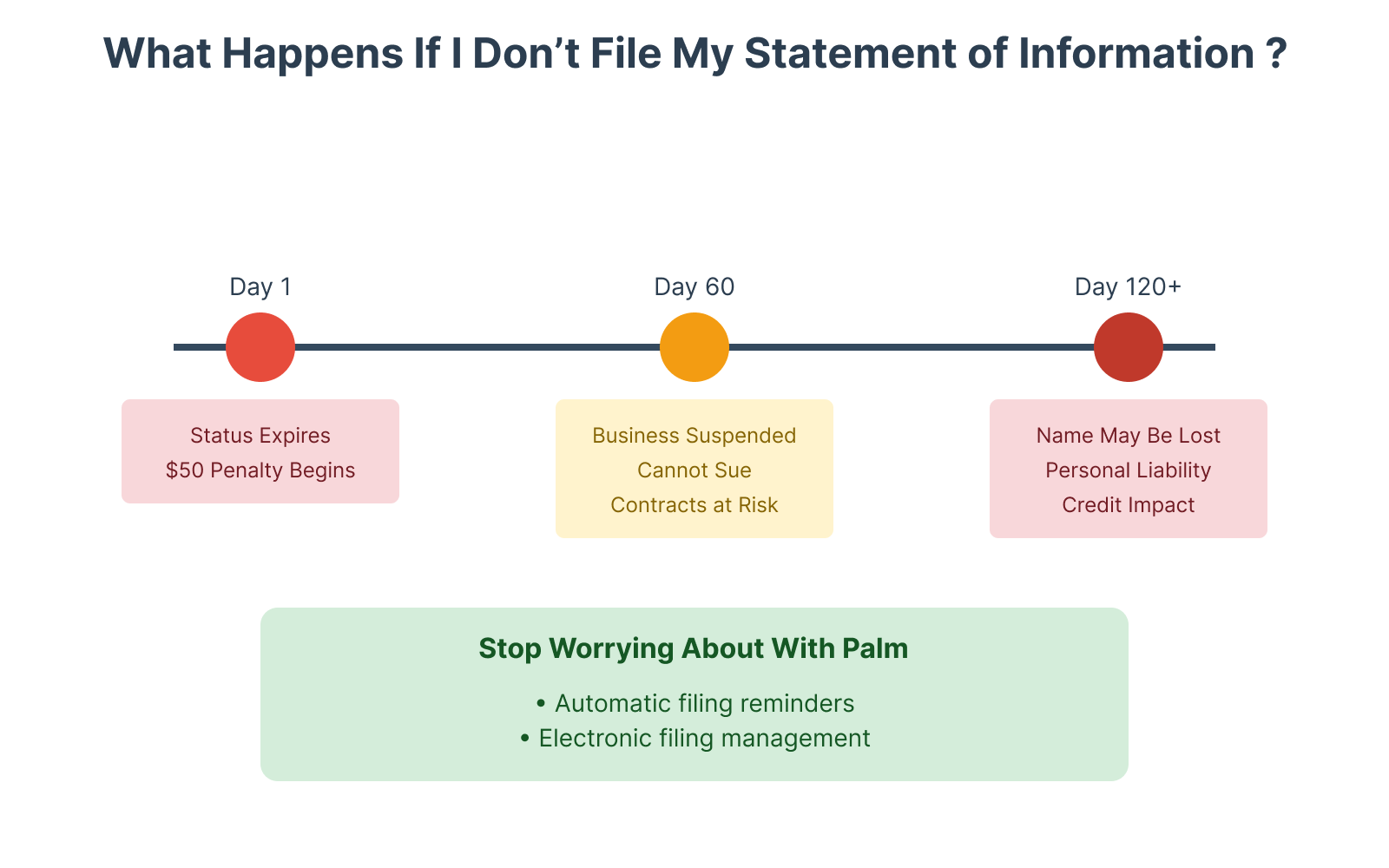
Key Takeaway: Failure to file on time can result in penalties and the loss of your business's legal good standing.
The easiest way to ensure you never miss a filing is to use Palm's business compliance platform. Palm will handle your compliance tasks:
Key Takeaway: Using Palm automates deadline tracking and document submission, ensuring you never miss a deadline.
To complete the filing, you will need to provide the state with current information on the following:
Remember, keeping your Statement of Information current isn't just about avoiding penalties - it's about maintaining your business's good standing and protecting your rights as a business owner in California.
Need help staying on top of your filings? Contact Palm to automate your compliance requirements and never miss a deadline.
## The Complete Guide to BOI Exemptions: Does Your Business Qualify? Source: https://www.getpalm.com/blog/who-doesnt-have-to-file-a-boiIs your business exempt from filing a Beneficial Ownership Information Report (BOI)? Let's break down the exemptions in plain English and help you figure it out.
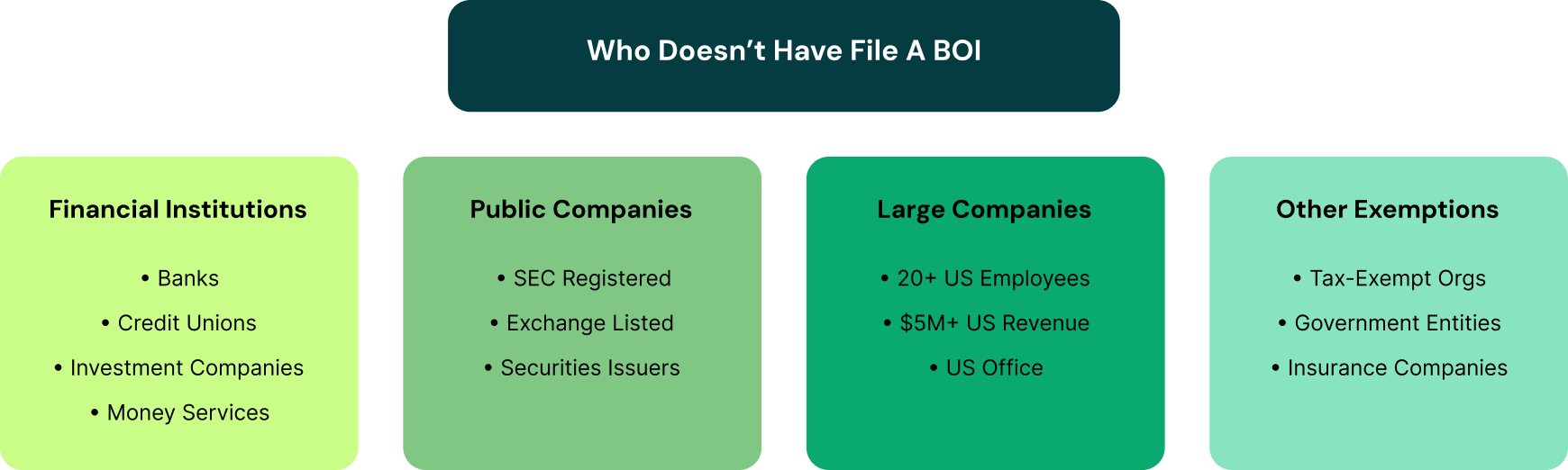
Let's start with the most common exemptions that might apply to your business:
You're exempt if ALL of these apply:
You don't need to file if you're:
No filing needed if you're:
Several other types of businesses are exempt, including:
Your company might qualify as "inactive" and exempt if ALL these apply:
Not sure if you qualify for an exemption? Palm can:
Remember: Claiming an exemption incorrectly can result in penalties. When in doubt, it's better to file or seek professional guidance. Palm can help you make the right decision and maintain compliance.
For the most current information, always check the official FinCEN website at www.fincen.gov/boi or consult with Palm for guidance specific to your situation.
Need help determining if your business qualifies for an exemption? Palm can provide a quick assessment and help you stay compliant with all BOI requirements.
## Who needs to file a BOI Report? Source: https://www.getpalm.com/blog/who-needs-to-file-a-boi-reportLet me help break down who needs to file a Beneficial Ownership Information Report (BOI) in a clear, visual way.
If you own or operate a small business in the US, you likely need to file. Let's break it down.
Basic Rule: If you have a registered business entity in the US, you likely need to file unless exempt. How to determine if you are exempt.
Common Business Types That Must File:
Don't Miss The Key Deadline- File Now For Free
Main Exemptions
Palm can assist with BOI reporting compliance by:
Need more help? Email, chat or text Palm! Hello@getpalm.com
Remember: Failing to file when required can result in civil and criminal penalties. When in doubt, consult with a legal professional or use Palm to ensure compliance.
For more detailed information, visit FinCEN's official BOI resource page at www.fincen.gov/boi.
## Don’t Fall For It: The Small Business Guide To Avoiding BOIR Scammers Source: https://www.getpalm.com/blog/dont-fall-for-it-the-small-business-guide-to-avoiding-boir-scammersThe Corporate Transparency Act requires Small Business Owners to self-report who the owners of their business are FinCEN. This is a legitimate requirement that began January 1, 2024 to help stop terrorism financing and drugs coming into the United States. Like most new regulations it’s not a clean and easy path to roll out successfully the first year. You should know that:
Be on alert for these warning signs that you are being targeted.

Follow these steps to ensure safe BOI compliance:
If you encounter a BOI-related scam, Palm can help. We will
As BOI reporting requirements continue to roll out, scammers will likely increase their efforts to exploit small business owners. By staying informed and following these guidelines, you can protect your business while complying with legitimate reporting requirements. Palm is a verified FINCEN partner and is here to help you stay compliant AND Safe.
## The Hidden Costs of Filing BOI Late: What 87% of Business Owners Don't Know Source: https://www.getpalm.com/blog/cost-late-boi-filingIn our daily rush to run our small businesses, many of us view the upcoming BOI filing deadline as just another item on our endless to-do list. But recent analysis reveals a startling fact: 87% of business owners are significantly underestimating the true costs and implications of delayed BOI filing. As we approach the January 1, 2025 deadline, understanding these hidden costs isn't just about compliance – it's about protecting your business's financial future.
When most business owners think about BOI filing costs, they focus on the obvious: the $500 daily penalty for non-compliance. But this surface-level understanding misses the deeper, more significant financial implications that late filing can trigger. The real cost structure is far more complex and potentially devastating to businesses of all sizes.
Consider the compounding effect of daily penalties. While $500 per day might seem straightforward, the cumulative impact can be staggering. A mere 30-day delay could result in $15,000 in penalties – enough to severely impact most small businesses' operating capital. What many don't realize is that these penalties can be applied retroactively from the deadline date, even if the non-compliance is discovered months later. A business discovering their filing obligation in March 2025, two months after the deadline, could immediately face a $30,000 penalty, even if they file the same day they discover the requirement. This retroactive application makes the cost of ignorance particularly steep.
The impact on business credit might be even more devastating than the direct penalties. Our recent analysis of similar federal filing requirements revealed that non-compliance flags can appear on business credit reports within 45 days of the deadline. This credit impact cascades through every aspect of business operations. Companies face increased interest rates on existing lines of credit, significantly reduced likelihood of loan approval, and substantially higher insurance premiums. Vendors begin imposing more stringent payment terms, while service providers demand increased security deposits. One small business owner in California recently shared how a similar compliance flag increased their business loan interest rate by 2.5%– an additional cost of $12,000 over the loan term.
As the deadline approaches, the cost of professional assistance skyrockets. Our survey of legal and compliance firms reveals a troubling trend in pricing:
These escalating costs reflect not just increased demand but also the additional complexity and urgency of last-minute filings.
Late filing often forces businesses into "emergency compliance mode," creating a ripple effect of operational disruptions. Companies find themselves calling emergency meetings with lawyers and accountants, rushing to gather documentation, and urgently communicating with business partners. Staff get pulled from regular duties, overtime costs mount, and rush fees accumulate for document retrieval and shipping. One medium-sized business reported spending 45 additional staff hours on emergency compliance measures – time that could have been reduced to 3 hours with Palm.
Business Relationships: The Long-Term Impact
The impact on business relationships and contracts can be equally severe. Late BOI filing often triggers automatic contract review clauses and potential breaches of compliance warranties. Companies face renegotiation requirements, increased reporting obligations, and enhanced due diligence requirements. Business partnerships strain under delayed transactions and increased scrutiny, while reputation damage leads to reduced negotiating power and limited business opportunities.
The shadow of late filing extends into future growth opportunities as well. BOI compliance status increasingly affects venture capital due diligence, angel investor confidence, and private equity evaluations. Strategic partnerships become harder to secure, and growth funding grows more elusive. Market position suffers as competitors gain advantages, industry standing diminishes, and both customer confidence and supplier relationships weaken.
Even technology costs increase for late filers. While early adopters can methodically implement compliance systems, those rushing to meet the deadline face rush implementation fees, premium support costs, and emergency training expenses. System integration and data migration become urgent, expensive necessities rather than planned transitions.
The good news is that these hidden costs are entirely avoidable with proper planning and early action. Here's what you need to do:
Understanding these hidden costs led us to develop Palm's free BOI filing solution. Our platform eliminates these hidden costs through immediate filing capability, automated information verification, and real-time compliance monitoring. With automatic update triggers and comprehensive record keeping, businesses can avoid both the obvious penalties and the hidden costs that could impact their future.
The true cost of late BOI filing extends far beyond daily penalties. When you factor in credit impacts, operational disruptions, professional service premiums, and long-term business implications, the real cost can be tens or even hundreds of thousands of dollars. Don't let your business become another statistic. Visit getpalm.com today to complete your filing in under 10 minutes. Our free service ensures you avoid not just the obvious penalties, but all the hidden costs that could impact your business's future.
Remember: The deadline might seem far away, but the cost of waiting grows every day. Take action now to protect your business from these hidden financial impacts.
## Business Reporting 101 for SMBs Source: https://www.getpalm.com/blog/business-reporting-101-for-smbsBetter understand the reported information on your small business.
In the competitive landscape of today's business world, small businesses face a unique set of challenges in establishing and maintaining their financial stability. One crucial aspect that can significantly impact their success is business reporting. Often overlooked or misunderstood, business reporting plays a pivotal role in demonstrating financial health, securing lending opportunities, and preserving a positive reputation. Join us as we embark on a comprehensive journey into business reporting, exploring its significance, various types of reported information, and the importance of compliance with regulations. Get ready to unlock the secrets of effective business reporting and empower your small business for peace of mind and prosperity with Palm.
Claim your Palm Profile today.
Why Your Business Profile Is Important
Business reporting is not just a formality; it's a strategic tool that can shape the trajectory of your company. Reported information on your small business can play a pivotal role in influencing key decisions that can impact your business's growth and success.
Let's delve into the significance of Business Reporting and why it matters:
1. Lenders' Assessment Tool:
Reporting such as 12 months cash flow, debt, liens, lawsuits and loans are like a financial X-ray for lenders. They provide a comprehensive view of your company's financial health, encompassing profitability, debt levels, and repayment patterns. Lenders meticulously analyze these reports to assess the risk associated with lending to your business. A well-maintained and monitored small business profile can pave the way for favorable loan terms and interest rates.
2. Gateway to Financing:
Reported information also holds the key to unlocking various forms of financing essential for business growth and expansion. When seeking external funding, be it from banks, investors, or other financial institutions, presenting a positive and healthy business profile is paramount. It serves as a testament to your company's stability and reliability, increasing the likelihood of securing advantageous financing terms.
3. Building Trust and Credibility:
Business reports aren't just numbers on a page; they're a reflection of your company's character. Potential investors, partners, and customers scrutinize these reports to gauge your financial performance, management practices, and overall business conduct. A positive and healthy business report acts as a beacon of trust, instilling confidence in those considering doing business with you.
4. Early Warning System:
Reports are not just retrospective snapshots; they're also forward-looking indicators. By regularly analyzing these reports, you can identify potential risks and vulnerabilities before they snowball into bigger problems. This enables proactive decision-making, allowing you to take corrective actions and safeguard your company's future.
In essence, business reporting is not just about compliance requirements like BOIR; they're a powerful tool that can enhance your company's financial health, expand your access to financing, build trust with stakeholders, and steer your business towards long-term success.
Claim your Palm Profile today.
When it comes to small business loans, reporting about your business could provide crucial information that lenders need to make informed decisions. These reports disclose essential details such as the names of the involved parties, ensuring transparency and accountability around payment trends. Additionally, the inception date of the loan and the loan amount are clearly outlined, allowing lenders to assess the loan's history and the company's borrowing capacity.
Furthermore, business reporting delves into the repayment terms, specifying the interest rate and the monthly payment obligations. This information is crucial for lenders in evaluating the company's ability to meet its financial commitments. Moreover, any collateral provided to secure the loan is meticulously documented, enabling lenders to assess the level of risk associated with the loan.
Liens against your business
In the realm of business reporting, understanding liens and their implications is crucial. A lien is a legal claim or charge against a business's assets, such as property or equipment, as security for an unpaid debt or obligation. Liens can be filed by various entities, including lenders, government agencies, and individuals or companies that have won lawsuits against the business.
There are two primary types of liens: general and specific. A general lien encompasses all of a business's assets, while a specific lien is limited to a particular asset or group of assets. The type of lien filed depends on the nature of the debt or obligation.
For instance, if a small business takes out a loan, the lender may file a general lien against the business's assets as collateral. This lien gives the lender the right to seize and sell the assets if the loan is not repaid according to the agreed-upon terms. Similarly, government entities may file tax liens if a business fails to pay its taxes. In the case of lawsuits, plaintiffs who win a legal judgment against a business may also file a specific lien against the business's assets to ensure payment of the awarded damages.
The presence of a lien against a business can have significant consequences. It can make it challenging to obtain credit or financing, as lenders are less likely to lend money to a business with existing liens. Additionally, liens can complicate the sale of a business, as potential buyers may be hesitant to purchase a business with outstanding legal claims against it.
Therefore, it is essential for small businesses to be proactive in managing their financial obligations and avoiding situations that could lead to the filing of liens against their assets. Regular monitoring of financial records, prompt payment of debts, and compliance with tax and legal requirements can help prevent liens and safeguard the business's financial health and reputation. If a lien is filed against your business, it is crucial to seek legal advice to understand your rights and options for resolving the matter promptly.
Claim your Palm Profile today.
Lawsuits can have a profound impact on small businesses, potentially resulting in significant financial losses, reputational damage, and even the loss of the business itself. Therefore, it is crucial for small businesses to accurately report any lawsuits filed against them in their business reporting. Failing to do so can have serious consequences, including legal penalties, loss of access to financing, and damage to the company's reputation.
The information that must be reported regarding lawsuits varies depending on the jurisdiction, but typically includes the plaintiff's name, the court where the lawsuit was filed, the docket number, the amount of damages being claimed, and the status of the lawsuit. It is essential to provide accurate and up-to-date information to ensure compliance with regulations and protect the interests of the business.
Reporting plays a vital role in managing the potential risks associated with lawsuits. By promptly and accurately reporting lawsuits, small businesses can demonstrate transparency and responsibility, which can enhance their credibility with lenders, investors, and customers. Additionally, timely reporting enables businesses to proactively address legal challenges, seek legal counsel, and develop strategies to mitigate potential losses.
Understanding reported information regarding lawsuits is crucial for small businesses to navigate the legal landscape effectively. By monitoring their business profile, small businesses can protect their assets, maintain their reputation, and ensure the long-term viability of their operations.
Claim your Palm Profile today.
Compliance with regulations set forth by the Business Owner Information Registry (BOIR) is crucial for small businesses. One of the most important requirements is filing annual reports. These reports must include specific information, such as:
It's essential to file annual reports on time to avoid penalties and potential legal consequences. Additionally, businesses may need to comply with other reporting requirements, depending on their industry and location. Staying up-to-date with these regulations is crucial for maintaining good standing and avoiding adverse consequences.
By complying with government and financial regulations, small businesses can demonstrate their transparency and commitment to ethical business practices. This can enhance their reputation and build trust with stakeholders, including lenders, investors, and customers. Moreover, compliance helps businesses operate smoothly and efficiently, minimizing legal risks and ensuring long-term success.
Claim your Palm Profile today. We're here to bring peace of mind to small business owners like you.
## When to file your BOI Report Source: https://www.getpalm.com/blog/when-to-file-your-boi-reportNavigating the world of business regulations can be complex, but staying compliant is crucial to avoid penalties and legal issues. One such regulation is the Beneficial Ownership Information (BOI) report, a requirement under the anti-money laundering regulations set by the Financial Crimes Enforcement Network (FinCEN). Filing this report accurately and on time is essential, and we're here to guide you through the process. In this blog post, we'll explore who needs to file, the potential consequences of late filing, the deadlines you need to meet, the information you'll need to provide, and how to file your BOI report with ease.
Timely filing of your beneficial ownership information (BOI) report is crucial as failure to comply can result in significant penalties. Late filers may face civil penalties ranging from $500 to $1,000 for each violation. These penalties can accumulate quickly, especially if multiple reports are overdue.
However, the consequences of not filing at all are far more severe. Businesses that fail to file a BOI report may be subject to penalties of up to $10,000 per violation. Moreover, the government may seek injunctions to prevent further violations. In cases where there is intentional disregard of the reporting requirements, penalties can reach as high as $500,000 per violation.
In addition to hefty fines, knowing and willful violations of the BOI reporting requirements can lead to criminal prosecution, resulting in fines and imprisonment. Therefore, it is essential for businesses to understand their filing obligations and ensure that their BOI reports are filed accurately and on time to avoid these severe consequences.
Don't let compliance become a hassle - file with Palm's easy and automated process. We're dedicated to helping small businesses like yours succeed and stay on the right side of regulations.
Filing your beneficial ownership information (BOI) report on time is crucial to avoid penalties and ensure compliance with anti-money laundering regulations. The due date for filing your BOI report depends on the type of entity you represent and its formation date.
New Businesses
If you're a new business formed in the US or a foreign entity registering in the US, you must file your BOI report within 30 days of the date you're legally formed or registered. This applies to corporations, LLCs, and other entities covered by FinCEN's regulations.
Existing Businesses
If you're an existing business that was formed or registered before January 1, 2020, you had until January 1, 2022 to file your initial BOI report. However, if you've experienced any changes to your beneficial ownership information since your initial filing, you must file an updated BOI report within 30 days of the change.
Trusts and Estates
Trusts and estates must file their BOI reports within 30 days of being formed, created, or otherwise established. If there are any changes to the beneficial ownership information, an updated BOI report must be filed within 30 days of the change.
Nonprofits
Nonprofit organizations are also required to file BOI reports. The due date for nonprofits is May 15 of each year, regardless of when the organization was formed. If there are any changes to the beneficial ownership information, an updated BOI report must be filed within 30 days of the change.
Foreign Entities
Foreign entities registered in the US must file their BOI reports within 30 days of the date of registration. If there are any changes to the beneficial ownership information, an updated BOI report must be filed within 30 days of the change.
Understanding these deadlines is essential for timely reporting and avoiding penalties. If you're unsure about your filing obligations or need assistance completing your BOI report, consider using Palm's easy and automated e-filing process. We're here to help small businesses like yours win.
Filing your beneficial ownership information (BOI) report accurately and on time is crucial for businesses to comply with anti-money laundering regulations. To ensure a smooth reporting process, it's essential to gather the necessary information beforehand.
The BOI report requires specific details about the business and its beneficial owners. For each beneficial owner, you'll need to provide their legal name, residential or business address, date of birth, and Social Security number or Individual Taxpayer Identification Number. Beneficial owners are individuals who own or control at least 25% of the business's ownership interests or voting power. If there are multiple beneficial owners, information about each one must be included.
In addition to beneficial owner information, you'll also need to provide details about the business itself. This includes the legal name of the business, principal business address, Employer Identification Number (EIN), and the date the business was formed or registered. If the business is a corporation, you'll also need to provide the state where it's incorporated.
Filing your beneficial ownership information (BOI) report doesn't have to be a hassle. With Palm's user-friendly and automated e-filing process, you can complete your reporting requirements efficiently and effortlessly. Our intuitive e-filing system guides you through each step, ensuring accurate and timely submission of your BOI report.
To get started, simply visit our website and create an account. You will be prompted to provide basic information about your business, such as your legal name, address, and industry. Once your account is set up, you can easily upload your BOI data using our secure and encrypted platform. Palm's system will automatically validate your information to ensure compliance with FinCEN's reporting requirements.
If you encounter any issues while filing your report, our dedicated support team is ready to assist you. We understand the importance of meeting BOI report due dates, and our team is committed to providing you with the support you need to successfully file your report on time.
Remember, late filing or failure to file your BOI report can result in penalties and fines. Don't let reporting compliance become a burden for your business.
File with Palm today and join the growing number of businesses that have simplified their BOI reporting experience.
## What's keeping your small business from growing? Source: https://www.getpalm.com/blog/what-s-keeping-your-small-business-from-growingGet smart about growing your small business with these key tips.
Do you know the third party reported information that exists on your business, such as any existing Liens, Lawsuits and your Business Standings, such as BOIR filing? Most small businesses don't know what's being reported about them, which affects their ability to obtain better terms for their small business as well as small business loans and funding.
Are you aware of any adverse actions on your business such as a small business lien or small business lawsuit? This information can take time to find out and uncover and be confusing. At Palm, we remove the chaos out of small business ownership with Palm Profile so you have access to all of the reported information on your business, including adverse actions such as liens and lawsuits on your small business.
Your cash flow over time is a good predictor for lenders looking to lend you a small business loan or funding. Your payment patterns also matter, and can get you better rates and terms on your biggest business expenses which could save you thousands of dollars.
Get full visibility to all of your business accounts in one place when you connect your accounts and claim your Palm Profile today. Receive 24/7 access to the most complete & verified source of truth for your small business.
How much debt your business has is also a consideration for business health and growth. Your debt-to-income ratio is important and how you use your funds to grow your business ultimately matters over time. Keeping up with loan payments will also affect your ability to get further lending down the road such as a small business loan or other type of funding, so keep up with your payments.
Using AI can help automate many tasks such as monitoring information in your Palm Profile for changes, alerting you of cash-flow based insights or when your policy is up for renewal. Palm is here to remove the chaos out of small business ownership and deliver peace of mind and prosperity to small business owners. AI can save you time and money by automating the tasks you once would spend hours on manually such as autofilling forms and obtaining the reported information on your business. The AI technology we use is in service of this.
## Don't miss your BOIR deadline! Source: https://www.getpalm.com/blog/don-t-miss-your-boir-deadlineBy now, you may have heard of a BOI report, or Beneficial Ownership Information Report. Beneficial ownership information refers to identifying information about the individuals who directly or indirectly own or control a company.
The Corporate Transparency Act (CTA) requires certain types of U.S. and foreign entities to report beneficial ownership information (BOIR) to the Financial Crimes Enforcement Network (FinCEN), a bureau of the U.S. Department of the Treasury. This is a new requirement to combat financial crimes. You can learn more about this new requirement on the FinCEN website.
Failure to properly file a Beneficial Ownership Information report may incur severe civil and criminal penalties, including fines of up to $100,000 and up to two years of prison time.
The owners of any company that willfully violates the BOI reporting requirements may be subject to civil penalties. The penalties start at $500 for each day that the violation continues. Owners may also be subject to criminal penalties of up to two (2) years imprisonment and a fine of up to $10,000.
File today with Palm's easy and automated filing. We're here to bring small business owners like you peace of mind.
Learn more about filing your BOI report and file today with Palm.
## How to e-file your BOIR Source: https://www.getpalm.com/blog/how-to-e-file-your-boirIf you're a business owner or part of a business that needs to file a Business Ownership Information Report (BOIR), you’ll be happy to know that Palm offers a streamlined way to e-file this report. Whether you're filing for the first time or need to update your existing information, Palm makes the process simple and efficient. Here's a quick guide on how to e-file your BOIR with Palm.
## The small business guide to a successful summer Source: https://www.getpalm.com/blog/the-small-business-guide-to-a-sucessful-summerAI is here to stay. Over two-thirds of small businesses have tried AI, more than four-in-five small business owners say the technology has been helpful to their company and 61% of SMB owners say they use AI to automate daily tasks. Not only that, but there's even a recent bill in the U.S. Senate that would mandate AI training for small businesses.
To say that AI has a chance to transform the small business industry is an understatement. AI can be used in a multitude of ways to grow your business and we believe is a big driver of future growth for small businesses everywhere.
The best way to save time & money this summer? Connect your business accounts to an AI finance tool like Palm. Palm's secure AI works to bring you weekly and monthly insights across all of your business accounts automatically as well as give you alerts when anything looks off.
Signing up for an AI tool to manage your business finances like Palm will also automate your biggest changes in spend and cash flow month over month, which can be especially helpful when you're managing cash flow and expenses during extra busy times and seasons to see how your expenses are comparing.
By automating your business finances, you have a more accurate view of your business performance over time - expenses, cash flow, and time-over-time predictability. With this level of predictability and a view of all of your finances in one place, it gives lenders and vendors a better idea of your business' financial health, which can lead to better terms, interest rates and offers.
Keeping up to date with your business finances can pay off, literally. When you pay your bills on time and manage your finances responsibly, you're able to open the doors to additional funding and capital to help your business grow at better terms, like small business loans, for example.
Read more on why your business health matters and how Palm can help.
68% of Main Street SMBs Leveraging Social Media See Increasing Revenues and 55% of Main Street revenue since early 2023 has been from online sales. Social media isn't just a nice-to-have anymore - it can seriously help you grow your small business along with e-commerce platforms that allow your business footprint to expand beyond just brick & mortar.
Consider how your business could benefit from social media exposure - is it promoting a local event or maybe a new set of merchandise for your coffee shop? There are multiple ways to expand your business footprint and sales online this summer as customers are out and about and willing to spend their money.
With the busy season comes additional revenue. Being able to see how your small business cash flow performs month-over month isn't only critical to your business' current success but also future success. Using an AI tool like Palm to manage small business finances, see how your business has performed over time as well as when large business expenses hit will give you information to plan better for the future and for the peaks and valleys of small business ownership. You'll enjoy peace of mind this summer knowing you are setting yourself up for future success.
Don't forget to visit our blog for more tips on how to help your small business grow.
## Five Cash Flow Management Tips for Small Businesses Source: https://www.getpalm.com/blog/five-cash-flow-management-tips-for-small-businessesIf you're a small business owner struggling related to cash flow issues, you're not alone. According to Forbes, 82% of small businesses in the U.S. struggle to keep up with cash flow.
Palm is here to help. We've gathered the top five things you should consider when you're ready to take control of your cash flow once and for all, including creating your free Palm account.
As Forbes reports, it's responsible and advisable to have a financial forecast. from managing cash flow to strategizing investments. By anticipating income and expenses, you can maintain a healthy cash flow essential for sustaining operations. Not sure what to anticipate or where to start? Visit our blog post on the top spend categories for small business and create your free Palm account to take control of your cash flow and expenses.
As we've mentioned, understanding your expenses can be daunting, especially if you're not tracking them automatically. This is where an AI tool like Palm can help with cash flow and expense management for small businesses. Connect your business accounts in a few easy steps and start receiving automated spend updates and insights to help you save time and money.
One way to grow your business and infuse healthy cash flow into the business is to obtain low or no interest funding. On our blog, we have put together the list of grants to consider at the local & state, corporate and federal levels. Grants are loans that don't need to be repaid, but they do take time and effort to apply for. We have broken it down for you. To receive weekly tips for how to grow your business like these, sign up for your free account today.
Finally, once Palm's AI detects savings opportunities, it is also able to match you with savings offers to switch and save on your biggest expenses like insurance, for example. These switch and save offers would take hours for small business owners to shop and find, and by automating this, you can save many hours and save hundreds to thousands of dollars.
As you can see, using an AI cash flow & expense management tool is the modern way to do business expenses to save time and money. Don't forget to create your free Palm account today and keep checking our blog for updates to save you time, money and peace of mind.
## Managing small business finances with AI Source: https://www.getpalm.com/blog/managing-small-business-finances-with-aiIf you're a majority of small business owners, you're looking for an opportunity to spend less time on your business finances and more time on your customers and growing your business.
AI tools like Palm help modernize small business finances and save time and money. Create your free account today and read on to learn what to expect working with AI.
Expense management tools like Palm use AI to automate expenses, catch errors and help you ditch the chaotic piles of paperwork for small businesses. This software reduces time that you or your team spends tracking and logging expenses and connects directly to your accounts, removing you as the middle man and ensuring accuracy.
With Palm, you also receive AI-generated savings insights on a weekly and monthly basis, so you're able to understand your small business spending, key trends and benchmarks and opportunities to save. With Palm's AI, customized insights are automatically sent directly to you based on your preferences once you connect your accounts. The more accounts you connect, the more personalized insights and savings opportunities we are able to detect for your business.
AI can also help small businesses find and connect to funding through location data and health-related business metrics, as well as help us understand what small business owners are looking for, so we can help. Don't forget to visit our blog weekly for more resources on how to grow business, and when you sign up, you'll also receive weekly newsletter with custom weekly content.
## What you need to know about National Small Business Week Source: https://www.getpalm.com/blog/what-you-need-to-know-about-national-small-business-weekDid you know it's National Small Business Week? We're bringing you the latest news and resources to consider for saving time, money and peace of mind.
Consider creating your free Palm account today to receive tips like these and personalized spending insights.
In his recent Proclamation on Small Business Week, President Biden shared that the country is in a “small business boom” and stated the government’s commitment to support small businesses as well as their access to funding. He lists several SBA funding updates to expand loans to underserved audiences and other federal government investment in local communities such as making sure every home and business has internet, to investing $10 million into state -level programs.
Read the full White House statement from President Biden and visit our other articles to learn more about additional funding opportunities for your small business, including grants and SBA loans.
As we’ve mentioned in our newsletter, the free SBA Virtual Summit starts today and goes through May 1st. Companies like Block/Square, Visa, Google, Nerd Wallet, Amazon and more are coming together to bring free resources, knowledge and courses to support small businesses.
The SBA is also hosting several in-person events to celebrate National Small Business week such as the National Small Business Person of the year in Washington, D.C. Learn more about those celebrations and be sure to check your local Chamber of Commerce to see if they are hosting events in your area as well. You can see a list of all local state winners on the SBA site here as well!
Companies like Chase for Business have dedicated programs to support small businesses and often offer free resources and additional offerings during this week. Below are a few highlights from Chase for Business for this week and on-going offerings for Members.
Spectrum is also doubling down on their small business support through community investment funds for underserved business through their Community Investment Loan Fund, which has helped finance $59 million in loans to more than 1,200 small businesses, creating or retaining over 5,000 jobs. as well as local strategic volunteer initiatives. "Pay It Forward," an initiative by Spectrum Reach – the advertising sales business of Spectrum – has helped more than 2,000 small businesses across 36 states and invested over $50 million since it began in 2021. Through the program, underserved businesses receive $15,000 worth of free advertising and creative services, which can help make or break a burgeoning small business.
Spectrum also has special small business bundles as well as free initiative called "Let's Get Started" which offers free support for new businesses like mentors and business tool kits to get your business started.
One of the biggest topics in the press around National Small Business Week this year, including the agenda for the SBA Virtual Summit this week, is how small businesses can use AI to leverage growth. In an economy with rising costs and inflation, efficiency and accuracy is imperative for SMB owners and operators. That’s where AI tools like Palm help can help save time, money and peace of mind by automating business finances, tracking spend and helping save money on your biggest expenses.
Create your free Palm account today to start saving time, money and peace of mind, and get tips & resources like these to help grow your business.
## The top macro trends affecting small businesses Source: https://www.getpalm.com/blog/three-trends-affecting-small-businessesRead on for several macro trends you should pay attention to if you are a small business in 2024.
40% of Americans plan to travel more in 2024 vs 2023 according to a recent Forbes study. With 55% of Americans planning a 2024 Spring Break excursion and 76% of spring break itineraries feature U.S. domestic travel, travel numbers are expected to increase year over year for airfare, hotels and cruises. This travel can affect small businesses in the restaurant, service, hospitality and many other industries as well as bring a seasonal upswing in revenue for small businesses. According to the U.S. Travel Association, sentiment is also growing for upcoming leisure travel in 2024. The share of travelers reporting having travel plans within the next six months increased to 93% in January.
Have you considered how your business can prepare for growth during travel and warm weather season?
Don’t forget to create your free Palm account to keep your finances organized, save on your biggest expenses and get more tips on how to grow.
According to Bank of America’s 2023 Small Business Owner Report, 80% of business owners digitally optimized their businesses in the prior year. If you’re not sure where to start, it’s worth considering a few tools to optimize your efficiency and decision-making.
AI software can take data and present synthesized courses of action, which is what makes it helpful and a productive tool when used as support. One of the best ways to use AI is to automate your business finances with a tool like Palm, so you can remain organized and have a handle on your business finances, all by just connecting your account.
Other technology tools include addressing shifting consumer behaviors such as e-commerce shopping, social media advertising and content as well as how people hear about your business. Digital and online media is here to stay. Not sure where to start? Sites like Upwork have freelance labor that you can hire based on your budget to help you get started.
As we’ve mentioned, according to the recent study by the National Federation of Independent Business (NFIB), The Small Business Optimism Index has reached the lowest it’s been since 2012. The NFIB sites that “inflation has once again been reported as the top business problem on Main Street.”
There are ways to combat inflation, like managing your biggest business costs with an AI tool like Palm that will not only alert you to your spending habits but also auto-shop your biggest business expenses for you to help you save. Create your free account today to get instant spend insights and savings recommendations.
Other ways to combat inflation are to use AI and technology to automate routine tasks as well as avoid high-interest loans and credit cards. Instead, investigate the SBA loans available to you, as well as federal and corporate and local/state level grants to see if you qualify.
We're here to help you succeed.
## 4 small business tax tips if you haven't already filed Source: https://www.getpalm.com/blog/4-tax-tips-if-you-haven-t-already-filedApril 15 is still the annual tax deadline for many small businesses although, unlike individuals, small businesses can have varying deadlines depending on the type of company, the state the taxes are filed in, and other factors. Quarterly estimated tax payments are generally required throughout the year. And certain types of small businesses had to file by March 15.
Since business tax filing is complex, most experts recommend small business owners work with a professional tax adviser rather than trying to file on their own or even with tax-filing software. To learn more, you can visit the Small Business IRS FAQs at this link.
Read on for our top tips to find money if you haven’t already filed your taxes.
As part of the American Families and Workers Act of 2024, it includes a bill extends the 100% Bonus Depreciation for small businesses. For background, businesses were permitted to claim 100% bonus depreciation in 2022 for qualifying assets placed in service in 2022. But then, the rate decreased to 80% in 2023, and was set to drop to 60% in 2024, 40% in 2025, 20% in 2026, and zero in 2027. This legislation would allow businesses to claim 100% bonus depreciation for investments in machines, equipment and vehicles for tax years 2023, 2024 and 2025, providing a retroactive tax benefit for 2023.
So, if you qualify for Bonus Depreciation, you may want to extend your tax filings to see if this happens.
The US Chamber of Commerce put together this comprehensive list of 9 Commonly Overlooked Small Business Tax Credits. Check the link to see if your business qualiifes.
In the past, underpayment penalties hovered at around 3%, but this year they’re more than double at 8%. That’s because the penalties are based on the federal short term interest rate plus three points, so when interest rates are up so are underpayment penalties. It's best to pay what you think you owe or filing an extension vs incurring extra interest.
The best way to save on your taxes every year? Ditch the chaotic pile of receipts and keep your finances in a database so you can easily categorize them and stay on top of quarterly estimated payments. With an AI assistant like Palm, you can connect your business accounts and we’ll not only help you save money on your expenses, but you can store all of your business documents on Palm as well to keep organized. Create your free account today.
## How to find free small business grants Source: https://www.getpalm.com/blog/how-to-find-free-small-business-grantsOne of the top inquires we receive at Palm is how to find grants to fund your small business. Grants provide free money to new and existing businesses and don’t need to be repaid (unlike loans) and can be harder to find.
While we do not provide grants or loans, we’re still here to help small businesses find and save money. That’s why we’ve put together the top federal and corporate grant resources to consider below.
Bear in mind that not all grant funding flows from the federal government directly to small businesses. Some funds are flowed through state and local governments, agencies, nonprofit organizations and institutions of higher education. These funds would be distritubed at the local level.
Also keep mind that you may qualify for more than one grant, so it is best to visit all of the resources below and see what is available to you.
Sign up for a free Palm account today to get more insights that help you save and check our blog for more resources.
The most comprehensive place to start searching for grants for your small business is grants.gov. There are thousands of types of grants available and you can search grants by keyword as well as posted date. For instance, when you type in “small business” as a keyword, over 42 pages come up - so it best to be specific and narrow down your search. The best way to do this is follow the instructions on the grants.gov blog for how to apply for federal funding.
Hot tip - go to the this link first and follow the instructions vs. starting your search from scratch. This will tell you what you’re qualified for so you won’t be left guessing and ultimately more likely to get approved.
The process you will follow:
Step 1: Make sure you have registered an account on Grants.gov
Step 2: Determine Your Eligibility and Identify a Funding Opportunity using Grants.gov Search
Step 3: Apply to the Funding Opportunity by Creating a Workspace
Step 4: Complete Your Application
Step 5: Check Your Application for Errors and Submit Your Completed Application
While the SBA typically doesn’t offer grants to small businesses, there are a few niche grants that they and other government agencies do offer.
The STEP grant program has helped thousands of small businesses obtain grants and find customers in the international marketplace since 2011. Through awards to U.S. states and territories, STEP helps small businesses overcome obstacles to exporting by providing grants to cover costs associated with entering and expanding into international markets.
STEP financial support helps U.S. small businesses:
The U.S. Small Business Administration (SBA) doesn’t typically offer grants directly to small businesses. The Program for Investors in Microentrepreneurs (PRIME), however, offers federal grants to microenterprise development and community organizations like private nonprofits, or state, local or tribal governments, so that they can provide assistance to disadvantaged microentrepreneurs of those communities.
The SBIR and the STTR grant programs focus on research and development for technology innovation and scientific research. The programs help connect entrepreneurs with federal business grants and contracts from 12 government agencies.
To qualify, you must operate a for-profit business, have no more than 500 employees and meet other eligibility requirements.
The U.S. Department of Agriculture (USDA) administers the Rural Business Development Grant program, which provides financing to strengthen and grow small businesses in rural communities.
Businesses must have fewer than 50 new employees, less than $1 million in gross revenue and be located in an eligible rural area to qualify. Applications are accepted once per year through the USDA Rural Development’s local or state offices.
The EDA is part of the U.S. Department of Commerce and offers ongoing funding opportunities for projects that support regional and national economic development. Applicants can apply for a variety of rolling-basis EDA investments that fund projects in construction, non-construction, planning, technical assistance, research and evaluation, higher education, and more.
Additional grants you may qualify for are at the regional and local levels as well as corporate level. Be sure to check our blog for updates on more resources to find and save you money and sign up for your free account to start saving and stay in the loop.
America’s Top Small Business Awards recognizes a small business for its contributions to the U.S. economy and offers a grant of $25,000. The competition also gives awards to businesses in a variety of categories, such as emerging business and green/sustainable business, with associated prizes.
Hello Alice partners with a variety of companies to offer different grants for small businesses, including startups. You can create an account to receive notifications about new opportunities and apply for the grants that are relevant to your business.
The Small Business Growth Fund, a partnership between the Global Entrepreneur Fund and Hello Alice — funded by Etsy and Progressive — is an annual program designed to help entrepreneurs grow their operations.
Restaurants that have experienced a natural disaster may be able to get a small-business recovery grant from the DoorDash Restaurant Disaster Relief Fund (also on Hello Alice). This program offers $10,000 business grants to brick-and-mortar restaurants that have been impacted by a federally or state-declared disaster, such as a wildfire, hurricane or earthquake.
To qualify, you’ll also need to have three restaurant locations or fewer, 50 or fewer employees, been in business for at least six months and made $3 million or less per location in the last year.
Applications are accepted on a quarterly basis but they must be submitted within 12 months of the declared disaster. Recipients will be notified within 30 days after the application period closes.
The U.S. Chamber of Commerce Foundation and FedEx have teamed up to create the Small Business Readiness for Resiliency (R4R) Program. The program helps small businesses put plans in place to prepare for disaster and also provides immediate emergency funding when necessary. Businesses are asked to complete a four-step process to be eligible for funding opportunities
In 2024, FedEx’s annual grant competition will award one $50,000 grand prize and nine additional $20,000 grants. The application window is open from March 1 to April 1.
The contest is for U.S.-based, for-profit small businesses with fewer than 99 employees. You must also have a valid FedEx business shipping account number and currently ship with FedEx to apply.
The Backing Small Businesses grant program is a collaboration between American Express and Main Street America. Now in its third year, the program will award $10,000 grants to up to 500 small businesses. Of those, 25 businesses will receive $30,000 Enhancement Grants, which have limited use cases. To be eligible, your business must be located in historic main street, downtown or commercial district. Applications are accepted from March 14 - April 7, 2024.
Verizon’s Digital Ready program gives business owners the opportunity to access free courses and educational materials, as well as apply for grant funding. To be eligible for a $10,000 small-business grant, entrepreneurs must register through the Verizon website and complete at least two of the following: courses, live coaching or community events.
Once these tasks are completed, you can submit a grant application. The latest round of funding is open to businesses located in Houston, Los Angeles, Miami and Phoenix. Applications are accepted from Feb. 26 - April 8, 2024.
The Venmo Small Business Grant program awards 20 eligible entrepreneurs with $10,000 grants for their small businesses. It also offers public promotion on the Venmo website and social media accounts, as well as mentorship from industry leaders.
To qualify, you must have a U.S. Venmo account and a valid business profile on Venmo in good standing. You also must have less than $50,000 in annual sales and 10 employees or fewer. Applications for the 2024 cycle have not yet been announced.
The annual Amazon Small Business Grant program offers free grants to small businesses that have an Amazon Business account and $1 million or less in annual revenue. The program offers grants to 15 businesses, ranging in amounts from $15,000 to $25,000.
Winners can also receive a one-year membership to Business Prime and free products from eero Wifi and Kindle Scribe. Grant applications are due May 21st, 2024.
The Visa Everywhere Initiative is a grant competition that offers free funding to tech-forward startups across five different regions around the globe. Applicants must show how they’ve developed a product or service that creatively involves Visa’s products.
Visa will select the top five finalists in each region, and these businesses will move forward to a global finals event. The overall winner of the competition is awarded a $50,000 small-business grant. Additional grants are awarded to second- and third-place finalists, audience favorites, as well as regional and local winners.
The Lenovo Evolve Small initiative is a program designed to support small businesses throughout the U.S. and Canada by offering grants and technology donations. This year, the Lenovo Evolve Grant provided 30 small businesses with $10,000 in funding, a Lenovo laptop and business support.
LegalZoom, the NBA, WNBA and NBA G-League partner with Accion Opportunity Fund to offer $10,000 grants and up to $500 in LegalZoom services to small-business owners. The Fast Break for Small Business program is available to entrepreneurs with at least three months in business.
If you have less than three months in operation or haven't started your business yet, you can also apply to receive a LegalZoom product of your choosing (up to $500). Applications for the 2024 cycle of this grant program are open until Sept. 13, 2024.
Bizee's Fresh Start Business Grant (previously known as the Incfile Fresh Start grant) offers $2,500 to help new entrepreneurs cover startup costs. The winning business owner will also receive free formation services in their state, free registered agent services for a year and a free tax consultation from Bizee.
To qualify, you must be planning to start a new business or grow an existing business. Bizee also offers a Young Entrepreneur Grant for students interested in starting their own businesses.
Etsy partners with the nonprofit organization, CERF+, to provide its sellers with financial relief after they’re affected by a disaster. To qualify for this small-business hardship grant, you’ll need to have experienced a federally declared natural disaster within the last year, as well as have had an active Etsy seller account in good standing for at least one year.
Etsy Emergency Relief grants are available in amounts of $2,000. Applications are accepted on a rolling basis and funds are issued quarterly.
https://www.newsweek.com/vault/business-loans/best-small-business-grants-for-veterans/
https://www.nerdwallet.com/article/small-business/small-business-grants
https://www.uschamber.com/co/run/business-financing/small-business-grants-and-programs
## The Top Five Small Business Benchmarks You Need to Know Source: https://www.getpalm.com/blog/the-top-five-small-business-benchmarks-you-need-to-knowIn today's competitive business landscape, small businesses face numerous challenges in managing their finances effectively. From automating financial tasks to gaining valuable insights and personalized advice, Artificial Intelligence (AI) has emerged as a powerful tool that can revolutionize the way small businesses handle their finances. In this article, we will explore how AI can assist small businesses in streamlining financial processes and achieving growth. We will also delve into the five key financial benchmarks that every small business should closely monitor to ensure financial stability and success. By leveraging AI and understanding these crucial benchmarks, small businesses can make informed decisions, stay on track, and gain a competitive edge in the market. Learn more about how Palm can help grow your business and sign up for free today.
In today's fast-paced business world, small businesses face numerous challenges in managing their finances efficiently. From tedious data entry and invoicing to staying compliant with tax regulations, the financial tasks can be overwhelming, hindering growth and success. Fortunately, Artificial Intelligence (AI) has emerged as a game-changer for small businesses, offering a wide range of tools and solutions to streamline financial processes and empower informed decision-making.
Automate Tedious Tasks. One of the key benefits of AI for small businesses is its ability to automate mundane financial tasks. AI-powered tools like Palm can effortlessly handle data entry, invoicing, and bill payments, freeing up valuable time for entrepreneurs to focus on more strategic aspects of their business. Additionally, AI can provide real-time financial insights and analytics, enabling business owners to make data-driven decisions and identify areas for improvement.
Personalized Recommendations. AI-powered financial assistants, such as Palm, offer personalized financial advice and recommendations tailored to each business's unique needs. These intelligent tools can analyze financial data, identify trends, and suggest strategies to optimize financial performance. Moreover, AI can assist small businesses in securing financing and managing cash flow, ensuring they have the necessary resources to operate and grow.
Organization, Tax Prep and Compliance. Furthermore, AI simplifies tax preparation and compliance for small businesses. AI-powered software can automatically categorize transactions, generate tax reports, and identify potential deductions, reducing the burden of tax season and ensuring accuracy. With AI as a reliable partner, small businesses can navigate the complexities of financial management with confidence, focusing their energy on driving growth and achieving success.
Small businesses can use AI to automate financial tasks, gain real-time financial insights and analytics, and receive personalized financial advice and recommendations. With AI, small businesses can free up valuable time, make data-driven decisions, identify areas for improvement, secure financing, manage cash flow, and simplify tax preparation and compliance.
This section will discuss the five key financial benchmarks that small businesses should track. These benchmarks include profit margin, cash flow, assets after debt, COGS and inventory turnover, and CAC.
Profit margin measures the profitability of a business and is calculated by dividing net income by revenue. A higher profit margin indicates that a business is generating more revenue than expenses.
Cash flow measures the movement of money into and out of a business and is essential for maintaining financial stability. Positive cash flow indicates that a business is generating enough revenue to cover its expenses and invest in growth.
Assets after debt is how much debt a company owns compared to its assets. This information can reflect how stable a company is.
COGS [and inventory turnover] measure the efficiency of a business's supply chain. COGS (cost of goods sold) represents the direct costs of producing goods or services, while inventory turnover measures how quickly a business sells its inventory.
Customer Acquisition Cost (CAC) measures the cost of acquiring a new customer. A high CAC can indicate that a business is spending too much on marketing and sales.
By tracking these five key financial benchmarks, small businesses can gain valuable insights into their financial performance and make informed decisions to improve their profitability and growth.
Looking for a tool to better understand your business finances? Palm is here to help.
Small businesses can use AI to help. AI can help automate your financial benchmarks to help you set goals, track progress, identify areas for improvement, compare performance to industry averages, make informed decisions, and stay on track. When you use AI [by connecting your accounts] to automate insights and tasks, the results compound and lead to saved time and money.
Ready to take control of your finances? Sign up for Palm today.